
Subtle intimacies: On Gypsum Gallery’s “Codes of Coupling”
It had been a long time since I attended an afternoon opening on a Friday. As a result of the temperate weather and the patio area in Gypsum’s (relatively) new location in Maadi, the exhibition opening for “Codes of Coupling” felt like a garden party, packed to the brim and topped with a buoyancy that’s rare in contemporary art gallery openings. Instead of the typical side-eyes and polite nods, Gypsum’s opening was filled with a warmth dictated by the necessity of physical proximity. There were greetings of hugs and kisses, squeezing through a crowd in the corridor, standing shoulder to shoulder, next to those observing a film or listening to audio. Nasa4Nasa, a dance collective comprised of Noura Seif Hassanein and Salma Abdel Salam, performed outside, cornered by a halo of people pushed up against each other, practically sitting on each other’s laps to witness the duo’s delicate, slow movements. In the empty corner space left by the crowd, they moved gently and carefully in unison. With studied exactitude, they mimicked one another in parallel — never touching, rarely facing each other, never intersecting. Their performance questioned what it means for two bodies to move in unity, and alerted me to the relational nature of my own, individual body. Is it possible to exist only as one?
I recently read that the human brain needs eight hugs per day to maintain steady cognitive growth. In the hunger for intimacy, quotidian gestures and ordinary touches can be a lifeline; sometimes resulting in an adrenalin rush in the form of a familiar corporeal electric sensation, sometimes leading to discomfort, violation or an assertion of boundaries, but ultimately, always rendering one aware of his/her person. Subtle intimacy is the primary subject matter uniting all of the works exhibited in “Codes of Coupling.” The works on display expose the intimate nature of everyday spaces we mindlessly occupy, the affections that permeate our linguistic choices. They subvert the idea that our public sphere is a sterile, repressed one, devoid of sexuality and romance. While some of the tropes and images present in the works might be facile and overly direct, the proposal itself is a radical one. In the exhibition text, curator Mahmoud Khaled provokes the potential for a politics based on intimacy.
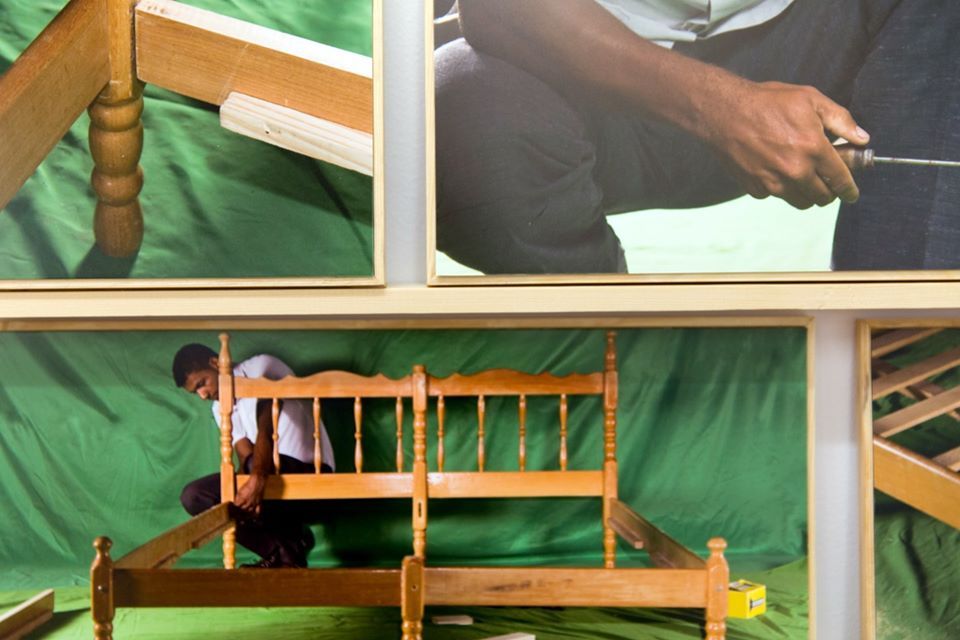
The first work to the right of the entrance is Jonathas de Andrade’s “2 em 1” (2 in 1, 2010), a series of photographs and drawings depicting two bed frames attached together. When I saw the images and sketches, I vaguely recalled that there was some sort of moniker that carpenters call the fitting of the headboard and the rest of the bed-frame. A friend affirmed the slang for the two parts: ashiq wa maashouq. “Because it’s like they’re hugging each other when they fit together,” he said. Though he is the only non-native-Arabic speaker amongst the artists exhibited in “Codes of Coupling,” De Andrade’s depictions alert us to the romances present in even the most mundane aspects of our language. Ashiq wa maashouq, fardi wa zawgi, thakar wa nitaya: monikers used almost carelessly by electricians and carpenters, flung about, emptied of their snatching signifiers. There’s a breathtaking juxtaposition between the powerful images contained by these words and the banality and stiffness of woodwork. Of course, the images are not without innuendo: white glue rammed into a carved crevasse, awaiting the perfect pair to be attached in perfect union, a satisfaction akin to adding the last puzzle piece.

As the first work I confronted in the exhibition — and the only work that focuses on objects instead of people — “2 em 1” lends itself to powerful metaphors. From there the viewer departs from the implicit, and lands in front of a large stretch of human portrayals: first, Mohamed Bakeri’s video “Between Men,'' featuring two men foregrounded by a white backdrop in choreographed movement around two ahwa (local coffee shop) chairs. The two men in Bakeri’s work isolate fleeting, normal bodily interactions, sexualizing touches that would ordinarily be dismissed — using an adjacent thigh as support when standing, linking arms as you walk down the street. The artist throws homosociality into relief, as if to ask more out of these fleeting gestures.

Second is Nasa4Nasa’s “Untitled Extracts,” a series of small-scale photographs laid flush against the wall, forcing a closeness that renders the viewer a voyeur. Nasa4Nasa also creates high relief stills, photographing various dances in deserted spaces such as a bath, pool or changing room. Such spaces are communally coded, riddled with gray physical interactions, secured by a pre-sanctioned consent that allows for ordinarily taboo interactions, such as collective nudity, or touching on a massage table. As I witness the duo’s compositions around the abandoned spaces, I recall the discomfort that I felt as a pubescent girl entering a changing room filled with naked bodies whose normalized coexistence felt disturbing. By dancing through these deserted spaces, Nasa4nasa empties out the community that occupies these environments, leaving behind the unwritten codes inscribed in the walls for us to read into. For me, these two works share more than same-sex pairs and choreographed depictions. They both recall traces of common, public spaces: the ahwa, two seats on the metro, the bath, the pool, the changing room. These are spaces we occupy on automaton, often unaware that they are inter-relational, shared settings. Both works freeze moments that are typically transitory, calling on us to pay attention to the meaning behind a charged interaction.

The fourth work in this space is “No Comment” (2020), an audio meta-commentary on the video work “Jewel,” by Hasan Khan, completed a decade prior. The audio, a series of detailed annotations, is presented separately from the video, though a link is included for those who wish to watch at home. As a result of this conscious uncoupling, the listener is left to piece together layers of subjectivities. Firstly, a third-party analysis presented in an eerily familiar diction, along with incessant repetition and the all too resonant linguistic tick of “I’m not joking.” Secondly, an authorial description, in the voice of the artist, of the inspiration behind and process of creating the video. He describes the day he witnessed a sudden burst of joy on a street corner in Abdeen by two individuals consumed in dance. Thirdly, the personification of the two actors as individuals — Shehta and Ahmed — in the scene and beyond, results in an intimate dive into their naive dreams and tragic ambitions. All of these different voices are woven together in an audio piece that dictates the listener’s imagination and occupies the entire process of consumption and understanding. We listen as this ephemeral moment shared between two men decomposes, unraveling — at the behest of the artist — into an overanalyzed, dissected, and stylized reproduction. The work is of course about the moment shared by these two men and their relationship to each other, but it is also about the voyeur, the artist, the commenter, the analyst, the gallery-goer, and the relationships between all these people to one another. Upon returning home, I watched the original video, “Jewel,” devoid of commentary, voices, ephemerality, or the corner in Abdeen, disenchanted: a feeling perhaps intended by the artist’s own artifice.

The exhibition’s curatorial statement says “‘Sameness’ can be used as a tool of assertion and examination of physical and geographical grids to test what two bodies can do if they are acting as one.” Sameness in Arabic (al-mithliya) shares the same root as gay or queer (he who is like me). Throughout the exhibition, viewers are set up to approach the idea of sameness in love in all of its intended meanings. In Mohammad Shawky Hassan’s short film, “It was Related to Me,” sameness also means family, brotherhood, familiarity, proximity. The film begins with a portrait depicting faces that are immediately familiar, as if they are members of my own family, then quickly moves to an interior space that feels uncanny, as if my own home. We are drawn into intimate, household moments: measuring height, a family engagement, sitting on a childhood couch, filming with an at-home camcorder. Shawky immediately casts a pervasive sense of familiarity, such that a lengthy look of longing from one brother to another is not immediately registered as abnormal in this context.

I first saw “It was Related to Me” in an entirely different context a few years ago at Cimatheque. Then, it raised questions about fiction and artistic constructions. Now, situated in Khaled’s curatorial framing, the film unveils layers of material for consideration. The overlaying audio is full of childhood fables, didactic moral tales about good and bad, love and sacrifice. One track teaches the difference between right and wrong. Another track tells the story of a fisherman who rescues a gorilla and raises her as his child until she sacrifices herself to save his life. In the story of the nightingale and the red rose, we hear high pitched squeals as the nightingale penetrates the red rose tree to inject its blood into its veins and bring it back to life. As the fables progress from black and white morality tales to more ambiguous depictions, the progression of the two brothers also becomes grayer. We see the two brothers in the family grow and progress through different life landmarks, and in the background, we hear consistent quizzing by a school-teacher: Would this be right or wrong? Right or wrong?
The very last fable, which we hear as we begin to register the weight of one brother’s longing for the other, discusses the necessity of doing the right thing in the right place at the right time. The narrator’s voice stresses the importance of appropriateness, emphasizing that if you do the right thing in the right place at the wrong time, all will go awry. This final note points us back to the necessary interrogations taking place throughout the exhibition: the appropriateness of intimacy, the “when,” “where,” and “why” of affection. Together, the works lay bare that which we socially (if tacitly) sanction, inviting us to push the boundaries further and utilize the power of the intimacies we normalize in our quotidian interactions.
تقارير ذات صلة
Lara Baladi’s Cosmovision
In Cosmovision, Lara Baladi breaks down photography’s cadre into a discursive unfurling of her becoming from 1996 to 2011, autobiographically performing the logic of the white cube. Shown at Tintera,…
In pursuit of filling art-historical cracks: Chafik Charobim and missed opportunities
Hana Elhaddad considers the effectiveness of the retrospective's curatorial framing

On the creative impulse under violence: What is the point of making art during genocide?
Multidisciplinary artist Ash Moniz has turned art-making into aid relief for Gaza
Your support is the only way to ensure independent, progressive journalism survives.
You have a right to access accurate information, be stimulated by innovative and nuanced reporting, and be moved by compelling storytelling. Subscribe now to become part of the growing community of members who help us maintain our editorial independence.
Join us