
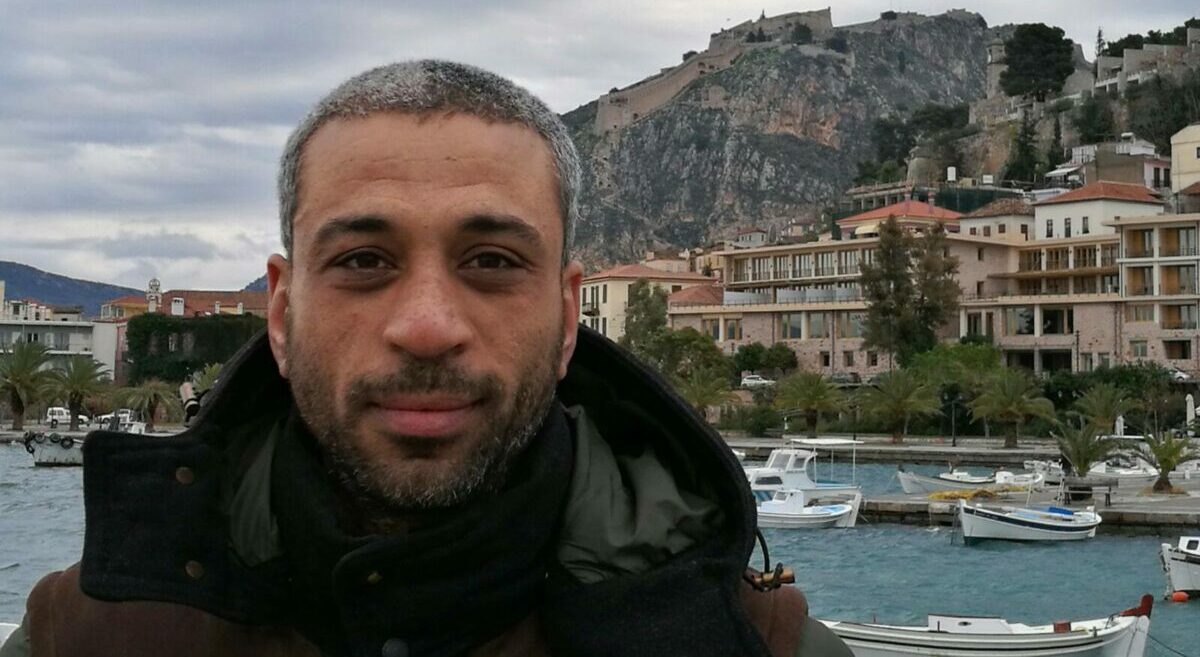
A conversation with Shady Lewis Botros on the genealogy of literary refusal
The writer discusses his decision to turn down the Sawiris Cultural Award for his recent novel
Last week, writer and novelist Shady Lewis Botros stirred up controversy by turning down the Sawiris Cultural Award for best book in the established writers section for his novel A Brief History of Creation and East Cairo, published by Dar al-Ein, which applied for the award after consulting with the author.
Lewis did not reveal the reason for his decision at the time, allowing for the debate over the Sawiris Foundation for Social Development’s role in the Egyptian arts and culture sector and the political meaning of literary awards given directly by institutions to swell online.
Shortly after the ceremony at the American University in Cairo for the award’s 18th edition closed on January 8 and news of Lewis’s decision began to reverberate in literary circles, Mada Masr sat down with the writer to talk about the logic of awards and the right of refusal.
Mada Masr: Is there a reason why you preferred not to disclose your reason for turning down the award?
Shady Lewis Botros: There is more than one reason. First, to win an award and then turn it down, boycott it and denounce it is a long-standing literary tradition, and its implications are clear and agreed upon and do not need explanation or clarification. For example, in 1972, the famous author and critic John Berger won the Booker Prize but refused to attend the ceremony and condemned the award, whose financing depended on a company that made its profits from a monopoly on African colonies and had a history entangled with slavery and exploitation.
Of course, there isn’t one way to refuse. In the end, Berger accepted the financial award, donated half of it, and kept the other half, simply stating that he “needed money.” But regardless of what Berger did, the message was clear, or at least became clear. This did not stop the award, applications for it, or the celebration of those who won it, but the 1972 incident became the most prominent in the Booker Prize’s history. And any book that talks about awards, their logic, funding, or function as symbolic or financial capital, references Berger’s incident. Today, after half a century has passed, there is a rich tradition with an implicit agreement on what giving up or refusing awards means, and this is what many surmised after I gave up the award. It would be insulting to explain, not to me, but for the literary circles and the general public, by which I mean there is no reason to explain the already explained.
The second reason is that, immediately after giving up the award, the media got in touch with me, and truthfully, I was on a family visit with a busy schedule, but I was worried it would be interpreted as rudeness or condescension, so I commented. And soon enough, the questions took on the tenor of a police interrogation with a sharp tone and urgency that demanded I defend myself against a list of accusations and doubts as to my intentions. So I decided I would not justify my decision, because I didn’t care. Is there a journalist who asks the winner of an award why they accepted? It would not happen. What happens is the opposite, and that is worth thinking about. How did the institution of this award become so entrenched that those who refuse it need to defend themselves, have their intentions questioned, and be insulted and painted as liars? This itself is grounds for refusal. In the end, this is an award that I won, and after I won it, I decided to give it up. So in theory, it is something of mine that I decided to get rid of. Why does this need to be justified? It is as if I belonged to the award and not the other way around. And of course, this is an important part of the logic of awards and how they function.
The third reason is that this is not the first time I have gotten into a battle over awards. Two years ago, I was also involved in a violent clash on the subject, and I learned a lot from it, including how to consider other people’s positions and concessions, people who are at the end of the day friends, colleagues and mentors, so as not to devolve into condemnations and pointing fingers unnecessarily, simply because the world and ethical situations are highly complex with many things to consider. In truth, any justification or explanation of my refusal will carry a condemnation, implicit or indirect, to a large sector of the literary world, and such a condemnation is as far from my intention as possible. Therefore, I’ve clarified in my brief and only statement to the press my conviction of the integrity of the award committee and its choices of colleagues and mentors, be they members or winners, and I've emphasized that my position carries no condemnation of anyone or at least isn’t intended to.
There is also another reason, which is that, a year and a half ago, I said in a previous interview that what I wanted to do regarding awards was not condemn them but ask the questions we need to ask. I said that I understood the answers weren’t final and that people had different positions regarding this matter. What would be terrible is if these questions didn’t exist and didn’t get asked to begin with. Today, my position is different from a year and a half ago. I don’t necessarily see that the role of the writer is to speak the truth in the face of authority, including the authority of awards, capital and literary consecration, nor even suggest questions and answers. Rather, it simply suffices to cast stones and then remain silent. Literature is symbolic work, and, through it, we know that the symbolic and the implicit are more effective than the direct and the spoken.
I have said my opinion on awards in the past in a clear and detailed manner, which is known to a not-so-small segment of the wider literary circle and is easily available to those interested. To say it again for the hundredth time would be boring for everyone and would be repetitive.
There are also personal reasons to my decision, integral reasons, in fact. And I don’t find myself obligated to share them publicly and prefer to keep them to myself.
Finally, as I expected from the beginning, it will be said that the point of refusing the award is to create a spectacle and a desire to attract attention. So, I decided, unlike my usual self, to withdraw from the public sphere and not defend myself, not even by rallying with those who defended me and declared solidarity. Otherwise, it would turn into a political speech, which no one is prepared to hear, especially these days.
MM: Many of us went to your interview on Al-Modon in 2021, where you said: "Who gives the award? In whose name and why? Do we accept an award in the name of a dictator, for example? Or from the profits of the arms trade or white slavery? Or from a regime that abducts writers and tortures them until they die? Or from one involved in genocide?" Can any of these questions be asked about the Sawiris Cultural Award?
SLB: As I said in my previous answer, I am not interested in asking questions today. If this refusal caused so much controversy, certainly there will be questions to ask, but what are they? I leave those to the cultural sector, the general public and consumers of culture, and all those concerned with literature or the public sphere, so they can ask them and phrase them in their own way, and then we can all discuss them in different contexts. Will this happen? It would be very difficult in the current political climate, where there is no place for a real discussion or for real actions, and what remains are limited symbolic maneuvers.
MM: Are there other positions of resistance to the authorities of art management and production that are effective in your opinion, positions on the level of practice itself, say for example, the preference of some to not submit their work to awards in the first place?
SLB: There are dozens of ways to resist. Some of them include people applying to awards, grants and residencies to make use of them, exploit them for their sake and the sake of their work and criticize them simultaneously in public or sometimes in private. The world is a very complicated place, and we cannot take puritanical or ethically perfect positions. People need to survive, especially in a country like Egypt, where there is no real market for culture, not enough state support and where people’s livelihoods are under threat everyday. There are those I know personally who refuse to submit work for awards, and they stop at that in silence. But public positions are rare in our cultural history. We haven’t seen public rejections since Sonallah Ibrahim’s rejection of the Multaqa Prize in 2003. And since the launch of the Sawiris award with all its offshoots, there hasn’t been, to my knowledge, anyone who has publicly refused it. The effect of these incidents lies precisely in their rarity and exceptionality. In all cases, these incidents are needed and are helpful for the health of the cultural sector and, truthfully, for the awards themselves at the end of the day.
MM: Besides the controversy that your decision has generated, is there an emerging discourse to establish an alternative cultural movement that has crystallized with your refusal? Have there been critical positions that have piqued your interest or made you want to reconsider?
SLB: Of course not. I know my place and the effect of my simple symbolic act well, and I don’t have big aspirations for it. I expect the controversy will have died out before this interview is published. We can consider this entire thing, simply, as just “blowing off steam,” as Mahmoud al-Meligy famously said. But at the same time, every foundation to protest institutions builds for itself a history of small symbolic actions, disparate and rare, and this history becomes a model to follow in the future or a ghost or annoying chatter around an image striving for perfection. There are still references to Sonallah Ibrahim's incident today (though, given the vast differences between us, I would not dare to compare my situation to his inspiring and brave decision). In 10 or 20 years, someone will come along who refuses the award, and they will also say so-and-so refused. And in 2023, there was an author who turned it down, and therefore we have a tradition of protest and a genealogy of its history.

تقارير ذات صلة
Mai Serhan imagines Palestine and recounts life after for us
"I have never been to the place where I am from, but I can imagine it for us, Baba, for you and me." This opening line of Mai Serhan's I…
Who’s Afraid of (a) Minor Detail?
Adania Shibli and Specters of the Disaster on Literature and the Body
Noor Naga, metafiction and the limits of self-knowledge
Sometimes a story needs three acts
Your support is the only way to ensure independent, progressive journalism survives.
You have a right to access accurate information, be stimulated by innovative and nuanced reporting, and be moved by compelling storytelling. Subscribe now to become part of the growing community of members who help us maintain our editorial independence.
Join us