
119 companies, 1 wage structure? Unified wage bylaws spark outrage among public business sector workers
In late October, Public Business Sector Minister Hisham Tawfiq was in damage control. He had been the public face and driving force of an aggressive new development strategy focused on introducing private sector managerial policies to address the over LE45 billion in debt accumulated by 119 state-owned companies under the ministry’s remit.
The ministry pushed through amendments to the law governing the sector earlier this year, tying worker benefits more closely to company profits, decreasing worker representation on company boards, and introducing conditions for liquidating companies whose losses exceed half of their capital.
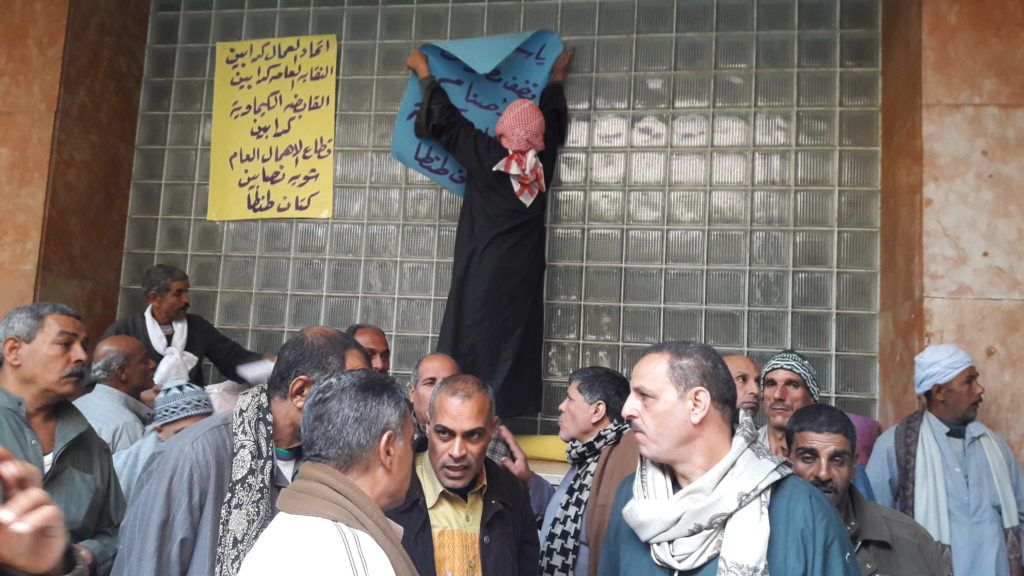
But in early October, Tawfiq and the government’s plans hit a bump in the road. Employees at three major state-owned insurance companies — Misr Life Insurance, Misr Insurance, Misr Real Estate Assets — organized sit-ins and protests at company branches across the country to voice opposition to a bylaws draft that would introduce uniform human resources measures for a sector that employs over 200,000 people and would, they claimed, erode their salaries, health insurance and social benefits, and protection against sudden contract termination.
The protests continued throughout the month, with various unions joining the fray, publishing memos on a nearly daily basis to voice their opposition to the new changes, which Mada Masr obtained a copy of. Many employees expressed their objections on social media groups that included thousands of members, who shared angry posts and videos showing employees protesting inside company headquarters. In their memos, the trade union committees were united in their refusal of canceling most of the benefits, detracting from employees’ health insurance schemes and reducing wages.
By the close of October, the minister was signaling his willingness to sit down for negotiations with delegates from insurance companies and professional syndicates. As the October 19 meeting approached, security forces moved to clamp down on the vocal opposition, arresting at least 10 workers throughout the days before the sit-down, according to their colleagues who spoke to Mada Masr. While no official statement was released regarding the arrests, the ministry tried to make its case in a three-hour meeting.
The companies’ employees do not disagree with the government’s desire to “develop” the sector. However, they are against the way in which the government went about the plan.
The differences in human resources bylaws across the sector’s companies have allowed managers across many decades to implement tailored incentive and rewards programs and provide workers with compensation schemes that the new unified bylaws threaten to eliminate. Labor lawyer Abdel Ghaffar Meghawry tells Mada Masr that the government’s move is an unreasonable endeavor given that employees in the 119 companies under the Public Business Ministry work in vastly different fields with divergent salary ranges, experience, seniority and in companies with different profit margins.
Some workers have also told Mada Masr that the new bylaws are even more threatening as they pave the way for merging or liquidating some of the public companies that incur losses, without providing any real guarantees for its employees.
The new government plan is not the first attempt to develop public sector companies. Several of the companies date back to Gamal Abdel Nasser’s era, and some of them go back even further, like the Misr Insurance Company, which was established in 1934.
The organizational frameworks of those companies varied before they were brought under the governance umbrella of Law 203/1991, which was the first attempt at development. The law was intimately tied to the signing of an agreement with the International Monetary Fund as one of the measures geared toward introducing economic structural adjustments and closing the gap between the public sector and private sectors.
But the losses of the public sector continued and the minister himself gave conflicting estimates of the losses incurred. In May, the minister said that the losses had reached LE58 billion, LE16 million of which is the total losses of 48 companies, while the remaining LE42 million in debts to a number of government entities. But in another statement in August, Tawfik said that the public companies’ debts surpassed LE 45 billion.
Faced with these losses, the government launched the new long-term strategy plan, amended some of the 1991 law’s articles and proposed new human resources bylaws that will cover all the ministry’s companies.
The initial draft of the unified human resources bylaws linked monthly incentives to companies’ net profits and put a ceiling to profit incentives at 16 percent of wages. Meghawry describes this as “unfair” because some companies are more lucrative than others. For example, oil companies, which compete with the private sector in oil exploration and sales, naturally make more profits than pharmaceutical companies, which sell subsidized products to consumers. For this reason, Meghawry believes that profitable companies should not have an incentive ceiling similar to that of companies operating at a loss in providing subsidized goods.
The draft also put a ceiling on compensation payments at 10 percent of wages, whereas it used to be varied according to each company’s bylaws. This will likely reduce employees’ income significantly, especially that compensation payments hit 300 percent in some companies, according to what Marwa al-Sharqawy, the head of the human resources department at the Holding Company for Tourism and Hotels, tells Mada Masr.
A large number of employees and workers also objected to the new mechanism for evaluating workers, which puts a ceiling on the number of employees qualified for a higher ranking. The new draft stipulates that only 15 percent of employees in each department are allowed to receive an “excellent” ranking, and only 15 percent of employees are allowed a “very good” ranking. The draft also put a ceiling on promotions and annual bonuses.
Employees across several companies tell Mada Masr that the proposed evaluation system makes it more difficult for workers to obtain annual incentives and bonuses. It will also expose employees to more threats as the draft states that they should be fired if they receive a weak evaluation for two consecutive years.
Some trade union committees have also objected to the cancellation of some benefits in kind, which include club memberships, seasonal recreational trips, and pilgrimage trips that companies used to offer. They also objected to getting rid of company-owned transportation vehicles that brought employees to and from work, which will be replaced by outsourcing deals with transportation companies or giving out transportation pay that is the equivalent of one month of salary per year.
The workers of some companies are more resentful than others. For instance, the workers in Misr Insurance Company said that detracting from employee benefits will harm them more than workers in other companies. Workers in the insurance sector receive life insurance, which was partially paid for by employees in installments, while the company shouldered the rest of the payment.
“This money was indeed deducted from our salaries, and if the new bylaws are passed, we will neither get good health insurance nor life insurance coverage. When we retire, we’ll go out just as we came in,” says one of the company’s employees.
While the government obliged the companies to bring their employees under the government health insurance scheme, it canceled all premium health insurance. It only allowed companies that generate profits for two consecutive years to spend a limited percentage of these profits on private health insurance for employees, excluding the employees’ families and those receiving pensions. This specific article was met with outright objection from everyone, especially because public sector companies have been deducting money from workers’ salaries for years under the pretext of “deferred medical treatment,” which would have allowed them to receive premium healthcare after retirement, according to Mohamed Wahballah, the head of the trade union committee in one of the public sector companies.
According to Yasser Saad, a lawyer who spoke to Mada Masr, ending the premium healthcare insurance scheme and other benefits is a violation of the labor law because it essentially overturns a legal right that has been exercised for years, and it should not be prevented now.
From his side, the public business sector minister has been continuously reaffirming over the past two weeks, through his social media accounts and in TV interviews, that there will be no deductions from the complementary wages that come with the main salary in both the profitable and non-profitable companies. In a TV statement a month ago, Tawfiq said that the average salary for workers was between LE 300 and LE 900, and it would be complemented by several incentives under different names, including a complementary wage, bonuses, and grants. All of these categories have been unified under one main salary, in addition to linking the incentives to a company’s profit margins. The minister promised more clarity in the future without addressing any of the non-wage related objections.
Nonetheless, according to the minister himself, 38 percent of the 209,000 workers in the public sector companies will be negatively affected by the wage amendments.
Despite insisting on the draft in its current form, the government seems to have given in to some of the pressure from workers and unions, announcing over the weekend that it would amend 30 articles in the bylaws.
The new bylaws come as a part of a new development strategy for state-owned companies, highlighted by amendments to the 1991 public business sector law, which were approved by the president in September.
The government has already taken its first steps in the development plan by trying to sell some of its companies to the private sector, like the Heliopolis Company for Housing and Development, or offering company shares on the stock market to increase the transparency around their work and development, like the Alexandria Container and Cargo Handling Company. However, the private sector was reluctant to buy shares in the former, and the performance of the stock exchange during the pandemic crisis forced a delay in the sale of shares of the latter.
However, despite the government’s rhetoric of “development,” it seems that many of the companies are on the path toward liquidation or mergers, as Tawfik himself hinted at in August. An official in a public sector company tells Mada Masr that what was happening is very similar to privatizing public companies.
The early signs of this strategy were when the Holding Company for Construction and Development launched a plan in mid-October to merge 11 of its affiliated companies, leaving only five companies. This was followed by the decision of the general assembly of the Nasr For Rubber Products (Naroben) to cease production in Shubra due to rising costs. These decisions confirmed the comments of a source in the public business sector who told Youm7 in June that the following fiscal year would see a decrease in public companies from 119 to only about 90 as a result of mergers, predicting a further drop due to future mergers or liquidation.
The merging and liquidation of companies threaten thousands of workers. Article 85 of the draft human resources bylaws permit laying off some employees in the event of a partial closure or reduction in activities. The draft bylaws also state that merging and liquidating a company can occur under conditions of economic necessity if the company has reported losses for two consecutive fiscal years, or under other necessary circumstances which it did not specify, with the approval of the company’s general assembly and the provision of end-of-service bonuses to laid-off employees.
Workers and employees blame the administration for these companies’ failures and see no hand in them. However, the ministry believes in the necessity of tying wages to production as the way to end decades-long losses, stating more than once that it would not shoulder the companies’ losses once more.

تقارير ذات صلة

Judges of tomorrow to be picked, trained by Military Academy, judicial sources say
Anchor Isaad Younis interviewed on Sunday a crew of newly hired government employees — judges, a diplomatic attaché, a school principal, a legal researcher at the Customs Authority, and an…
Worker-management rift remains as state pharma company reopens after strike
One trade union representative called the move to shutter the firm amid the strike 'unprecedented'
Public sector giant Egyptian Iron and Steel Company to be liquidated despite opposition
Monday's decision has already faced substantial pushback.
Your support is the only way to ensure independent, progressive journalism survives.
You have a right to access accurate information, be stimulated by innovative and nuanced reporting, and be moved by compelling storytelling. Subscribe now to become part of the growing community of members who help us maintain our editorial independence.
Join us