
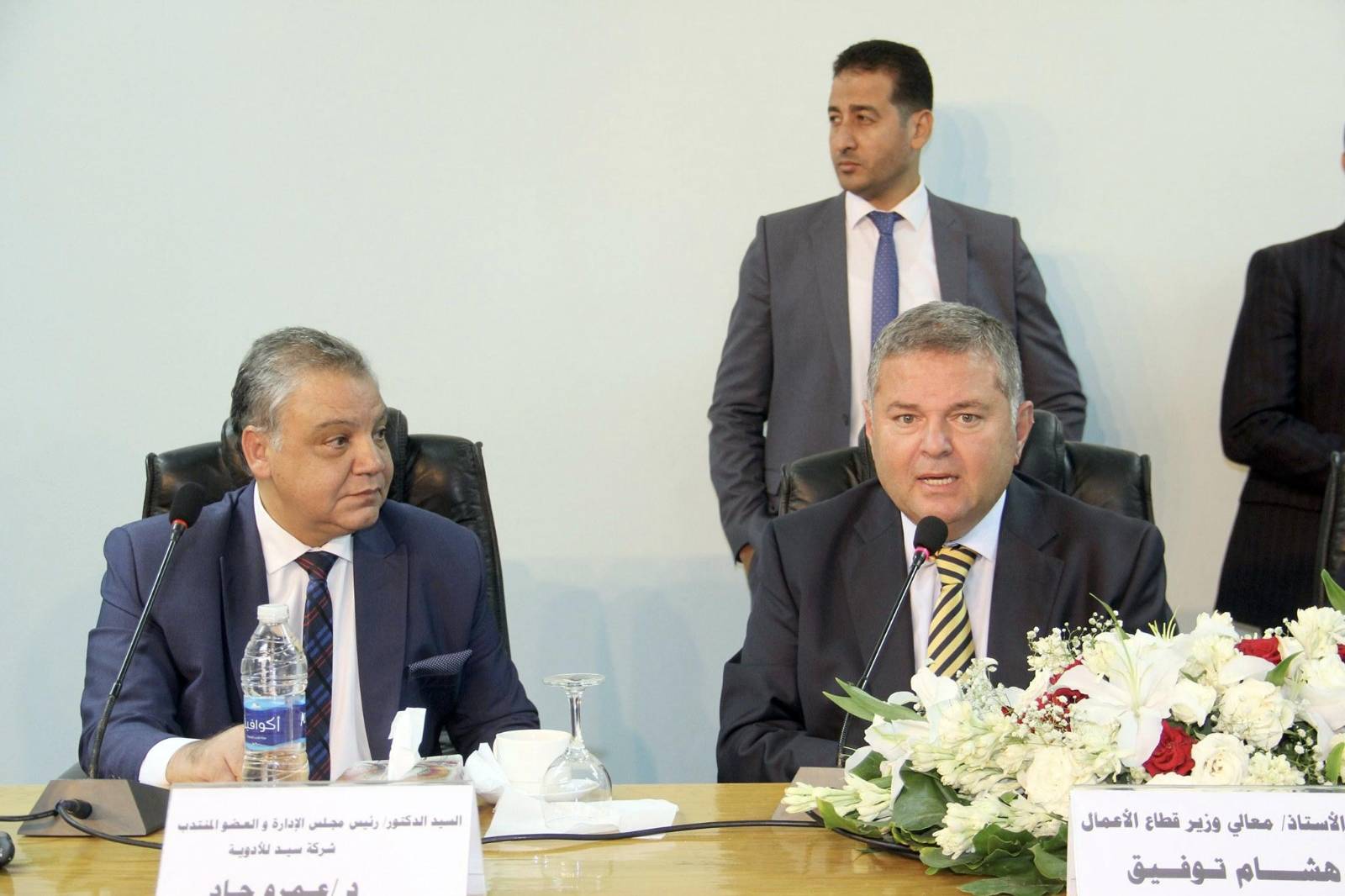
Worker-management rift remains as state pharma company reopens after strike
Workers at a state-owned pharmaceuticals manufacturer who protested massive cuts to their annual profit share bonus payments earlier this month returned to their jobs on Sunday amid uncertainty as to whether their grievances, an outcrop of a fundamental restructure taking place in the state industrial sector, will be heard.
Responding initially to a strike that began in early October by shutting factory doors and suspending the disbursement of wages for September, the Chemical Industries Development Company, known as CID, decided unilaterally, without speaking with workers, that it would reopen its doors for employees to resume work on Sunday.
CID reaped sizable profits in 2020, playing a key role in supply during the pandemic as its staff continued to turn up to their places of work to produce drugs that were in high demand to treat coronavirus patients.
But the ongoing, aggressive overhaul of the 119 companies that make up the state sector entails a raft of changes that include capping worker bonuses at much lower percentages of company profits.
Though the alterations to company wage structures have sparked anger among the hundreds of thousands of workers employed in the sector, the new managerial composition brought about by amendments to the public sector business law has decreased worker representation, leaving protesting workers out in the cold while the process unfolds.
Workers began a partial strike on October 4, a member of CID’s trade union committee told Mada Masr on condition of anonymity, adding that their labor action came after a leak from the company’s general assembly indicated that profit shares distributed to 2,600 workers would barely exceed the value of two months’ worth of their basic wage, or just a third of the proportion of profits they got last year.
“Last year, workers got bonuses that amounted in total to 33 percent of the net profit. So, one worker received the equivalent of six to seven months’ worth of their basic wage. But this year, [the total disbursed to] workers as profit shares didn’t amount to more than 12 percent [of the net profit,]” the union member said.
Another CID trade union member, Hisham Soliman, explained his profit share to Mada Masr as an example of how the workers would be affected. Soliman, whose basic salary after 38 years of service in the company is LE2,500 (LE5,000 with incentives), is set to receive a profit share of LE4,400, compared to the LE11,600 he received last year. The majority of workers, who have been in CID for 10 years or less, will receive much less, he added.
Workers’ financial commitments are dependent on the profit share payments as well, the first trade union member said. Many people have pending loan payments that were calculated with the expectation that the profit shares, which have been consistent for decades, would come in at the expected rate and time.
How low incentive payments will be capped is still to be decided, though a fourth iteration of draft regulations that was discussed in September set incentives at a maximum 16 percent of company net profits. The draft was roundly rejected in this season’s series of syndicate general assemblies, with statements of protest issued by labor bodies in the metals, spinning and weaving, chemical and other state industrial sectors.
The cuts come after “a long year of hard work to provide large quantities of the company’s products, which include essential materials for the coronavirus treatment protocol,” the union member said. “Work in production departments would continue until 11 pm, reaching up to 15 working hours per day, including seven extra hours for a total of LE50.” Many workers and even their families contracted COVID-19 during this period, the union member added.
While some public sector companies, many of which are already saddled with large debts, have struggled to weather the impact of the pandemic, net profits at CID amounted to LE57 million last fiscal year, a year-on-year increase of LE6 million or around 11.7 percent growth, according to information published by the parent company.
In response to the strike, on October 10, CID decided to shut down most of its branches “indefinitely” and freeze workers’ monthly wage payments accordingly.
A statement from the Public Enterprise Ministry at the time pointed to investments in CID worth about LE200 million due to boost a development plan for the company to meet the manufacturing requirements set by the ministry without clarifying when the funds will arrive or how they will be spent.
In the meantime, CID’s main headquarters on Haram Street in Giza and branches in Alexandria and Mansoura were shuttered, though the company’s factory in Assiut stayed open. “The workers stopped working, so it’s better to shut down [the company] until they return,” Public Enterprise Minister Hisham Tawfiq told Mada Masr at the time.
The closure was unprecedented, according to general coordinator of the Center for Trade Union and Workers Services (CTUWS) Kamal Abbas, who said that “granting workers a leave of absence for several days is among the usual reactions to strikes,” but that he cannot remember the state responding with an indefinite shutdown, which he claimed had “no legal basis.”
A decision to reopen the company was taken on Thursday during a meeting between the minister, the chair of CID’s parent company, the Holding Company for Pharmaceuticals, and the chair of the sector’s parent union, the General Syndicate for Chemical Industries.
Workers' demands regarding their profit shares were ignored at the meeting, according to CTUWS, which said that CID’s management insisted on only disbursing payments of two months’ worth of the basic wage instead of payments equivalent to the six months’ worth of bonuses that workers received in 2020.
Soliman told Mada Masr that the general syndicate chair submitted a memo to Tawfiq requesting a bonus equivalent to two or three months’ salary to compensate them, in addition to the profit shares.
Workers will likely resume their jobs on Sunday, Soliman said, when they will receive their financial dues for the month of September, which were frozen as part of the decision to shut down the company.
The protest action is not the first to break out at state companies after the new public enterprise law’s controversial bylaws on unified wages were introduced last year. Protests were held at three state insurance providers in October 2020 as it became apparent that the new law would entail major reduction in many workers’ salaries, with the minister himself admitting at the time that around 40 percent of workers will likely experience decreased wages.
تقارير ذات صلة

e-Finance’s EGX debut: What’s whetting investor appetite for the govt payment services provider?
The company saw its share price skyrocket by 40 percent on the first day of the listing
New bill proposes financialization of public utilities providers
The bill raises questions about the cost for the public who will use the services.
The Kafr al-Dawar textile company: On the road to liquidation
Kafr al-Dawar reflects the state’s desire to back out of the sector, analysts say
Your support is the only way to ensure independent, progressive journalism survives.
You have a right to access accurate information, be stimulated by innovative and nuanced reporting, and be moved by compelling storytelling. Subscribe now to become part of the growing community of members who help us maintain our editorial independence.
Join us