

Judges of tomorrow to be picked, trained by Military Academy, judicial sources say
Anchor Isaad Younis interviewed on Sunday a crew of newly hired government employees — judges, a diplomatic attaché, a school principal, a legal researcher at the Customs Authority, and an Endowments Ministry imam — about "what the government wants." The show was in fact a not-so-silent nod to the Military Academy's ever-expanding role in selecting and training civil servants.
The themes explored on the show dovetail with a new editorial direction by the United Media Services-owned DMC network, one that increasingly promotes the Egyptian Military Academy as the "pride" of all Egyptians. The network has increasingly platformed the Academy's training workshops —courses that have become a requirement for candidates applying to a wide range of government jobs, from preaching, to teaching and diplomacy."
Only a few hours before Younis would ask her guests, "What does the state want ?” the president’s office director, Omar Marwan, was meeting with the heads of several judicial bodies and authorities at the presidential palace, according to three judicial sources who spoke to Mada Masr on condition of anonymity.
In the meeting, Marwan would inform the heads of the Court of Cassation, Egypt’s highest criminal jurisdiction, the State Council, and the Administrative Prosecution Authority, that their power to select and make new appointments would be transferred to the Military Academy.


Marwan informed them of the presidential directives to transfer all decisions regarding judicial appointments to the Military Academy, starting with the Public Prosecution, rather than the Supreme Judicial Council and the headquarters of the other judicial bodies and authorities.
Marwan outlined the new procedures during the meeting, the three judges told Mada Masr.
They added that the presidential office director explained that selections for the 2022 law graduates — whose appointment process began in February 2023 — were cancelled, and that candidates would be reselected by the Military Academy.
Job interviews at the Public Prosecution for the 2024 cohort — which have been ongoing since January 10 before a member of the Judicial Inspection Department — will be cancelled as well, the sources noted, adding that the Military Academy will take over the interviewing process instead.
According to one of the applicants for the position of deputy Public Prosecutor, the interviews held up until January 10 included verifying the completion of the required appointment documents, questions about family and measuring applicants’ weight and height.
The sources told Mada Masr the new directives would drastically change the appointment process.
Before, each judicial body or authority would select their own candidates, run related legal tests and then refer those who pass to the Military Academy for appointment-qualifying training. Under the new presidential directive, trainings will begin and end at the academy itself.
The three sources explained that graduates of law school will first head to the Military Academy to undergo medical, psychological and fitness tests, as well as verification of height to weight ratio and security screenings.
After passing this phase, the names of the successful candidates will be referred to the Supreme Judicial Council for legal exams administered by the Seven-Member Committee — a body composed of the seven most senior judges in each judicial body.
The committee will then send test scores to the Military Academy, which is to conduct the final evaluation of each applicant based on the results of all the exam. Its final list of accepted candidates will determine who is admitted to the academy’s training course, the final rung in the ladder before the list is submitted to the Supreme Judicial Council for approval and appointments.
During the final stage, the academy sends a list of those who passed the course to the president to issue the presidential decree appointing them.

Media outlets reported that the Judges Club, the professional syndicate for judges, decided to hold an emergency meeting on Wednesday to consult and deliberate, before taking further measures.
Speaking on condition of anonymity, a member explained to Mada Masr that the club’s meeting on Wednesday aimed to express the anger among judges over the recent presidential decree, which he said is supported by the director of the presidential office and the justice minister.
The club accordingly called an extraordinary general assembly for February 6 to discuss what its internal statement described as “a grave matter” affecting the judiciary and its independence, without specifying the matter itself.
The Judges Club source also noted that judges are demanding a reversal of the decision granting the Military Academy any additional role in judicial appointments, and added that negotiations are currently underway between the Supreme Judicial Council and several state entities to reverse the new directive.
Mada Masr attempted to reach Judges Club President Abu al-Hassan Fathy Qayed, but received no response as of the time of publishing.
The directives Marwan conveyed to the members of the judiciary — which were paired with the assertion that they were non-negotiable and required immediate implementation — sparked widespread anger among many judges, chiefly those at the Court of Cassation who described the directives as “an assassination of judicial independence, and a drying up of the sources of justice,” according to a second deputy head at the Court of Cassation who spoke to Mada Masr on condition of anonymity.
“Justice cannot be run by orders, upheld through silence, or preserved by submission and acceptance of the status quo. It is founded on free deliberation, responsible effort, independent thinking and a conscious conscience. It is a dangerous illusion for some to think that justice can be achieved with trembling hands, fearing minds, or judges who do not possess the right to express their rejection of the wrongful condition surrounding them and affecting their dignity and independence,” the source said.
The source also noted that the growing acceptance among judges to make concessions regarding their independence empties justice of its substance, turning them from a rights guaranteeing power to a mere silent instrument that is devoid of its spirit and message, all while society bears the cost.
From his side, Arab Centre for the Independence of the Judiciary and the Legal Profession Director Nasser Amin says the new directives would constitute the greatest catastrophe the judiciary system in Egypt has faced since its establishment, stressing that subjecting the appointment and promotion of judges completely to the Military Academy erodes any remaining judicial independence in Egypt.
Amin noted that the directives grant the executive branch complete control over all branches of the judiciary in Egypt, which he said is in violation of the Constitution, the judicial authority law and the United Nations’ fundamental principles on judicial independence.
“We face an unprecedented attack that targets judicial authority, not only its independence, destroying the principle of the separation of powers as a foundation of constitutional governance and allows for Egypt to be run by a single authority: the executive branch, ” Amin added.
Starting January 2025, the Military Academy began imposing mandatory fees — LE112,000 for men and LE120,000 for women — for training judicial appointees, five new hires confirmed to Mada Masr. They noted that the appointment decisions by judicial bodies and authorities — the State Council, the Public Prosecution, the Administrative Prosecution and the State Lawsuits Authority — were only issued after the fees were paid.
Before that, in April 2023, the Military Academy began the task of training candidates for government posts after the Cabinet’s secretary general issued a memo at the time.
The letter, which Mada Masr reviewed, included a presidential directive to the Cabinet that requires all state institutions to ensure that those applying for government posts complete a six-month qualification training at the Military Academy as an essential condition for appointment.
Since February 2023, before the memo was issued, President Abdel Fattah al-Sisi has personally attended a number of evaluations at the Military Academy to select civil servants.
Transportation Minister Kamel al-Wazir justified the step at the time by saying “we aim to appoint competent and patriotic employees.”
The minister added, in response to fears regarding the increasing role of the military in civil sectors, “we welcome militarization if the selection of employees will be done in that way. What is wrong with teaching applicants security so that we can protect them and shield them from evils ?”


This was followed by Sisi attending other tests at the Military Academy for a number of applicants to various posts, which included teachers, Endowments Ministry imams, diplomatic attachés and judges, among others.
The president put the project into words during a visit to the training establishment on September 26, saying the aim was to “build, develop and prepare a radiant character. Whether [the applicant] is a young man or woman, their influence extends to their family and society.”
The president explained that over the next ten years, he aims to train nearly 100,000 civil servants, whose influence would extend to their families — bringing the number to nearly half a million people, according to his estimation.
Favorable press coverage, coupled with religious benediction from Academy-trained and appointed imams, have offered the program considerable reach.
“Together, we can all achieve the impact or the aim we want for our country, me and those who will come after,” the president said.
Another deputy head at the State Lawsuits Authority told Mada Masr on condition of anonymity that the Military Academy’s role also extends to determining promotions for existing appointees from before 2023.
Nearly 100 judicial employees at the Lawsuits Authority alone — the 2017 and 2018 graduates who were appointed by Presidential Decree 207/2023 — were denied promotions because they did not pass the tests required to attend the academy’s training. The training had only begun in 2024.
The president subsequently issued decree 429/2025, which explicitly excluded appointees from promotion unless they passed the military’s training.
The State Commissioners Authority, a branch of the Administrative Court, had recommended in dozens of lawsuits filed before the Administrative Court starting October 2025 the annulment of the presidential decree.
In their reports, reviewed by Mada Masr, the commissioners argued that passing the Military Academy training is not a legal condition for promoting a member of the Lawsuits Authority, whether under the State Lawsuits Authority Law 75/1963 or the law establishing the Military Academy, 149/2022.
Therefore, they argued, completing the academy training course doesn’t in and of itself constitute a promotion criterion.

تقارير ذات صلة

Militarizing the Supreme Constitutional Court
In historic first, an Armed Forces general is set to take a seat on the bench of Egypt’s highest court. Mada Masr looks at the politics behind the decision.
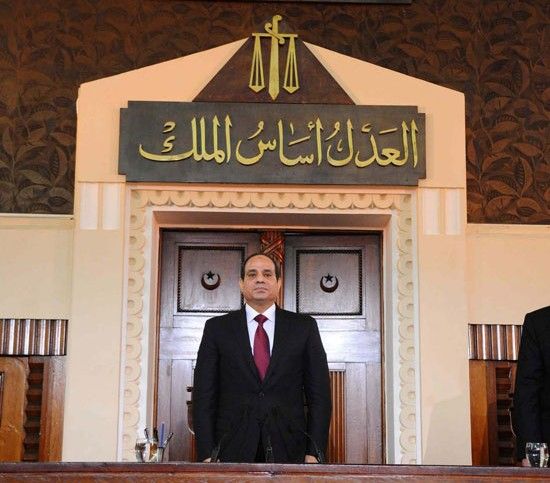
Normalizing the military judiciary: How the constitutional amendments bring the Armed Forces into Egypt’s judicial system
The laws bestow more authority on the Armed Forces, already the most powerful actor in the country
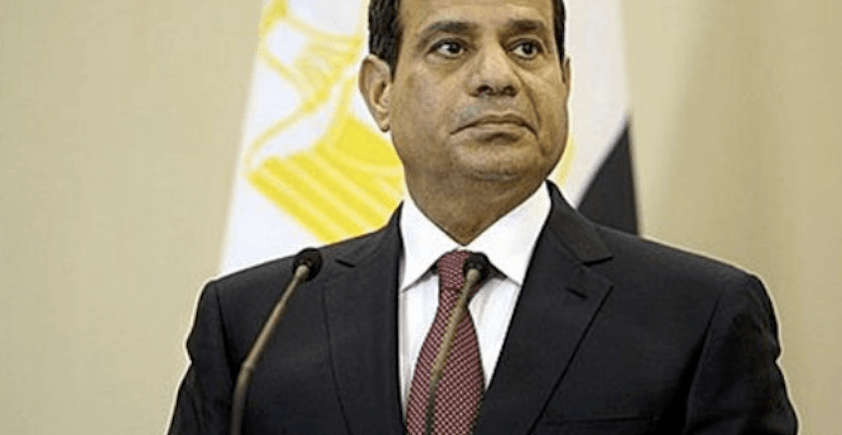
New judicial heads first in series of appointments under new law granting Sisi power to select judicial leadership
The heads of all civil judicial bodies are set to leave their posts in October
Your support is the only way to ensure independent, progressive journalism survives.
You have a right to access accurate information, be stimulated by innovative and nuanced reporting, and be moved by compelling storytelling. Subscribe now to become part of the growing community of members who help us maintain our editorial independence.
Join us