
Anatomy of an Incarceration: Life in a cell

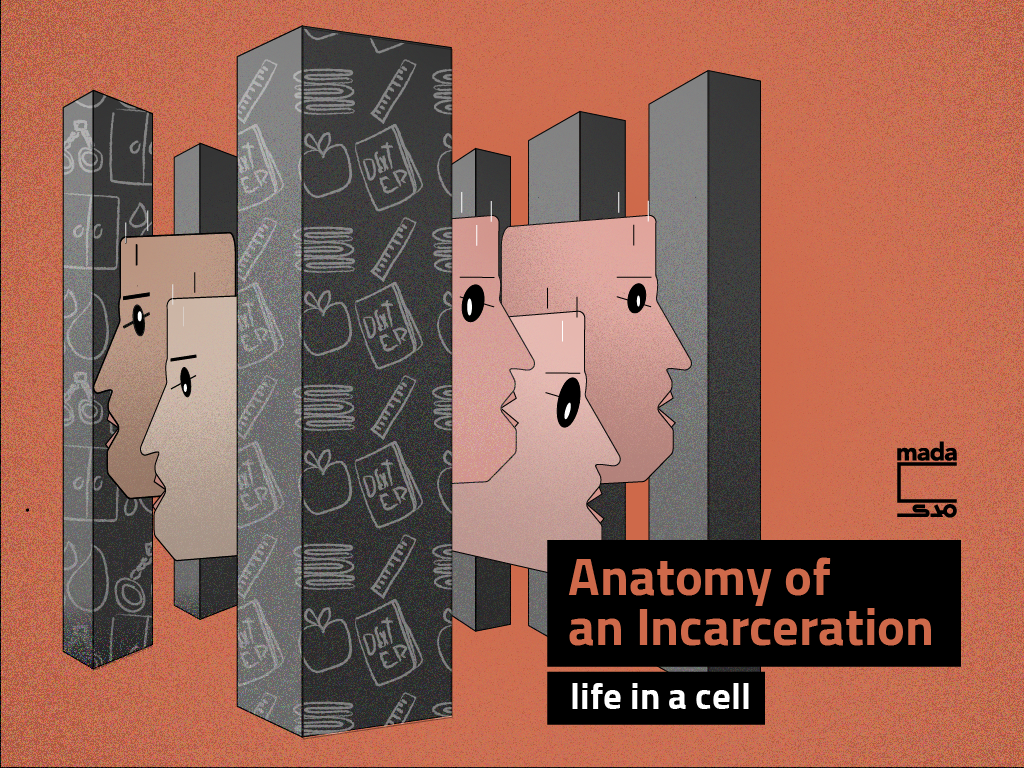
Anatomy of an Incarceration is a multi-part series that focuses on different aspects of prison in Egypt by Abdelrahman ElGendy who spent more than six years behind bars, from October 6, 2013 at the age of 17 until his release on January 13, 2020, at the age of 24.
A soaking wet mountain of blankets is heaped in the middle of the cell — soaked not in water, but cooking oil. Clothes and underwear lie crumpled on the floor alongside scattered, empty bags. Glittering brush strokes of spilled salt and sugar decorate the scene: an abstract piece of art that I contemplate in wonder.
My cellmates push past me at the threshold as they squeeze their way into the cell. They pause to behold the tornado-stricken spectacle before them. The last inmate who is still being patted down outside, facing the wall, dares to sneak a look, and the slap rings through the hallway, echoing in our ears. We do not turn and look. This is inmate code. You do not watch your cellmate being humiliated by the jailers — you look away.
Exhausted, I make my way through the detritus. Like a robot I move from corner to corner, picking up my strewn belongings from across the cell. I find my open-mouthed duffel bag, cram everything in it, and attempt to dust off my wrinkled clothes — I eventually give up and toss them inside too.
It’s going to be a long night. With every search, it’s the same scenario. They rampage through the cell, cut down the ropes we use to hang our bags, empty everything on the ground, destroy our food supply, pile our sleeping blankets in the middle of the cell, and for the epic finale: drench everything with our stash of cooking oil.
The purpose of a cell search is rarely about catching contraband. It’s more of a statement: do not get too comfortable — we own you. And we will remind you of it whenever we please.
“Whose boxers are these?” someone shouts. “I found them in my spot!”
I stand before my designated 25 centimeters. I call over Ayman and Tooha, my closest friends and case-mates, so we can make our farsha.
A farsha is the prison equivalent of a bed. Two prison-issued blankets — or three if you can bribe your way into getting an extra one — are folded into a body length rectangle, between 25 and 50 centimeters wide, depending on how crowded the cell is at the time, then placed on top of each other and smoothed meticulously and tightly wrapped in a bed sheet to keep the whole thing from coming apart with time and use.
Ayman, Toosha and I combine our assigned spaces together to make one big farsha — a full 75 centimeters! That way we can take shifts sleeping, so that each of us can bend our knees, and maybe even afford the luxury of taking the full width to sleep on our backs.
Ayman and I face each other, holding opposite ends of the blanket, and start taking measurements using the marks on the wall that designate where each farsha begins and ends — marks we spend many hours measuring and re-measuring with a small ruler to reassure everyone they are accurate to the millimeter. We stand up and start folding. The itchy rough texture of the blanket scrapes my skin.
An argument breaks out two farshas away from us. “Hey! Your farsha is two centimeters into my space! Destroy it and make it again!” This will go on all night. The process is both physically and mentally draining. Even using the term “destroy” to refer to the act of taking your farsha apart is precise and deliberate. Non-prisoners would be bewildered by the scene of two grown men fighting over one or two centimeters — they wouldn’t understand.
A farsha to a prisoner is what a shell is to a turtle; it’s not just for sleep, it’s a sanctuary. On his farsha, a prisoner sleeps, eats, drinks, reads, studies, thinks, cries, laughs, chats, screams, ponders existential questions, goes mad, and, in some instances, dies. When moving prisons, he wraps it up and hauls it over his back, travels for hours, only to reconstruct it in another cell in a different prison in a place far away. It’s his most treasured possession, each centimeter of which he defends ruthlessly. You do not give up a single millimeter. It’s a concept people on the outside would never grasp. Your farsha is your prison, so goes the saying.
The three of us work side by side, putting our miniature prison together again.
***
Squatting beside the ankle-level water tap protruding from the bathroom wall, I scrub the plastic container for the third time. The grease still isn’t dissolving, and I know I’ll spend an even longer time trying to un-grease my fingers. I pause to wipe my sweating forehead with the back of my hand. I have hyperhidrosis — excessive sweating. The least amount of physical effort leaves me sweating rivers, even in the coldest weather. A dwarfish cell crammed with dozens of fully-grown men is not doing me any favors.
Tooha places two more plastic containers in front of me, and I groan.
“Do they ever end?” I exclaim. He laughs. Somehow our service day always coincides with the visitation of a certain cellmate whose family likes to divide the food they bring into a million plastic containers.
An hour later, after I am done scrubbing the tiny space facing the bathroom, which we call the kitchen, one of the two cell mates whose service day is tomorrow comes to check the area — after that, our shift is officially over.
Every day, two people are responsible for servicing the entire cell: cooking, cleaning, washing the dishes and so on. A cyclical schedule of pairs is up on the wall: one person who can cook, and one who can’t. The second one usually ends up doing all the dirty work, more of an assistant to the cook.
That would be me.
Tooha is a great cook, at least considering our meager tools and supplies. And since he is a close friend, he graciously ends up helping me with my duties as well.
We report an issue with the cell’s plumbing to the nabatshy — the cell’s leader. Bakr is short and sturdy, his hairline receding by the day for “psychological reasons,” as our doctor cellmate informed him.
In Egyptian prisons, criminal prisoners and political prisoners are often held in separate cells.
In criminal cells, the nabatshy is typically the detainee who has spent the longest period in the cell. In political cells, we try to follow a democratic model, so we hold elections to choose the nabatshy, who in turn appoints supervisors for different cell functions: the food and service, the bathroom, the religious rituals, the entertainment.
Bakr tells us he will have the plumber — a criminal prisoner who is put to work by the prison administration — fix it tomorrow.
“Our new nabatshy is tough,” I say, punching his shoulder jokingly. He laughs. It’s only his first week in charge.
***
Closing my eyes, I relish the feel of the cold water rushing over my head and body. One of the small pleasures I enjoy most is the shower. I take it all in — the refreshing sensation of sweat washing off my body after a day of service work, the smell of the shampoo, the aloneness of the experience. That’s the best part: a full five minutes of privacy.
A hand slips in from behind the curtain: “Hey, wash this apple for me, will you?”
Well, almost privacy.
I wash my hands, take the apple, wash it under the shower, and hand it back.
“Thanks man!”
“Yeah, just let me finish my five minutes in peace!” I retort.
I always wait until after lights out, when most people are asleep, to get a few calm meditative minutes under the shower. The “shower.” I chuckle as I look up. Nothing more than an empty plastic jar punched through with holes in the bottom by a pen. A larger hole in the lid is fitted with one end of a contraband tube — purchased from a criminal prisoner for six packs of cigarettes — in a way that ensures it doesn’t slip out. The other end is attached to the water tap near the floor. When the tap is switched on, water flows through the tube, fills the jar and streams out of the holes at the bottom for a near shower-like effect.
It’s what we do in prison all the time, like little children playing in a make-believe world, we turn our holding room into an imaginary empire, recreating a pretend outside.
The knee-level cement step at the corner of the cell facing the bathroom, where we put the food heater, is our kitchen. The food heater is just a water-filled bucket with a heater inside. Yet this simple-looking device is a marvel of invention and prison ingenuity. The heater is made up of a metal anode and cathode — usually a contraband nail or a broken water tap — separated from each other by a piece of wood or plastic with each connected to a separate electric wire. When this device is submerged in salted water and connected to electricity, the current turns the water into an electrolyte that, ionizing, results in an exothermic reaction which heats up the water to a boil. (A fellow electrical engineer furnished me with the scientific explanation behind this fascinating contraption.)
Leftovers are kept in the refrigerator — half a block of ice, tightly wrapped in a prison-issued blanket, with all the food and water we wish to cool closely surrounding it from all sides.
Drying my hair with the towel, I step out of the bathroom and painstakingly tiptoe toward my farsha, trying not to step on anyone by accident. I grab Ayman’s perfume from his wardrobe — a hanging bed-sheet wrapped around a vertical assembly of hard plastic container covers, each sewed tightly into the inside of the sheet to act as a row of shelves.
I drape my towel over the wardrobe to dry, and start squeezing myself into my 25 centimeters of space. Tooha, exhausted, went to sleep early after our service ended, while Ayman is up reading with a small flashlight. I try to push Tooha towards Ayman without waking him up, my other hand dug into the back of the guy from the adjacent farsha to keep his body at bay. I wedge myself in and let go — they both instantly spring back and squash me between them, our three bodies merging in an indistinguishable mass of flesh and limbs.
We sleep in “reverse” — head to toe. Each inmate’s head rests near the feet of the inmate on either side of him, one head by the wall, the next reversed near the middle of the room. That way, between two sets of legs, each inmate has an infinitesimally wider space for his upper body, than if we were all to sleep on the same side.
The middle of the room is a tangle of heads and feet. The cell’s width barely accommodates the length of two grown men, and there are nearly 30 of us crammed inside.
I move Tooha’s toes away from my mouth, and look at the book in Ayman’s hand.
“Still hooked on that Dexter series?” I whisper.
He places his bookmark on the page, closes the book, and enthuses about the current events he’s reading. I have nearly read the entire series vicariously through him.
“Do you think Mr. Ali would ever leave the cell and abandon the maslab?” I tell him, staring longingly at the farsha in the corner, two cellmates away from ours.
The maslab is the farsha in the corner of the cell on the side facing the door. This side is called the “mirror;” it’s the preferred side as farshas here are less likely to be stepped on by anyone entering the cell. The maslab is the most prestigious farsha in the prison cell hierarchy, reserved for the inmate who has spent the longest time in the cell, usually the nabatshy, though not always in political prisoners’ cells, since the nabatshy is elected.
Mr. Ali has been sentenced to 25 years, so being released is out of the question for now. And he does not seem very keen on putting in a request to change cells any time soon.
We have journeyed all the way up through the hierarchy, starting near the bathroom, taking kicks to the face and wet feet on our farshas all day, moving up from one spot to the next, progressing to the mirror and eventually ending up right before the maslab and Mr. Ali.
“That would be a dream come true.” Ayman chuckles.
We fantasize about what it would be like to have the entire side wall to rest our backs on, to hang our bags, and to be the furthest farsha from the bathroom.
“Imagine that! We can even—OUCH!” Tooha kicks me in the face as he violently rolls onto his other side between us. Ayman snickers loudly but is silenced by the angry glare of our disturbed neighbor. He continues his muffled laughter with his hand over his mouth.
I throw a punch at his shoulder over Tooha’s leg, and end up bursting into laughter too.
I rest my head on the folded blanket I use as a pillow with my flip flops tucked underneath to raise it a notch higher so my neck doesn’t hurt.
“Do you think we’ll ever go home man?” I sigh.
He re-opens his book and chuckles softly: “Let’s worry about reaching the corner first brother. One day at a time, remember?”
I yawn, hug Tooha’s leg, whisper good night to Ayman, and drift into my familiar whirlpool of nightmares and dreams.
One day at a time.

Abdelrahman ElGendy
Abdelrahman ElGendy is a former political prisoner in Egypt who spent more than six years behind bars, from October 6, 2013 until his release on January 13, 2020. He was…
آراء أخرى

Anatomy of an Incarceration: Athazagoraphobia
«"Was I ever outside? The prisoner starts to wonder"»
Anatomy of an Incarceration: A story of arms
«"I throw my arms around her in a firm hug. Holding on. Recharging for the next two weeks"»

Anatomy of an Incarceration: Took nothing, saw nothing, know nothing
«“Do you know how we mark snitches?” he asks. “We cut them in a way that sets them apart.”»
Your support is the only way to ensure independent, progressive journalism survives.
You have a right to access accurate information, be stimulated by innovative and nuanced reporting, and be moved by compelling storytelling. Subscribe now to become part of the growing community of members who help us maintain our editorial independence.
Join us
لا توجد تعليقات بعد