
Anatomy of an Incarceration: Athazagoraphobia

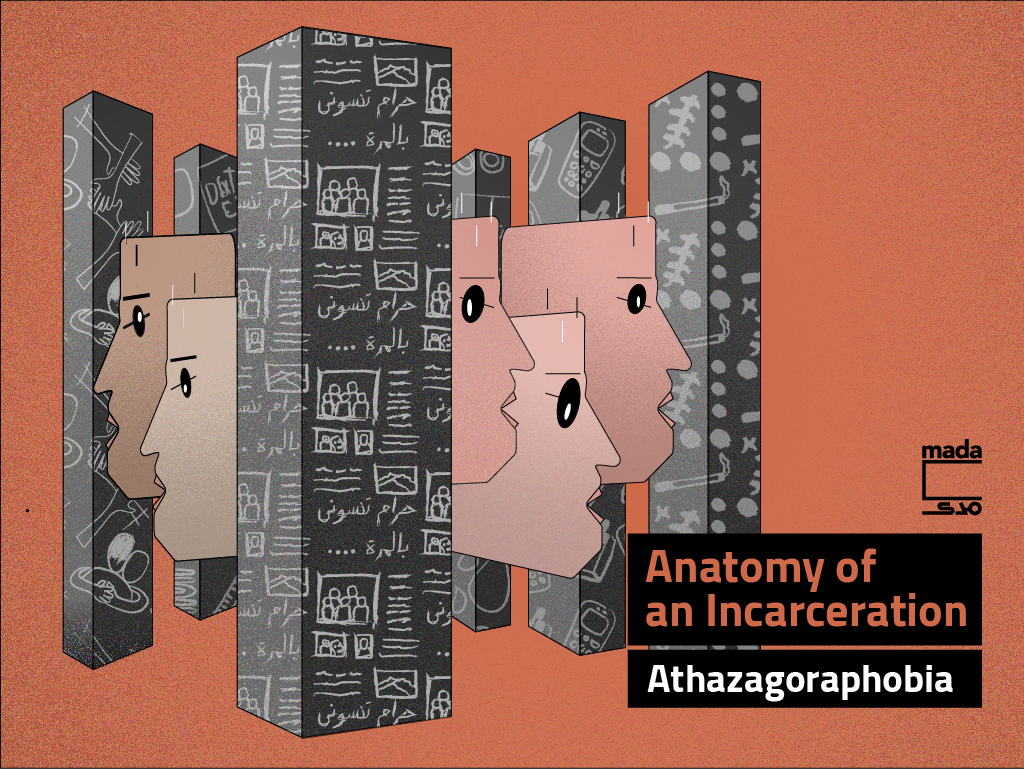
Anatomy of an Incarceration is a multi-part series that focuses on different aspects of prison in Egypt by Abdelrahman ElGendy who spent more than six years behind bars, from October 6, 2013 at the age of 17 until his release on January 13, 2020, at the age of 24.
I embrace my mother and sister in the visitation room before we sit down on the hard bench and immediately begin to chat.
They update me on what’s happening on the outside: talk of a possible pardon, news about friends and relatives, NBA updates.
My sister drops the news of a girl getting married, one that I used to deeply like before I was incarcerated, and my mother scolds her. Why did you tell him that?
I laugh and nonchalantly wave the news away; they still think I have functional romantic emotions.
My mother eyes me in pity, believing me to be in denial.
“Guys, I really don’t care anymore. There are kind of more pressing matters now, like my doomed life maybe?” I let out a cynical chuckle but my mother is still not convinced, her expression does not change. She pats my back and squeezes my shoulder, and I smile and shake my head. Mothers will be mothers.
I ask them about some friends to whom I have sent letters, and they pause and exchange awkward looks before blurting some words about how they must be busy and would write back eventually.
I sent the letters two months ago.
Self pity is my nemesis. I do anything to eradicate that feeling from my emotional system, and I feel disgusted when I put myself in a pitiable position.
A position like this one.
Each time I vow not to reach out to any of my old friends again, only to waver after a couple of months and give it another try.
I need to face it, they’ve moved on. It’s normal. You’re shackled at the start line while they’ve already finished the race and have gone on to other races. Why would they remember you?
No one remembers you.
***
I bite on my smuggled toy flashlight to hold it still with my mouth, lighting up a portion of the wall in front of me, and I draw.
My wall is my gallery: an exhibition of scribbled quotes, song lyrics, poetry, taped pictures, random ideas and meaningless sketches. It’s my outlet, a therapeutic canvas.
In the darkness of the cell, the vigorous scraping of my pencil against the concrete wall creates a monotonous soothing rhythm. With a background melody of soft snores, the tune is almost hypnotizing.
I emphasize the letters with my pencil, then go over them once more to make them bolder.
Over the past few weeks, I have developed a habit of going through an advanced dictionary I have in my cell, and searching for definitions of obscure phobias.
I found some amusing ones, like alektorophobia, the fear of chickens; onomatophobia, the fear of names; pogonophobia, the fear of beards.
But today, I stumbled upon one that felt like a punch to the sternum. Athazagoraphobia, the fear of being forgotten.
I scrape more harshly, tightening my grip on the pencil. A prisoner’s worst nightmare is to be forgotten on the outside. People do not pause for you: friends get on with their lives, relatives are either too busy or too scared to be involved, lovers move on, and supporters have newer, fresher cases to advocate for every day. As time passes, you become yesterday’s news, and even your loved ones get used to the fact that you are no longer a presence in the world.
But prisoners remember. They remember everything.
As the years fly by, doubt starts to creep into the mind. Was I ever outside? The prisoner starts to wonder.
The vivid memories you’ve survived on start fraying at the edges and blurring in the center. Faces are not easily conjured anymore, and the scenes fade until only a hazy shadow remains of what once was a vivid kaleidoscope of memories.
So, the prisoner starts to collect mementos, starts to wear the accessories of loved ones and stays up for hours contemplating their features in photographs he cherishes with all his heart.
He stares long and hard at each face, then longer at his own among them —I was there. This is proof that I have not always been in prison. They knew me, they exist. And this life that now only exists in my mind was a reality once upon a time.
A few months ago, I earned my degree in mechanical engineering after studying and taking my exams in prison without attending a single class on campus. Afterward, my family brought me a photograph of my colleagues, the entire mechanical engineering class at a graduation ceremony, holding a banner with my picture on it, paying tribute to me and my achievement with a standing ovation.
A thing of beauty, they told me.
Tears well up in my eyes as I recall the moment I opened the smuggled stack of letters and saw the hidden printed picture neatly folded inside.
I saw my face on the banner, the colors contrasting beautifully, my black suit and tie shining with a firm expression of defiance on my face, the clenched raised fists of my classmates, whom I have never met before, held high in solidarity. I tried to envision the rocketing applause moments later — they remember me.
The warmth I felt then was exquisite, this was living proof that I was not a ghost.

My wrist aches a little, sweat drips from brow and under my chin, yet I continue my fervent sketching.
A picture of our family on my high school graduation day is taped to the bleak wall in front of me: vivid colors brightening my gray, pale reality. Their frozen smiles thaw the ice that has formed around my heart a little, as they always do.
Another picture. This one is of me with a group of friends at our welcome party before the start of the academic year, one week before my arrest. We are huddled together, close, familiar — five friends, none of whom I now know.
Captured moments, seized and preserved from another life, a life whose memories have faded as if bleached. They are there to remind me. You were there. This happened. You have not been a prisoner all your life. This was you once.
This can be your life again.
I feel a pang of pain in my stomach: will anyone be left in that life if I ever return?
why do they never write me back why do they never ask did i imagine this life was i ever outside was i born in prison i cant be in prison i cant have been in prison for six years six years six years—
I tighten my grip and the pain spreads up my arm. I let it anchor me to reality, balancing the recurring waves of derealization and panic. The pencil tip snaps and shoots into the darkness. I wipe at my tears and take deep breaths. Inhale, hold for five seconds, exhale. The numbness in my forehead fades and I rest my head against the wall. My sweaty forehead will be smeared with graphite, but I press harder.
Haram tinsooni bil marra. Please, don’t forget me. The line from Fayrouz’s song is laid out on the wall, my newest addition to the gallery, another futile cry into the void adorning my wall.
I repeatedly thump my head against the wall, a slow pattern that grounds me.
Thump. One. Two. Thump. One. Two. Thump…
***
“Faith is believing in things.” The white letters engraved on my pink bracelet stare back at me. I whisper the words to myself, relishing their sound.
My closest friend, Farida, got me this bracelet from Greece four years ago and I haven’t taken it off since. It is a source of warmth, a comforting handhold, wrapped around my wrist, reassuring me: someone remembers and cares.
Some people here think I’m going crazy, the zealous ones believe I am being haunted by jinn and ghosts. I find them amusing.
It’s just that sometimes I suffocate with words I can’t say, words with no one to hear, ideas I want to share, discussions I’m dying to have. So I let the words out.
I speak. Yes, I confess, sometimes they do turn into imaginary conversations that last for hours, with exchanges going back and forth. Hence their suspicion that I am hiding a phone.
I wasn’t. I was just talking to my friends. My friends who do not remember me anymore. My friends whom I very much remember.
I admit, sometimes the discussions get heated and I raise my voice, occasionally wave my hands and gesture. But that’s normal, right? It happens in discussions all the time.
Is it my fault that I know my friends too well, that I predict their snarky retorts?
I’m not crazy.
I stretch and yawn, exhaustion taking over.
Reading the Game of Thrones series last year, I was infatuated with Arya.
Arya Stark repeated a mantra each night of people she wanted to kill. Each night before she sleeps, she whispers their names and fantasizes. And each time one of them is gone, a name is scratched off her list.
My list is of people who remember. I recite my list each night, wondering who will be gone next.
Arya’s list accumulated names as the years passed.
My list has only gotten shorter.
I shake my head to clear it of thoughts, imagining them as bubbles that I prick with a sharp sword like Arya’s Needle.
I stick them with the pointy end as I drift to sleep, smiling.

Abdelrahman ElGendy
Abdelrahman ElGendy is a former political prisoner in Egypt who spent more than six years behind bars, from October 6, 2013 until his release on January 13, 2020. He was…
آراء أخرى

Anatomy of an Incarceration: A story of arms
«"I throw my arms around her in a firm hug. Holding on. Recharging for the next two weeks"»

Anatomy of an Incarceration: Took nothing, saw nothing, know nothing
«“Do you know how we mark snitches?” he asks. “We cut them in a way that sets them apart.”»

Anatomy of an Incarceration: Sweatbox
«A suffering that never seems to end. A sweat-box, as British prisoners’ lingo accurately coins it.»
Your support is the only way to ensure independent, progressive journalism survives.
You have a right to access accurate information, be stimulated by innovative and nuanced reporting, and be moved by compelling storytelling. Subscribe now to become part of the growing community of members who help us maintain our editorial independence.
Join us
لا توجد تعليقات بعد