
Anatomy of an Incarceration: Took nothing, saw nothing, know nothing

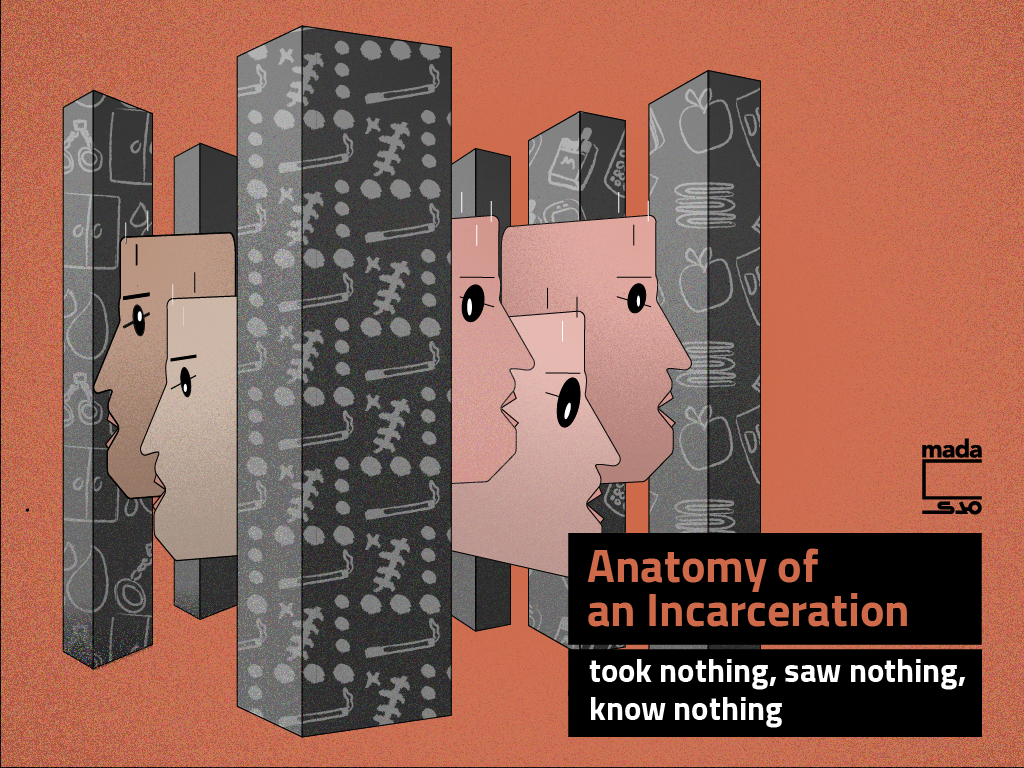
Anatomy of an Incarceration is a multi-part series that focuses on different aspects of prison in Egypt by Abdelrahman ElGendy who spent more than six years behind bars, from October 6, 2013 at the age of 17 until his release on January 13, 2020, at the age of 24.
“Hey, Abu Shakira … I couldn’t help but notice those three dots on your foot. I have seen them tattooed on various body parts of genai prisoners.”
Abu Shakira’s face breaks into a wise, all-knowing smile, his massive body leaning against the wall, the countless scars and shank marks covering his neck accentuated as he nods with pride, explaining the genai ritual: “This is the genai code of honor. Took nothing. Saw nothing. Know nothing.”
A genai is someone imprisoned on criminal, as opposed to political (siyasi), grounds. Inside prisons here, the distinction between a genai and a siyasi is openly acknowledged by jailers and prisoners alike; it is a primary reference point, a bifurcating marker, a penal brand.
Abu Shakira elaborates on how any self-respecting criminal insists on those three principles regardless of how long and hard he is interrogated. The most dishonorable act a prisoner can commit is to snitch; it’s high treason. A snitch is loathed by all prisoners, evokes hostile contempt, and is at constant risk of being targeted.
“Do you know how we mark snitches?” he asks. I shake my head and he continues. “We cut them in a way that sets them apart.”
I raise my eyebrows in anticipation. He guffaws, “We gift them with a second crack.”
I burst out laughing. He gestures to direct my gaze at a prisoner in his cell, climbing to the upper bunk bed in his boxers. As he raises his knee, I spot a long scar running along his left hamstring, extending up his leg and disappearing under his underwear. I nod chuckling, remembering the looks of disgust Abu Shakira shot this guy whenever he passed us in the hallways. I thought they had a feud — now I understand.
A renowned drug-dealer with his own gang and a fearsome reputation in prison, Abu Shakira has been my best friend for the past couple of months since my transfer to Tora Maximum Security 2 Prison.
Every day, I get up during morning recess hour, wash my face and head over to his cell, where we settle in our usual spot in front of the door. Three times my size, he’s the kind of overweight person that used to be a pure-muscle hulk in his youth until age caught up with him. Always wearing a thin-strap tank top, you can easily spot the myriad tattoos peeking out from underneath. Just when you think he couldn’t be any more intimidating, you get closer and notice the violent scars extending up from his chest, across his throat, and stopping right before his face at the chin.
“Never the face, Gendy. Your face is your reputation. If they get you in the face, they get your dignity. I am 54 years old, 25 of which I spent behind bars, and not once has someone gotten the honor of scarring my face.” He slaps his face repeatedly to emphasize his seriousness.
Our friendship began when he wanted to send a message to his mother, whose old age prevented her from being able to visit him more than once every few months. I was the only one who agreed to smuggle it out during my family visitation, and my mother delivered the message by phone. The next time his mother visited the prison, she told him my name and that this was the first time a political prisoner’s family had contacted her. His gratitude was boundless.
There is a nasty form of discrimination practiced by many political prisoners toward their criminal counterparts. They treat them with condescension, at times going so far as to prioritize political prisoners when giving away food or drink. Not everyone is that way, but it’s certainly there, a pervading prejudice within the prison walls, and it’s sad to observe. Criminal prisoners are aware of it, and are often sensitive to any demeaning attitude when dealing with political prisoners.
After I helped deliver the message to Abu Shakira’s mother, we started to chat during recess, which evolved into longer conversations and a burgeoning friendship. Amazed by Abu Shakira’s kind heart and trustworthiness, I eventually took to visiting him for daily, hour-long meetings, during which I listened to fascinating stories from the criminal underworld and was educated on its traditions and codes of honor.
“Abu Shakira,” a genai prisoner calls, approaching us in the midst of a chat. He leans in and starts to whisper something in his ear, a major affront to anyone sitting in the circle — in prison, it implies the other circle members are snitches that should not hear what you have to say.
Abu Shakira’s arm thuds against the guy’s chest, pushing him away. “This guy here is my friend, a true one,” he pats my shoulder heavily. “You disrespect him, you disrespect me, understand?”
I’ll never forget the day I overheard him arguing with another prisoner. The guy asked Abu Shakira why he was treating him with hostility — weren’t they supposed to be friends?
He smirked and said loudly: “I only have two friends here! Gendy and Sayed Moshagheb.”
Warmth, it filled my insides.
The twist in the story is that Abu Shakira is technically a political prisoner. That’s not supposed to make sense, but sadly, in Egypt it’s a well-known practice.
We were told by a large number of criminal prisoners that were assigned to our cells that they were wrongly placed in political cases at the police station, whether accidentally, or intentionally for purposes of revenge. They embark on their journey behind bars as political prisoners despite having been convicted for apolitical crimes.
Sometimes this phenomenon also occurred during mass arrest sweeps, particularly during the period of marches and demonstrations after 2013, which led to a large number of criminals being lumped into political cases. Cases are never labeled political or criminal on legal documents, since Egypt insists it has no political prisoners and appearances need to be kept up. But there’s an internal labeling system arranged by state security, according to which files are separated when a prisoner enters prison, so that criminal and political prisoners rarely share the same cells.
We do not know for certain why this happens, but some theories revolve around a fear of more radical political prisoners influencing criminals, producing, in their estimation, seasoned violent radicals, hence the cell segregation. Maybe there are other motives that we do not know of.
In any case, criminal prisoners who share political prisoners’ cells suffer from not being able to live a prison life they are used to. Political prisoners come up with far too many rules and regulations, practice a democratic model that most criminal prisoners couldn’t care less about, and give them a hard time about smoking and drug use.
I once heard a criminal prisoner banging on the cell door, hysterically shouting to the guards that he needed to instantly be moved to a criminal cell before he killed someone. It turned out that the political prisoners in the cell had been pressuring him about smoking, trying to force him to stand beside the door’s porthole each time he smoked to blow the smoke outside. The request itself was incomprehensible to him — the very attempt to impose rules on smoking confounding as a concept. After several days of trying to be respectful about it, he eventually snapped and kept yelling I’d rather be shanked to death than spend another minute in this madhouse!
Sometimes the two groups manage to coexist in the same cell, but over time, the alienating environment often engenders violence, and criminal prisoners can become fed up and decide to shank a political prisoner.
With the rise in incidents, a new label began to emerge: genai siyaasi, or political criminals. Prison administrations began to informally open new cells when the number of prisoners fitting that label was large enough for them to be grouped together. This allowed prison administrations to sidestep the headache caused by police officers labeling criminal prisoners as political ones, forcing these two groups into the same space of confinement.
In Abu Shakira’s case, he nearly killed a low-ranking policeman in the police station after his most recent arrest. He had previously tattooed the chief intelligence officer’s name on his foot and after being dragged to his office following the incident, he removed his slipper and raised his tattooed foot to the officer’s face to humiliate him. That was enough. I have that officer to thank for Abu Shakira’s presence in the political criminals’ cell adjacent to mine.
“I have an offer for you, Gendy,” Abu Shaira says one day, turning to face me in all seriousness. “Why don’t you work with me?”
I crack up, then realize he’s not joking.
“Work doing what?”
“I heard you live in a compound that has rich people who leave their cars and travel abroad most of the year. It’s simple. Pick up the phone, give me a location, brand, color, and license plate number, and that’s it. You get 10%.”
Not managing to hold it in anymore, I begin to laugh. He looks disappointed. “It’s easy money!”
I pat him on the shoulder. “It’s a very tempting offer indeed, my friend, but I’ll pass.” I point at a tattoo on his forearm that has caught my attention several times. “What’s that tattoo, Abu Shakira?” It looks like a logo, a mix of jargon and images.
His countenance turns proud. “That’s the name of my gang.”
I lift his arm as we pace back and forth in the hallway: DLAVRE NAMBAR 0
“That looks pretty cool… what does it mean?” I ask, and his face falls a little.
“Delivery Number Zero, is it not clear? I thought you knew English.” He glares at me.
“Oh yes! Absolutely! I’m just a bit slow these days. What does it stand for?”
“I just like it.”
I nod vehemently, as if it makes perfect sense. It’s not worth the risk, I am happy with my single crack, thank you.
He goes on to explain how he formed his gang to return stolen property to their rightful owners. How he uses his connections in the crime world to find stolen cars or people who have been kidnapped, and returns them to his clients in exchange for a fee.
I am impressed. That’s some genuine Robin Hood stuff right there. I nod appraisingly and tell him it’s great how he’s using his power and influence to do good.
He bellows with laughter. “I didn’t tell you about the first half of the gang, the one that steals and kidnaps first, so the second half can do the salvaging.”
I shake my head and chuckle. He always does that — intentionally misleading you on a story to shock you with a surprise punchline. An adept storyteller I must admit.
Every day I listen to stories about the criminal underworld and the characters in it, and their dealings with authorities. He casually recounts the shocking arrangements he has with the police where they allow him to operate in exchange for certain services or a percentage of the spoils. The depth of the corruption blows my mind.
One day, a cellmate whom I had a huge fight with decided to get back at me by going to Abu Shakira and telling him that I’ll never respect him or see him as an equal. That no matter what he does, I will always view him as a criminal and look down on him.
I remember his furious expression when I walked over to him on my daily visit and how he growled at me. I was instantly alarmed — I am no fool. For a while I had thought Abu Shakira was a kind, gentle person, until I witnessed him slicing another criminal prisoner’s back into shreds with a shank. It was the first time I witnessed the violence he is capable of.
I cautiously inquired what was bothering him until he eventually spat out what the cellmate had told him.
As I processed his words, another realization hit me. Looking at his enraged countenance, I saw other feelings beside the prevalent fury; I could make out hurt and betrayal too. The fearsome, mighty Abu Shakira was feeling insecure. He just needed some assurance that I viewed him as a friend, an equal.
I approached him slowly. “Do you see me making friends with many people here? Political or criminal?”
He hesitated. He knew I didn’t have many friends since my transfer here.
“I only have two friends here: You, and Sayed Moshagheb,” I said firmly, and his face instantly softened.
He pulled me into a bear hug that almost choked me to death, then let me go, and just like that, we were friends again.
I hadn’t realized how complicated human relationships can be in detention, how moral lines blur under extreme conditions, and how traditional standards of ethics and respect can shift and realign, making them harder to recognize.
Standing before the barred window of my cell’s steel door, searching for someone to deliver a risky message to a high-security prisoner in another ward close by, I see a number of prisoners returning from their visitation time, all of them political, except for Abu Shakira.
Fellow political prisoners: incarcerated for a cause, noble defenders of ideas, trustworthy by default. I ignore them all and fix my eyes on my drug-dealing, car-stealing, back-shredding friend.
At that moment, I realize I don’t trust any of them to uphold their morals under pressure if they happened to be caught with my message. But I fully believe in the three blue dots on Abu Shakira’s foot.
Took nothing. Saw nothing. Know nothing. A sacred code of honor, that I know will never be broken.
I near the window and call out for my friend.

Abdelrahman ElGendy
Abdelrahman ElGendy is a former political prisoner in Egypt who spent more than six years behind bars, from October 6, 2013 until his release on January 13, 2020. He was…
آراء أخرى

Dressed with intention: On Ahmed Douma
«Keeping one in the room even when they aren’t is never only about the person you're trying to hold»

Thinking with Alaa: Nothing but love
«We have much more from Alaa than his absent condition and possible disappearance to grapple with»

Thinking with Alaa: Alaa’s utopia
«Alaa (and Seif) tried to solve the problem of law by inhabiting a legal world entirely of their own»
Your support is the only way to ensure independent, progressive journalism survives.
You have a right to access accurate information, be stimulated by innovative and nuanced reporting, and be moved by compelling storytelling. Subscribe now to become part of the growing community of members who help us maintain our editorial independence.
Join us
لا توجد تعليقات بعد