
Trump’s foreign aid cuts cast shadow on students’ futures as AUC freezes new scholarships
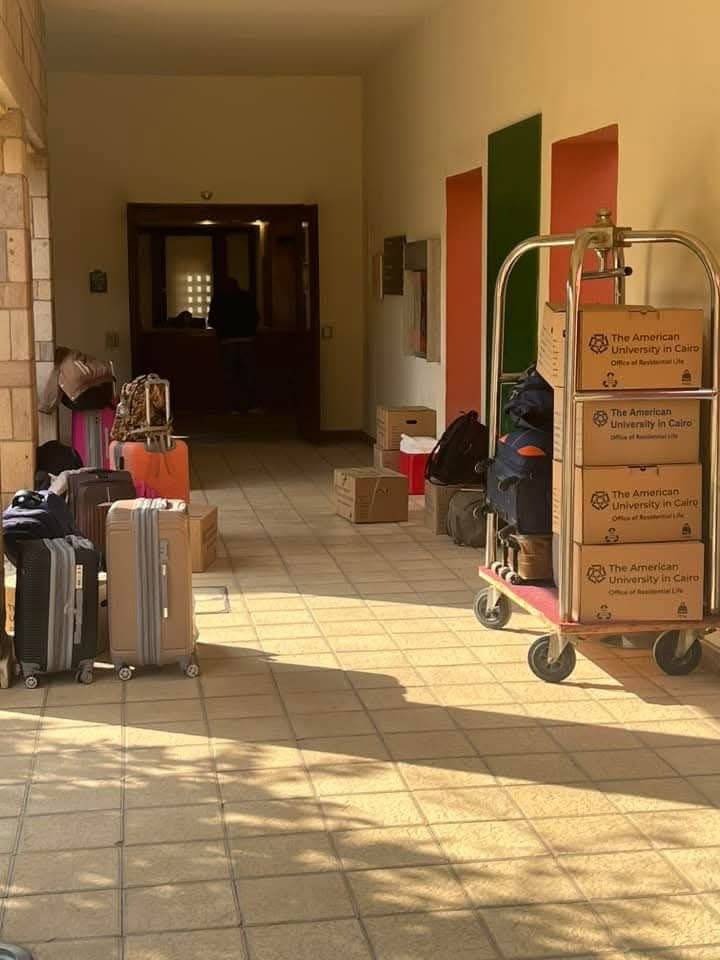
Over 100 students taking a preparatory language course before their first academic year at the American University in Cairo (AUC) were informed on Sunday that their scholarships would be suspended, leaving them without financial support for their study plans for the academic year.
They are among hundreds of other students and employees in aid and development roles impacted by the inaugural decision taken by United States President Donald Trump to pause all foreign development aid.
The enforcement of an immediate 90-day pause on US developmental financing issued last week is expected to affect projects around the world, with impacted sectors in Egypt ranging from school education to family planning programs among many others whose employees are also at risk of losing their positions.
Although the Higher Education Ministry announced Tuesday that universities would cover tuition fees for current students affected by the cuts, the fate of the newest cohort of scholarship recipients at the AUC, bridge students and spring 2025 newcomers remains uncertain.
The 110 impacted students at AUC are among over 370 higher education students in Egypt who won scholarships from the United States Agency for International Development (USAID) for the 2024/25 academic year at 10 universities across the country, some public and some private.
The scholarships supported students to study in credit-hour programs with courses in English, with USAID funding tuition to “support economic, social and environmental development plans in Egypt.” USAID grants also paid for the students’ accommodation at AUC.
The cohort of new scholarship recipients due to begin studies at AUC next September checked into accommodation at the university on Saturday to begin a language course camp they are required to complete before beginning their bachelors courses. Yet on Sunday, they received emails informing them that their funding would be suspended with immediate effect.
“At 12:20 in the morning, we received an email that the program has been suspended,” one of the attending students who was a beneficiary of the USAID program said.
Preferring to remain anonymous, the student said that the AUC administration’s email, of which screenshots were circulated online, gave recipients two options: either assume responsibility for their own tuition costs, or explore alternatives.
“These were the options presented to us," the student added.
Other AUC students shared the story on their social media accounts, expressing dismay that the students’ educational futures are now in jeopardy unless they replace the tuition fees out of their own pockets.
The decision, coming mid-year, could force them to forgo completing the current academic year to the detriment of their academic futures, since for many it is too late to reapply to public universities.
“What we were informed of, as AUC students, is that it's over. Don't wait for the scholarship anymore,” the student told Mada Masr. “The emails made it clear, everything around us said the same.”
He explained that they were informed during their attendance of the winter camp for preparatory year students on Sunday.
“On Sunday at 8 am we went to the camp, everything was normal until 1:20 pm, when the company organizing the camp told us that there was an important meeting at the university hall that we had to attend. When we got there, we found [scholarship] students from all academic years were present,” he continued.
Assembled students were informed of the scholarship suspensions and AUC students were asked to wait for more information regarding their fate.
Without any clarity on whether funding will resume after the 90-day suspension period, the student said that he is not prepared to waste a semester waiting for further information with no guarantees that the scholarship won’t be permanently canceled.
Students are not only concerned that the move will also affect their academic year but that it will also harm their career opportunities in the future.
“Right now, I'm not acknowledged by any university, and Cairo University, where I’m meant to be enrolled, considers me to have failed the first semester since I’m attending the USAID funded language program,” the student explained.
He expressed concern that this could permanently impact his career opportunities, if the semester he missed stays on his record. “Ultimately I won’t be able to be appointed as a professor, even if I graduate with honors every year or even become a teacher assistant.”
He added that all other AUC students in his situation are facing similar issues, explaining that he, along with his colleagues, are currently looking for other scholarships that can support them.
Nada Nashaat, a Center for Egyptian Women’s Legal Assistance (CEWLA) lawyer and former recipient of a USAID grant at AUC said that in theory, universities and the government should be able to offer the cohort of students funding alternatives.
The program has been offered in its current form since 2004 to one male and one female student from every governorate in the country per year, she said, noting that the USAID partners with the Egyptian International Cooperation Ministry and the American University in Cairo, all of whom contribute to the scholarship through financial assistance or services.
Nashaat suggested that either the AUC or the International Cooperation Ministry should assume responsibility for the suspended tuition fees, or the university should begin to fundraise for those whose grants are suspended by cooperating with social entities or businesspeople.
Not doing so would be an evasion of the university’s responsibility to students, said Nashaat, adding that not providing the support will create class discrimination and bar access to study for people with lower income.
“It’s not like we are here on a scholarship because we can’t afford to eat, we are here because we are capable, " she said.
Other students subject to the funding suspension have been more fortunate than the new AUC cohort.
At Ain Shams University, one of those included in the paused USAID program, dean Mohamed Diaa Zein Alabedin announced on Tuesday morning that all tuition fees for scholarship students would be covered by the university, "provided they adhere to academic standards and discipline."
As the impact of the US funding suspension became clear over recent days, sparking panic among students at many universities, the Higher Education Ministry announced on Tuesday that the universities would cover fees for 1077 students who are already studying nationwide.
The statement also confirmed that AUC will cover tuition fees for its 200 USAID scholarship students for the second semester, adding that the university will continue to coordinate with the ministry in the future.
From its side, the AUC Student Union announced the updates on Tuesday, stating that while tuition, dorm fees and stipends will be fully covered for currently enrolled USAID and Tomorrow Leaders grant students, the situation of the bridge year and newcomer students in the spring semester is still being discussed.
But students at AUC were not hopeful. “We are not waiting for the grant to be resumed, the decision is beyond the control of Egypt as a whole, literally,” said the student, echoing the sentiment of many others who posted on social media.
"They told us to wait again today, maybe today they will have a meeting and we’ll see,” the bridge year student told Mada Masr on Wednesday.
Other than university students, civil society organizations and social programs funded by USAID are at risk, including six foundational education programs in Egypt which were beneficiaries in 2023.
Diana al-Deba, Senior Communication Advisor at Workforce Egypt, one of the USAID funded educational programs, said on her social media account on Tuesday that nearly 2000 employees across USAID projects were informed of their contracts’ immediate suspension on Sunday.
She added that there was also an immediate freeze on any funding for previously USAID-backed development projects, forcing some to close their offices with others expected to follow suit. She explained that many households rely on these projects for their income.
“It’s like a punch,” said Nashaat, describing the decision as striking deep to the heart of policies in the region.
“People are anxious,” the lawyer continued, adding that many are uncertain about whether they can take legal action against the funding suspension and fear being punished for standing up against the decision.
“But no one should object to how people will react to the decision,” she said, “because this isn’t just about the students, it’s about the global level — students, student movements, education rights and civil society.”
But Nashaat said that AUC, for example, should review its contract with USAID and see whether the financier has the right to withdraw abruptly from the agreement.
“The US especially is not a one-man country, it is, above all, a country of institutions,” said the lawyer, arguing that the US has a legal obligation to fulfil its commitments.
In the US, a federal judge temporarily raised a block to Trump’s decision on Tuesday, with a review of the appeal built on a suit from non-profits that received funding support due next week.
But the administration expressed resolve to implement the cuts on development funding, with officials in Trump’s White House framing it as a move against a “preposterous waste of taxpayer money.”
In a press briefing on Tuesday, Press Secretary Karoline Leavitt argued that the US administration is taking into consideration “how hard the American people are working” and the importance of their tax dollars, adding that the disbursement of millions of dollars to either the World Health Organization or “condoms in Gaza” is considered by Trump’s agenda as money down the drain.
أخبار ذات صلة

Gaza, the Board of Peace and the active cancellation of the past
The future By the time we get to the speech of Cypriot-Israeli real estate businessman and billionaire Yakir Gabay at the Board…

How to make friends, by Jeffrey Epstein
power begets power, even if just by association

Israel agrees to limited reopening of Rafah border crossing — details pending
Israeli Prime Minister Benjamin Netanyahu’s office announced on Monday that it has agreed to a “limited reopening” of the Rafah border crossing…

White House launches Board of Peace with chain of command including Blair, Kushner, global representatives
The White House announced on Friday the formation of two boards, tasking them with the management of Gaza’s affairs and assigning them…
Your support is the only way to ensure independent, progressive journalism survives.
You have a right to access accurate information, be stimulated by innovative and nuanced reporting, and be moved by compelling storytelling. Subscribe now to become part of the growing community of members who help us maintain our editorial independence.
Join us