
Gaza, the Board of Peace and the active cancellation of the past
The future
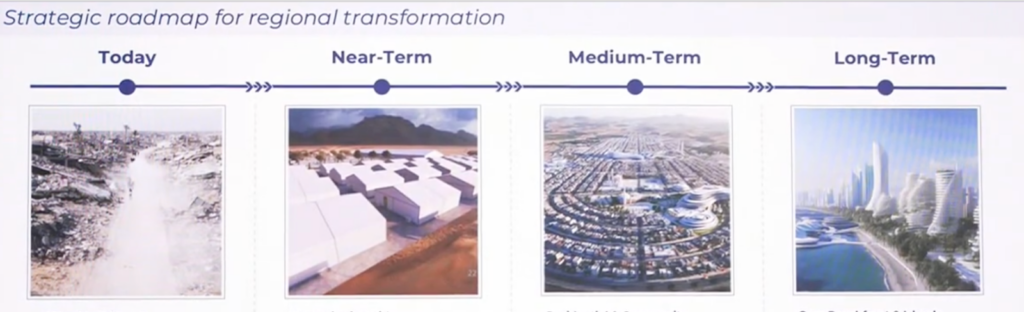
By the time we get to the speech of Cypriot-Israeli real estate businessman and billionaire Yakir Gabay at the Board of Peace’s first meeting on February 19, we already have a comprehensive image of the future of Gaza. Speaking with a map of the strip in the background boasting bright green, purple and yellow, he lays out what “many regional contractors who built houses for millions of people in the Middle East” have signed up for.

Gabay’s list includes:
- Recycling and removal of 70 million tons of rubble, UXO and hundreds of miles of tunnels
- Fast temporary housing
- Parallel construction of infrastructure and permanent housing
- Infrastructure of modern schools and hospitals
- Manufacturing and agriculture
- Roads and trains
- Water and energy plants
- Logistics hub
- Telecommunications technology and data centers
- Seaport and airport
- 25 miles of coastline into a new Mediterranean Riviera with 200 hotels and potential islands
- Sports and leisure facilities
On the last item, United States President Donald Trump says in his opening remarks that FIFA will be raising US$75 million for soccer-related projects in Gaza, including fields and "getting the greatest stars of the world to go there. People that are bigger than you and I, Gianni... People in Gaza know each one of them,” he continues, calling FIFA President Gianni Infantino a “great guy.” “Everyone is the head of a country other than Gianni, but he's the head of soccer. So, thats not so bad, right, Gianni? I like your job best,” he adds later.
The funding for all of the above initiatives, Gabay assures, “is ready and will be invested in a free economy. The value goes to Gazans through the Gaza sovereign fund.”
Once Gabay completes his list, Marc Rowan, the US billionaire and CEO of Apollo Global Management, reveals more construction plans:
- Build 100,000 homes for 500,000 residents in Rafah at first.
- Scale to 400,000 homes for the entirety of the population.
Complementing him in creating an image of Gaza’s virtual environment is former Israeli military intelligence official and tech entrepreneur Liran Tancman, who lists a series of digital financial initiatives:
- Reconnecting Gaza to the world digitally and economically
- Replacing corruption with an open tax free system
- Upgrading Gaza’s 2G network to free high speed access to essential services by July
- Building a secure digital backbone
- Creating an open platform enabling e-payment and financial services, e-learning and healthcare, with user controlled data
- Advancing an Amazon-like logistic system to help Palestinians launch businesses, import globally and trade securely, which should lower prices and drive growth
All of this will “help transform Gaza into an open, transparent, corruption-free economic zone,” he says.
Rowan speaks of holistic economy, bringing “Gaza’s productive assets into one unified structure, expeditious planning and zoning, and not fragmented projects that do not contribute to an economic whole.”
More importantly, he speaks of financial potential:
- The shoreline alone: $50 billion of value on conservative basis
- The housing stock: more than $30 billion as rebuilt
- The infrastructure: more than $30 billion
- $115 billion of value
“It just needs to be unlocked and financed,” he says.
Tony Blair, former prime minister of the UK and head of the Tony Blair Institute for Global Change, which advises governments and leaders, agrees on the potential, envisioning three things:
- 25 miles of Mediterranean coastline (as mentioned by his peers)
- Proximity to regional markets
- Young dynamic population with median age of 19
“Rebuilding Gaza not as it was but as it should be,” Blair says, summing up the aspiration as comprising effective public institutions, a “business environment where enterprise flourishes,” an education system that teaches "tolerance" and a tech-enabled society.
Ajay Banga, the president of the World Bank and also an entrepreneur, assures that a Gaza Reconstruction and Development Fund is housed at the World Bank as a limited trustee to allow all of the above and manage donors' contributions.
The fund serves three World Bank-like regulatory functions:
- Leveraging public finance and private bond money to help create the resources
- De-risking private investing
- Having people and expertise on the ground
The initial money for the board, according to Trump, has come from Kazakhstan, Azerbaijan, Morocco, the United Arab Emirates, Bahrain, Qatar, Saudi Arabia, Uzbekistan and Kuwait, who have already collectively contributed more than $7 billion. Individual state representatives go on each to specify their specific contribution.
Moreover, he says, the United Nations Office for the Coordination of Humanitarian Affairs (UNOCHA) is raising $2 billion for the support of Gaza.
Japan has also committed to host an aid fundraiser, which will be attended by Singapore, South Korea, the Philippines and others. “China will be involved. Russia will be involved,” Trump says.
Jared Kushner, Trump’s son-in-law, real estate developer and businessman, sums up the atmosphere:
“We cannot change the past. We can potentially change the future.”
The above-mentioned presentations, maps and bullet points propel Gaza into a future that seems only possible through the active cancellation of history. Peace, reconstruction and potential are mentioned far more than war, destruction and loss, and when Tancman conjures some history, it is ancient history nonetheless:
“Gaza was once a vital trade hub between Asia and Europe. Reconnection is a return to its roots. Even the word gauze comes from Gaza, where silk was woven and exported to Europe.”
And you really know that this is the Board of Peace when it is only the Egyptians who conjure modern history, reminding participants that Gaza is part of an active 1967 arrangement that also includes the West Bank. In his speech, Prime Minister Mostafa Madbuly is the main leader present to speak of Palestinians’ right of self determination and statehood, rejecting the annexation of the West Bank, empowering the institutional and geographic ties between the West Bank and Gaza in order for the Palestinian National Authority to be able to take over governance of a unified Palestine again and refusing the displacement of Palestinians from Gaza.
The faultlines
But for history to be actively canceled, there needs to be some work to ensure it does not come back whole, or seeping in fragments. This is the work of security presented at the convention.

US Major General Jasper Jeffers, the UN-mandated International Stabilization Force (ISF) commander, notes the following:
- The ISF works with two mandates: stabilize the security environment in Gaza and enable civilian governance as established by the National Committee for the Administration of Gaza.
- US military experts have been on the ground for the last few months preparing the infrastructure for the ISF operations.
- The ISF is operating from a combined operations center in Gaza, which will be its headquarters.
- ISF is assigned to five different sectors, each sector receiving one ISF brigade.
- In the short-term, deployment will be in Rafah.
- In the mid-term, there will be expansion, sector by sector.
- In the long-term, there will be 12,000 police and 20,000 ISF soldiers.
- Five countries have committed troops: Indonesia (appointed deputy commander of the ISF), Morocco, Kazakhstan, Kosovo and Albania.
- Two countries have committed to train police: Egypt and Jordan.
Taking on the subject of security, Ali Shaath, the Palestinian technocrat and chief commissioner of the National Committee for the Administration of Gaza, the only gesture toward Palestinian representation in the Board of Peace, mentions the restoration of security via professional civilian police “under one authority, one weapon and one law.” He references the training of 5,000 Gazan police to be deployed in 60 days.
“Blessed the peacemaker,” he nods at Trump.
Also speaking on the recruitment of Palestinian police is Nikolay Mladenov, the Bulgarian former defense and foreign affairs minister turned-director-general of the Board of Peace. He explains how, within the first few hours of announcing the recruitment, 2,000 people applied to join a new transitional Palestinian police force for Gaza, to be formed under the authority of the administration committee with the support of the Board of Peace, and with training in Egypt.
This police force, according to him, will ensure that “all factions in Gaza are dismantled and all the weapons are put under the control of one civilian authority…There is no option except through the full demilitarization and decommissioning of all the weapons in Gaza.”
On the question of demilitarization, Trump opines, in his opening remarks:
“I think they will give up their weapons. They promised. If they don’t, it will be very harshly met. You know all this stuff about how they don’t mind dying. They told me that’s not true. They do. People don’t want to die.”
Further on, he says:
“We have two countries [which he doesn’t name] that want to go in and do a number on Hamas. That’s not gonna be necessary. It’s no longer a hotbed of radicalism and terror.”
In his presentation, Mladenov is sure to communicate that the decommissioning plan is on track, with the exception of one detail. “We are yet to negotiate the implementation with the factions on the ground.”
As per the ISF’s mandate from the UN Security Council, it is empowered under international law to disarm Hamas and to destroy and prevent the rebuilding of “military, terror and offensive infrastructure, as well as the permanent decommissioning of weapons from non-state armed groups.” An Egyptian official previously stressed to Mada Masr that disarmament should not be part of the interim force’s mandate and should instead be negotiated between the relevant parties.
Now
For now, as per the conference, Palestinians are given relief aid and Israelis are given back their hostages.

Mike Waltz, US ambassador to the UN, notes the following:
- Over 70 countries are participating in civil military operations and deconfliction.
- 4,200 aid trucks have entered Gaza each week, for 13 consecutive weeks, the longest stretch of high volume assistance to Gaza in years.
- Diversion is significantly down from prior to the ceasefire with less than 1 percent diverted this month.
- Food supplies are up, reaching the full 2.1 million Gazans, up five times from the delivery levels before the ceasefire.
- The percentage of households struggling with severe hunger has dropped from 30 percent to 1 percent.
- Drinking water has doubled.
- Child malnutrition has been cut in half.
Meanwhile, Steve Witkoff, the US special envoy to the Middle East, distributes thanks to Qatar’s prime minister for being “an incredible human being,” the Turkish foreign minister for being “amazing,” as well as Shaath, the Turkish president, “and of course, the Egyptians. [Foreign Minister] Badr [Abdel Atty], you are smiling because we have been through much. General Hassan [Rashad, General Intelligence Services director], was amazing. And Prime Minister Sisi… Em, President Sisi. Pardon me. Oh and the Israelis, I forgot. Prime Minister [Benjamin] Netanyahu and Ron Dermer.”
He highlights:
- 251 hostages, 168 came back alive. 83 bodies were returned.
“They dug and dug and dug. You can imagine, it's a job that's brutal. And Hamas really did a lot of that work. And you got to give them credit for that,” Trump says.
Some trivia, or the new world order
To those who did not attend the conference, Trump still has some words to say. Here are some snippets:
"This is a big day and lots of people watching, and especially from other countries, the leaders of, as you know, the other countries because we have a large group of leaders. And the ones that aren't here are watching on Zoom. I hope they enjoy it."
“Amost everybody is accepted, and the ones that haven't will be. Some are playing a little cute, doesn't work."
Key European US allies have so far expressed reservations about joining the Board of Peace, including France, Germany, the UK and the European Union.
Addressing those who attended, he says:
“[Argentinian President Javier] Milei. I endorsed him. I'm not supposed to be endorsing people, but I endorse when I like people. You know, I've had a very good record of endorsing candidates within the United States, but now I endorse foreign leaders, including [Hungarian Prime Minister Viktor] Orbán, who's here and others. And I endorsed this gentleman, Milei...I just endorsed the prime minister of Japan. She was in a tight race but was probably going to win, and she won in the largest number in the history of Japan. So, she likes me a lot."
To the Azerbaini president, he says, "I love saying that name. At the beginning it was giving me a hard time."
"His Majesty King Hamad bin Isa Al Khalifa of Bahrain. Bahrain, thank you. Thank you. Where are you?...He's so rich, he can sit there. He can sit wherever the hell he wants....He could sit up top. He might take a piece of this building... He'll take 25 percent of the building for about $6 billion."
To Prime Minister [Mostafa] Madbuly: Egypt. Say hello to the general — the president.
Indonesia: Big guy. I don’t want to fight him.
Kazakhstan: What a country. Rich country. We have some very rich people here.
Pakistan: I like this man. There was a fight with India. I got on the phone with them. I know [Indian Prime Minister Narendra] Modi quite well. I said if you fight I am going to put 200 percent tariffs. When they came to lose a lot of money they stopped.
Paraguay: Young handsome guy. I don’t like young handsome guys, women I like. Men, I don’t have any interest. Women okay.
Qatar: Great man and highly respected. But the emir needs a PR agency. You do so much good, and they have you down as evil. You are not evil. You are such a good ally.”
Trump also uses his speech to touch on other political issues:
“I am going to China in April. Last time I went to China, President Xi [Jinping] gave me such a display. He treated me so well. I never saw so many soldiers at the same height. I guess you can do that when you have 1.4 billion people.”
“Egypt and Ethiopia: We are going to get that. There is a little dam built and financed by the US brilliantly, but the water is having a little trouble going through the Nile. But we are going to solve that.”
“Cambodia and Thailand. Those are nasty fights. Congo and Rwanda… you are nice guys compared to this. Congo and Rwanda.”
“We just updated our B2 bomber, it’s a wing. It carries very big bombs. It went to Iran and decimated its nuclear potential. And all of a sudden, we have peace in the Middle East.”
The UN was not exempted:
“We are going to be working with the UN very closely. I think the UN has great potential
it has not lived up to. Someday I won’t be here, the UN will. It is going to get stronger. The Board of Peace is going to be looking over the UN and making sure it runs properly. We are going to strengthen the UN. We are going to make sure its facilities are good. We are going to help them money-wise.”
And neither were his own personal notes:
“Norway has agreed to host an event that would bring together the Board of Peace. When I heard this, I thought they were going to give me the peace prize. Oh this is less exciting. But I don’t care about the Nobel Prize. I care about saving lives.”
US vice president, JD Vance, meanwhile, reminds everyone it is all about the US:
“You save lives and promote peace, and this creates incredible prosperity. The countries represented here represent trillions of dollars of investments in the US that would not have been possible if it weren’t for the president’s advocacy for peace. The economies here represent millions of American jobs receiving products built in American factories by American workers.”
Final words
In our latest podcast on the Board of Peace, we had an argument about whether Trump is the one with political imagination right now. US Secretary of State Marco Rubio confirms.
“We are here today because Trump is using the power of his office to think outside the box. It’s a unique situation in Gaza; international organizations couldn’t solve it. The Gaza situation was impossible to solve under orthodoxy and existing structures,” he says, proposing that what Trump is doing in Gaza should serve as “a model for other complex and difficult situations.”
Trump's imaginative wealth, and the board set-up to be run like a corporation, at a time when states are increasingly looking up to corporations, is confirmed by Kushner. That, in turn, confirms that we are still within the movement of history, despite attempts to actively cancel it.
“We tried to structure this meeting like a proper board meeting,” Kushner says, “like we do in the private sector. We have all the preparations and we got the right people together.”

أخبار ذات صلة

In meeting with Board of Peace director-general, Hamas refuses UN disarmament plans until Israel commits to withdrawal
Hamas has refused to commit to the plans proposed by the United Nations for its disarmament, citing lack of advancement in Israel’s…
Prices surge in Gaza redoubling food insecurity after Israel shuts borders citing attack on Iran
For the first week of Ramadan, Reem al-Masdar was cooking vegetables, salad and bread to prepare iftar and sohour meals for her…
Only 12 Palestinians permitted to return to Gaza Strip since Rafah crossing opened
Sabah al-Raqab is one of only 12 Palestinians who have been able to return to the Gaza Strip via the Rafah crossing…
How to make friends, by Jeffrey Epstein
power begets power, even if just by association
Your support is the only way to ensure independent, progressive journalism survives.
You have a right to access accurate information, be stimulated by innovative and nuanced reporting, and be moved by compelling storytelling. Subscribe now to become part of the growing community of members who help us maintain our editorial independence.
Join us