
Still no aid for Gaza as Israel rejects diplomatic pressure from UK, EU
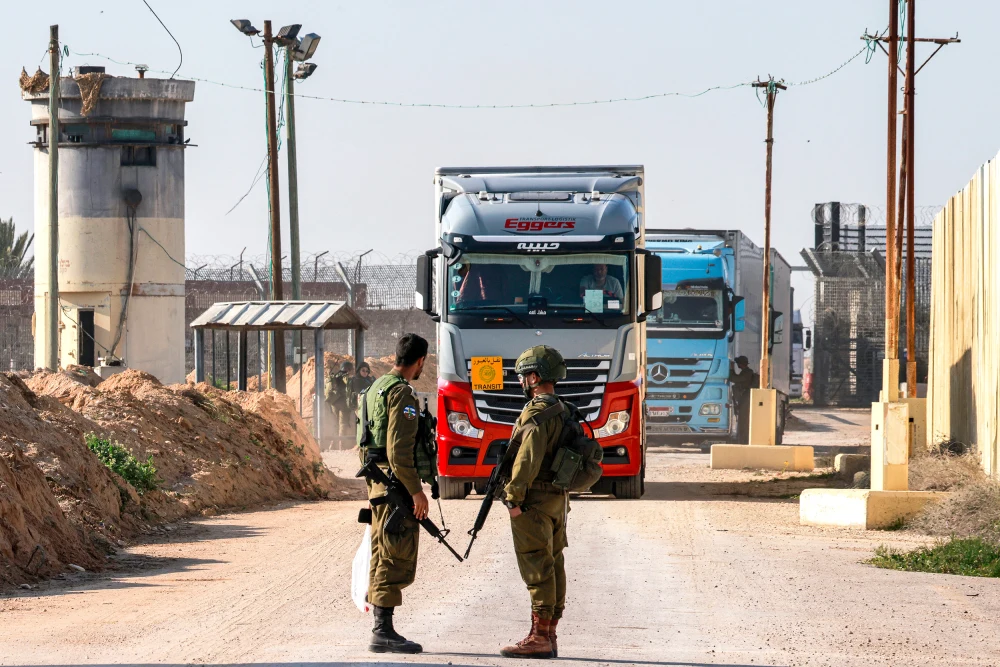
Humanitarian aid has still not reached people in the Gaza Strip who have endured 80 days with no food, fuel, medical supplies or other humanitarian aid due to Israel’s blockade of the coastal enclave. The Government Media Office in Gaza confirmed in a statement on Wednesday that no aid had been delivered for the third consecutive day since Israel announced that it had approved some humanitarian deliveries. The office said that malnutrition has caused the death of hundreds already.
Israel’s Foreign Ministry has also spoken out in the last 24 hours to reject diplomatic gestures from Western officials geared to pressure Israel into breaking its siege on Palestinians in Gaza.
Following reports of pressure from the United States to allow supplies into the strip, Prime Minister Benjamin Netenyahu’s office announced on Sunday that a “basic amount of food” would be allowed into Gaza in parallel with the expanded ground operation, dubbed Gideon’s Chariots, that Israel’s military launched on the same day. A hunger crisis would endanger the operation, Netanyahu said.
But steps to implement the delivery have dragged over the two intervening days. By Monday, only nine trucks were cleared for entry into the strip, according to the United Nations Office for the Coordination of Humanitarian Affairs.
A source in the Palestinian business association in Gaza who spoke on condition of anonymity detailed the delivery plan to Mada Masr. They said that Israeli officials made contact with the World Food Programme, which was to receive the aid in its warehouses and then distribute it by directing residents via text message to collect the supplies there. The source also pointed out that a number of businessmen in Gaza have tried to find out how aid will be distributed, but they were informed that only the WFP will be distributing aid.
By Tuesday, however, only five of the nine trucks had actually been allowed to enter to the Palestinian side of the crossing, OCHA stated. Two of these were loaded with body bags donated by an Arab country through the UN, said Euro-Med Human Rights Monitor founder Ramy Abdu, describing the development as a "preparation for mass death."
“Gaza is not being fed, but buried,” he said, after reporting that trucks did not reach the heart of Gaza, but that their entry was “deliberately delayed until the evening.”
UN Spokesperson Stéphane Dujarric also said Tuesday that while the Israeli Coordinator of the Government Activities in the Territories (COGAT) cleared the entry of an additional 93 trucks into Gaza, the aid was yet to be delivered to the humanitarian agencies responsible for distribution.
“We have not been able to secure the arrival of those supplies into our warehouses and delivery points,” Dujarric noted.
The director of the Civil Networks Organization in Gaza also confirmed on Wednesday that aid trucks are yet to be delivered to UN-affiliated warehouses, echoing statements that the Israeli government is intentionally slowing down the entry of aid.
The failure to deliver aid continues Israel’s “systematic policy of siege and starvation,” the Palestinian government media office said on Wednesday, adding that Israel hindered the entry of aid without legal or humanitarian justification at a time when people in Gaza have been suffering from deteriorating health and living conditions and a severe shortage of food, medicine and fuel.
Highlighting the depth of humanitarian crisis unfolding in the besieged enclave, UN humanitarian coordinator, Tom Fletcher, warned on Tuesday that 14,000 babies are at risk of dying in 48 hours if aid does not reach them in time. The limited amount of aid that reached the enclave on Monday was “a drop in the ocean” of the sector’s needs, he said.
Several western governments have pushed for Israel to deliver the aid supplies over recent days, with little to no effect.
The British government summoned its ambassador for Israel on Tuesday, suspended negotiations toward a free trade agreement and imposed sanctions targeting West Bank settlements.
It also issued a joint statement with Canada and France a day prior calling for Israel to “stop its military operations in Gaza and immediately allow humanitarian aid to enter Gaza,” adding that “concrete actions” would be taken if the Israeli government continued its military operation and “egregious” restrictions on humanitarian aid.
The European Union also put its trade agreement with Israel under review, EU diplomat Kaja Kallas said on Tuesday, adding that the decision was favored by a strong majority of EU foreign ministers during their meeting in Brussels this week.
Describing the situation in Gaza as “catastrophic,” Kallas said that while the aid allowed in by Israel was welcomed, it is however “a drop in the ocean. Aid must flow immediately, without obstruction and at scale, because this is what is needed."
The Israeli Foreign Ministry said in a response to the UK’s measures that “external pressure will not divert Israel from its path in defending its existence and security against enemies who seek its destruction.” In response to the EU, it said, “We completely reject the direction taken in the statement, which reflects a total misunderstanding of the complex reality Israel is facing.”
The seemingly sharp statements and measures by Western officials follow months of calls to action by several officials and humanitarian agencies operating in the strip, who have been warning against famine and extreme deterioration of humanitarian conditions.
Since March, Israel's military blockade has killed 326 people in the strip, either from malnutrition or lack of food and medicine, according to the Gaza Government Media Office, which added that the deaths were part of “the Occupation’s starvation policy.”
In its announcement earlier this week, the Israeli government highlighted that the resumption of aid delivery would be a “temporary measure” that would only last for around a week until a full-scale aid distribution plan is put into effect.
Israel has proposed a new scheme that would see it take over the aid distribution system from local agencies and Gaza’s police force, which UN agencies collectively rejected in May, describing its provisions for distributing aid only inside an Israeli-enclosed area in southern Gaza as “bait” to draw already displaced people into high-risk areas. The agencies refused to participate in the plan, given what they said would create an impossible choice between displacement and death.
“It’s dangerous to ask civilians to go into militarized zones to collect rations, UNICEF spokesperson James Elder said at the time, adding that “humanitarian aid should never be used as a bargaining chip.”
No food, fuel or any other supplies have entered Gaza since March 2, when Israel abandoned the prisoner exchange outlined in the ceasefire deal and imposed a total blockade on the strip.
أخبار ذات صلة
Prices surge in Gaza redoubling food insecurity after Israel shuts borders citing attack on Iran
For the first week of Ramadan, Reem al-Masdar was cooking vegetables, salad and bread to prepare iftar and sohour meals for her…
Gaza, the Board of Peace and the active cancellation of the past
The future By the time we get to the speech of Cypriot-Israeli real estate businessman and billionaire Yakir Gabay at the Board…
Only 12 Palestinians permitted to return to Gaza Strip since Rafah crossing opened
Sabah al-Raqab is one of only 12 Palestinians who have been able to return to the Gaza Strip via the Rafah crossing…

Israel agrees to limited reopening of Rafah border crossing — details pending
Israeli Prime Minister Benjamin Netanyahu’s office announced on Monday that it has agreed to a “limited reopening” of the Rafah border crossing…
Your support is the only way to ensure independent, progressive journalism survives.
You have a right to access accurate information, be stimulated by innovative and nuanced reporting, and be moved by compelling storytelling. Subscribe now to become part of the growing community of members who help us maintain our editorial independence.
Join us