
Sisi on climate change: Investments are needed
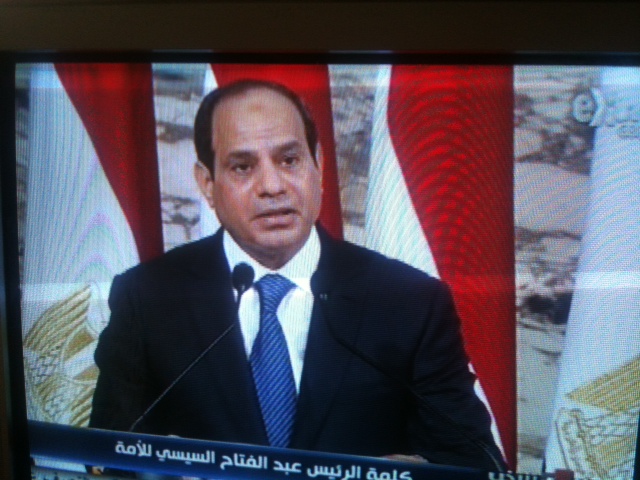
At a speech before the United Nations Climate Summit on Tuesday, Egyptian President Abdel Fattah al-Sisi emphasized the dangers climate change poses for the Arab world, and also the need for international investment in renewable energy projects in Egypt and the rest of the region.
"The Arab region is one of the most vulnerable regions worldwide to climate change due to its geographic location in a dry and arid region," Sisi said, speaking on behalf of the group of Arab nations. He highlighted problems the Arab world is facing, particularly desertification, and invited the international community to participate in initiatives like planting trees in desert regions using treated wastewater.
Sisi also alluded to the energy shortages faced by Egypt and other energy-importing Arab states. “Our countries are suffering from a worsening power crisis at a time when we are aiming to achieve high growth rates,” he said.
Experts have repeatedly called for a comprehensive energy strategy to help Egypt manage its rapidly growing power consumption. At last week’s Euromoney conference, Siemens Egypt CEO Mohamed al-Mahdi noted that Egypt’s demand for energy has grown at a rate of around 7 percent per year since the 2011 revolution, despite economic growth slowing to just 1 or 2 percent per year. “We really have to tackle the energy demand, and curtail the energy demand,” Mahdi said.
However, Sisi simply emphasized the need for more renewable energy projects, to be supported by investments from “developed countries, financial institutions, and the private sector.”
Sisi, whose government has announced a goal of generating 8 gigawatts of power from renewable energy but has also paved the way for coal power in Egypt, also steered clear of discussing specific ways in which Arab countries could work to reduce their carbon emissions.
Instead, he emphasized that any new climate agreements should not replace the Convention on Climate Change, which was originally negotiated at a 1992 summit in Rio de Janeiro and which Egypt ratified in 1994.
The convention emphasizes that developed countries, which bear the most responsibility for historic carbon emissions, should take the lead in fighting climate change. Less developed countries are entitled to prioritize their own economic and social development, with financial and technical support from their wealthier counterparts to reduce emissions while doing so.
A 2009 climate convention in Copenhagen called for the establishment of a Green Climate Fund to serve as a mechanism for transferring funds from the developed to the developing world. The fund was intended to be the centerpiece of a climate financing effort aiming to reach US$100 billion per year, but has so far stalled.
Sisi ended his speech by calling for the fund to be activated.

أخبار ذات صلة
Climate goals flounder in headwind from militarization, competition, AI
COP30 kicked off in Belem, Brazil earlier this week. Delegates from 200 countries are attending. The Climate Action Tracker report released on November 13 shows that the planet is on…
COP29 launches in Azerbaijan aiming to renew climate financing goal unmet for majority of past decade
Monday marked the start of the 29th Conference of the Parties (COP29) in Baku, Azerbaijan, where representatives from around the world are…
Unsweetened days: How the sugar crisis was stirred by government policy missteps
Another sugar crisis spells out longer queues and shortages as government rushes to address problem.
What can we expect from this year’s COP28?
Interview on COP28 with lead Egyptian climate financing negotiator Mohamed Nasr.
Your support is the only way to ensure independent, progressive journalism survives.
You have a right to access accurate information, be stimulated by innovative and nuanced reporting, and be moved by compelling storytelling. Subscribe now to become part of the growing community of members who help us maintain our editorial independence.
Join us