
RSF kills dozens in Zamzam, Abu Shouk camps, fears rise over prospect of yet another genocide
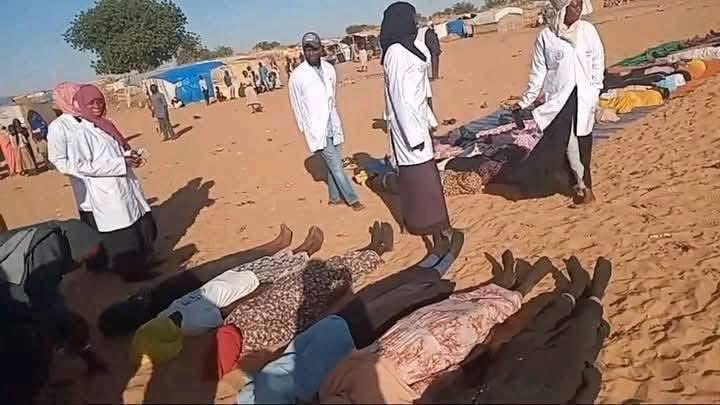
The Rapid Support Forces (RSF) followed through on threats made by Deputy Commander Abdel Rahim Dagalo, launching an assault on Fasher, North Darfur’s capital, and killing dozens in Zamzam displacement camp, south of the city, over the course of Friday and Saturday.
Casualty figures remain uncertain, but the actual toll is likely higher than the 100 killed in Friday’s assault that medical sources have tallied so far.
Abu Shouk camp, north of Fasher, also came under RSF artillery fire on Saturday morning. Over 40 people were killed and hundreds others injured in the attack, according to the camp’s emergency room.
The RSF’s raid on Zamzam camp — home to over 100,000 people displaced to North Darfur, according to the Darfur Regional Government — remains ongoing. The offensive follows repeated threats from Dagalo to seize the regional capital and his call last week for residents to evacuate the city for their safety.
North Darfur Health Ministry General Director Ibrahim Khater told Mada Masr that over 100 people were killed when RSF forces attacked the camp on Friday. According to the Sudanese Armed Forces, the RSF used suicide drones and 120mm artillery in the assault.
A field source added that Friday’s ground offensive involved around 30 combat vehicles equipped with DShK machine guns and double-barreled guns, as well as hundreds of fighters advancing on motorcycles. Communication outages have made it difficult to verify the actual casualty count or assess the extent of damage to civilian property, according to the field source and Khater, who added that the death toll is likely higher.
During the invasion, RSF fighters carried out executions, killing medical staff and aid workers from Relief International operating inside the camp, according to both Khater and Mohi Eddin al-Sahaf, a journalist based in Fasher who spoke to Mada Masr.
Sahaf said that nine members of the humanitarian organization, including a doctor, were executed while volunteering, along with ten Quran students at the Sheikh Farah religious teaching center. Dozens more were either killed or injured, he added.
The Fasher Coordination of Resistance Committees also accused the RSF of executing all medical personnel working in the clinics and hospitals of Zamzam camp, as well as dozens of Quran students, during its assault.
On Saturday morning, the RSF renewed its offensive on Zamzam, causing further civilian casualties and displacing hundreds amid dire humanitarian conditions, according to three local and field sources who spoke to Mada Masr.
Another field source said the RSF resumed its assault using heavy weapons and advancing on two fronts — from the south and west. According to the same source, the military, alongside its allied joint force and popular resistance forces, engaged the RSF in an attempt to halt their advance and protect the camp.
Over the past year, Zamzam camp — one of the largest in the Darfur region — has been the target of more than 150 documented ground assaults, according to Mada Masr, in addition to heavy artillery shelling on several neighborhoods in Fasher.
Friday’s assault marked one of the deadliest since the beginning of the year. The first field source said waves of attacks continued throughout the day and resumed Saturday morning. Clashes lasted over four hours on Saturday, with civilians fleeing the camp on foot.
Sahaf said that the RSF is attempting to impose a siege on Zamzam camp to sever it from Fasher, paving the way for an offensive on the city — unless military airstrikes manage to disrupt the RSF forces.
While clashes inside the camp subsided briefly on Saturday, Fasher’s resistance committees said the RSF continued to bombard the area with long-range rocket launchers, which they described as “raining down” on the camp.
Meanwhile, pro-RSF social media pages circulated videos showing RSF fighters storming the camp, including scenes of executions and bodies in civilian clothing strewn across the streets.
Mohamed Adam Kish, North Darfur commander of the Sudan Liberation Movement (SLM) led by Minni Arko Minnawi, told Mada Masr that Zamzam is suffering dire humanitarian conditions due to the RSF-imposed siege, compounded by heavy shelling and large-scale attacks on unarmed civilians.
Kish accused the RSF and its allies of carrying out ethnically and racially motivated killings during Friday’s assault. He said casualty figures remain unavailable due to the ongoing fighting and the military’s focus on defense.
He also accused the Gathering of Sudan Liberation Forces and the SLM’s Transitional Council — led by Abu Bakr Hagar and Al-Hadi Idriss, respectively — of participating in Friday’s ground assault on Zamzam camp.
Both factions joined a political and military alliance with the RSF in February, signing a political charter in Nairobi to form a parallel government and establish joint forces known as the Tasees Forces.
Kish held Hagar and Idriss’s forces responsible for crimes committed against civilians, saying they had long played a role in planning the siege and assaults on Zamzam camp and Fasher.
He called on the SLM, led by Abdel Wahid al-Nur, to expel Hagar’s group from their territory, saying they had fled to Tawila locality with injured fighters after retreating from Zamzam. He also urged the movement to take a clear position on the crimes committed against civilians and displaced people.
Kish rejected claims made by RSF-aligned groups that the military and the joint force were preventing civilians from leaving the camp. He described the accusations as fabrications meant to suggest that residents want to flee, stressing instead that camp residents have pledged not to abandon their land, convinced that forced displacement is part of a wider plan to alter the region’s demographics and hand over their lands to “cross-border militias.”
Zamzam camp, located south of Fasher, is one of Sudan’s largest displacement camps. It was established in early 2004 following the outbreak of armed conflict between the central government and rebel movements in Darfur. Before the current war, the camp was home to over 200,000 displaced people.
The camp has been repeatedly targeted by RSF forces throughout the war. On February 11, the RSF launched one of its most violent attacks on the camp, carrying out widespread violations, setting fire to the main market, and looting property and vehicles belonging to displaced residents before eventually being pushed back by the military, the joint force and popular resistance groups.
Fears of genocide and ethnic cleansing have intensified amid the RSF’s push to seize the camp, particularly given its leaders’ repeated threats and claims that the camp’s population is affiliated with the military-allied joint force.
Over the past two years of war, the RSF has committed violent attacks across Sudan, leveraging tribal and ethnic tensions.
In March, Sudan filed a lawsuit against the United Arab Emirates at the International Court of Justice (ICJ), accusing it of violating the Genocide Convention by supporting RSF-led attacks in West Darfur between June and July 2023, which killed an estimated 10,000 to 15,000 members of the Masalit tribe.
Sudan has constantly accused the UAE of arming, financing, and directing RSF leaders.
At the ICJ’s first public hearing in The Hague on Thursday, Sudan called for urgent provisional measures to prevent genocide.
UAE representatives denied involvement in Sudan’s conflict or support for any factions, but Sudan presented multiple pieces of evidence, including a UN expert panel report from January 2024 confirming the RSF received weapons via Chad.
Sudan also cited the US sanctions imposed on RSF commander Mohamed Hamdan “Hemedti” Dagalo in January, which included a determination that the RSF committed acts of genocide in Sudan.
Tens of thousands of people displaced by RSF attacks in Geneina and Ardamata, West Darfur, now live in camps in North Darfur.
Over 500,000 members of the Masalit tribe have sought refuge in neighboring Chad, following mass killings, including the murder and mutilation of former West Darfur Governor Khamees Abakar in June 2023.
West Darfur — which borders Chad and is historically known as Dar Masalit, home to the Masalit people — has seen tensions between Arab and African communities, stemming from successive Sudanese regimes undermining African communities, arming Arab groups and manipulating tribal governance.
The division of Darfur into separate states under ousted president Omar al-Bashir exacerbated disputes over land and resources.
The 2023 conflict in Darfur allowed Arab groups — from within Sudan and outside — to seize the region’s most fertile lands. Backed by the central government, they displaced the native populations, pushing them into camps and urban margins.
Before the current war, around two million displaced members of African tribes were already living in camps.
أخبار ذات صلة

Sudan Nashra: Sudanese bid to rejoin global financial system unlikely to succeed amid wartime realities, sources say | Burhan seeks political backing for state control of aid in brief Jeddah visit | Idris’s intra-Sudanese dialogue proposal lacks seriousness, party sources say | Sudan Shield Forces arrive in Blue Nile | Military launches ground attacks in North Kordofan
Subscribe to our Lens on Sudan newsletter here. A Sudanese delegation pressed for Khartoum’s re-entry into the international financial system on the…
Sudan Nashra: Dengue outbreak in Khartoum, medical sources say capital still unprepared | Measles outbreak causes daily deaths in North Darfur displacement hubs | Mahamid RSF commander, forces defect to the military | RSF-SPLM-N shelling kills 6 in Dalang, military foils new offensive
On the third anniversary of the war, Khartoum — recaptured by the military last year and held up as a symbol of…
Sudan Nashra: Nyala healthcare workers on strike | Burhan abolishes deputy, assistant commander-in-chief positions | Sudanese military intelligence head in high-level talks with Tripoli’s chief of staff | Military operation to retake Blue Nile’s Kurmuk underway
Subscribe to our Lens on Sudan newsletter here. A series of announcements this week has fleshed out the April 2 decision by…
Sudan Nashra: Military retakes North Kordofan’s Bara, RSF attacks villages to its west | White Nile’s Kosti, South Kordofan’s Dalang under RSF fire | Military signals push to integrate armed movements, but leaders worry over loss of leverage
Speaking at a military camp in Khartoum on Saturday, Sudanese Armed Forces Assistant Commander-in-Chief Yasser al-Atta signaled the start of a process…
Your support is the only way to ensure independent, progressive journalism survives.
You have a right to access accurate information, be stimulated by innovative and nuanced reporting, and be moved by compelling storytelling. Subscribe now to become part of the growing community of members who help us maintain our editorial independence.
Join us