
Matrouh to expropriate chalets at Agiba beach in coming weeks, owners not officially informed yet
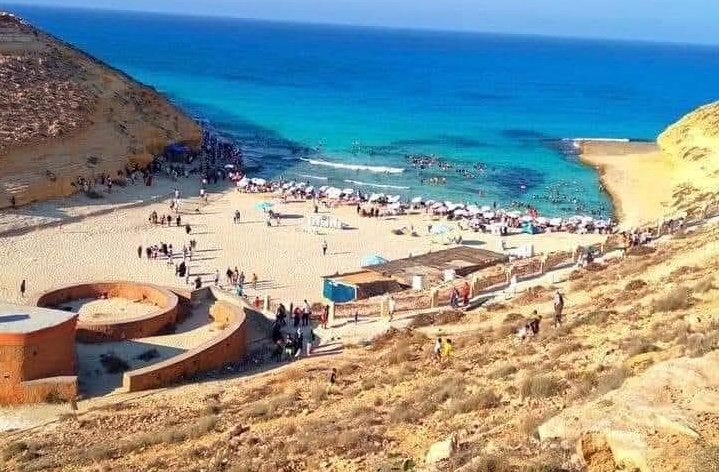
Matrouh Governorate authorities are set to implement a presidential directive to expropriate an area of chalets in Agiba beach and its southern extension, located along the Mediterranean, starting mid-January, according to an official letter circulating on social media sent from the General Organization for Physical Planning (GOPP), addressing Matrouh Governor Khaled Shoaib and Defense Ministry Secretary General Ayman Naeem.
The directive is to be implemented in a few weeks time but chalet owners in the area told Mada Masr that, as of the time of writing, no official has formally informed them of the expropriation plan, evacuation timelines or proposed compensation.
The leaked letter, detailing action points from a meeting which took place in December, instructed the Egyptian Armed Forces Engineering Authority to begin constructing fences around the chalet area, in coordination with the governorate and in parallel with property expropriation procedures, evacuations and demolitions.
It also directed the governorate to finalize and oversee the issuance of expropriation orders, while simultaneously surveying current occupants and assessing compensation costs.
Starting January 10 next year, the governorate is required to submit monthly progress reports to the GOPP. A meeting is scheduled at the Presidential Palace two days later, involving relevant representatives from the Defense Ministry, the Armed Forces Engineering Authority, the Housing Ministry and the governorate to review implementation progress, according to the letter.
Current owners said they have only heard scattered, unofficial information from governorate or district employees, causing anxiety among those who have invested heavily in acquiring and maintaining these properties over the years.
Faten al-Wakeel, one of the affected chalet owners, told Mada Masr that in 1982, she and others purchased 93-square-meter chalets from the governorate for LE28,000. Four years later, when it was time to finalize and register their contracts, the registrar office refused to issue ownership documents, saying the land was not designated for construction according to Law 52/1940, which stipulates the subdivision of land for building purposes.
The governorate later budged and agreed to transfer ownership of the buildings, but for an annual land usufruct fee of LE120, Wakeel said.
But in 2020, Matrouh “raised the usufruct fee from LE120 to LE183,000 annually, in one go,” Mostafa Mahmoud, another chalet owner and lawyer representing several affected parties, told Mada Masr. Owners appealed to the State Council at the time, he said, but the council ruled in favor of the state’s right to increase revenue.
Mahmoud argued that this decision contradicted Article 147 of the civil code, which states that contracts are binding to both parties and can only be altered with mutual agreement or for reasons specified by law. The owners then turned to the Supreme Administrative Court, which ultimately overturned the governorate’s decision.
Mahmoud said that chalet owners, who never received land ownership contracts due to the governorate's refusal to sign them — despite having fully paid their dues — were later forced to reconcile with the state over alleged building violations under the 2023 reconciliation law. He said they paid around LE2,000 per square meter as a “good faith payment,” which is a fee to demonstrate “seriousness” in settling building violations.
Another affected owner, who spoke to Mada Masr on condition of anonymity, said that since the second Egyptian International Economic Conference which took place in Matrouh in 2016, the owners have “been hearing about agreements to sell the land to Emirati investors. People have even come to check out the area under security escort.”
أخبار ذات صلة
In Fustat, cultural center Darb 1718, pottery factories face demolition
“Old Cairo is one of the seven oldest cities in the world doing pottery art"
At least 3 homes demolished in Ezbet Abu Ragab, with over 200 households facing evictions by April
The rate of compensation isn’t nearly enough for most of the residents to afford alternative homes
Residents of Qalyubiya agricultural area face eviction to make way for state housing project
It remains unclear how they will be compensated for the loss of their properties
Residents of Arish’s coast face evictions, demolitions amid plans to develop, expand port
Residents remain in the dark about how they will be compensated for the demolition of their homes
Your support is the only way to ensure independent, progressive journalism survives.
You have a right to access accurate information, be stimulated by innovative and nuanced reporting, and be moved by compelling storytelling. Subscribe now to become part of the growing community of members who help us maintain our editorial independence.
Join us