
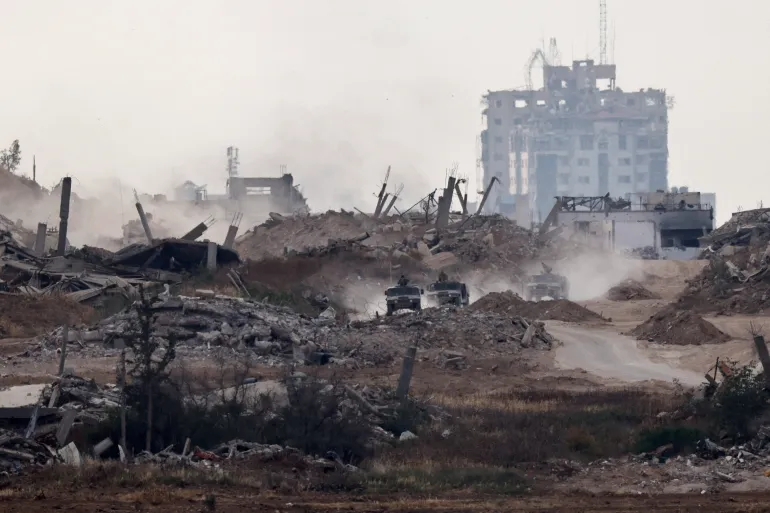
Bombarding families in their homes, on the streets and in community shelters and centers, Israel scaled up its military escalation in northern Gaza late on Thursday and into the early hours of Friday, killing dozens of people in a matter of hours as its troops advanced into Beit Lahia while negotiations proceeded miles away in Doha.
Among those who managed to flee the deadly campaign was Mahmoud al-Hassany, who told Mada Masr that he and his family fled their home in the Salatin area of Beit Lahia amid heavy shelling to head south toward Gaza City after Israeli artillery vehicles advanced on their neighborhood.
Hassany, along with his family of eight, fled under the cover of night on Thursday, he recounted, passing the bodies of many people killed in Israeli drone strikes.
"We were gripped by terror as we moved,” he said. “We didn’t dare make a sound as we ran from death. The shelling was all around us.”
Gaza’s Civil Defense Agency spokesperson Mahmoud Basal confirmed to Mada Masr that there are several reports of Israeli drones firing at anyone seen moving in several areas of the north.
Other eyewitnesses shared images on social media of Israeli tanks they said were seen advancing on Beit Lahia late on Thursday.
Israel’s forces have heightened their aggression on the strip over the last 24 hours, invading Beit Lahia, amid reports that negotiations on a ceasefire with Hamas have reached a impasse. Israel is belligerent, threatening to continue escalating if Hamas doesn’t agree to the immediate release of a group of the Israeli nationals in the group’s custody under a plan devised in March by the United States’s envoy to the region, Steve Witkoff. Hamas, meanwhile, is insisting on a guarantee that such an agreement would bring a definite end to the war that has seen Israel kill over 53,000 Palestinians over the course of 18 months.
The intensified attacks extended to Jabalia camp and Beit Hanoun, among other areas, sources in northern Gaza told Mada Masr on Friday.
Civilians and first responders struggled to retrieve bodies with their hands from beneath the rubble of the multi-storey buildings leveled in last night’s attacks, delivering dozens at a time to the remaining operational medical facilities in northern Gaza.
Bahaa Mattar, an eyewitness in the area, stated that the north has become “a disaster zone,” adding that he watched as an Israeli airstrike destroyed the home of the Zeinaty family.
According to Mattar, multiple missiles hit the house, completely leveling it and burying its civilian residents alive under the rubble.
“I could hear the victims screaming for help from beneath the rubble, but the heavy shelling prevented anyone from reaching and rescuing them,” Mattar stated. He added that quadcopter drones were flying overhead and firing at anything that moved, making rescue operations impossible.
Civil defense teams who reached the site the following morning said they were unable to find the family members’ bodies as the building, comprising at least two floors, had been leveled completely to the ground.
Scores of bodies are thought to be buried in this way after the night’s attacks. The Gaza Health Ministry said it had confirmed the death of 93 people whose bodies were delivered to hospitals since dawn on Friday.
But Basal told Mada Masr that civil defense teams struggled to conduct rescue operations due to the intense fire that made it impossible for the agency’s crews to keep up with the amount of work required. “The situation is growing more difficult by the minute," he said. He explained that the Occupation is committing more multi-fatality attacks, estimating the death toll from last night’s strikes on crowded homes could amount to hundreds.
Residents are also being blocked from evacuating targeted zones, which could cause the number of casualties to rise in the coming hours if the attacks continue, the civil defense spokesperson added.
Israeli forces have also deliberately targeted civil defense vehicles with gunfire to prevent them from reaching bombed areas and rescuing the injured, Basal said, adding that civil defense teams continue to receive pleas to help trapped or wounded civilians across northern Gaza, with teams on the ground unable to respond.
Israeli media cited security sources on Friday to report that the prisoner exchange and ceasefire negotiations are at a fork in the road, after they were kickstarted by US pressure and Hamas’s release of American-Israeli IDF soldier Edan Alexander last week.
Witkoff led another round of negotiations on Wednesday in Doha on the sidelines of President Donald Trump’s visit to the Gulf. The US Special Envoy to the Middle East initially proposed the release of half of the Israeli prisoners held in Gaza in exchange for a ceasefire that would last for a number of weeks. During that time, Israel would participate in talks on terms to end the war, albeit without making any upfront commitment to that outcome.
Fifty-eight Israeli prisoners are still believed to be held by Hamas, more than half of whom are thought to be dead.
For its part, Hamas continues to hold its stance on not releasing prisoners until it is provided with guarantees that a long-term ceasefire agreement will be reached, saying on Thursday that Israel’s attacks against Gaza on Thursday represent its "desperate attempt to negotiate under cover of fire." It called on people worldwide to protest in support of Palestinians under Israeli occupation on Friday.
Israel Prime Minister Benjamin Netanyahu stressed last week, however, that his government would continue negotiations “under fire” in order to achieve all of the war’s objectives. Israeli outlet Yedioth Ahronoth reported on Friday that a deadlock has emerged in Doha, with Israel resolute on expanding the war if no agreement is reached. The intensification of attacks in Gaza last night was part of operations to pave the way for ground and armored forces to advance if the heightened offensive begins, security sources told the outlet.
Israel is hours away from the “lost opportunity of the century,” said the Israeli Hostages and Missing Families Forum in a statement on Friday morning, criticizing the Israeli military’s recent escalation on the strip.
The statement called the intensified attacks “ a resounding Israeli failure,” adding that their government’s effort to stall the ongoing talks in Doha will be "remembered for a lifetime.”
Qatari Prime Minister Mohamed bin Abdel Rahman al-Thani also criticized the Israeli strategy to intensify the attacks on Gaza, telling CNN on Wednesday that Israel’s offensive is sending the signal that they “are not interested in negotiations.”
In the Awda Hospital in northern Gaza, the facility’s director, Mohamed Salha, said that over 200 wounded people were transferred to their care in recent hours, most of whom had suffered critical injuries. “Northern Gaza is living through extremely bloody days,” he said.
The hospital, he said, is packed with the dead and injured, and staff are unable to cope with the influx amid severe shortages of medicine and medical supplies.
No food, fuel or vital supplies have entered Gaza since March,, when Israel abandoned the prisoner-release framework established under the January ceasefire deal and imposed a total blockade on humanitarian aid, while also resuming its strikes on the enclave, with the express intent to pressure Hamas into releasing the prisoners it still holds.
أخبار ذات صلة

Hundreds of Gaza students demonstrate for right to study abroad
Hundreds of university students trapped in the besieged Gaza Strip gathered on Monday outside the Journalists Syndicate’s headquarters in western Gaza City…

In meeting with Board of Peace director-general, Hamas refuses UN disarmament plans until Israel commits to withdrawal
Hamas has refused to commit to the plans proposed by the United Nations for its disarmament, citing lack of advancement in Israel’s…

Israel agrees to limited reopening of Rafah border crossing — details pending
Israeli Prime Minister Benjamin Netanyahu’s office announced on Monday that it has agreed to a “limited reopening” of the Rafah border crossing…

Sisi touts ‘stabilization’ agenda at first Davos appearance in over 10 years
President Abdel Fattah al-Sisi advertised Egypt’s “stabilization” agenda in Davos on Wednesday, saying the country’s focus on steering away from regional conflicts…
Your support is the only way to ensure independent, progressive journalism survives.
You have a right to access accurate information, be stimulated by innovative and nuanced reporting, and be moved by compelling storytelling. Subscribe now to become part of the growing community of members who help us maintain our editorial independence.
Join us