
Sisi touts ‘stabilization’ agenda at first Davos appearance in over 10 years
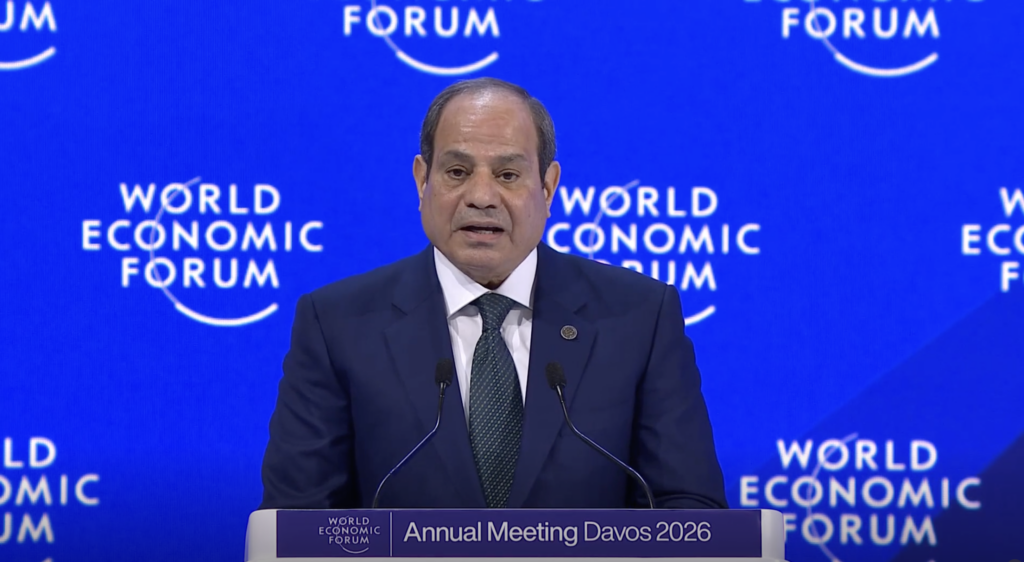
President Abdel Fattah al-Sisi advertised Egypt’s “stabilization” agenda in Davos on Wednesday, saying the country’s focus on steering away from regional conflicts distinguishes its role and economic potential.
Sisi arrived in Switzerland this morning for his first appearance at the annual World Economic Forum in over a decade.
In his opening speech, which was broadcast live on domestic television channels, Sisi presented Egypt to the forum as a force for both economic and political stability in the region, a theme he developed further in a conversation with WEF President and CEO Borge Brende.
This time, amid a critical geopolitical moment and increasing regional and global uncertainty, Brende jokingly said at the start of their conversation that his main takeaway from Sisi’s address was that “economy is going a lot better than geopolitics.”
Gaza was top of the agenda, with Sisi expected to meet with United States President Donald Trump on the sidelines as the latter seeks to build on the Board of Peace plan he launched earlier this week.
Despite thanking Trump multiple times for his role in bringing about the second phase of the ceasefire in Gaza, Sisi made no clear mention of the US-led Board of Peace.
Shortly after Sisi’s speech, however, the Foreign Ministry announced Egypt's acceptance of Trump’s invitation to join the board, expressed support for its mission as part of the ceasefire’s second phase and noted that it will move forward with fulfilling the “relevant legal and constitutional procedures.”
Out of 60 nations, Egypt, Israel, Morocco, the United Arab Emirates and Bahrain are among the few countries that have accepted the invitation to sit on the international board.
Meanwhile, Sweden, Norway and France have rejected Trump’s invitation, with French President Emmanuel Macron expressing concerns that project has ambitions exceeding Gaza’s transitional governance, undermining the United Nations framework.
The White House announced its selection of Egyptian General Intelligence chief Hassan Rashad to the board’s sub-agency.
Back in Davos, Sisi emphasized Egypt’s longstanding support for the Palestinian cause, describing the Sharm el-Sheikh Summit in October as its crowning achievement and stressing the importance of building on its gains in the coming period.
He also stressed ongoing efforts to coordinate with global partners toward a “fair, comprehensive permanent solution” grounded in a two-state framework — an outcome notably absent from the Trump’s administration’s discussions.
Sisi called for an accelerated launch of Gaza’s early recovery and reconstruction efforts, which Egypt has repeatedly offered to spearhead, calling for the need to uphold the ceasefire and guarantee unrestricted aid flows into the strip.
Commenting on the other conflicts across the region, Sisi described Egypt’s approach as distinguished by the principle of “non-intervention,” a characteristic he said allows it to support of push for stability in neighbouring countries.
“This policy supports all countries, including those in the region, in relying solely on their national institutions and agencies to manage their own state affairs,” Sisi said.
Brende prompted him to elaborate, describing Egypt as an “anchor between Europe, Africa and Asia,” and stumbling to find a politically anodyne turn of phrase to describe the conflicts that have shattered the region since 2023.
Sisi was as careful as his host, refraining from naming the countries in question so as not “to raise issues with the states.”
“Egypt always believed in non-intervention. When militias and armed groups [intervene], they make things bad.”
Implicit in his words were proxy interventions in the region that have fuelled the three-year conflict in neighboring Sudan, where Egypt has lobbied for international backing to curb UAE financing and logistical support for the Rapid Support Forces.
He also mentioned Somalia, a growing foreign policy concern for Egypt as the Horn of Africa emerges as a site for political jostling between regional actors, though he did not expand on Egypt’s position.
Egypt has commented on Somalia in recent weeks, voicing support for Somali President Hassan Sheikh Mohamud and for Somalia’s territorial integrity, after Israel officially recognized Somaliland, a breakaway region within the country.
Without getting into the weeds, Sisi stressed that Egypt aims to back “national institutions” and the importance of statehood, and to “resort to international institutions” to settle disputes.
Economic opportunities
Aside from regional political stability, the president vaunted Egypt as an economically emerging state rich in resources and human capital and “full of investment opportunities in various sectors,” from clean energy to artificial intelligence, car manufacturing, pharmaceuticals, logistics and technology.
He highlighted Egypt’s economic structural adjustment policies, which he said paved the way for more private sector participation.
The president introduced Egypt as an ideal investment destination ready to receive increased investments after years of reforms in many sectors, highlighting the State Ownership Policy Document, first introduced in 2022, to lay out a roadmap for the government’s withdrawing from key economic sectors in favor of the private sector actors.
Sisi also highlighted the private sector’s major role in the economy, reiterating statements he made at the 2015 WEF, where he said that private sector-led growth will guarantee “a decent life to the people of Egypt.”
He highlighted the infrastructure boom over the past decade, including massive road and bridge projects and the establishment of several economic zones across the country, including the Suez Canal Economic Zone.
The president also made sure to boast about the country’s “human capital,” namely its student population, saying Egypt is investing in education to prepare young generations for a labor market dominated by the latest technologies eyed by investors, from renewable energy to Artificial Intelligence.
Sisi returns to Davos after 10-year absence
The speech he gave to the assembled world and business leaders stood in contrast to his intervention at the 2015 WEF, where he centered the domestic priorities preoccupying his administration at the start of his term — initial economic reforms in the lead up to the devaluation of the pound, Egypt’s war on terrorism and reforming religious discourse.
Speaking to Mada Masr, Cairo University Political Science Professor Mostafa Kamel Al-Sayed attributed Egypt’s long absence from Davos to international pressures over its human rights record throughout the past decade. This scrutiny has eased following recent agreements with the European Union and under the Trump administration.
Egypt was scheduled to host the WEF in Sharm el-Sheikh in 2016, but cancelled the event after a militant attack downed a Russian-owned jet flying over the Sinai Peninsula. The president did not return to the forum in the following years.
Sayed noted that this period was marked by the government’s campaign of internal repression against political opponents in Egypt, an approach that saw it exposed to external pressure, especially with Democratic administrations in the White House for half the decade. The Barack Obama administration called Egypt’s human rights policy into question, conditioning a portion of US military aid to Egypt on rights improvements.
In that context, it made sense for government officials to avoid the high-profile international forum, which draws potential critics among world leaders, as well as journalists and academics — especially since attendance isn't required and Egypt can attract foreign investment without the WEF scrutiny, Sayed suggested.
But now, with the international order led by Trump and other world leaders less concerned about the optics of pressuring some nations on human rights, that fear of criticism may no longer be there, he argued.
أخبار ذات صلة
Egypt advances in Global Competitiveness Index, still in bottom quintile
Egypt advanced three places from last year to rank 116 out of 140 countries tracked in the World Economic Forum’s 2015-16 Global…
Egypt ranks 129th in World Economic Forum gender report
Egypt has ranked 129th out of 142 countries in the World Economic Forum’s Gender Gap Report, in a list topped by Iceland,…
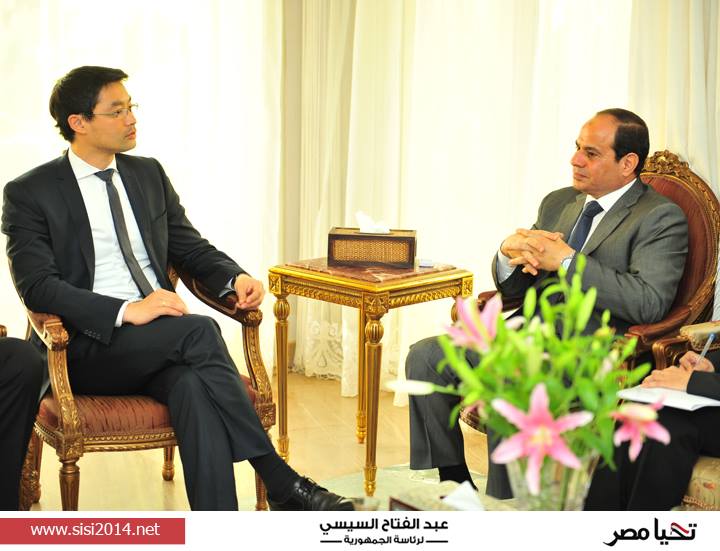
Sisi meets with World Economic Forum officials
Presidential frontrunner Field Marshal Abdel Fattah al-Sisi met with officials from the World Economic Forum (WEF) this week, although it was unclear…
Economy in a week: Sisi is a ‘De Gaulle’ figure says PM
Egyptian Cabinet members explain roadmap progress at the World Economic Forum while instigating measures to boost economic output; Arab neighbours take the lion's share in FDI in 2014, and local…
Your support is the only way to ensure independent, progressive journalism survives.
You have a right to access accurate information, be stimulated by innovative and nuanced reporting, and be moved by compelling storytelling. Subscribe now to become part of the growing community of members who help us maintain our editorial independence.
Join us