
Israel displaces thousands into streets of Gaza City, threatening to attack 6 sites ‘with force’
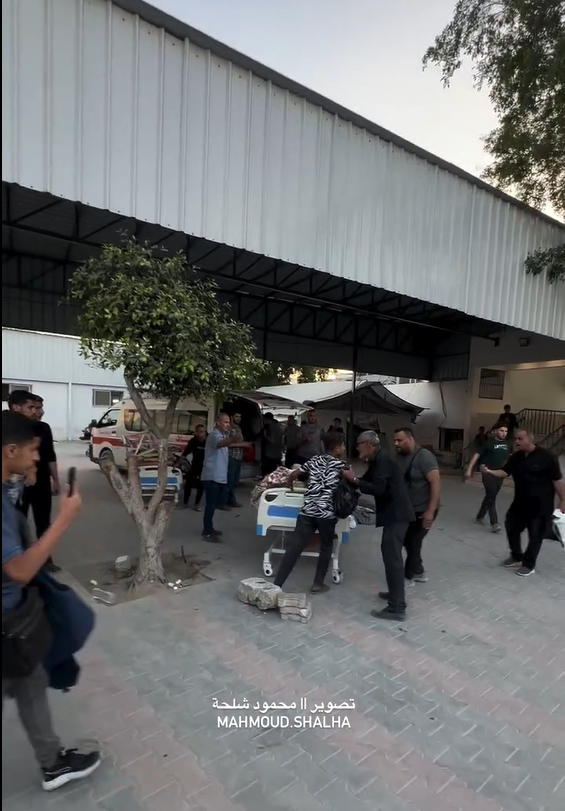
Israel has issued repeated expulsion orders since Wednesday night to people in several specific shelters located in areas of central and western Gaza City, some of the most densely crowded areas in the entire strip.
The evacuation orders sparked immediate terror and thousands fleeing eastward filled the streets of the strip’s most populated city. “We don’t know where to go,” Shady Jundiya told Mada Masr. “Every area is under the threat of evacuation. Today, we’re running from death to death.”
Israel’s military has already bulldozed and bombarded many areas in northern Gaza, flattening most of the neighborhoods that lie in the east of Gaza City since it invaded the coastal enclave’s northern governorate in October of last year. Troops withdrew for a few weeks during the ceasefire, but when Israel resumed the campaign in March it pushed over 400,000 people out of their homes into the diminishing available areas of western Gaza, which have become packed with people taking shelter in tents and refuge centers.
The new orders issued on Wednesday were accompanied by a detailed map — the first of its kind since the start of the war — which identified six buildings in the Rimal neighborhood, Gaza City, all being used as public shelters, and cited reasons for their designation as targets.
Among the locations marked are the Shifa Medical Complex, the school complex in Shati camp, Karmel School in western Gaza City and the Islamic University and Mostafa Hafez School in the city center. The map marks these buildings and the surrounding areas as strike zones.
In maps issued previously with displacement directives over the past 20 months, Israel has generally demarcated broader blocks or zones and specified the destinations where displaced residents should relocate. The current map by contrast identifies specific buildings and does not say where the evacuees should go.
The targeted areas have absorbed hundreds of thousands of displaced Palestinians over recent weeks. People fleeing eastern Gaza City and the northern parts of the strip had taken refuge in the west and center of the city — areas now hosting hundreds of thousands of people as well as its permanent residents.
Palestinians in the areas ordered to evacuate on Wednesday spoke to Mada Masr, with many expressing a sense that after repeated waves of displacement there is nowhere left to turn.
Jundiya was among them, describing how he was forcibly displaced from his home in the eastern neighborhood of Shujaiya weeks ago. He set up a tent with his family near the Shifa hospital. But now, they are being forced to flee once again with no sense of where they can run to. “East and west” makes no difference, Jundiya said.
This is the seventh time his family of six has been displaced since the war began. “We left Shujaiya to escape the bombing, and now it’s following us here,” he continued. “We’re exhausted from displacement.”
He said many of the hundreds of thousands of people living in the central and western areas of Gaza City, where the sites that Israel threatened on Wednesday are located, refuse to be displaced again and could end up staying where they are. If Israel follows through with its threats to strike these areas, he warned, the result would be large-scale, horrifying massacres.
Some of those fleeing on Wednesday evening had to do so while sick or injured, including patients from the Shifa hospital, which was among the targeted sites. The hospital’s director, Mohamed Abu Salmiya, told Mada Masr that many patients, including injured and sick people, have now evacuated the hospital with their companions. Critical cases, he said, were transferred to the smaller Helou International Hospital.
While none of the hospital’s staff were directly contacted to inform them to leave, the map the Israeli military released clearly indicates its intent to strike Shifa hospital, Abu Salmiya said, condemning the move as yet another blatant crime by the Occupation.
The medical staff refuse to leave and will continue working despite any threat, he stressed, categorically denying Israeli claims that the resistance operates from within the hospital.
Abu Salmiya noted that much of the hospital had already been destroyed in earlier strikes, including medical equipment and several entire wards. In recent days, a few departments had been partially restored to treat the wounded and sick.
With no direction from the Israeli military regarding safe sites to relocate to, many spent the night on the streets, including Salwa al-Nemnem and her children, who had been sheltering in Karmel School. Karmel was home to thousands of displaced people, with Nemnem telling Mada Masr she was staying there in a small tent with her children. When she saw that the school was highlighted on the newly released map, she feared for her children’s safety and decided to leave. She left the school in tears, she said, with no clear sense of where she was taking them.
In the hours following the expulsion orders, Israeli aircraft struck various areas in western and central Gaza City, leaving many dead or injured, including at a site near Shifa hospital.
Israeli drones and aircraft continued to hover at low altitude above the city on Thursday morning, as is usual in the period before attacks are launched, leading residents to anticipate Israel’s operations in the area could unfold over several days.
The Israeli military claimed its new evacuation orders are based on militant activity it alleges to be taking place in the designated buildings and areas. Along with instructing residents to leave the sites, it said they could also “expel” individuals it described as “terrorist militants” from the area.
أخبار ذات صلة
Prices surge in Gaza redoubling food insecurity after Israel shuts borders citing attack on Iran
For the first week of Ramadan, Reem al-Masdar was cooking vegetables, salad and bread to prepare iftar and sohour meals for her…
Gaza, the Board of Peace and the active cancellation of the past
The future By the time we get to the speech of Cypriot-Israeli real estate businessman and billionaire Yakir Gabay at the Board…
Only 12 Palestinians permitted to return to Gaza Strip since Rafah crossing opened
Sabah al-Raqab is one of only 12 Palestinians who have been able to return to the Gaza Strip via the Rafah crossing…

Israel agrees to limited reopening of Rafah border crossing — details pending
Israeli Prime Minister Benjamin Netanyahu’s office announced on Monday that it has agreed to a “limited reopening” of the Rafah border crossing…
Your support is the only way to ensure independent, progressive journalism survives.
You have a right to access accurate information, be stimulated by innovative and nuanced reporting, and be moved by compelling storytelling. Subscribe now to become part of the growing community of members who help us maintain our editorial independence.
Join us