
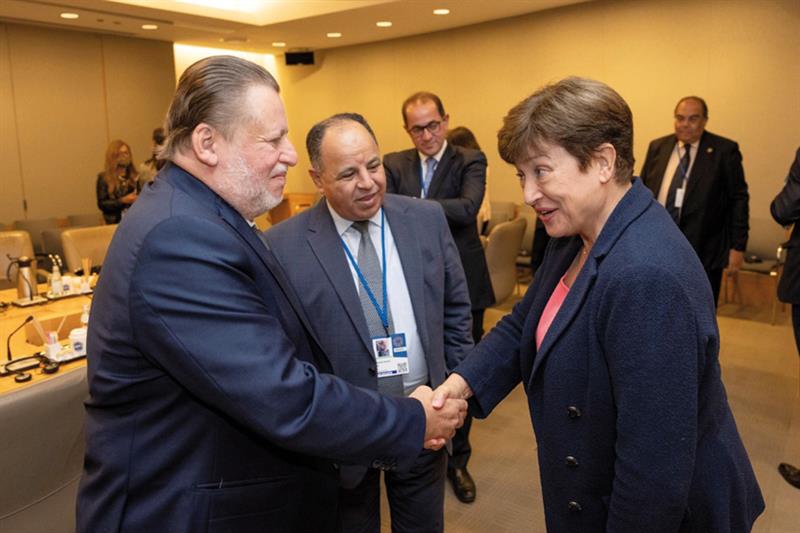
Egypt and the International Monetary Fund have reached a formula that paves the way for the value of the 2022 US$3 billion loan to be increased once the government implements a devaluation of the national currency, several sources familiar with the negotiations told Madar Masr.
An increase to the loan had been telegraphed by the financial lender in November, but the details surrounding the loan were unclear, especially as Egypt had failed to implement many of the conditions mandated under the terms of the 2022 agreement and the fund had suspended scheduled reviews necessary for the disbursement of the second and third tranches in 2023.
But now, the two parties have reached an agreement on the technical aspects of a new agreement, according to a source from the Finance Ministry with knowledge of the developments.
A parliamentary source from the state-aligned Nation's Future Party, who is familiar with the negotiations, confirms the agreement but adds it is not clear when it would be announced.
Both sources, who gave differing accounts of the value of the expected increase, say that a final figure will depend on the economic reforms Egypt undertakes.
A final agreement on the loan is now in the hands of the government and the IMF’s "senior management," the Finance Ministry source says.
The main economic reform in question remains the timing and extent of the devaluation.
Egypt has been mired in an economic crisis that has left it facing mounting debt servicing obligations and a steep import bill but unable to secure the necessary foreign inflows to meet these needs. This impasse has placed substantial downward pressure on the value of the currency, which has plummeted in value on the parallel market. At the start of the week, the pound fell to LE70 to the dollar on the black market, while it has been held at about LE 31 per dollar over the last year, despite the government pleading to adopt a “flexible exchange rate” in agreeing to the 2022 loan.
As a result of the foreign currency crunch, prices have soared and household purchasing power has cratered, leaving many households nationwide struggling to make ends meet.
The government has made little progress to ease the effects of the crisis, as its much ballyhooed plan to sell off state assets, which has been revamped several times, has attracted little interest from Gulf buyers, the program’s main target buyers, due to reported political differences between Cairo and Gulf capitals. Without dollar inflows, the government has held the value of the currency steady in fear of a vicious devaluation spiral.
Now, however, the government seems poised to devalue the currency to unlock needed dollars and give the lending agency a public sign that it has brought about “reform,” even without securing the much needed inflows.
A source at the IMF says that the final value of the total loan could come in between $6 and $7 billion, but all of that depends on how the central bank moves ahead in devaluing the currency.
Government sources give different accounts of the measures the central bank will take, highlighting the remaining fluidity of the negotiations.
According to a source at the Planning Ministry, the central bank could allow the pound to fall to between LE40-45 per dollar on the official market. The parliamentary source, however, has the central bank willing to allow a 30-35 percent devaluation for the official rate, which would move the exchange rate from LE31 per dollar to LE40 per dollar. When asked about the devaluation, the Finance Ministry source said that Egypt will move to implement the requirements of the IMF to complete the agreement within days.
Speaking at a press conference in Cairo on Wednesday, IMF Middle East and Central Asia Department Director Jihad Azour took a similar line, saying that a loan increase is currently being discussed, but that it is "tied" to the economic reforms that Egyptian authorities must undertake. A fundamental part of the loan program, he continued, is to protect the Egyptian economy from external shocks, adding that exchange rate flexibility is one of the most important tools to ensure the highest level of protection for the economy.
Azour noted during Wednesday’s presser that the loan’s increase in value will also be tied to what measures are taken to bridge Egypt’s financing gap.
These could include new inflows from the Gulf.
"Egypt has clarified that it needs an increase in its foreign currency reserves by approximately $5 billion in the short term, to reach a reserve of $40 billion, given that this increase will be provided by an IMF installment and loans from regional partners in the Gulf,” says the parliamentary source.
An increase in inflows would be an important step toward devaluation. The central bank could then inject foreign currency into the banking system, preventing a free fall.
However, the new value of the loan will still be far from providing a solution to Egypt’s foreign currency scarcity, says a financial analyst at a domestic investment bank. Egypt's need for foreign currency far exceeds the loan’s value, the banker notes
Part of this need is a large debt service burden. Egypt is required to repay approximately $6.11 billion to the IMF during the current year. The government will continue to repay loan installments, interest, and administrative fees the four IMF loans it has agreed to over the last decade until 2037.
According to the latest central bank reports on Egypt's external economic position, Egypt is set to pay over $42 billion in debt installments and interest during this year alone, in addition needing to secure cash to meet its import needs.
Egypt’s foreign currency inflows have taken a blow in the shadow of Israel’s ongoing aggression on Gaza.
Egypt is particularly vulnerable to regional tensions as the Suez Canal contributes about 1.2 percent of the GDP to budget revenues, according to a Wednesday IMF report of which Mada Masr obtained a copy. "If the conflict intensifies, the risks of trade routes’ disruptions may increase. Shipping costs could rise further if tensions persist and shipping companies divert a larger portion of their trade to longer alternative routes, which would raise fuel and operational costs," the report stated.
Suez Canal revenues are down 40 percent in 2024 compared to the same period last year, while shipping traffic has decreased by about 30 percent due to attacks by Yemen’s Houthis on commercial vessels passing through the Bab al-Mandab strait en route to the Suez Canal.
Tourism revenues, which stood at $13.2 billion in 2023, are also down five percent over the first weeks of 2024 in comparison to the same period last year, said the IMF report. "So far, the tourism sector in Egypt has not been significantly affected compared to some other economies like in Jordan and Lebanon. However, Tourism Ministry data shows signs of potential deterioration," the report indicated.
Other sources of foreign currency are also on the downturn. Remittances were down 29.9 percent for the first three months of the current fiscal year compared to the same period in FY 2022/23.
Exports — hampered by the absence of important imported inputs due to the foreign currency shortage — also declined by about 10 percent annually to $39.6 billion in the past fiscal year, compared to $43.9 billion in the year prior, according to external sector data issued by the central bank.
The Importers Division at the Federation of Egyptian Chambers of Commerce estimated that the value of goods and merchandise held at ports during the current period amounts to $7 billion.
Even with a higher IMF loan value on horizon, the outlook isn’t exactly rosy, with the IMF predicting fewer foreign currency inflows and analysts anticipating this could send the value of the pound down still further in future.
"Increasing uncertainty is expected to impact investors’ sentiments and foreign direct investment net inflows,” the IMF report said. “With the continued negative impact of the foreign currency shortage on the private sector, these factors are expected to have a detrimental impact on the external sector and economic growth."
While the Egyptian pound sank to around LE70 to the dollar on parallel markets inside the country, the value of the Egyptian pound in futures contracts surged for the first time to LE63 to the dollar for the first time.
News of an imminent agreement between Egypt and the IMF would logically entail that the gap should close a bit, says a macroeconomic analyst at a securities trading company. People would assume that signing the agreement entails an imminent influx of foreign currency to the official market, the analyst adds.
"The news should prompt participants in this market to try to take advantage of the current high price by selling dollars in the parallel market more vigorously, which should mean it declines in price," the analyst says.
But the negative outlook on the parallel market is a bad sign, according to the analyst. “It means that there is a prevailing belief that anticipated dollar inflows are less than the country's short- and medium-term needs,” the analyst continues. “Lots of traders are holding on to foreign currency instead, anticipating that a foreign currency shortage will soon resurface and that the value of foreign currency will increase [against the pound] in the short to medium term in the parallel market.”
أخبار ذات صلة
Egypt passes 5th, 6th IMF loan reviews, with fund easing tone of govt criticism
In a Tuesday statement, the International Monetary Fund announced that Egypt passed the fifth and sixth reviews as part of its ongoing…
IMF in Cairo to discuss privatization, over-reliance on short-term borrowing
A delegation from the International Monetary Fund touched down in Cairo on Monday to begin its final review of the US$8 billion…
Former employees sue to block sale of Eastern Company workers’ shares to Fidelity
Two hundred former workers at Eastern Company have filed a lawsuit to halt the payout of proceeds from the sale of the…
Unnamed investor buys out workers’ stake in tobacco giant Eastern Company after monthslong conflict
Share-holding workers at partially state-owned tobacco firm Eastern Company were bought out on Thursday following months of conflict over the sale. The…
Your support is the only way to ensure independent, progressive journalism survives.
You have a right to access accurate information, be stimulated by innovative and nuanced reporting, and be moved by compelling storytelling. Subscribe now to become part of the growing community of members who help us maintain our editorial independence.
Join us