
Income slashed for thousands of teachers after changes to high school curriculum
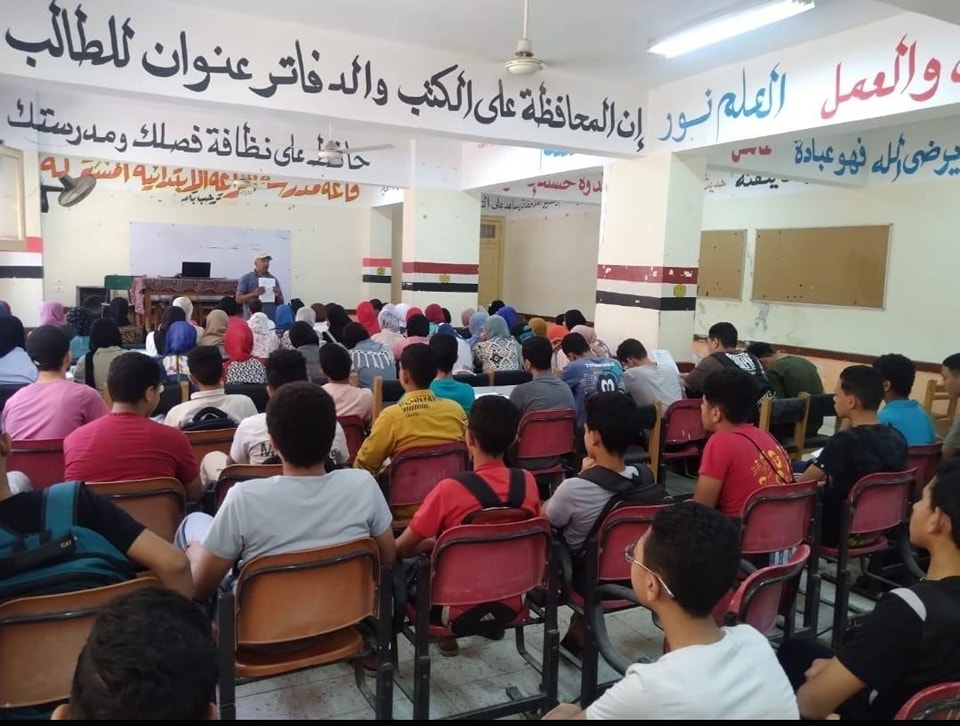
When the education minister announced that several subjects would become non-essential to school curriculums last month, Ali Abdou al-Sheikh, a teacher of psychology and philosophy at a private school in Faisal, soon realized that his income will be more than halved in the new school year.
Like many teachers, Sheikh anticipates that with his subjects no longer essential to the curriculum, fewer students will take private lessons from him, cutting into the main portion of his income.
“I work for a private school that we can say offers no salaries. With my 14 years of experience, my salary is LE2,300 from the school and nearly LE10,000 from private lessons — it is an enormous difference,” Sheikh told Mada Masr.
Conditions for school teachers are already hard, with low wages failing to keep pace with inflation.
New Education Minister Mohamed Abdel Latif introduced a set of reforms in August that included curriculum changes for high school students. Subjects including a second foreign language, psychology, philosophy and geology will no longer count toward the total final score for students taking thanaweya amma exams, part of what the minister described as an initiative to alleviate the burden on students and parents.
Students will still take the subjects, but will only get a pass/fail grade that will not contribute to their total aggregate exam score.
Teachers in public and private schools who spoke to Mada Masr explained that the curriculum changes will mainly impact uptake in the private classes they give outside of school hours.
To compensate for issues in Egypt's chronically underfunded education system, many children in different learning stages resort to private lessons, especially in subjects that count toward their final exams. A 2014 research paper estimated that around 70 percent of students were enrolled in tutoring at the thanaweya amma level.
The removal of the designated subjects from high school students’ final score will likely cause them to pay less attention to these subjects and stop taking private lessons. “If the ministry marginalizes a subject, the student will marginalize it too,” said Abdel Rahman al-Nahrawy, a French teacher for all school grades at a public school in Basyun.
Some parents appear glad of the changes, resenting the expensive parallel education system, which is vital to enroll in to supplement the low quality of school classes, and which some refer to as the “private lessons mafia” — accusing teachers of using the extra classes to make higher profits and make children dependant on these lessons in their learning process. When teachers began to protest the curriculum changes on social media, using the hashtag, #No_To_The_Marginalization_of_Second_Foreign_Languages , parents bit back to say they deserved to lose income from private lessons due to the removal of certain subjects from the total final grade.
Commenting on negative reactions directed at her due to a post she shared on social media, Israa Abdel Nasser, a French teacher at a private school in Suez, told Mada Masr that parents themselves enroll their children in these private lessons and that many teachers offer their classes for reasonable prices.
Sheikh, whose salary is LE2,300 at a private school — much lower than the officially sanctioned minimum wage for public and private sectors — explained that teachers have been in a vulnerable position for a long time. “What made me resort to private lessons? That my salary is very low,” he said.
Sheikh explained that teachers themselves would also prefer that the Education Ministry put an end to the private lessons system. “We only need wages that provide us with a decent life, like developed countries where teachers’ pay is high. If the ministry gives us suitable wages, we will no longer need to give private lessons,” he said.
The Finance Ministry allocated LE8.1 billion for additional salaries for school teachers in February, which was reflected in salary increases that varied between LE325 and LE475 a month.
However, a former Education Ministry official who spoke to Mada Masr on condition of anonymity said that despite the increase, rewards and incentives in public schools are still valued based on the basic salary rate set in 2014 under the civil service law. Deductions and taxes, on the other hand, are calculated in accordance with the 2024 law, the source said, leading to a large gap between incomes and expenses and making it hard for teachers to keep up with the rising cost of living.
Teaching in schools is also tough, with far too few staff compared to the number of children. In the state system, the Education Ministry announced last year that 470,000 more teachers are needed in public schools across the country.
Now, tens of thousands of teachers already in the system will face more financial precarity due to the curriculum changes this year, the former education official estimated. “There is a minimum of one teacher for each subject in each high school. We therefore have nearly 50,000 teachers across the country who will be affected by the decision,” the source said.
Mada Masr reached out to the Education Ministry spokesperson to confirm the number of teachers affected, but did not receive a response by the time of publication.
Israa Abdel Nasser, another teacher at a private school in Suez, said she’s also earning a much lower income due to the curriculum change. “Last year, I had 20 to 30 registrations per lesson from senior year students,” she told Mada Masr. “Only five registered this year — and when I start the lessons, they could dwindle down to three or four students within two weeks, maybe even one.”
Other schools, meanwhile, appear to be considering letting staff go. Alaa Badran, a French teacher at a private school in Cairo, described the situation to Mada Masr as one of the “disasters” caused by the reforms this year.
He explained that since these subjects will no longer be included in students' final grades, the minimum number of teachers for removed subjects will go down, prompting some schools to downsize their teaching staff.
Israa Abdel Nasser’s job in Suez was one of those jeopardized. She told Mada Masr that shortly after the minister’s decisions were issued, she was on the brink of getting fired.
“I received a phone call from the school’s administration telling me that I have to go sign my resignation letter within three days. I was confused and asked them whether I did something wrong because my contract is valid for the coming school year,” Nasser said.
If the school had actually let her go, Nasser explained, she could have filed a case and won it because of the arbitrary nature of her dismissal.
“What should I do after this decision? Should I stay at home all of a sudden like that?” she added.
Another teacher who spoke to Mada Masr on condition of anonymity said that he started being deliberately marginalized and excluded from key school meetings after the decision.
In its attempt to contain the situation, the Education Ministry notified all educational administrations of the option for teachers to “change their job title” by switching from teaching their subject to another subject specified by the ministry.
Teachers who spoke to Mada Masr explained that French teachers can switch to teaching English, while psychology and philosophy teachers can switch to social studies.
“This is their strategy: ‘You are affected? Teach another language,’” Sheikh said, explaining that the scheme is for teachers whose subjects were removed from students’ grades to teach another subject, therefore compensating for the chronic shortage of teachers in the education system that the ministry is attempting to address.
Some may take the option, but others, including Badran and Sheikh, are looking to supplement their incomes more urgently and have started looking for job opportunities in sectors unrelated to education, mentioning supply chain or accounting jobs.
The teacher who spoke anonymously is likewise taking supplementary work, describing acquaintances doing “jobs like working at pharmacies or as a taxi driver to fulfill their needs, while I started a small poultry farming project to secure some income.”
أخبار ذات صلة
Victims’ lawyer: Military Prosecution to take over school assault investigation under ‘presidential directive’
“On presidential directives,” the Military Prosecution has taken over the ongoing investigation into a series of sexual assaults perpetrated against children at…
New Education Ministry hiring competition sidelines thousands of part-time teachers
Alongside Amin are thousands of per-class teachers who are still studying to receive their teaching
Govt amendments to education law approved as critics warn changes could worsen inequality
Critics have repeatedly flagged the amendments as a gateway to worsening existing inequalities in th
State regulation drive shutters 300 Sudanese community schools, disrupting learning
Many worry the state’s unclear legalization requirements could lead to indefinite shutdowns.
Your support is the only way to ensure independent, progressive journalism survives.
You have a right to access accurate information, be stimulated by innovative and nuanced reporting, and be moved by compelling storytelling. Subscribe now to become part of the growing community of members who help us maintain our editorial independence.
Join us