
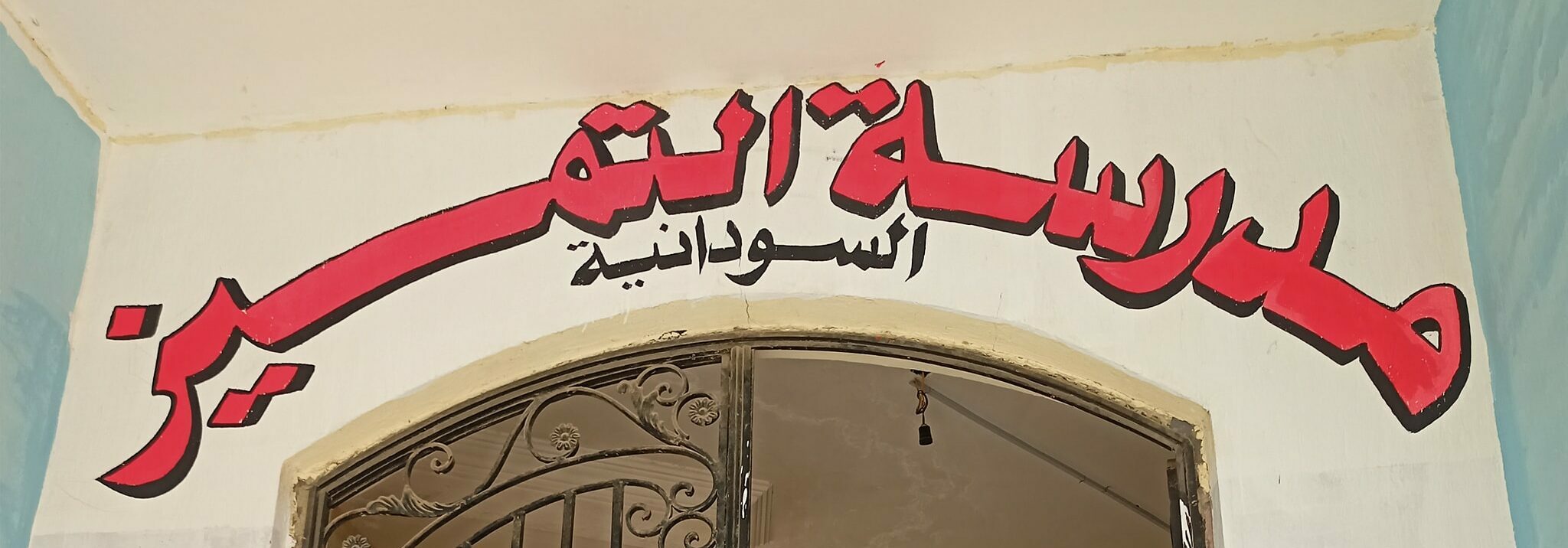
State regulation drive shutters 300 Sudanese community schools, disrupting learning
Over 300 Sudanese community schools that were operating in Egypt have been shuttered since June, following a campaign in which Egyptian authorities closed several of them and instructed others to remain closed. The schools have been told they have to legalize their situation and come fully under the oversight of Egyptian authorities before being allowed to operate again.
Many of these community schools operated for years in a legal gray area, establishing understandings with the Sudanese embassy in Cairo and different neighborhood authorities to teach Sudanese curricula to children from Sudan, and sometimes from other East African nationalities as well, residing in Egypt.
As the number of schools and attending students increased over recent months, especially since the war in Sudan prompted many to flee their homes, Sudanese educators and parents in Egypt who spoke to Mada Masr were very open to steps to regulate the operation of Sudanese schools, citing recurring problems arising in the community school system such as lack of oversight, interruptions to the continuity of education, and, for some of them, expensive fees.
However, they also pointed to a lack of clarity that leaves owners and directors of most community schools unsure what steps they are supposed to take to fulfill the legalization requirements announced by the Egyptian government. Teachers and parents fear this uncertainty may lead to indefinite shutdowns for many.
Sudanese community schools operate in Egypt to meet the needs of many in the Sudanese community who wish to resume their children’s education from where it stopped in Sudan, explains Sami al-Bagir, spokesperson for the Sudanese Teachers’ Committee, a Sudanese nationwide independent teachers union. Bagir says that while some families choose to integrate their children into the Egyptian school system, others are concerned that it will be difficult for their children to join Egyptian schools after missing out on several years and choose the Sudanese community schools instead.
A source working in refugee education in the humanitarian sector tells Mada Masr that some refugee students with other nationalities, such as those from South Sudan or Eritrea, also register at Sudanese community schools, as the Sudanese curriculum is similar to the one in their countries. The source adds that some also prefer Sudanese schools to avoid the possible difficulties they may face with Egyptian schools, which could vary from legal obstacles to registration depending on the student’s legal status to difficulties dealing with Egyptian teachers and students as African students amid rising discrimination in the country.
According to Bagir, legal requirements for Sudanese community schools have existed for a long time. They include acquiring initial approval from the Sudanese ministries of education and foreign affairs, approval from their Egyptian counterparts, as well as tax records, a commercial registration number, and a full count of the students and teachers registered at the school.
Until recently, however, the Egyptian government has allowed most schools to operate without meeting the legal requirements. Bagir says that most schools only sought initial approval from the Sudanese Education Ministry or did not even take that step. They operated instead — some for many years — through understandings with neighborhood authorities in the area where the school was located.
Funding for the community schools would come mainly from student fees. For students who hold official refugee status from the United Nations, organizations like Catholic Relief Services would register them at schools and pay fees to the school on the pupil’s behalf, the humanitarian source says. For the rest of the students, the schools rely on the students’ parents paying the fees, the source adds.
A teacher at a Sudanese community school located near downtown Cairo tells Mada Masr that a majority of its 300 students are refugees registered with the UNHCR and financially supported by CRS. The teacher explains that the school has operated this way for nine years without seeking profit thanks to coordination with the Sudanese embassy in Cairo and the neighborhood authorities, noting that they also had a good relationship with the Egyptian Education Ministry.
Schools like this one, which has initial approval from the Sudanese Education Ministry, are able to host students to take their major degree exams — primary and secondary finals — through the Sudanese embassy. They usually pay exam fees through the Sadaqa School in Giza, the only Sudanese community school whose situation in Egypt is legal, according to a June statement from the Sudanese embassy’s cultural attaché, of which Mada Masr acquired a copy.
The uncertain legal ground makes school operations disorganized at times, according to Bagir as well as teachers and parents who spoke to Mada Masr, many of whom noted that the situation has worsened since a jump in the number of community schools due to the war in Sudan. While there are no official statistics on the number of schools, teachers, or students currently enrolled in Sudanese community schools, the teacher says that the schools hosted around 3,000 students before the war, and Bagir estimates that over 7,000 students took primary school finals this year and a similar number were enrolled in middle school finals, meaning well over 14,000 children in the system.
Another teacher, who has worked in multiple community schools over the past seven years, points out that children’s education in the schools is often interrupted, making it difficult to ensure they’ll be qualified to sit the exams organized by the embassy. She indicates that part of this is down to informality. Some people merely rented an apartment or two, gathered enough students for one class, secured initial support for the refugee students from UNHCR and CRS, then turned to the remaining parents for fees, she explains. Fees may not be enough to keep the schools open, or teachers may decide suddenly to depart, or, out of dissatisfaction with the conditions at the new school, decide to leave and open a different school nearby.
She indicated that CRS has tried to lay down more criteria for the schools to which it will pay student funding and has withdrawn support from schools it feels are not meeting educational standards.
The only official form of oversight most schools have to deal with, she explains, is that of neighborhood authorities, which come to ask about the school’s legal status every once in a while, usually when they receive noise complaints against the schools erected in apartment buildings. She adds that the authorities usually get paid off to drop the complaint and then leave.
With the war pushing Sudanese nationals out of monied areas of Sudan with higher-achieving schools, fancier community schools have also opened in Egypt in larger and more purpose-suited buildings, the second teacher says. She notes that the informal nature of the schooling system also makes things challenging for students at these more aspirational institutions, which set fees at a costly rate on par with those for Egyptian international schools. Olwyya, a Sudanese parent who came with her family to Egypt in January to escape the war, says that she pays fees up to LE18,000 per year for her children’s Sudanese school, while some other schools require up to LE22,000.
Olwyya also described some schools offering what has been dubbed ‘the extended school year,’ in which the students study continuously without a summer break in order to jump more than one grade per year. The logic, according to the second teacher, is for students who arrived recently to make up for time they lost to the war. She notes, however, that this system also means more fees for parents and skews the curriculum plan laid out by the Sudanese Education Ministry.
Some of these issues broke the surface in June, when some outlets reported that the Giza governorate authorities and the Giza facilities police directorate had shut down three Sudanese community schools in 6th October City and two more in the Faisal area for operating without a license. The reports added that the school directors were being questioned for charges, including “converting residential units into educational activities visited daily by large numbers, without taking into account public safety conditions, and causing inconvenience to citizens.”
A Sudanese asylum seeker who previously spoke to Mada Masr recounted that his two sisters, who work as teachers at a Sudanese school, received a call from a police officer in late June telling them not to go to work. Later on the same day, the school director told them the school was shut down.
A source working in the governorate headquarters, who declined to be named as they were not authorized to speak on behalf of the governorate, says that before taking any legal measures to close the schools in Giza, the governorate notified the schools that they must shut down until the required documents are submitted for review. The source adds, “Sudanese schools issued a decision via social media websites granting Sudanese students indefinite leave from June 26 in order for the schools to quickly legalize their conditions and return to work.”
Soon after, all the Sudanese schools operating in Egypt, including Sadaqa, opted to shut down until the situation is resolved, both Bagir and the first teacher confirm.
Both note, however, that a number of schools were allowed to reopen from June 6 to 11 only to allow students to sit for middle school finals on time.
Giza governorate officials declined to respond to Mada Masr’s questions about the community school shutdowns.
However, the governorate headquarters source says that taking a firm step toward legalizing the status of Sudanese community schools was on former Giza governor Ahmed Rashid’s agenda for months and is one of the first issues being taken up by the current governor Adel al-Naggar following his appointment at the beginning of July.
Committees were recently formed in the governorate to study the legal situation of the schools before the orders were sent out to close all unlicensed facilities, says the governorate source.
The move came particularly to confront “schools that were established recently for the purpose of profit” without fulfilling official license requirements, according to the source. These schools had yet to face any legal consequences from the governorate or neighborhood authorities, the source adds, saying neighborhood authorities were supposed to be responsible for overlooking the licensing of the Sudanese schools and dismissing the responsible bodies as rife with bribery and corruption.
A new list of requirements for legalization was presented in the embassy statement Mada Masr obtained, including the approval of foreign and education ministries in both countries, as well as mandating that applicant schools provide proof of a suitable building; profiles and professional records of the school’s owner and director; detailed records of the school stages covered; the number of students registered in each of them; and a detailed sketch of the school’s organizational structure.
Bagir, as well as the teachers and parents who spoke to Mada Masr, were not opposed to the idea of legalization and proper oversight to regulate the schools’ operation and weed out some of the issues, but were ambivalent about the legalization process at present, noting the lack of clarity about the path forward, the timing of the mass closures, and their possible effects on the future of the students and the teachers working there.
“I believe that it is a very important step to codify the conditions of the community schools so that they can operate in accordance with the controls and systems set by the Egyptian Ministry of Education,” Sudanese Teachers’ Committee spokesperson Sami al-Bagir says.
However, both he and the first teacher pointed out that the schools have not been provided with a clear process they should pursue to fulfill the Egyptian government’s requirements for legalization, leaving them uncertain about when the schools can reopen and take in their students. “What is the problem now? In order to reach final approval and open the school, there is supposed to be a specific process. But this was not explained. The requirements currently lack a clear sequence. We need steps that have a clear and specific start and end,” Bagir says.
The governorate source also says that schools have not been able to complete their paperwork yet.
“Responsibility falls on the Sudanese embassy, specifically the cultural attaché. They should have addressed the schools about the required procedures in order to obtain final approval and addressed the Egyptian authorities to reach with them a formula for opening schools while their situation is being reconciled, because stopping schools now will certainly affect the students,” Bagir adds.
The second teacher also wondered why the Egyptian government has ignored the situation for so long and why all the schools are being shut down right now. The move in late June to enforce legalization on the Sudanese community schools came around the same time the Egyptian government pushed for all undocumented migrants, asylum seekers and refugees in the country to “legalize their status” amid a spike in the rate of deportations being conducted and an accompanying wave of anti-migrant discriminatory sentiment among political figures and in public.
This is also related to the recent developments for Sudanese community schools, as legalizing the situations of students and teachers is part of the new requirements to reopen schools, according to Bagir. As the first teacher indicates, if the schools reopen, they will have to make sure not to hire any teachers who do not have a residency permit, lest they cause issues later down the line for parents and students or an interruption of the school year.
The governorate source likewise says they do not dismiss the possibility that Giza’s move to deal with Sudanese schools in the area may have originally come from higher levels of government, pointing to police involvement in the closures that took place in Giza.
The second teacher also points out that the school closures were paired with a more direct targeting of two Sudanese community school directors, one leading the African Vision educational center in 6th of October City and another leading a branch of the Sudanese Tamayoz Schools in Faisal. The teacher says that though both held active UNHCR refugee cards, they were detained by police and threatened with deportation to Sudan due to their teaching Sudanese history and geography curricula, of which Egyptian authorities did not approve.
The Egyptian Commission for Rights and Freedoms issued a statement on the detention of the former, Othman Hussein Yaqoub, citing his family as saying he was arrested from the school on the backdrop of teaching the Sudanese curricula and forcibly disappeared for a period without being presented to prosecuting authorities. Though his refugee status should prevent Egypt from deporting him as per an international convention signed by Egypt, Yaqoub’s family says the Sudanese embassy later approved an emergency travel document for him, according to the ECRF. Saying he was tortured into signing a voluntary return document, twenty-nine rights organizations called for Yaqoub’s release last week.
With the schools now closed without a clear date for when they can return, teachers will be left without income, says the second teacher. But those most affected will be the children and parents.
Even though the schools were closed just before the summer vacation, Bagir notes that it will still interrupt schooling, which was to be provided for many students who came to Egypt during the war and started the school year late.
When Mada Masr surveyed the opinions of parents on a social media group, responses were again torn between an awareness of the issues in the current schooling system and concern for what’s ahead.
“Is the Sudanese school owner to blame? Or was it the governorate authorities that granted them permission to open the school? Or is it the rent law that allowed the Egyptian landlord to rent a residential property as a school? Or is it the Egyptian Education Ministry for letting this huge number of schools open from the beginning? Or is the Egyptian law to blame for deciding to shut them down because they were in violation after they already opened and have been operating?” reads one comment.
Several parents, such as Olwyya, are in favor of the schools having legal status in Egypt and better regulation of their school year structure, required fees and the degrees they offer.
Many others express a sense of dread that, until the schools can reopen, the children will stay at home without a route to pursue an education and the hope that comes with it.
تقارير ذات صلة
Migrants haunted by the damp
The floor was cold concrete. The floor was cold tile. The air was heavy. A mix of stale sweat, cigarette smoke and dampness. Stale sweat, dampness clinging to the walls.…
‘Egypt’s guests’ in danger: Refugees face increasing arrests, deportations
Thousands of refugees in Egypt have been subjected to arrest, detention and forced deportations
Racial bias fuels outrage against Sudanese doctor accused of female circumcision, legal advocates say
MPs warn against “foreigners’ beliefs," although female circumcision remains prevalent in Egypt.
Your support is the only way to ensure independent, progressive journalism survives.
You have a right to access accurate information, be stimulated by innovative and nuanced reporting, and be moved by compelling storytelling. Subscribe now to become part of the growing community of members who help us maintain our editorial independence.
Join us