
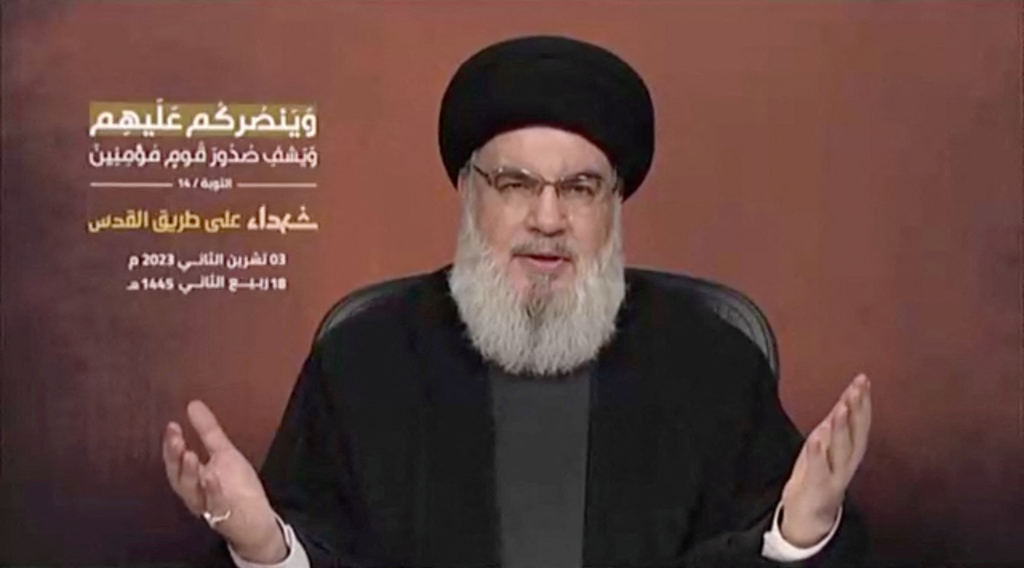
In his first and much anticipated public address since the October 7 attack against Israel by Hamas and the ensuing Israeli assault on Gaza, Hezbollah’s leader, Hassan Nasrallah, said in a speech on Friday that Al-Aqsa Flood is a 100 percent Palestinian battle, without incitement from any party.
"Some people thought I was going to announce that Hezbollah is joining the war, to which I say, we joined the war on October 8,” he said, adding that the operation “was not initiated or prompted by Iran or anyone else.”
Since the Hamas operation and the start of the Israeli offensive on Gaza, Hezbollah fighters began firing rockets at Israeli military positions near Lebanon’s southern border, which opened the scene for ongoing skirmishes on the front. The night before Nasrallah’s speech saw Hezbollah target 19 Israeli positions simultaneously along the border, followed by a retaliatory “broad assault” by the Israeli military.
“To those who were expecting us to enter a bigger war with the enemy, what we are doing might look modest, but our operations on the Lebanese front are major, effective and important, and will not be the end of it, in any case,” Nasrallah said. He added that Hezbollah has targeted various Israeli military points, including vehicles, soldiers, and tanks. Nasrallah also revealed that Israel initially intended to withdraw a third of its forces from its northern border to have them join the ground invasion in Gaza, but Hezbollah's forces kept them busy on the border.
On the possibility of a full-scale war between Israel and Hezbollah, Nasrallah put it vaguely in his characteristically menacing tone, “It could. Everyone should watch out.”
Nasrallah, who was seen days earlier in a cryptic video that showed him briefly passing in front of a Hezbollah sign, responded to the message that if his group gets involved, the US will bomb Lebanon. “Cool, bomb us and bomb Iran. Our actions are tied to how Israel is conducting itself in the ground operations and we will respond accordingly,” he said.
“It is clear that Israel has been screwing everyone in Gaza and the West Bank, as well as the Palestinian prisoners, for ages and no one has done anything about it despite all their human rights demands,” Nasrallah said, adding that all this made Al-Aqsa Flood an important and timely operation, proving the weakness and precarity of Israel.
“We should work for Palestine’s victory,” Nasrallah added, saying that “the fight is for Hamas and Hamas must win.”
Nasrallah also called for the aggression to stop in Gaza. “Everyone should work to stop the assault on Gaza,” he said, even if everyone doesn’t want victory for Hamas. “Do whatever you can to cut diplomatic ties. Boycott Israel,” he said.
Directing a broad call to Arab states to adopt a more active role in supporting Gaza, Nasrallah urged them to cut ties and exports to Israel and hinted at the slow trickle of aid going into Gaza and the impediments facing wounded Palestinians coming to Egypt. “Don’t you have within you some strength to at least open the Rafah border crossing and enforce bringing in aid and bringing out the wounded?” he said.
“Can’t these people go and occupy the Rafah border crossing? The kings, presidents, ministers, scholars, the elites of the Arab and Islamic world. They can turn the crossing into their platform to speak to the world, and their peoples, and hold everyone responsible,” Nasrallah added.
Hani al-Masri, an analyst with the Palestinian Center for Political Research and Strategic Studies (Masarat), tells Mada Masr that Nasrallah’s speech is fairly expected insofar as he specified his involvement in the war to be predicated on two things. One is Hamas facing major difficulties, and the other being if Israel targets Lebanon. “He put limits to his involvement in the war … I think he calculated the risks of a regional war and he clarified that they are neither ready for a war nor willing to fight one,” Masri said.
“Palestinians wanted big involvement from Hezbollah so that the massacres in the strip can be limited, but there is a difference between emotion and reality,” Masri said, adding that Nasrallah denying prior knowledge of the Hamas attack is significant and points to the level of coordination between Hamas and Hezbollah.
Meanwhile, Palestinian writer and analyst Abdel Rahman Nassar believes that Nasrallah's speech was directed more at the United States than at Israel. Nasrallah’s address, Nassar told Mada Masr, “sets the [tone] for how to deal with the US, its threats and its recent movements in the region.”
Nassar pointed to the beginning of Nasrallah’s speech, where he said, “Israel is in trouble. This is true, and Israel’s options are limited. Without the unconditional and open support of the US, Israel would have collapsed in such a war. And the US is going beyond support to active participation on the ground.”
The most important message of the speech, he notes, was the statement of “preparedness to confront the American fleets,” as well as the hint that Nasrallah was responsible for the 1983 bombing that targeted the US marines in Beirut, especially since Hezbollah never directly claimed responsibility for the attack before, despite the US insistence that the group was involved.
“The discourse on the United States and its position means throwing the ball back in America’s court, and saying ‘our behavior will mirror your behavior.’ Whether the war stops or not, you know where we are heading, because US support for Israel is major and pivotal at this point,” Nassar adds.
In his fourth visit to Israel, following the start of the war on October 7, US Secretary of State Antony Blinken said on Friday “We need to do more to protect Palestinian civilians.”
In some of his most forceful comments to date, the top US diplomat said that “civilians should not suffer the consequences for [Hamas’] inhumanity and its brutality.”
Still, Blinken continued to offer support for Israel’s “right” and “obligation” to defend itself after the brutal October 7 Hamas attacks.
Reflecting on this position, Michael Hanna, International Crisis Group US Program Director, told Mada Masr, “I think we are seeing an incremental set of shifts. Joe Biden began with a no daylight policy that was likely driven by his own instincts for how to deal with such a crisis and by the scale and brutality of the October 7 attacks. This message of total support was very clear in the administration’s public communications, although there was some private discussion of [protecting] civilians.”
Hanna thinks the shift was mobilized by “the unprecedented intensity of the Israeli air campaign, the growing number of civilian casualties and the deteriorating humanitarian situation.”
“This also reflected unease with the lack of clear planning both for the military operation and for what was to follow,” he added.
Hanna notes that the Biden administration’s inconsistent messaging about its humanitarian concerns in Gaza could also be indicative of the complex and tangled interests at play.
“Biden begins to talk about humanitarian access, albeit without real emphasis on a sustainable mechanism that could support the actual and growing requirements of Gazans. Blinken mentions the idea of a humanitarian pause,” Hanna said. “And most recently that language was echoed by Biden himself. This remains some distance from a call for a ceasefire, but it certainly reflects concern about both the situation in Gaza and the growing collateral costs for the US.”
أخبار ذات صلة

Hundreds of Gaza students demonstrate for right to study abroad
Hundreds of university students trapped in the besieged Gaza Strip gathered on Monday outside the Journalists Syndicate’s headquarters in western Gaza City…

In meeting with Board of Peace director-general, Hamas refuses UN disarmament plans until Israel commits to withdrawal
Hamas has refused to commit to the plans proposed by the United Nations for its disarmament, citing lack of advancement in Israel’s…

Israel agrees to limited reopening of Rafah border crossing — details pending
Israeli Prime Minister Benjamin Netanyahu’s office announced on Monday that it has agreed to a “limited reopening” of the Rafah border crossing…

Sisi touts ‘stabilization’ agenda at first Davos appearance in over 10 years
President Abdel Fattah al-Sisi advertised Egypt’s “stabilization” agenda in Davos on Wednesday, saying the country’s focus on steering away from regional conflicts…
Your support is the only way to ensure independent, progressive journalism survives.
You have a right to access accurate information, be stimulated by innovative and nuanced reporting, and be moved by compelling storytelling. Subscribe now to become part of the growing community of members who help us maintain our editorial independence.
Join us