
Govt rushes to hike energy prices in response to regional war
The Automatic Fuel Pricing Committee raised the price of all categories of fuel by rates between 15 and 22 percent at 3 am on Tuesday morning.
The sudden mid-week decision breaks the normal pattern by which the committee reviews prices quarterly and issues price increase decisions at the end of the working week.
The last hike was rolled out in October, when the government pledged it would not implement further increases for a year.
The Petroleum Ministry announced the hike one minute before the increases came into effect, citing in its statement the “exceptional circumstances” in global markets at present. While Egypt has signed hedging agreements to protect the prices of its crude imports, these cover only around 60 percent of the total volume.
The decision increases the prices as follows:
- All types of gasoline and diesel increased by LE3 per liter
- Natural gas vehicle fuel increased by LE3 per cubic meter
- 12.5 kg cooking gas canisters increased by LE50
- 25 kg cooking gas canisters increased by LE100
The adjustments came after Prime Minister Mostafa Madbuly met with several ministers, including Petroleum Minister Karim Badawy, on Thursday, to discuss different options to face the looming energy crisis if the US-Israeli war on Iran continues. Options included price hikes in both electricity and gasoline as well as maximizing use of mazut in generating electricity, an informed source close to the Cabinet and a former Petroleum Ministry official told Mada Masr.
Madbuly convened the meeting a few days after the war, which pushed energy prices to levels unprecedented in years, broke out.
The global price of Brent crude jumped around 20 percent during the first hours of trading on Monday morning to hit over US$110 per barrel, the peak of an upward spiral that has seen prices rise by around 64 percent in total since Israel and the United States launched their joint offensive against Iran ten days ago.
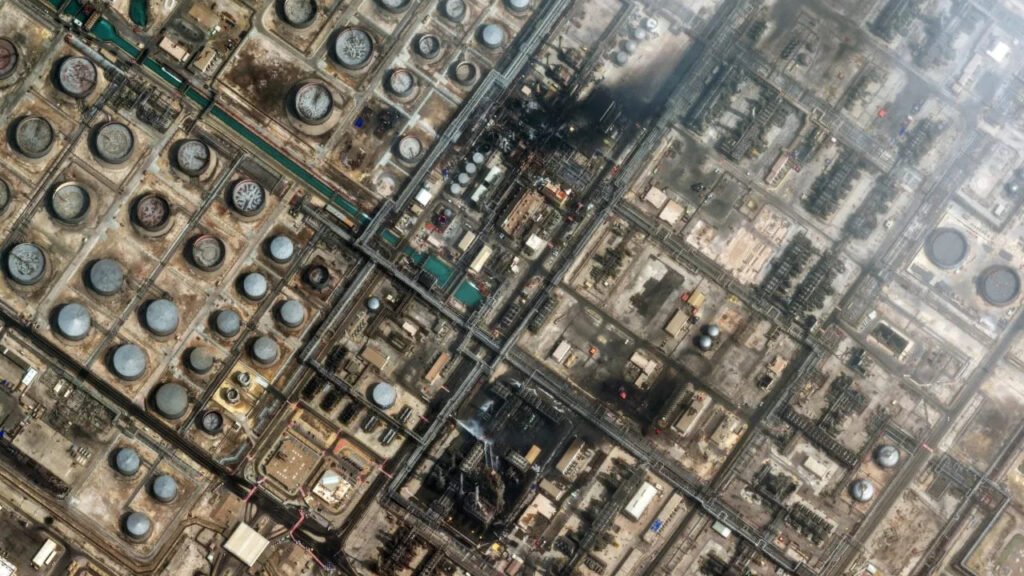
The price jump, the highest over the course of a single week since the oil price shocks of the 1970s, is a direct result of the war which has seen Iran rapidly adopt a strategy of targeting energy facilities in both Israel and Gulf countries hosting US military bases, leading to the partial or full shutdown of many.
Iran has also targeted oil and gas tankers in the Strait of Hormuz in the Persian Gulf, redoubling the pressure on producers in the Gulf who depend on the channel to deliver their exports and who, given limited storage capacity, have been driven to cut output.
QatarEnergy became the first last week to call force majeure, the legal recourse to claim circumstances beyond the producer’s control are forcing them to renege on their export commitments. Kuwait Petroleum Corporation followed, announcing a reduction in output, while Iraq has reduced its capacity by around 1.5 million barrels per day. Abu Dhabi National Oil Company (ADNOC) has said that it will “control output” and news outlets reported Monday that regional titan, Saudi Arabia’s Aramco, would be reducing output at two of its fields.
This domino effect is one that Qatari Energy Minister Saad al-Kaabi has predicted as long as the exchange of fire continues. Kaabi told the Financial Times on Friday that Gulf countries would stop production “in days” and that all producers in the bloc would “have to announce force majeure,” anticipating that this would push prices up to $150 per barrel, or $40 per million British thermal units in the coming two to three weeks.
Despite the warnings, US President Donald Trump’s response so far — beyond a promise last week to guarantee a small proportion of the rising insurance premiums for ships traversing the strait — has been to dismiss the price spiral. He described the impact as “short term” and a “small price to pay for U.S.A., and World, Safety and Peace,” something that “ONLY FOOLS” would disagree with.
But as long as the war persists, the problem persists. In the words of Kaabi, who is also the head of QatarEnergy, “if this war continues for a few weeks, GDP growth around the world will be impacted. Everybody’s energy price is going to go higher. There will be shortages of some products and there will be a chain reaction of factories that cannot supply.”
“This will bring down the economies of the world,” he concluded.
Governments around the world have begun to meet to discuss measures for the worst-case scenario. The G7 nations discussed the potential of releasing a portion of the oil reserves, falling short of an agreement but soothing the price spiral on markets.
Others, including the European Union, pointed Monday to the price shock as a more urgent consideration than declining supply, as national budgets pivot to face rising energy prices and their ripple effect throughout the global supply chain.
According to the two informed sources who spoke to Mada Masr, it’s these scenarios that Egypt’s government has gathered to consider over recent days.
As a net energy importer, Cairo is obliged to confront not only the challenge of recalibrating its procurement plan for the coming weeks, but also how to grapple with the associated costs, given that countries in the Gulf — on whom Egypt has relied on for cheap or facilitated energy supplies in other crises over the years — find themselves in the heart of the crisis this time.
****
There is no immediate shortage of gas supply yet, according to the sources who spoke to Mada Masr, both of whom stated independently that the government is still able to provide natural gas to the energy-intensive industrial sector.
However, the informed source close to the Cabinet, said that Egypt has already been obliged to resort to the spot market to secure an additional shipment.
For Egypt, the war’s most immediate impact is to its supply of natural gas, which represents around 49 percent of Egypt’s total energy supply and around 70 percent of the energy used to generate electricity.
As domestic natural gas production has dropped over recent years, Egypt has become increasingly dependent on natural gas imports to ensure the country can meet demand.
These imports took an immediate hit on the first day of the war, as the US and Israel launched their offensive and the latter acted rapidly to close production at Leviathan, its largest gas field and main supplier to Egypt, a casualty the government in Cairo acknowledged curtly in a statement on February 28, describing the cuts as “the disruption of gas supplies from the Eastern Mediterranean via pipelines” due to “current developments resulting from the recent military strikes and their repercussions.”
Around 15-20 percent of total annual demand is supplied via pipelines from Israel.
The impact would worsen over the ensuing days. Among the first energy targets to be struck by Iran were those at Ras Laffan Industrial City, the site of several QatarEnergy production facilities. Following an initial shutdown to inspect the damage, QatarEnergy would move to announce force majeure and shut down its production entirely just two days later.
Beside producing around 20 percent of the global supply of natural gas, second only to the US, Qatar is also one of the key suppliers of the liquified natural gas Egypt depends on to soothe its energy deficit.
To secure cheap supplies of LNG for the coming year, Egypt has signed off on two agreements, the first for 80 cargoes from the US, and the second for a further 24 cargoes from Qatar. It planned to issue an additional tender for 75 cargoes throughout the year.
The shutdown at QatarEnergy has a major impact on Egypt’s energy planning, according to the source close to the Cabinet.
The only alternative is to turn to the expensive, short-term spot market, a step the government has already deployed in the days since the war broke out to secure a shipment of LNG that is due to reach the port of Damietta Monday, according to a cargo schedule that Mada Masr reviewed.
The resulting deficit in supply, especially if the war continues, will likely push the government to lean more heavily on the spot market, according to the former Petroleum Ministry official.
Only a few weeks ago, the government decided to postpone some LNG shipments it had already contracted because it thought they were no longer needed, according to the first source, but since the war broke out, it has requested their expedited delivery.
Although the government has adopted a tone of reassurance to tell Egyptians that its “proactive measures” will ensure that the country’s supply of energy does not run dry, both sources noted that the government is eyeing the unplanned cost of importing short-term LNG with trepidation.
What complicates the matter this time, according to the former ministry source, is the fact that the Gulf, on which Egypt has relied for support to meet its energy and financing needs in successive crises over recent years, is in the eye of the storm.
Gulf countries, particularly Saudi Arabia, have supplied Egypt with emergency cargoes of both natural gas and oil derivatives in recent years, including at the height of a domestic economic crisis in the early years of President Abdel Fattah al-Sisi’s presidency, borne the cost of imports during the energy crisis of 2024 and provided facilitated payment agreements and schedules, including in the recent deal with Qatar.
With the cost of energy imports high, an electricity price hike was already scheduled for July this year, a step recommended under a structural reform program with the International Monetary Fund but that has been delayed several times.
The government was planning to implement a new round of electricity hikes in July at the outset of the new fiscal year.
The former official suggested that the government would be likely to opt for prices increases in the industrial sector, anticipating a hike of as much as $4 per million British thermal units, especially given that some industrial producers might be more able to recoup the costs by exporting some of their product, citing fertilizers, an energy-intensive product, which is also being driven up by the war, as an example.
The Petroleum Ministry already submitted a proposal in December last year to increase gas prices for industrial facilities.
***
It will also be crucial to ensure a supply of oil and oil derivatives, for which Egypt also depends on imports as its production of oil drops to its lowest levels in decades.
The former ministry source said that the government will continue to rely on mazut, a crude derivative, to substitute as much as possible for natural gas.
Mazut consumption is already due to be increased to the highest possible level to generate electricity at power stations.
Former head of the Electricity Regulatory Authority, Hafez al-Salmawy, previously told Mada Masr that Egypt’s power stations are able to consume around 35,000 tons of mazut per day, meaning they can generate approximately 24 percent of their full capacity from mazut.
On Monday evening, the government also announced a set of measures to rationalize spending and consumption, including “reviewing fuel consumption in various sectors.”
أخبار ذات صلة

How is the government preparing for the summer energy deficit?
Just before daily temperatures in Cairo peaked 30 °C in the middle of winter, the president met with the electricity and renewable…
Egypt, Cyprus ink plans to export Cypriot gas via Egypt in future
Egypt and Cyprus signed off on agreements with Chevron and Eni, the leading partners in two Cypriot natural gas fields, paving the…
Foreign companies given favorable terms in new oil, gas exploration deals
Two oil and gas exploration agreements came across the desk of lawmakers in the House of Representatives earlier this week, with parliamentarians…
Sources: Egypt’s gas supply dips due to temporary closure at Israel’s Tamar field
Power cuts will be extended by one hour for one day a week going forward
Your support is the only way to ensure independent, progressive journalism survives.
You have a right to access accurate information, be stimulated by innovative and nuanced reporting, and be moved by compelling storytelling. Subscribe now to become part of the growing community of members who help us maintain our editorial independence.
Join us