
50 Egyptian nationals in Turkey arrested as Sisi, Erdoğan prepare for presidential summit
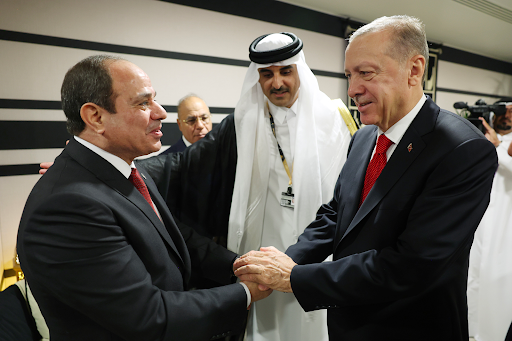
With Egypt and Turkey’s presidents set to meet later this month, Turkish authorities have arrested at least 50 Egyptian nationals residing in Turkey in an ongoing security campaign launched following the reelection of Recep Tayyip Erdoğan as president at the end of May.
Those arrested, said a source close to Egyptian opposition figures residing in Turkey since the 2013 ouster of the Muslim Brotherhood government, are being held in Gaziantep Prison on charges that are not yet clear.
With migration a key policy issue during the Turkish election cycle, the security campaign was conducted under the pretense of targeting a range of nationals residing in Turkey with expired visas.
However, according to the source, it was previously effective to seek resolution via informal channels with the Turkish authorities to resolve the status of Egyptians with expired residency permits. “Now, intervention doesn’t solve anything,” the source told Mada Masr.
Beyond the security campaign, Turkish officials have imposed a number of other restrictions on opposition figures since the elections, the source added, including putting a halt on some pending naturalization applications and rejecting their petitions for humanitarian residence permits.
These measures come in the context of a continued rapprochement between Turkey and Egypt after years of frosty relations due to Erdoğan’s fierce condemnation of the military-backed popular ouster of the Muslim Brotherhood.
A first step in March 2021 saw the Turkish government force opposition news channels broadcasting from Turkey to stop criticizing President Abdel Fattah al-Sisi and the Egyptian administration.
Egypt and Turkey began exploring high-level reconciliation talks in the summer of 2021, with several meetings held in Cairo and Ankara between senior diplomats on both sides. But the talks ground to a halt. While Ankara complained about the slow pace and held Cairo responsible, the Egyptian side put the blame on Ankara, indicating that the halt is due to the way Turkey continued to approach certain files, most notably the gas exploration in the eastern Mediterranean and Libya.
Yet, the two states were ready to return to negotiations when Qatar brought the two heads of state together on the sidelines of the 2022 World Cup in November in an attempt to iron out obstacles, offering direct financial support as an incentive, three government sources informed on the negotiations previously told Mada Masr.
Qatar has also taken steps to distance itself from Egyptian opposition figures. Mada Masr reported in early June that Qatari officials asked 100 Egyptian nationals affiliated with the Muslim Brotherhood, Jama’a al-Islamiya and Salafist Front to leave the country, after Egypt had requested their extradition.
According to the source close to the opposition in Turkey, Egyptian authorities are trying to break down the opposition blocs in Turkey and Qatar.
“Egypt knows that Qatar and Turkey will not hand anyone over, but they are pushing them to leave those two countries,” the source said.
The plans for a summit between Sisi and Erdoğan, which have been under discussion since the November meeting, materialized last week when both sides upgraded their diplomatic representation to the ambassador level and Turkish media reported on a summit between the two presidents scheduled tentatively for the end of July.
Several Western diplomats in Cairo who previously spoke to Mada Masr believe that Turkey’s endeavors to reconcile with Egypt are partially motivated by its declining economic situation, which prompted Erdoğan to consider the prospects of improving his relations with neighboring countries, including Egypt, in order to settle his country’s maritime borders — seen in Ankara as limited by the 2020 agreement between Egypt and Greece — and start drilling for gas.
Economic motivations were behind Egypt speeding up reconciliation with Qatar last year. Amid Egypt’s ongoing financial crisis, frustrations grew in Cairo as traditional Gulf allies — particularly the United Arab Emirates — used the situation to rapidly expand their Egyptian asset acquisitions, even working against Cairo as it sought out a new loan agreement with the International Monetary Fund. Thus, Cairo turned to Doha, seeking Qatari investment and Qatari-Egyptian cooperation in foreign policy to counterbalance the UAE’s influence.

أخبار ذات صلة
Kurdish forces taking up arms in Iran could drag Turkey into the war
When Syrian forces moved into Kurdish-held territories in northeastern Syria in January, Turkish officials let out a sigh of relief. The “Kurdish…

Sudan Nashra: Idris in Cairo as part of Egyptian-Turkish-Saudi coordination to prop up Sudanese military, Egyptian official says | RSF seizes Musa Hilal stronghold, stoking tribal tensions | RSF attacks North Darfur border town, engages Chadian forces | Hemedti in Uganda as head of parallel govt
Subscribe to our Lens on Sudan newsletter here. A week of heavy clashes in North Darfur has strained the region’s tribal landscape,…

The Quad War
After the fall of Fasher, Egypt turned to Turkey to find a way to deter the growing Emirati threat
Sisi pays first ever visit to Turkey amid ongoing rapprochement
President Abdel Fattah al-Sisi made his first official visit to Turkey on Wednesday to meet with Turkish President Recep Tayyip Erdogan, the…
Your support is the only way to ensure independent, progressive journalism survives.
You have a right to access accurate information, be stimulated by innovative and nuanced reporting, and be moved by compelling storytelling. Subscribe now to become part of the growing community of members who help us maintain our editorial independence.
Join us