
Without money for national vaccine campaign, Egypt turns to Tahya Masr Fund, private sector partnerships, voluntary vaccination
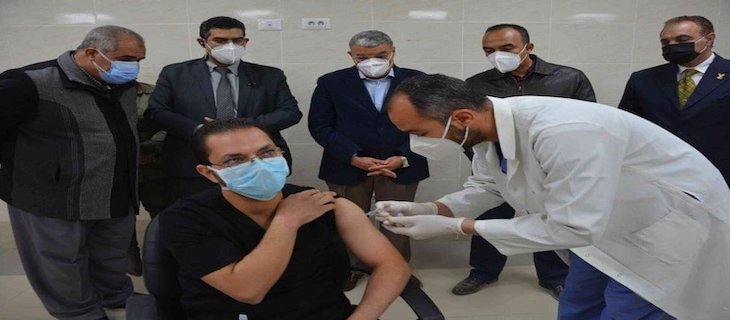
Egypt kicked off its vaccination campaign with a live television broadcast of a nurse and a doctor from Ismalia's Abou Khalifa isolation hospital on January 24.
The live vaccination was followed by a press conference led by Health Minister Hala Zayed, wherein she stated that the vaccination program for medical teams that treat COVID-19 patients in public, police and military hospitals would commence the following day. Doctors treating other patients are next in line to receive the vaccinations, followed by elderly citizens who have chronic and autoimmune conditions, then those above 45 who have chronic health conditions, and finally the rest of the population.
According to the health minister, the vaccines will be free of charge for medical staff. As for the rest of the population, the price will be decided after citizens register through an online form. The form will classify citizens into those who are able to pay and those who are unable to pay. According to Zayed, those that are able to pay will pay a modest fee for the vaccination, with one dose not exceeding LE100.
How the state will pay for the vaccination of the rest of Egypt’s over 100 million people, however, remains unclear. A push at the World Trade Organization to waive international property rights on Covid-19 drugs, a move that would ramp up manufacturing and drive down costs, has been met with intransigence from the European Union, the United States and Switzerland, all home to major pharmaceutical companies. And, in Egypt, there are no actual financial resources, specifically from the state budget, allocated for the purchase of vaccines, according to a medical source who works in a state medical sector, as well as other medical and government sources that spoke to Mada Masr over the last few weeks.
Sources close to the handling of Egypt’s COVID-19 response who have spoken to Mada Masr in recent weeks say that the government is considering various measures to try to finance the vaccine rollout. Chief among these include turning to black-box funds outside state control and partnerships with the private sector, while making vaccination voluntary, a step analysts say is “an attempt to manufacture a loophole that would allow the vaccine not to be offered free of charge for everyone.”
The shortfall of cash for the vaccines can be seen in the state budget. Despite the increase in financial allocations for the Health Ministry this year, it is practically impossible to purchase the vaccines from the ministry’s budget, according to MP Ayman Aboul Ela, a current member of the House of Representatives and a member of the previous Health Committee that approved the ministry’s budget for the current fiscal year. “The ministry’s current budget can barely cover the necessary measures needed to curb the spread of COVID-19, which includes expenses such as upgrading hospitals for example,” he explains.
The ministry’s budget for FY 2020/2021 comes in at LE93 billion, which is a nominal increase of about LE20 billion — around 28 percent — over what was allocated to the health sector in the previous fiscal year. This number still does not meet the minimum threshold stipulated by the Constitution, which holds that the health sector’s budget must be at least 3 percent of GDP.
“In reality, the Health Ministry’s current budget has a total of LE4 billion allocated for COVID-19 spending, which we requested to add to the budget proposed by the ministry. Finances for vaccinations were not included in this year’s budget because it was approved in mid-2020, before there was any serious talk about manufacturing vaccinations, let alone importing them,” says Mohamed Magdy Morshed, a former member of the Health Committee in the previous House.
To make up for this shortfall, the Cabinet has been discussing ways to finance procurement of vaccines, fielding different avenues of funding, according to an informed government source.
One of those avenues is the Tahya Masr Fund — a black-box reserve managed directly by the president without parliamentary oversight — which launched the “We Partner for Humanity” campaign in mid-January to solicit donations for citizens who will not be able to pay for the vaccine. The fund’s spokesperson also announced that they have collected LE160 million from different businessmen. Al-Shorouk Editor-in-Chief Emad Eddin Hussein said that Ahmed Heikal, the chairman of Qalaa Holding, which owns Al-Shorouk, donated LE30 million to the fund.
The donation campaign was announced one day after another announcement was made about a protocol of cooperation between the Health Ministry, the Tahya Masr fund, and the Talaat Mostafa Group, overseen by the Mubarak era-parliamentarian and business tycoon Hisham Talaat Mostafa, who was sentenced to 15 years in prison for arranging the murder of Lebanese singer Suzanne Tamim before being pardoned by President Abdel Fattah al-Sisi in 2017. According to the agreement, Talaat Mostafa’s company will make substantial donations to cover two million vaccine doses.
To determine eligibility for the free provision of the vaccine, the government is relying on data from the Takaful and Karama cash transfer programs, according to statements by Health Minister Hala Zayed. Takaful and Karama are cash transfer programs that were launched by the Social Solidarity Ministry in March 2015. Takaful is a cash assistance program for poor families with children; Karama is aimed at seniors and those with disabilities.
An official directly involved in the Takaful and Karama program in the Social Solidarity Ministry tells Mada Masr that the ministry will provide its data pertaining to citizens who are unable to pay for basic needs to the Health Ministry. The official explains that the Takaful and Karama database includes 35 million individuals, the total number of citizens who applied for the cash transfer program rather than those currently receiving aid.
Beneficiaries of the Takaful and Karama program will have priority in obtaining the vaccines free of charge over those who are included in the program’s database, adds the source, who spoke to Mada Masr on condition of anonymity. According to Social Solidarity Minister Nivine El-Qabbaj, there are 15 million beneficiaries of Takaful and Karama.
According to the December expenditure report released by the state’s census bureau CAPMAS, 29.7 percent of Egypt’s population live below the poverty line, set by the government at an income threshold of LE857 per month.
Meanwhile, according to an independent medical source, the Health Ministry has a parallel track of providing vaccines at a modest price through partnership agreements with the private sector, similar to what happened with PCR testing operations. The source added that the matter is still rife with uncertainty, however.
“It is understandable that the government does not want to be subject to criticisms for not shouldering the entire burden of vaccination, which is what all other countries have done. And generally speaking, vaccinations fall within the purview of the government,” the source adds.
In an apparent rollout for this plan, the Federation of Egyptian Industries called on owners of industrial facilities on January 24 to cover vaccine costs for their workers through donations to the Tahya Masr Fund.
Last week, sources from the Health Ministry had specified three features of the upcoming vaccination program. The first was that the ministry would start inoculating medical teams starting the end of January, which has already happened. The second is that vaccination is optional, not mandatory and that medical teams will be registered via hospital surveys and online forms. Finally, the ministry’s officials identified 200,000 medical workers and 23 million citizens with chronic diseases as the first segment of people to receive the vaccine. As for the rest of the people, they will be allowed to get vaccinated if more vaccines become available.
“The urgent question here is: why did the government decide not to provide the vaccines for everyone free of charge?” says Alaa Ghannam, the director of the Right to Health program at the Egyptian Initiative for Personal Rights. “The vaccine must be completely free for everyone without debate.”
“The determining factor in deciding whether or not a vaccine should be free is the epidemiological nature of the disease, according to the World Health Organization. The default rule is that vaccinations should be free of charge to everyone when there is an epidemic,” says Ghannam, adding that rendering the vaccine as optional, not mandatory, is nothing but “an attempt to manufacture a loophole that would allow the vaccine not to be offered free of charge for everyone.”
Even though many people who work in the medical sector have expressed concern over the Sinopharm vaccine due to the lack of transparency around clinical trial information, government sources who previously spoke to Mada Masr said that Egypt is obliged to purchase Chinese vaccines due to the larger context of economic agreements between Egypt and China. And according to some medical workers, there is a preference for the Sinovac vaccine over Sinopharm in medical circles; Sinovac has already been approved for use in a number of countries. But the matter is not yet decided, as China wants to market the vaccine from state-owned Sinopharm instead.
The government source and another foreign diplomatic source say that Egypt intended to obtain 20 million doses of Sputnik V, the Russian vaccine, but it went back on that decision as it preferred to cooperate with China. A medical source also tells Mada Masr that the government received an additional shipment of Sinopharm, following the first shipment that arrived in early December, in addition to another shipment of the Oxford-AstraZeneca vaccine, which will be used to inoculate doctors working in isolation and pulmonary hospitals as part of the vaccination program’s first phase. The source added that the Health Ministry is currently working on a mechanism to allow doctors to choose between the Sinopharm and Oxford-AstraZeneca vaccines.
However, the government’s decision to allow medical personnel to choose between vaccines has prompted suspicion among frontline workers, whose confidence in the ministry has been rocked by the state’s public health response to COVID-19. Doctors Syndicate members previously told Mada Masr that a large number of doctors have opted out of receiving the Sinopharm vaccine.
The government source stated that there are no major price differences between the Sinopharm, Sinovac and Oxford-AstraZeneca vaccines. However, the country will not be able to provide steady shipments of vaccine orders unless it pays a substantial portion of the vaccine cost to the production companies, which already have massive requests from wealthy countries and developing countries that have successfully prepared the necessary budgets for purchasing vaccines.

تقارير ذات صلة

Devaluation drama and hot money’s return: What happened with the pound’s historic plummet?
'As long as there is more demand than supply, the price of the pound will continue to decrease.'
Q&A: Egypt’s emissions, the environment, and the relationship between air pollution and COVID-19
The loudest voices in this area are not those of environmental scientists, but of investors
Q&A with anthropology professor Hania Sholkamy | On the need to rethink social spending as crisis response after COVID-19
The pandemic exposed flaws in the way social protection is thought about in Egypt
Your support is the only way to ensure independent, progressive journalism survives.
You have a right to access accurate information, be stimulated by innovative and nuanced reporting, and be moved by compelling storytelling. Subscribe now to become part of the growing community of members who help us maintain our editorial independence.
Join us