
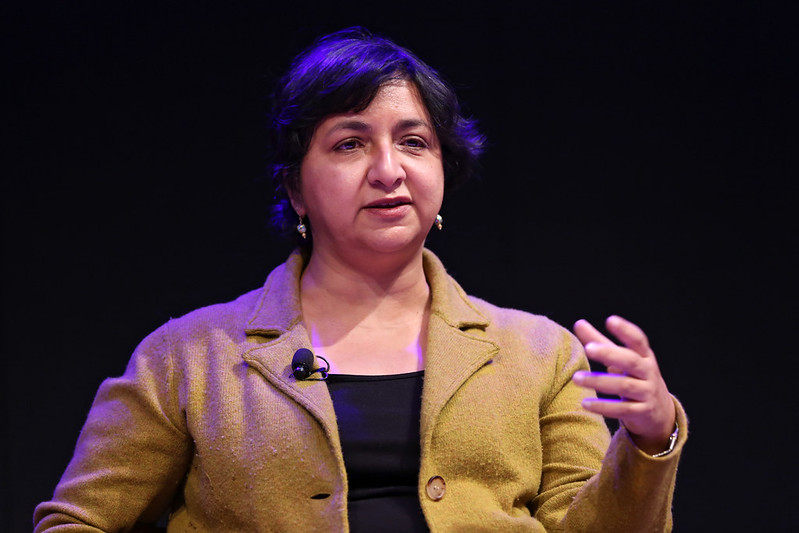
Q&A with anthropology professor Hania Sholkamy | On the need to rethink social spending as crisis response after COVID-19
With the stark worldwide economic downturn brought on by the COVID-19 pandemic, Egypt’s government stepped in to try to keep its economy afloat.
In came a sweeping package of measures directed at investors and industry, and energy subsidies billed to cost the government as much as LE6 billion were also announced, while major tax give-aways and cash support are also on offer.
To support informal laborers struggling to find work amid the downturn, the Manpower Ministry dispersed three payouts of LE500 as a special relief measure during lockdown. However, the program had limited reach and saw substantial delays, stretching from May to August though it was initially due to be paid out three times over consecutive months.
Despite these measures, the coronavirus pandemic laid bare the gaps in Egypt’s social protection policies.
To speak about the need to imagine a new social protection program that is based on inclusion and that could be a locomotive for growth, Mada Masr sat down with Hania Sholkamy, an anthropology professor and member of the Social Research Center at the American University in Cairo, following a panel that was organized by the Phenix Center for Economics and Informatics Studies and the Arab Reform Initiative about the social protection policies put in place for the informal labor sector during the pandemic. Sholkamy, who helped design the Takaful and Karama cash transfer programs that have been in place since 2014, talked about how the two programs and the grants to informal workers were used during the pandemic
Mada Masr: What did COVID-19 reveal about Egypt’s social protection policies?
Hania Sholkamy: In my opinion, the pandemic exposed many shortcomings about the way social protection is thought about. What I am talking about is a shortcoming in thinking, not in execution. Social protection is perceived as a temporary need, not as a social security system that can provide real protection against inevitable problems. The prevailing view of social protection is that it should be temporary, and sometimes it’s also looked at as a waste. On the other hand, both the Takaful and Karama programs represented a successful model for continuous social protection as it helped alleviate the repercussions of the pandemic. Currently, there are 15 million people receiving cash transfers that didn’t have access to the programs before. The pandemic revealed that this type of social protection is undoubtedly necessary.
MM: What about the temporary program to support informal laborers?
HS: First, I would like to point out that informal labor itself is not the problem. In fact, it’s highly productive and enjoys a level of flexibility that allows it to capitalize on different opportunities in the Egyptian market. We cannot look at informal labor as a problem given how highly adaptable it is, to the extent that someone might work day and night as an informal parking attendant because he finds an opportunity in this work. In reality, the problem is with the Egyptian economy in its current form, which does not provide enough opportunities to absorb people’s productive abilities. Despite this, I’ve noticed that many people think that the priority now should be regulating informal labor. In my view, this is a futile way of thinking. Informal labor is a vast and expanding sector. The formal private sector even relies on it through employment companies, for example. The priority right now should be protecting workers. This can only be achieved if we stop thinking about commodifying social protection. Such commodification happens through tying social protection to the amount of subscription fees paid by workers and the fact they have to pay those fees to begin with.
MM: What should we do then about informal labor?
HS: It is actually in the state’s interest to compensate informal workers for their subscription fees through a mechanism specifically established for that purpose. And it’s also in the state’s interest to provide financing and protection mechanisms for savings, which would incentivize workers to save. For example, temporary workers should have access to a flexible savings mechanism whenever possible, because their work is impermanent. They can also be incentivized to pay the subscription fees if the government agrees to contribute as much as each worker saves (with a maximum threshold) as part of a social protection system. Following this approach, the state should not regard the protection system as a waste of money because we can encourage saving in a way that aligns with the needs of informal and seasonal workers through incentivization. Your savings could amount to social insurance, subscriptions fees paid by the government, healthcare and health insurance. It is in the state’s interests to have everyone work, so people should be incentivized to work and not remain dependent on their families or on society.
I would also like to point out that this system could be a locomotive for growth. The government will pay much more money if it relies on improvisational protection programs during times of crisis as opposed to building this protective system. All those children whose parents will take them out of schools to help provide for the family will eventually pose a developmental burden that the government won’t be able to escape. Sooner or later, it will face a marked deterioration in poverty and human development indicators because it did not pay attention to the importance of building a social protection system at the right time.
In addition to all of that, there’s an issue that often gets overlooked. Building the infrastructure that allows a social protection mechanism to exist is a costly and time-consuming matter. A case in point is the information infrastructure. In the case of Takaful and Karama, we had databases about poverty and who is considered poor based on certain criteria that took a long time to define. But when this database was completed, the government was able to use it to mitigate the effects of the pandemic by adding more families to the program, targeting them correctly and adjusting the poverty criteria in light of the situation. I think that the opposite happened when it came to the temporary program aimed at informal laborers, because the information infrastructure is actually nonexistent.
To target those laborers, the government relied on the records of the Manpower Ministry in every governorate, which are insufficient. Then registration was opened in labor offices and post offices, creating huge traffic at a time when crowding was a hazard for COVID-19. After that, people were allowed to register through a complaints office affiliated with the president’s office. Of course, many people could not register. Then, the government decided to go to big contracting companies that employ informal laborers for day jobs and use their databases. But relying on those companies’ databases means that almost all informal workers who are women were excluded, as those companies mainly hire men. I think that women beneficiaries of this assistance are very low in number because official information about them does not exist. All of this proves that building a social protection system must happen before a crisis happens, not in response to one. And in reality, the concept of social protection must go beyond “sufficiency” and toward social inclusion.
MM: Can you provide a definition of social inclusion?
HS: Social inclusion is about both immediate and future needs. It surpasses the idea of providing the bare minimum for sufficiency. In the long run, when we stop treating education as a commodity, that is social inclusion. The same goes for healthcare. Providing COVID-19 vaccinations for free to everyone is a pattern of social inclusion. When basic rights are provided in a non-commodified form, this is social inclusion. If there is discrimination among beneficiaries, or if there is a huge gap between people’s abilities to access basic rights because they are commodified, then the richest and the poorest will be so far from each other that neither of them will participate in electoral events, for instance. So even the political system, in my opinion, needs social inclusion.
MM: Can we say that social inclusion is part of a larger pattern of public support that paves the way for equality between citizens when it comes to accessing rights that go beyond bare survival?
HS: A more accurate definition is a real provision of basic rights. For example, as the government invests in innovation, it also needs to invest in educating the less fortunate and in bridging between innovation centers and marginalized areas, because the government’s job is more than just providing the bare minimum for survival. It also must work towards inclusion. This actually happened with the Takaful program, as the beneficiaries are also exempt from school fees. This is an example of social inclusion for families that might have otherwise not cared about education. It qualifies as inclusion because the program approaches protection as something beyond just improving the financial situation of those families. This approach had a positive impact on those families during the pandemic, because even though they are categorized as poor families, their situation was better than other families that are considered more financially comfortable. Because the latter group did not receive social support, they suffered more when they lost their sources of income during the pandemic and had to deal with the burden of school fees. Families enrolled in the cash transfer programs did not experience this, which is why any social protection system must include non-monetary benefits.
The comprehensive health insurance system should play that inclusionary role when it comes to healthcare. We also must not forget that the subsidy programs have a social inclusion element because they reach a wider section of people beyond those who need assistance for survival. This system proved vital during the pandemic, but instead of perceiving it this way, many people criticize it for being a burden. And we never hear of voices asking that it be reformed to include necessary food items for children, for instance.
In reality, developing social inclusion systems and ending the common perception that they are a burden will only come about if there is a just progressive tax system that can continuously finance those programs. Otherwise, we will always be stuck in loops talking about how to finance social protection and social inclusion.
تقارير ذات صلة

Devaluation drama and hot money’s return: What happened with the pound’s historic plummet?
'As long as there is more demand than supply, the price of the pound will continue to decrease.'
Q&A: Egypt’s emissions, the environment, and the relationship between air pollution and COVID-19
The loudest voices in this area are not those of environmental scientists, but of investors
As Egypt looks to ramp up vaccinations, some gain privileged access with favoritism coming into play
Sources say people have been getting vaccinated outside of the public system since before April
Your support is the only way to ensure independent, progressive journalism survives.
You have a right to access accurate information, be stimulated by innovative and nuanced reporting, and be moved by compelling storytelling. Subscribe now to become part of the growing community of members who help us maintain our editorial independence.
Join us