
Why is Egypt not on the IMF’s December public agenda?
When Egypt and the International Monetary Fund announced a staff-level agreement on October 27, the IMF stated that “the agreement is subject to approval by the IMF's Executive Board, which is expected to discuss the authorities' request in December.”
However, as of today and until December 14, the executive board's calendar does not have the discussion around Egypt's loan on its agenda, despite Finance Minister Mohamed Maiet trumpeting that the first tranche of the loan would arrive soon.
What does this mean for the fate of the 46-month US$3 billion Extended Fund Facility that sources have repeatedly told Mada Masr the government sees as a “certificate of trust” that can help it try to climb out of the hole it fell into when its reliance on risky currency inflows gave out on the back of the effects of Russia’s invasion of Ukraine?
While Egypt and the IMF engaged in protracted negotiations to come to a final loan figure — the saga saw the figure yo-yo until the final days of negotiation as the government mulled the potential political ramifications of agreeing to steep reforms like slashing the subsidy program and putting military companies on the auction block — the two parties were finally able to come to a limited reform program in October.
However, three high-level bankers, a source informed of the Egypt-IMF negotiations and a government official who have spoken to Mada Masr in the last week say that these reforms were not enough to cross the finish line. The IMF, the sources say, is asking for further measures before it agrees to table the loan, with the government having little options left but to concede.
A key issue delaying the penciling in of Egypt’s loan on the executive board’s agenda is Egypt’s significant financing gap to cover debt servicing and strategic imports, according to a source informed of the discussions between the government and the financial institution.
In early November, Maiet told Bloomberg that Egypt is facing an external funding gap of $16 billion over the next four years, but he appeared confident that the country would be able to meet it.
“I am expecting that in the coming days, weeks and months, we will hear about more money coming — whether from the Gulf or from other sources,” Maiet said. “We’re hoping that as we move into 2023, the market will be better.”
However, according to the source, Egypt must secure pledges to close this gap in order to have the IMF table the funding facility program.
This is why, the source says, Egypt is currently collecting funding pledges from Japan and China or extending the due dates of various deposits at the central bank to fall within the financing period, as was done with some of the deposits of various Gulf countries in the Central Bank of Egypt last week.
Saudi Arabia, Kuwait and the United Arab Emirates extended the terms of their $7.7 billion in total deposits at the central bank, according to data issued by Egypt’s top bank and disclosures from the three countries.
Saudi Arabia extended a $5 billion deposit, and the UAE and Kuwait each extended $2.7 billion of their deposits.
However, according to an informed political source, the renegotiation of the maturity dates in order to close the financing gap will come at a cost. Saudi Arabia has demanded that Cairo pay a higher interest rate on its deposit, and negotiations with the UAE around the extension’s terms are ongoing.
While Egypt will have to mortgage its future further by piling up yet more debt obligations, it will not be able to escape present hardships.
Two high-ranking bankers, one at a private bank and the other at a government bank, say that the central bank is preparing to devalue the Egyptian pound in the coming week, “because if the devaluation is not done before the IMF meeting, the loan will not be signed.”
Shortly before Egypt and the IMF announced that they had struck a deal on a new loan in October, the central bank took steps to move off its long-held position of a managed float, whereby it had artificially pegged the value of the pound at around LE15.70 per US dollar, despite having agreed to liberalize the exchange rate in 2016.
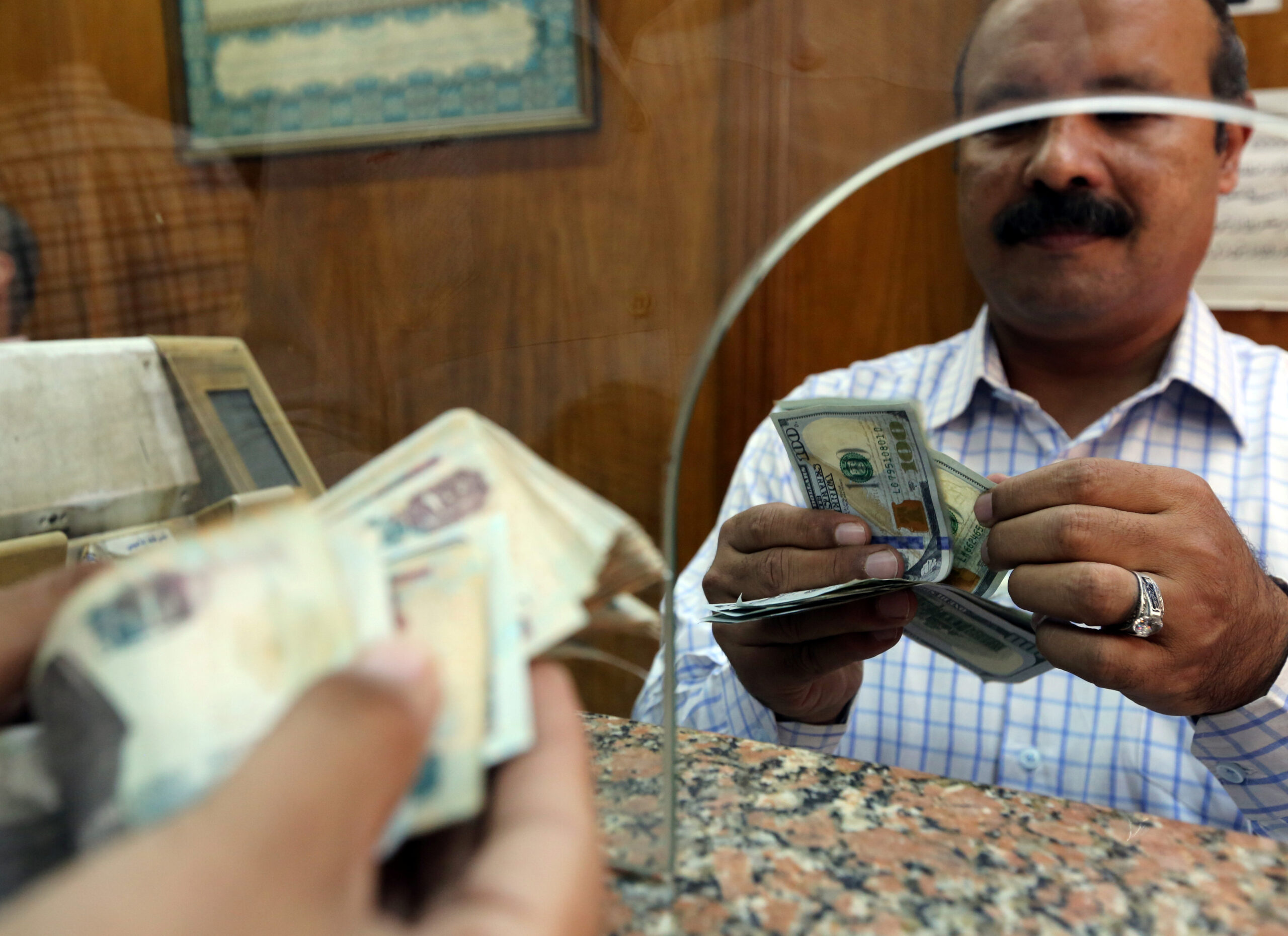
The central bank allowed the value of the foreign exchange rate to inch up ever so slightly since April, with it reaching a high of just over LE19 on the morning of October 27. But in one fell swoop, the central bank let the walls of the dam down and the pound plummeted to around LE23 in a few hours.
However, backing off from a managed float was a short-lived policy.
While the current rate of the pound has hovered around LE24.5 for several weeks, according to the two banking sources, the value of the Egyptian pound against the dollar on the black market was LE28 as of Saturday.
Egypt hoped to put off taking a move toward further devaluation until it had gotten the executive board’s final approval and made sure the money was on its way, according to a government official with inroads into decision-making circles. The government tried to tell the IMF that there would be “significant political hiccups” if the pound was devalued before the loan arrived, the source says.
However, the IMF has insisted on the devaluation happening.
The banking sources have raised concerns about what a devaluation could mean for Egypt in the present moment without being able to secure a sustainable source of foreign currency. If the government devalues the pound to LE28 without addressing the shortfalls in foreign currency supplies for imports, the demand for dollars could send the pound’s value plummeting even further.
A large part of the demand for dollars is tied to importing basic commodities, according to a third banking source.
While, earlier this year, the central bank introduced a letter of credit system obliging importers to secure a line of credit at a bank to guarantee import deals upfront, many basic commodities — medicines, certain necessary food commodities, fish, certain types of manufactured tobacco and tobacco substitutes, salt, sodium chloride, molasses, sugar, as well as some nuts, grains and flour — are excluded from the restrictions.
The banking source adds that the fear of a lack of dollar liquidity has prompted many manufacturers and importers to buy as much hard currency as possible in order to hedge against any future price hikes and to try to save as many dollars as possible for future import purposes.
The government will have little margin to maneuver on its own as well, as it will be facing increased scrutiny from the financing agency as it tries to manage this situation, according to the government official, who also says that the IMF has insisted that the government consult with it on how the devaluation is being done. The IMF will also conduct a three-month review of the program to ensure strict adherence to reforms, the official adds.
The source informed of the negotiations with the IMF is confident that the loan will be tabled by the financing agency's executive board by the end of December. Both sides have also made headway on an agreement that would unlock the additional $1 billion from the Resilience and Sustainability Facility announced as a possibility in the October agreement , the source says, with final approval pending the loan being tabled.
However, getting the loan table will only be the first hurdle. The banking sources and the government official agree that the next three months will be a significant test for the government, with no easy choices ahead.
تقارير ذات صلة

Govt’s launch of ‘Citizen Bonds’ challenges domestic banks, sources say
The Finance Ministry’s new “Citizen Bond” is being rolled out today, available for individuals exclusively through Egypt Post branches. The 18-month savings and investment instrument offers a fixed annual return…

Queuing for gold
Gold remains a trusted option for people looking to invest their savings despite a volatile market
A day afloat
Egypt will be getting another US$5 billion in loans from the International Monetary Fund as an increase to the 2022 $3 billion loan, IMF representative in Egypt Ivanna Vladkova Hollar…
Your support is the only way to ensure independent, progressive journalism survives.
You have a right to access accurate information, be stimulated by innovative and nuanced reporting, and be moved by compelling storytelling. Subscribe now to become part of the growing community of members who help us maintain our editorial independence.
Join us