
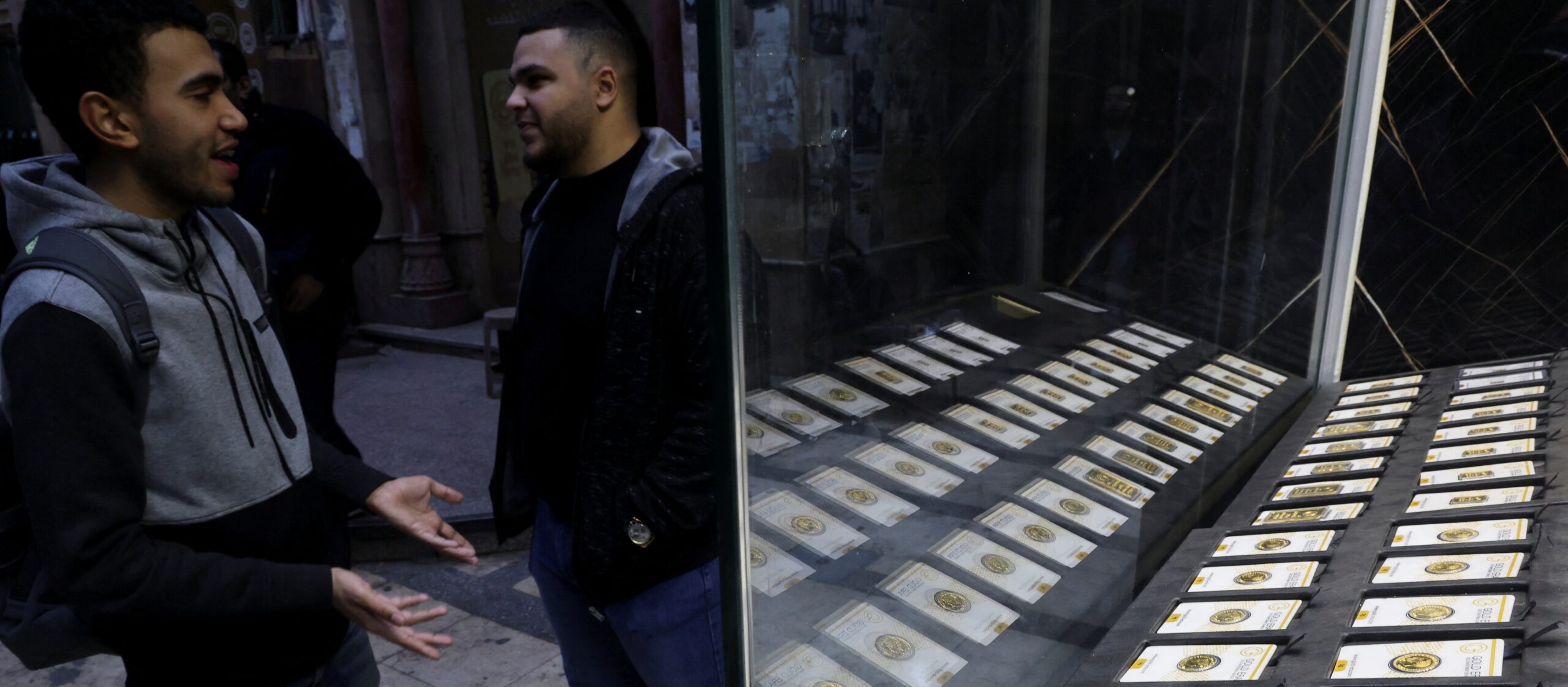
After a year-long trial, Mohamed*, a middle-aged engineer, realized he had lost out when he decided to sell his gold to buy savings certificates at a state bank.
The certificates were issued in 2024 by a number of banks in Egypt, part of a monetary drive to boost liquidity in the national banking system and bolster the pound at a moment of high inflationary pressure.
Though the special-issue certificates offered the relatively high annual return of 27 percent, an unprecedented surge in gold prices over recent weeks meant that Mohamed’s savings would have made more if invested in gold.
He bought his gold before 2024, at around LE3,000 per gram, and sold it at around LE4,000. When he drew his cash out of the gold investment, and placed it in the certificates, it seemed like a safe option for his savings.
But now, he says, his savings will buy a lesser quantity of gold today than the amount he sold nearly a year ago.
That is why, as soon as his certificates matured in January, he rushed to re-freeze the liquidity and buy gold again, he told Mada Masr on Saturday as he stood in the long queue that had formed outside a branch of BTC company for trading gold bars and coins.
As inflationary pressure has eased over recent months and the Central Bank of Egypt’s policy shifted toward monetary easing after months of tightening, the National Bank of Egypt and Banque Misr have stopped issuing the high-interest savings certificates.

As a result, Mohamed and many others are now rushing to BTC to buy gold bars. He says he has been to the branch several times since his certificates matured 11 days ago, but each time faced heavy crowds and the registration till closed early. He finally succeeded in registering for his purchase as he and his wife teamed up and queued separately to double their chances of beating the queues.
They managed their mission in around five minutes on Saturday morning. Two BTC reception staff told Mada Masr that those five minutes saw 500 people register, who then had to wait for long hours to complete the purchase. When the purchase is completed, gold is not delivered on the spot; the customers receive a receipt to collect it days later, they said.
Despite the surge in demand for gold, Sahar al-Damaty, former deputy chair of Banque Misr, does not think that the trend poses a threat to liquidity in the banking sector.
A segment of depositors remains committed to bank deposits and certificates even if the returns are low, despite the allure, since they depend on access to liquidity at fixed intervals, she tells Mada Masr. Another segment of higher-income depositors might allocate part of their savings to gold, but without fully abandoning bank deposits.
A number of people may even rush to buy banking certificates before rates fall even further, she continues, given that all expectations point to interest rates falling in the near future.
For Mohamed, the climbing value of gold has offered him an opportunity to recover what, for him, was an erosion to the value of his savings while they were tied up in bank certificates, and a signal to return to gold as an alternative store of value and means of saving.
For Ahmed*, who was waiting for his turn with a friend, the rising gold prices are a push to begin saving for the first time. In his twenties, he kept his modest savings in a non-interest-bearing current account, hesitant to place them in an interest-bearing certificate or deposit because he felt such interest “might be riba. I don’t know,” as he put it.
The crowds at BTC’s Korba branch clearly signaled the surge in demand for gold bars, but jewelry shops in the nearby Gamea Square area — where much of the gold trade is typically concentrated — were quieter. Saeed*, the owner of one such shop, interpreted the lull as indicating either a shortage of gold bars, or some sellers’ reluctance to sell them at the height of the climb in value.
“Every now and then, someone comes in asking, ‘Do you have gold bars? Do you have gold coins?’” Saeed tells Mada Masr. “But we tell them we don’t, even if we do, because there’s no guarantee — I could sell to you, and then try to buy gold myself but find the price has changed and I’d be buying at a loss.”
Adham*, another gold shop owner, says his solution has been to act only as an intermediary when it comes to gold bars. “I don’t buy bars myself. I just wait for a customer who wants a bar, call the company, agree on a price and pass it on. If the customer agrees, they come back to pick it up a few days later,” he says. “Even if someone comes in and buys a pair of earrings from me, I immediately go and buy replacement gold from neighboring shops [to avoid losses from rapid price increases]. I want my gold here with me.”
Meanwhile, Saeed says that jewelry purchases have slowed down dramatically. Buyers seek to avoid losses at resale, fearing they will not recoup the price of their pieces which are most expensive when new to reflect the manufacturing cost. For sellers, these initial costs are a key source of profit — unlike bars, whose selling price includes only a minimal manufacturing margin.
Saeed explains: “If I sell a 10-gram bar, it comes out to about LE76,570. The company’s manufacturing cost for the bar is around LE600, and I make around LE200 in manufacturing profit on top of that.” By contrast, he would have earned around LE800 in manufacturing fees on a piece of jewelry weighing no more than 2.5 grams — had the buyer not backed out at the last moment “after her mother called her and told her to cancel the purchase and buy a gold bar instead,” he says, citing an incident that happened a few days earlier.
What Saeed describes is reflected in data from the World Gold Council on gold purchases in Egypt in 2025 compared to 2024.
Total gold purchases in Egypt declined over the course of 2025, but a greater proportion of this appears to have come from declining jewelry sales. Jewelry sales fell by 18 percent, compared to 2024, while sales of bars and coins dropped by just two percent.
In the final quarter, the sale of gold bars and coins surged by 27 percent year-on-year, indicating a late year pivot toward increased demand for investing in gold.
Although local factors play a role in bolstering the demand for gold bars in Egypt, the value of gold has surged globally.
“Gold pricing in Egypt is generally tied to global prices, with a margin of no more than about five percent that may be related to local demand factors,” says Hany Milad, head of the Gold Division at the Federation of Egyptian Chambers of Commerce.
Global gold prices rose by a record 55 percent in the fourth quarter of 2025 y-o-y, and by 44 percent annually, according to the World Gold Council.

Four gold sellers, including Saeed and Adham, tell Mada Masr that the rapid rise in global gold prices — mirrored in the local market — became a driver of demand in itself, as buyers have rushed to purchase before the wave crests.
Global gold prices eventually fell by eight percent on Friday after reaching a historic peak of more than US$5,400 per ounce (31.1 grams).
Walaa Bakry, head of the Institute of Middle East for Public Policy, tells Mada Masr that the recent drop in global gold prices “came as the result of several combined factors, including the US Federal Reserve’s decision to keep interest rates unchanged, which partly preserved the dollar’s appeal, despite widespread expectations beforehand that Federal Reserve Chair Jerome Powell would be forced to yield to pressure from US President Donald Trump and cut rates.”
On the local market, prices dropped by more than LE500 per gram for 21-karat gold, and local demand eased as buyers held off anticipating a further decline that would allow them to reap a greater profit, according to the four sellers.
Before that decline, gold prices had risen by more than 18 percent since the start of the year, building on record surges in 2024, driven by a combination of factors, including heightened geopolitical and economic uncertainty, expectations of US interest rate cuts and increased purchases by central banks amid a global trend toward de-dollarization.
Despite this volatility in both local and global gold markets, gold remains an attractive option for savers and investors — particularly after the expiration of high-return savings certificates and the waning appeal of other traditional savings vehicles such as real estate in recent months. For Mohamed, for example, property is no longer a viable store of value, as prices have soared to levels that put buying real estate beyond his reach, he says.
Fathallah Fawzy, head of the Real Estate Development and Contracting Committee at the Egyptian Businessmen Association and chair of MENA for Real Estate Development Consulting, tells Mada Masr that he does indeed see a negative impact from the rush into gold on individuals’ investment in real estate for savings and value preservation, especially given the sharp rise in property prices.
Mada Masr’s review of secondary-market real estate prices over the past 12 months, based on data from the real estate search engine Aqarmap, found that prices in some areas have risen by more than 200 percent.
At the same time, however, Fawzy points to what he describes as attractive opportunities in fractional real estate investment through fractional property investment platforms, as well as real estate investment funds. These, he argues, offer advantages similar to those of gold investment funds, which have recently begun to emerge in Egypt.
*Pseudonyms
تقارير ذات صلة

Govt’s launch of ‘Citizen Bonds’ challenges domestic banks, sources say
The Finance Ministry’s new “Citizen Bond” is being rolled out today, available for individuals exclusively through Egypt Post branches. The 18-month savings and investment instrument offers a fixed annual return…
A day afloat
Egypt will be getting another US$5 billion in loans from the International Monetary Fund as an increase to the 2022 $3 billion loan, IMF representative in Egypt Ivanna Vladkova Hollar…
Egypt and the IMF’s economic dilemma: To review, or not to review, that is the question
Egypt is struggling to make progress on IMF recommendations amid a dollar crunch
Your support is the only way to ensure independent, progressive journalism survives.
You have a right to access accurate information, be stimulated by innovative and nuanced reporting, and be moved by compelling storytelling. Subscribe now to become part of the growing community of members who help us maintain our editorial independence.
Join us