
Weekly spotlight on state culture: The Culture Ministry speaks up
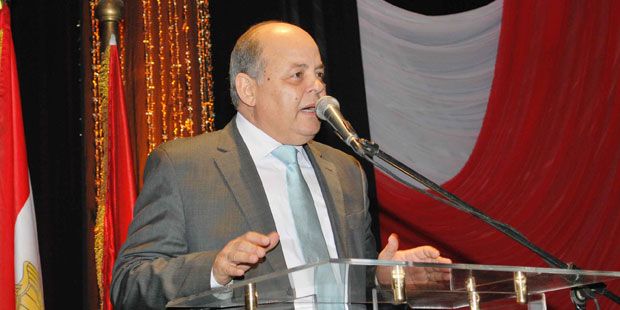
Supporting local creative production and public access to the arts is a difficult task, Culture Minister Saber Arab admitted at a press conference Monday.
Two major challenges the ministry currently faces are declining state funding and a dire need to restructure the state’s massive cultural bureaucracy, he said in a candid speech. Salaries and staff benefits have been eating up more than 50 percent of its budget.
Arab and his team seem to be facing a kind of chicken and egg paradox.
On the one hand, over the past few years, the state has been allocating no more than 0.23 percent of GDP to the ministry — less than a quarter of the minimum one percent required by UNESCO. On the other, the Culture Ministry suffers from over bureaucratized legislation and procedures, as well as overlapping activities among its various departments. It also has more than 35,000 employees on its books, in addition to tens of thousands of part-time workers, the minister said.
“Overstaffing [in some cases] reaches the point of hindering activities altogether,” Arab explained, citing the example of a “small” cultural palace in Luxor that employs around 1200 people.
He said that he has proposed to several of Luxor’s consecutive governors that a percentage of the palace workers volunteer with the governorate’s literacy programs, channeling their efforts to more productive ends.
For the financial year 2013/14, the Culture Ministry has been allocated LE1.4 billion (US$201,000,000), according to a ministerial report distributed during the press conference. More than half of this goes to salaries, wages and staff benefits. In some departments, Arab explained, these costs can even take up 80 percent of the budget.
“There is no clear salary and benefits scheme at the Culture Ministry,” Arab said. Some employees receive 200 percent of their salaries in bonuses, while their co-workers earn 50 percent. Additionally, the ministry does not have a minimum or maximum wage limit.
Many of these mismanagement problems over the years have culminated in investigations, several of which are currently underway. But perhaps what has put the ministry in a tight corner now is the effect of the Supreme Council of Antiquities’ decision to become an independent ministry in 2011. When it existed under the umbrella of the Culture Ministry, the council used to chip in with 10 percent of revenue when tourist numbers ranged between 11-13 million each year, Arab said.
“The money that poured into the ministry reached hundreds of millions of Egyptian pounds,” he said. “It was our safety net to support various projects.”
Currently, the Culture Ministry allocates no more than LE252 million ($36,200,000, and just 17.51 percent of the ministry’s budget) for the support of cultural activities and production. This translates into an average annual investment of LE2.8 ($ 0.40) per capita, according to the ministerial report. A 2012 World Bank report ranking Egypt as 97th on the Knowledge Economy Index (KEI) was included in the report to support the ministry’s case. The KEI is an aggregate index that measures a country’s overall level of development toward a knowledge economy, taking into account economic incentives and institutional regimes, education and human resources, innovation systems and ICT. Ten Arab countries are ahead of Egypt, according to the report: the UAE, Bahrain, Oman, KSA, Qatar, Kuwait, Jordan, Tunisia, Lebanon and Algeria.
“We’ve compared [the ministry’s budget as a percentage of total state funding] to budgets allocated in other developing and developed countries. We’ve found that they often allocate between one and two percent of GDP to cultural production,” Arab explained. “No country that has an interest in culture spends less than one percent on supporting creative production.”
To compensate for diminishing funding, Arab said the ministry plans to cooperate with the Ministry of Trade and Industry to develop economically viable models for the creative industries.
The Culture Ministry is also limiting the new projects it embarks on until it develops more cost-efficient models. Huge cultural palaces with state-of-the-art designs are in development in some Egyptian governorates and cities. Yet these projects have been put on hold simply because the ministry is unable to complete construction work and start programming. One obvious example is Alexandria’s Al-Anfoushy cultural palace, which has been on hold for 10 years, with millions still required to complete construction.
“Why embark on such projects from the start? And why build a hospital at an arts institution?” Arab asked, referring to an unlikely project started by the Arts Academy years ago, also on hold. “This money should have been spent on renovating and improving existing buildings, but also on supporting cultural production.”
Going forward, he said, the ministry will aim to follow a more cost-effective approach that better serves the local communities that its projects are meant to target. Recently, it has developed two models better suited to the local context. The first is a culture palace in the village of Al-Tarif in southern Luxor, and the second is the Bahaa Taher Palace, also in Luxor. Constructions costs have been modest for both, while other buildings cost millions.
The ministry also openly acknowledged the need to restructure its various sectors and operations. An agreement has been signed with the Ministry of State for Administrative Development to help develop the artistic, administrative and financial structures of all the Culture Ministry’s departments and sectors, which have been working with the same mentality for decades, Arab said.
“This is taking longer than we planned, however, because of the political and economic situation in Egypt,” he added.
Training and job re-design are another priority, but the ministry seems to be adopting yet another centralized approach: Arab said it is establishing a new body to be responsible for training programs across all departments.
Many of these planned initiatives will require time to materialize, so the ministry's commitment and ability to carry them out will only become clear in the future.
In the meantime, Arab promised that cultural activities will continue to run, adding that non-governmental sector institutions and artists will increasingly be invited to participate in programming and restructuring efforts.
تقارير ذات صلة
Trade-off: Madbuly’s big debt target and even bigger debt problem
A grand debt-swap proposal is gaining government and media traction
Egypt to seek LE1.5 trillion in borrowing as debt servicing consumes 50% of 2022/23 expenditures
An MP blamed the government for not developing an austerity plan.
General budget approved despite apparent shortfall in spending on health, education
Successive cabinets have failed to hit the constitutionally mandated marks for health and education.
Your support is the only way to ensure independent, progressive journalism survives.
You have a right to access accurate information, be stimulated by innovative and nuanced reporting, and be moved by compelling storytelling. Subscribe now to become part of the growing community of members who help us maintain our editorial independence.
Join us