
General budget approved despite apparent shortfall in spending on health, education
Egypt’s general budget for the coming fiscal year was approved this week, though the figures for spending on health and education laid out in the budget bill fall short of minimum spending rates for the key sectors enshrined in the post-revolution Constitution.
However, comments from senior government officials and from the House of Representatives Planning and Budget Committee point to vastly different figures, claiming that the government’s spending plan exceeds the minimum targets set out in the Constitution.
On Monday, the House of Representatives voted to pass the fiscal year 2021/22 general budget after adding six revisions to the initial proposal, which included minor additions to health and education spending after lawmakers proposed additions to the bill the Cabinet submitted to the House in April. MP Mohamed Badrawy, a member of the House Planning and Budget Committee, told Mada Masr that Monday’s revisions raised appropriations for the health sector by LE1 billion and for education by LE3 billion.
After accommodating the increases made by the House, spending on the health sector outlined in the budgetary bill comes in at LE109.8 billion, or 1.55 percent of GDP. The Constitution stipulates a minimum spending of three percent of GNI.
The revised budget for education passed on Monday stood at LE175.6 billion, or 2.47 percent of GDP. The constitutionally mandated minimum for spending on education, however, is six percent of GNI.
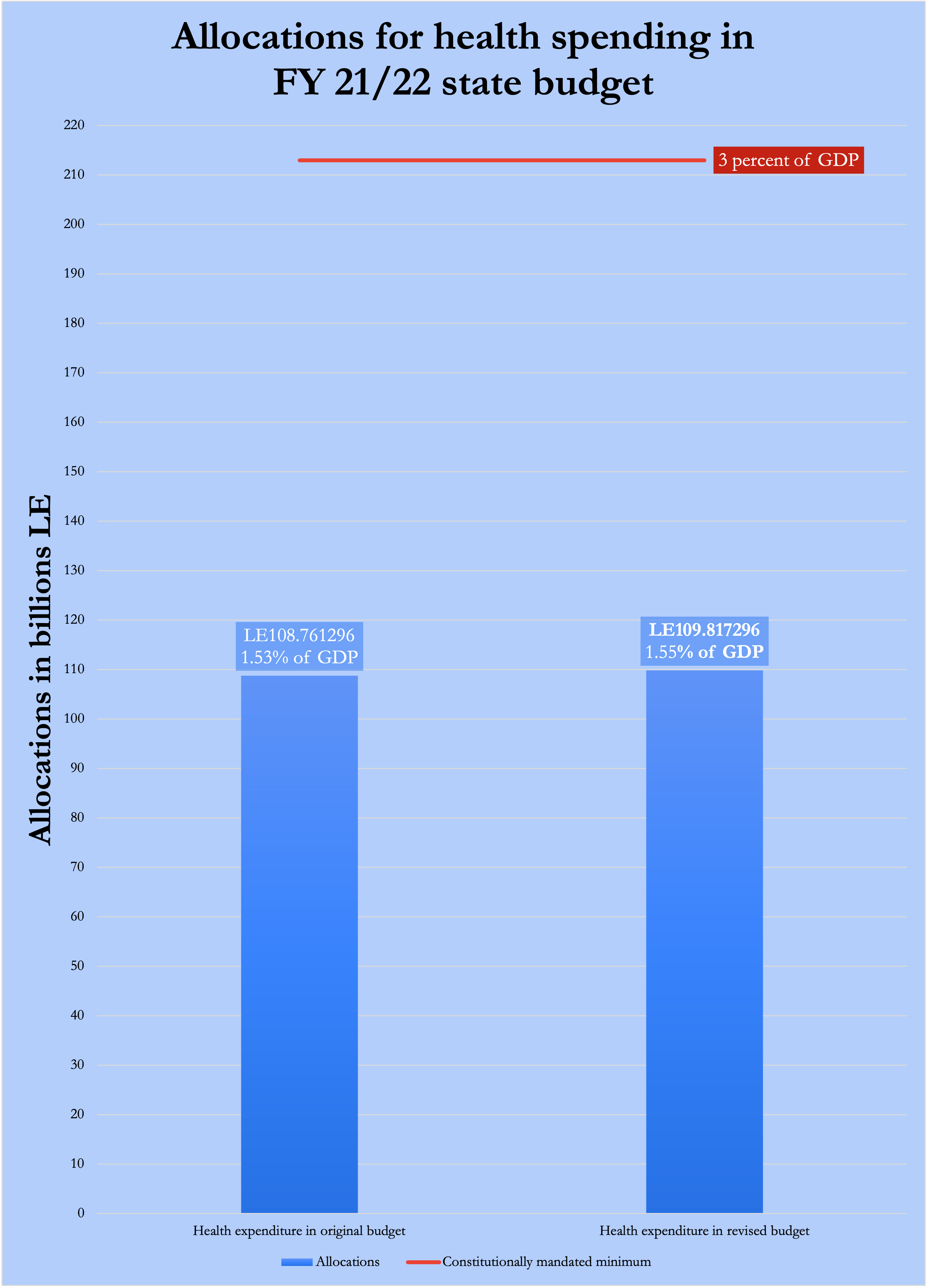
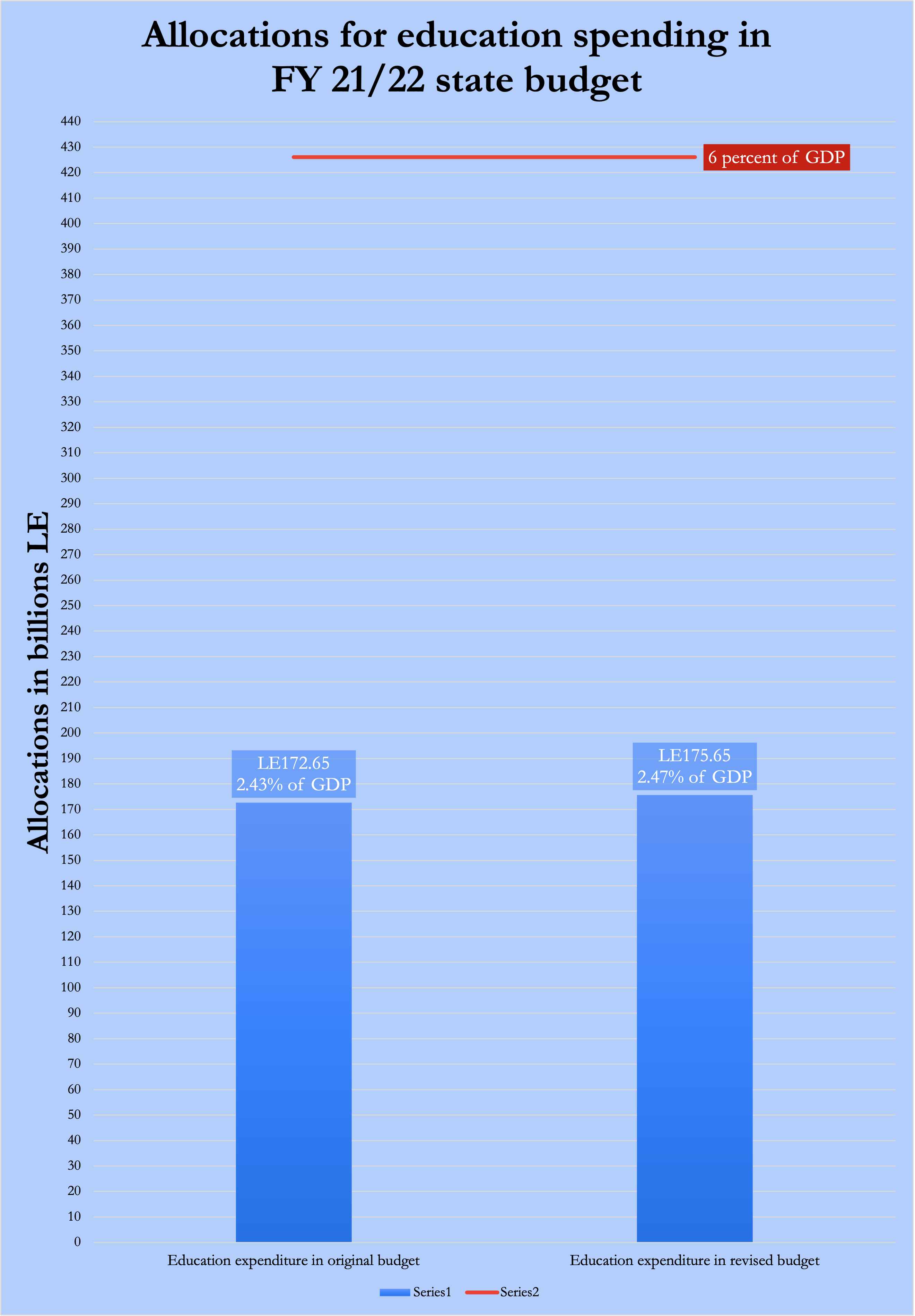
The state is obliged by the 2014 Constitution to spend at least three percent of gross national income on health and six percent of GNI on education. Since GNI figures are difficult to calculate accurately, Parliament agreed in 2016 to calculate the minimum rate of spending as a percentage of GDP instead. GDP, in contrast to the GNI, however, does not include remittances from Egyptians living and working abroad, a significant source of income that circulates in the Egyptian economy.
Successive cabinets since 2014 have failed to hit the constitutionally mandated mark for health and education sectors amid austerity measures that the government took as its economy struggled in the wake of two upheavals in less than three years. A US$12 billion loan agreement with the International Monetary Fund furthered the country’s austerity program as the government gave more emphasis on reining in its budget deficit and deprioritizing social spending, which sat at 12.5 percent of GDP in FY 2015/2016. In the coming fiscal year’s proposed budget, the aim is to cut the deficit down to 6.6 percent from last year’s 7.7 percent.
Despite the shortfall outlined in the budgetary legislation, Finance Minister Mohamed Maiet has made comments in the media claiming that spending on education stands at just under 5.5 percent of GDP, or LE388.1 billion: LE256.1 billion for primary and secondary education and LE132 billion for higher education. In the health sector, Maiet claimed that appropriations for the sector stood at LE275.6 billion. Both figures given out by Maiet are more than double what is outlined in the budgetary bill passed by Parliament, even when the additions made this week are considered. The same figures are recorded in the House Planning and Budget Committee’s report on the budget, which was cited by several media and press outlets.
But not everyone in the House adopted this rhetoric. During the Sunday session in the House in which the revisions were passed, the House leader of the Egyptian Social Democratic Party Ihab Mansour criticized the disparity between the spending accounts mentioned in the budget bill and the higher figures circulating in the press.
Mansour declared that his party rejected the budget bill, making a call for increasing spending further on health, education, and scientific research.
In light of a similar disparity in figures quoted regarding the FY 2019/20 general budget, a high-level Finance Ministry source told Mada Masr on condition of anonymity that the government uses a more “general and comprehensive” methodology to measure spending on the health and education sectors. The source said that what counts as spending on health and education is not limited to entities specialized in education and health, but to other public enterprises and state economic entities’ spending on health and education issues, with spending on police hospitals under the Interior Ministry counted as a contribution to the health budget, for example. Debt servicing on projects relating to health and education are also accounted for in the final figures, the source said.

تقارير ذات صلة
Trade-off: Madbuly’s big debt target and even bigger debt problem
A grand debt-swap proposal is gaining government and media traction
Egypt to seek LE1.5 trillion in borrowing as debt servicing consumes 50% of 2022/23 expenditures
An MP blamed the government for not developing an austerity plan.
Where does social protection spending stand in Egypt’s 2nd COVID-19 budget?
The budget fails to meet the constitutionally mandated spending minimum for health and education.
Your support is the only way to ensure independent, progressive journalism survives.
You have a right to access accurate information, be stimulated by innovative and nuanced reporting, and be moved by compelling storytelling. Subscribe now to become part of the growing community of members who help us maintain our editorial independence.
Join us