
Unworkshoppable cinema: A visit to the 11th Cairo Video Festival
Recently, I finally got to see Payal Kapadia’s All We Imagine as Light (2024), winner of the Cannes Grand Prix. I was lucky to experience it in a theater and not on some streaming site. The film was so beautiful and transcendent. The freshness of introductory documentary voices of immigrants to Mumbai, a repressed nursing teacher cooking a late meal, a surprisingly hot sex scene — I truly appreciated how the film departed from traditional narrative structure, honoring the beauty of ordinary people. Then, gradually, the film started to feel eerily familiar: It had a touch of Thai filmmaker Apichatpong Weerasethakul’s magic realism, haunting night scenes à la Mati Diop, and an ambiguous, open ending. Slow cinema, only Indian. It felt…workshopped.
In December 2024, I visited Cairo and reunited with some dear old friends. Among them was the brilliant filmmaker and producer Hala Lotfy, founder of Hassala Films. After years of making and producing films, she told me she was fed up — not with filmmaking itself, but with the machinery of international “independent” cinema. Lotfy described how festivals and pre-festival workshops have devolved into factory-like production lines. Their mission: to make all films from the Global South look exactly the same. “Independence,” she explained, has lost its meaning for filmmakers who are forced to mold their work to fit predetermined criteria if they want to get money and have their film seen. To her point, the many production support credits of All We Imagine as Light, including the coveted Rotterdam Prize for Films in Progress, hint at a film that’s been kneaded and massaged to meet European tastes while retaining a spicy taste of elsewhere.

On top of this neoliberal-capitalist-deliver-the-world-to-Netflix-on-a-plate strategy, Lotfy explained that independent cinema in Egypt has died. The government has figured out it can impose laws to extract money from Egyptian filmmakers, especially those who receive foreign funding — for example, by charging thousands of dollars to film in the streets of Cairo. According to her, these restraints have made low-budget filmmaking impossible. Unable to afford all the permits, Egyptian filmmakers are forced to refuse international funding. She is now determined to make films in radical independence, with no funding at all.
To cheer Lotfy up, I showed her the trailer for the Small File Media Festival (SFMF), the festival I founded in 2020 to draw attention to the carbon footprint of streaming video. Reading our line “End the 4K dystopia,” she shouted “Yes!!” At SFMF, we enforce a near-impossible criterion: the bitrate must be under 1.44 megabytes per minute. But even at a moderate 10 megabytes per minute (a tiny fraction of the bitrate of standard video), movies can travel lightly on networks, take up little space on servers, and avert their faces from the high-resolution criterion of the festival circuit.
While in Cairo, I visited Cairo Compressed, the small-file workshop that artist Mena El Shazly was teaching at Medrar, part of an international workshop series I am organizing. Over three sessions, nine participants created gorgeous videos, tiny in bitrate. Amal Shafiq, in Snow, discovered how video compression can clothe a naked body in soft pixel blocks. Ibrahim Rabie’s hypnotic Syzyf is all spinning movements — a whirling dervish, a cotton-candy maker, a car careening around a roundabout — that look just fine in low resolution.
A while ago, Shazly moved from Cairo all the way to Vancouver where she completed her MFA under my supervision, all under the spell of small files. She has since become SFMF’s treasured Vancouver-Cairo small-file connection. As the director of the Cairo Video Festival, she has been featuring small-file movies from SFMF for the last four years, culminating in the introduction of small-file making to the city with Cairo Compressed.
I have been a longtime fan of the Cairo Video Festival, and, on this visit, I finally had the chance to attend it. The festival celebrates every kind of movie that will never pass through the filters of the indie film system. These animations, weird narratives, personal documentaries and essay films are all perfect in their short form — they are not calling cards for a workshoppable feature. The works were lovingly curated by Shazly, Mohamed Allam, Ismail Fayed and Nadine Khan and they were screened at Zawya, the Italian Cultural Center, and the Institut Français, along with exhibitions at Medrar and the Italian Cultural Center. There were also artist talks. I was impressed by and, honestly, envious of the lively half-hour audience discussion after one of the programs. Even though I only grasped some of the Egyptian Arabic, it was clear the audience were deeply informed, curious and full of opinions.
I noticed a dizzying motif of worlds within worlds. Many of these works have a microcosmic intimacy, burrowing into physical or virtual realms that open into vast spaces, like Jaehyeon Kim’s animation Peel the Dimensions (South Korea) that discovers pretty cloud-studded skies inside the peel of a tangerine. Sohyun Lee’s digital animation The Song of Diffusion (South Korea) also witnesses the birth of mysterious creatures, as, tunneling through some kind of bodily tract, we encounter pupa-like forms that grow human faces and body parts. I don’t know if they’re friendly spirits or intestinal bacteria, but a textual dialogue assures us that they come “with a simple and clear heart that wants to help.” In Graziella Rizkallah and Jalal Toufic’s imaginal travelogue Hong Kong, China, Solaris (Lebanon), Rizkallah travels physically in a Chinese garden and on a train, while she and Toufic carry out a metaphysical dialogue. As the film embeds itself in a dream that itself is embedded in the darkly sentient ocean of Andrei Tarkovsky’s Solaris, I felt myself gasp for air.
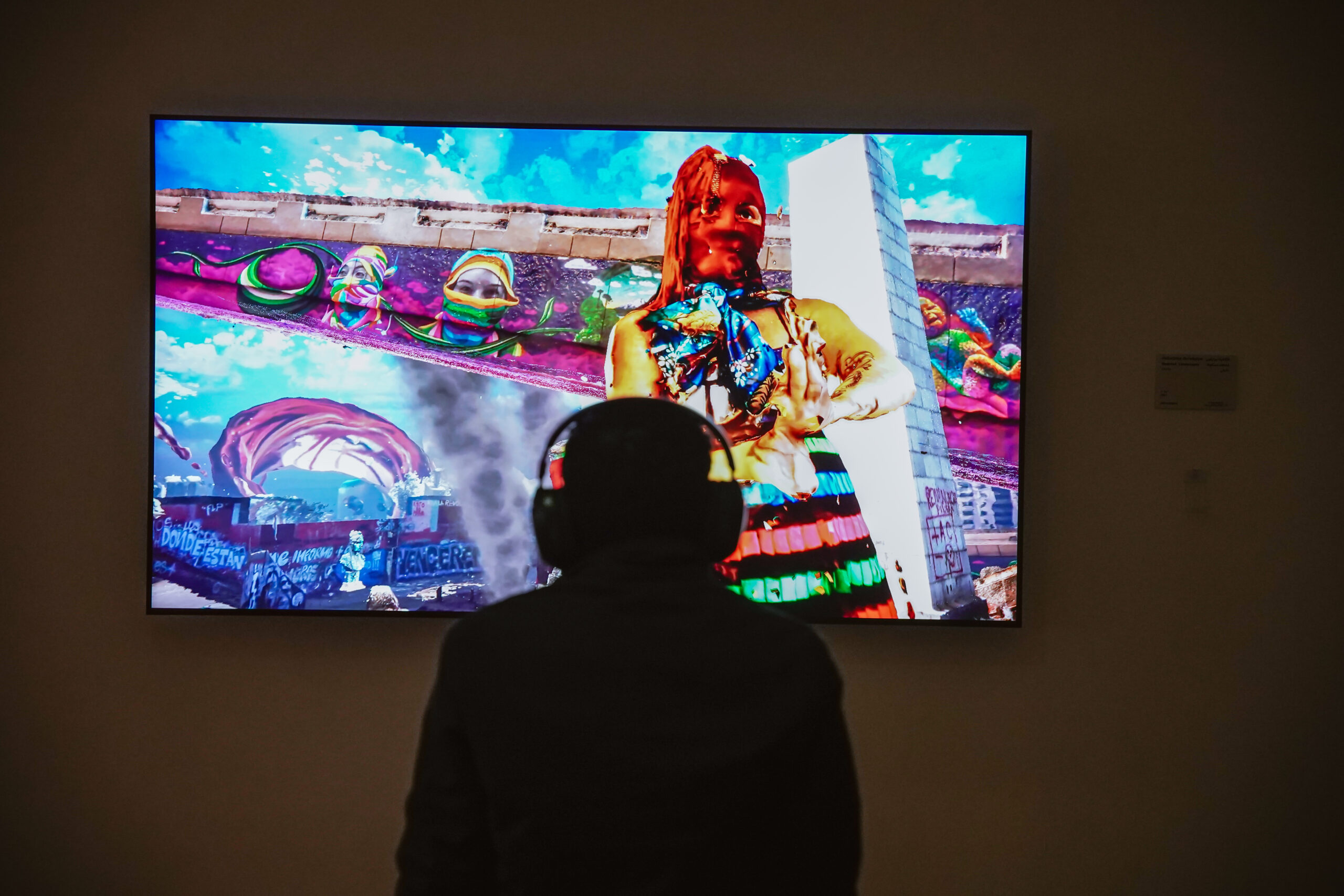
As Fayed writes in his curatorial notes, these works successfully “traverse a fine line between the virtuosity of technological tools and and their limits and pitfalls.” This is evident across the spectrum from digital animation to live action. In Omar Bazan (SAREENA)’s Digital Threads (Egypt), creatures too gorgeous for gaming float in celestial ruins, swaddled in a dense goth-noise soundscape by Egyptian musician Electroneya. A green-winged fairy floats like an angel — a smudge-eyed, spiky-haired and sharp-eared punk on a wheelchair who fixes the camera with their gaze. As a virtual camera explores the mostly still digital image, the video is sumptuous but economical. Combining VR, performance and elaborate costume design, Valentina Berthelon’s Haunted Landscapes (Chile) transforms a 2019 people’s uprising into a joyously apocalyptic work in which glorious Amazons stride through the colorful ruins of Santiago. In the artistic duo BiglerWeibel’s hilariously erotic Fleisch am Bau (Switzerland), feminine limbs infiltrate and caress serious-looking public buildings. And Joel Jimenez’s grave live-action La Panadella (Spain) is a fog-clad hotel where waiters prepare ceremoniously for absent guests. As a voice utters a prayer that they may travel safely and “may all have consciousness together,” it feels that we are witnessing the staging ground for a collective act of memory or time travel.
The Earth’s wisdom and, sometimes, its rightful hostility toward us humans, arose across the festival. The Currency—Sensing 1 Agbogbloshie, by Elom 20ce (Togo), Musquiqui Chihying (Taiwan) and Gregor Kasper (Germany), is an incantation in a Ghana e-waste dump, sonified in thrilling groans and rumbles. I felt that Elom 20ce was performing as a kind of antenna, linking the sad dead minerals and pulverized fossils (i.e. plastic) of rich countries’ abandoned tech with the deep, live currents alive in Africa. Here, the video titles say, the four elements are fire, earth, water — and feather.


At Medrar, I was hypnotized by Lebanese filmmaker Nour Ouayda’s The Secret Garden, a film about plants that conspire to rebel against their captivity. Agitated shots of tangles of roots, a yucca plant squeezed on a balcony, or a bougainvillea vine aggressively climbing cables, with a whispered voiceover and unnerving crackling, percussion and insect sounds, suggested that the plants are just biding their time against us humans. Plant mysteries also abound in the surgical and almost unbearably sensuous Parallel Botany by US filmmaker Magdalena Bermudez.
As in Ouayda’s film, nature takes over in the snow-draped landscape of Paulius Sliaupa’s Winterteller (Lithuania) in a science fiction cloud seeding narrative. Sounds of the soft crunching of snow underfoot and the rattle of falling snowflakes accompany overhead shots of ruins created by snowfall, towns immobilized by snow and frozen fallen drones. Describing it all, an elegiac voiceover deems “the warmth of the human world a mark of failure.” I didn’t like the shift to AI-generated images, which I find annihilating in a completely different way, but I was inspired to contemplate the human world’s end not in fire but in snow.
Proudly self-contained experiments, the jewel-like shorts in the 11th Cairo Video Festival are not likely to be tamed into industrial nor indie cinema, and that is something to be glad about.
تقارير ذات صلة
9th Cairo Video Festival: Decentralization, representation and potentiality
What does it mean to have a city-specific festival, when different localities within a city can each contextualize that meaning in very different ways? The organizers of the 9th Cairo…
A letter about a nostalgic art tour: A screening and three exhibitions in Cairo
You were probably expecting this in a different format, but we’re living in a different time now
A review with a curatorial task: On the 8th Cairo Video Festival
What happens when a place's locality is taken for granted as detached from external relations?
Your support is the only way to ensure independent, progressive journalism survives.
You have a right to access accurate information, be stimulated by innovative and nuanced reporting, and be moved by compelling storytelling. Subscribe now to become part of the growing community of members who help us maintain our editorial independence.
Join us