
UN human development report on Egypt criticized for overlooking human rights concerns
Three prominent human rights organizations are preparing to address the administrator of the United Nations Development Program, Achim Steiner, to protest the contents of the body’s recent human development report on Egypt, which they say overlooks human rights concerns in Egypt, a source at one of the groups told Mada Masr on condition of anonymity.
The three organizations — Amnesty International, Human Rights Watch and the Cairo Institute for Human Rights Studies — are calling for the report to be temporarily withdrawn from all UNDP websites pending a review, for UNDP’s Egypt office to consult with human rights organizations and civil society before issuing its reports, and for an investigation to be launched into how such a report was released with the results made public, according to the source.
The report, issued in September, praises Egypt’s laws to combat terrorism, terrorist entities and cybercrime, which the organizations say ignores Egyptian authorities' use of the legislative framework to criminalize all forms of dissent and undermine guarantees of a fair trial for those accused of terrorism and national security-related offenses, the source said.
The three organizations also object to the report’s praise of a law regulating non-governmental organizations, which they say runs counter to previous positions by UN experts who have criticized the law for imposing restrictions on civil society. They also reject the report’s claims about Egypt’s commitment to procedures that are consistent with UN principles on the evacuation of residents in unsafe areas, which they say contradict previous statements by the UN’s special rapporteur on the right to adequate housing during a 2018 visit to Egypt, wherein she expressed concerns regarding evictions in informal areas, as well as the exclusion of local communities from participating in housing policy planning.
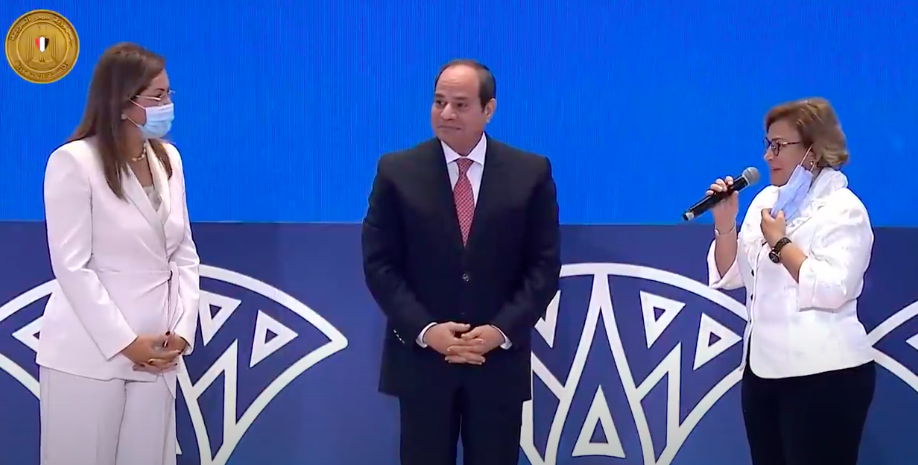
The UNDP and the Planning and Economic Development Ministry jointly launched the Egypt Human Development Report 2021 to much fanfare in mid-September, with President Abdel Fattah al-Sisi and other officials attending a ceremony in the new administrative capital to celebrate its issuance.
The report covers the years between 2011 and 2021 and comes over a decade after the publication of the previous Egypt Human Development Report in 2010. In the executive summary, the new report claims it “provides an analytical review of the policies adopted and implemented during this period and their impact on Egyptians” and “puts forward a set of policies for the future that would further boost the process of human development that Egypt has initiated.”
A previous human development report by the UNDP and Planning Ministry was published by the Finance Ministry in 2016, but was pulled from its website minutes later without explanation. Yet multiple sources who participated in the deleted 2016 report told Mada Masr on condition of anonymity that authorities pulled it because they found it too critical on issues of social justice.
One of the authors of this year’s report, who spoke to Mada Masr on condition of anonymity, said they sought to avoid a similar outcome with the current report by toning down the language. “Our goal was to release the report at any cost and to avoid the fate of the previous one,” the author said. “So, any criticism was toned down. Challenges, for instance, were turned into suggested recommendations.” Mostafa Kamel al-Sayed, a political science professor at Cairo University, agreed with the assessment, saying this year’s report “does not anger the government and avoids the fate of its predecessor.”
During the launch ceremony, Prime Minister Mostafa Madbuly said that the issuance of the new report after “a ten-year hiatus confirms that we have overcome challenges and have become more open.”
What could not be hidden
Sayed says while the new report “avoided almost all topics that would anger governments, chief among them public freedoms and political participation, and chose appropriate subject headings and titles to present many of the government’s achievements,” it nevertheless is a useful document that provides crucial data, particularly, on education and health, “without directing clear criticism at the government in this context.”
The education and health data to which Sayed referred appears in the report’s opening chapter, which breaks down the four sub-indexes used to calculate the composite Human Development Index (HDI): life expectancy at birth, expected years of schooling, average years of schooling and average Gross National Income (GNI) per capita.
According to the report, Egypt’s HDI in 2020 was 0.707, placing it 116th out of 189 countries. However, when inequalities are taken into account using the inequality-adjusted version of the metric, Egypt’s score drops 29.7 percent to 0.479, below the average score of 0.531 for Arab countries, as well as the 0.618 average for countries categorized as having “high human development.”
Egypt’s drop in the income inequality-adjusted HDI is attributed as follows: 11.6 percent due to inequality in life expectancy at birth, 38.1 percent due to inequality in education, and 36.5 percent due to income inequality. The report points in particular to education inequality as an area for improvement.
For example, compared to the 10 countries that precede it in the index and are at a similar economic level, Egypt has the lowest average number of years of schooling, even though it is ahead of six of them in terms of expected years of schooling. “These figures indicate the need to focus on improving the quality of education in Egypt,” the report said.

Heba al-Laithy, an advisor to the government Central Agency for Public Mobilization and Statistics (CAPMAS) who supervises the Household Income, Expenditure and Consumption Survey and has participated in previous human development reports, broke down to Mada Masr what this data reveals about inequality in education. “There is an increasing tendency among poor families to push their children to work, and thus drop out of secondary education in particular.” She added that "the decline in the national poverty rate in 2019-2020 compared to 2017-2018 is due in part to attempts to adapt to poverty by searching for new sources of income through child labor. This is reflected in the secondary school retention rates, which means that poor families are expending their human capital.”
The income, expenditure and consumption survey released by CAPMAS in December 2020 noted an increase in school enrolment rates among poor children aged 6–15, up to 95.2 percent in 2019-2020 from 94.3 percent in 2017-2018 for males, and from 92.6 percent to 94.2 percent for females. Meanwhile, the same data revealed a decline in school enrolment among poor 16–18 year-olds over the same period, from 76.7 percent to 76.2 percent among poor males, and from 69.1 percent to 66.4 percent among poor females.
In this context, the most recent UN human development report notes a decline in government spending on health and education in Egypt, as shown in the following graph.

The report compares these percentages to government spending on education during various years in the bracket of middle-income countries to which Egypt belongs.

Meanwhile, the following graphs illustrate government spending on health as a percentage of GDP, as well as total government spending in Egypt and selected middle-income countries that can be compared with Egypt:


Israa Adel El Husseiny, an associate professor of economics at Cairo University who co-authored the first chapter of the 2021 UNDP report, told Mada Masr that she does not think poor government spending on health and education is not a result of disproportionate resources directed to housing, as some critics have said. “The imbalance here is between health, education and housing on one hand, and other sectors on the other,” she explained.
“Classrooms are heavily overcrowded, and this is exacerbated as the population grows, with a very large percentage of Egyptians being of primary and preparatory school age,” Husseiny said. “Egypt now has about 23 million students in pre-university education.”
“Government spending rates on education and health in Egypt are lower than the rates in comparable countries,” she added. “Therefore, allocating more funding to education and health would improve the competitiveness of education and health in Egypt, as would expanding partnerships with the private sector.”
In Egypt’s budget for the coming fiscal year, spending on health and education fall short of minimum spending rates for the key sectors enshrined in the Constitution (six percent for education, three percent for health).
Ahmed Abdrabou, a visiting professor of comparative politics at the University of Denver who took part in the deleted 2016 report, says that the new report reflects the state’s discourse on rights. “By celebrating government achievements in some economic and social aspects, the new report serves the state-adopted discourse that prioritizes economic and social rights over political freedoms,” he said.
Mada Masr reached out to the new report’s lead author Khaled Zakaria, an advisor to the planning minister, but he was unavailable for comment.
Another source who took part in the deleted 2016 report told Mada Masr on condition of anonymity that “this year’s report may appear to be very light on criticism for one released by a UN agency. But those who work on such reports know well that local offices of international organizations often give the utmost priority to releasing their reports at any cost, so they exercise lots of flexibility with governments in order to do so.”
The Egypt Human Development Report is published by the UNDP office in Egypt in collaboration with the Planning Ministry, with the latter supplying the necessary data to compile the report. A third participant in the 2016 report told Mada Masr that “the Planning Ministry in fact plays a supervisory role, or let’s call it oversight, because ultimately the report can only be published with its approval.”
Why did the state bury the 2016 report?
Laithy, the CAPMAS adviser who took part in the deleted human development 2016 report, said that it “certainly wasn’t deleted for any reasons pertaining to professional or scientific issues.”
Another source who took part in the 2016 report said that its lead author, Magued Othman, told him after it was pulled that “ then-Interior Minister [Magdy Abdel Ghaffar] had told [Othman] that the government was displeased with the report because of the injustices it showed.”
Three other participants in the deleted report who spoke to Mada Masr on condition of anonymity all said that Othman’s justification at the time for the report being pulled was that “it wasn’t liked” by unspecified government agencies. A fourth source who took part in the 2016 report said that Othman informed them at the time that “the Egyptian government disagreed with the UN office on the report.”
While Othman, the director of the Egyptian Center for Public Opinion Research (Baseera), was the 2016 report’s main author, he is only credited as a reader in the new report. Mada Masr tried to reach Othman for comment, though he did not respond.
Mada Masr previously obtained a complete copy of the deleted 2016 report, which focused on addressing various aspects of social justice. It was scheduled for publication in November 2016, only days after the government devalued the Egyptian pound, which led to skyrocketing inflation and is linked to poverty rates rising to record levels in 2017-2018.
“The Egyptian government didn’t think at that particular time that addressing social justice in a human development report was among its priorities,” according to a prominent participant in the report who spoke to Mada Masr on condition of anonymity. “In fact, the opposite is true.”
تقارير ذات صلة

HRW and Amnesty International request investigation of ‘extrajudicial killings’ in leaked video
Amnesty International and HRW authenticated video showing the execution of civilians

The Board of Occupation
“We call it the board of peace. Sort of a beautiful name, the Board of Peace."
Egypt prepares to present human rights record to UN Human Rights Council
Egypt is set to present its human rights record for review before the United Nations Human Rights Council (UNHRC) on January 28, amid stark discrepancies between the government's depiction of…
Your support is the only way to ensure independent, progressive journalism survives.
You have a right to access accurate information, be stimulated by innovative and nuanced reporting, and be moved by compelling storytelling. Subscribe now to become part of the growing community of members who help us maintain our editorial independence.
Join us