
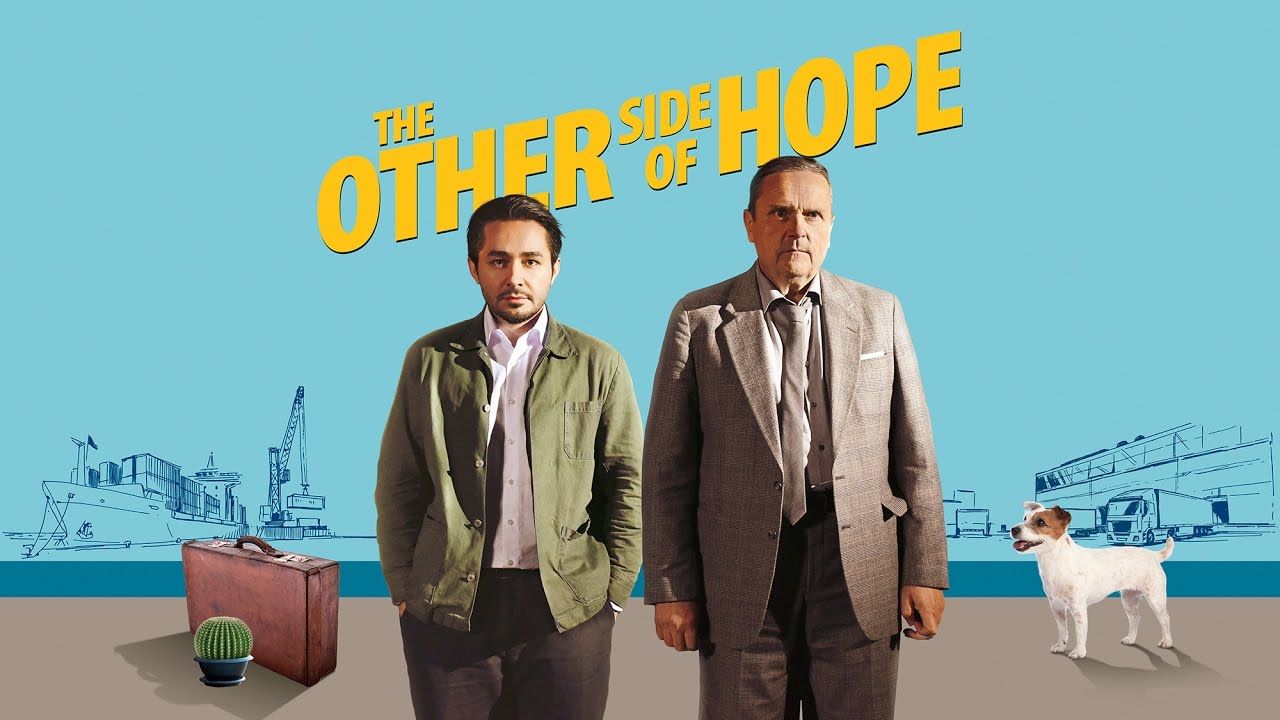
The other side of refugee dramas: Kaurismäki’s perfectly orchestrated tragicomedy
Finnish filmmaker Aki Kaurismäki’s The Other Side of Hope, a tragicomic treatment of the current refugee crisis, skips the usual political exposition and dives straight into the humanity of the situation, delivering a simple, honest and highly relatable story in the process.
The film opens with its Syrian refugee protagonist, Khaled (Sherwan Haji), sneaking out of a freight ship that has just arrived in Finland, while in a parallel scene we see the co-protagonist, Wikström (Sakari Kuosmanen), a Finnish salesman in the process of quitting his tedious job and marital life in pursuit of other interests. With this beginning, the film establishes two main character arcs, setting them in motion in separate directions. Simultaneously, we follow Khaled’s harsh confrontations with cold, apathetic Finnish authorities as he tries to legally seek asylum in the country, and Wikström’s efficient, materialistic approach as he sets out to invest in a new restaurant, placing both characters against one another in stark contrast.
The gravity of Khaled's situation and the depth of his suffering are exemplified in one powerful, genuine scene where he recounts the emotional story of his dead family, the destruction of his city and his quest to find the sister he lost on the Balkan route, his words met with a blank expression on the face of a detached government official. A corresponding, nearly dialogue-free scene shows Wikström during a poker game, entirely in his element and displaying a great command over his facial features — when he wins, he expresses his content with a barely noticeable smirk.
These two scenes highlight the differences between both men, and the power of Kaurismäki’s directorial style, particularly the way he manages his actors. Rather than attempt to control their performances, he places them in the carefully structured world he has created, and — providing them with comfort and freedom within it, evident in the ease with which they portray their characters — allows events and emotions to spontaneously unfold on the screen.
Although the director offers a humanistic story rather than one that is overtly political, he does not shy away from depicting the viciousness of his country’s refugee laws. The authorities decide that Khaled should be deported back to his country, concluding that, statistically, the situation in Aleppo is not a serious one. Juxtaposing this claim with real TV footage of the deadly conflicts in the Syrian city, Kaurismäki succeeds in getting a strong message across, and dramatically strengthens his story by establishing the government as “the villain,” in turn giving weight to Khaled as a “hero” in his continued struggle against it.
When Khaled goes on the run, his and Wikström's paths finally converge: The desperate Syrian clashes with the rigid, self-absorbed Finn, stirring within him a dormant compassion. Wikström offers Khaled a job in his restaurant, The Golden Pint, and adopts the role of a mentor to him throughout his ordeal.
Kaurismäki assumes an expressive visual style throughout the film, relying on an almost exclusively cold-colored palette, mixed with flat lighting and minimalist decoration in most locations. He contradicts his still portrayal of the cold industrial environment of Helsinki with the colorful presence of the film’s immigrant characters, bringing in vibrant life with their bright clothes and flavorful food, as opposed to the bland cuisine being served at The Golden Pint. The restaurant is used as a simple, comic symbol for the cultural integration taking place, as it switches from serving cold sardines and playing classical music to offering Japanese food and dance numbers, the scenes gradually growing warmer and more colorful.
What is most impressive, however, is that while highlighting this change, Kaurismäki never allows us to forget the hardship these characters endure, etching subtle but unmistakable traces of it in their faces, attitudes and sparse moments of silence. Yet unlike the stereotypically sad, martyred portrayals of refugees, Khaled is witty, cynical and disillusioned, making him a well-rounded character that earns empathy — like Wikström’s — without ever demanding it.
Music is also a very important tool that serves Kaurismäki's narrative. Uplifting tunes from the Finnish rock and roll scene, alleviating the city’s oppressive atmosphere, and melancholic melodies played by Khaled on the oud, emphasizing the tragic nature of his predicament, make for an overall brilliant soundtrack that becomes an integral part of the film.
Kaurismäki — along with cinematographer Timo Salminen — depends on still frame compositions, with mostly medium shots in which the action is slowly orchestrated to convey the intended mood and emotion. He resorts to dialogue only when necessary, keeping it short and embedded with deadpan humor. One daring choice he makes in the film is suggesting the ironic connection between the stray dog the employees adopt and hide from Wikström after he orders it gone, and Khaled, the illegal immigrant Wikström takes in and hides from the government. Only an artist with extraordinary sensitivity can pull off a parallel like this without being offensive, employing it as a humorous and engaging trope to highlight the multi-layered reality of power structures in our world.
When asked at the Berlin International Film Festival, where his film won the Silver Bear, what he thinks about the “Islamization of Europe,” Kaurismäk's answer was "I don't see any Islamization … all I see is a normal cultural change, which I think we need because our blood is getting too thick." In The Other Side of Hope, he makes this strong statement with the simplest and richest of cinematic means.
—
The Other Side of Hope screens during the following times in the 10th Panorama of the European Film:
Thursday November 9 at 7:00 pm in Port Said
Friday November 10 at 7:00 pm in Zamalek Cinema
Friday November 17 at 10:00 pm in Zawya Cinema
تقارير ذات صلة
Unworkshoppable cinema: A visit to the 11th Cairo Video Festival
Recently, I finally got to see Payal Kapadia’s All We Imagine as Light (2024), winner of the Cannes Grand Prix. I was lucky to experience it in a theater and…
The thin thread between misogyny and emancipation
Faten Hamama gives a rare, realistic portrayal of the frustration experienced by women in Egypt
Detox | No drama
#31: Without the drama, though — both on-screen and in all our lives — what's left to explore?
Your support is the only way to ensure independent, progressive journalism survives.
You have a right to access accurate information, be stimulated by innovative and nuanced reporting, and be moved by compelling storytelling. Subscribe now to become part of the growing community of members who help us maintain our editorial independence.
Join us