
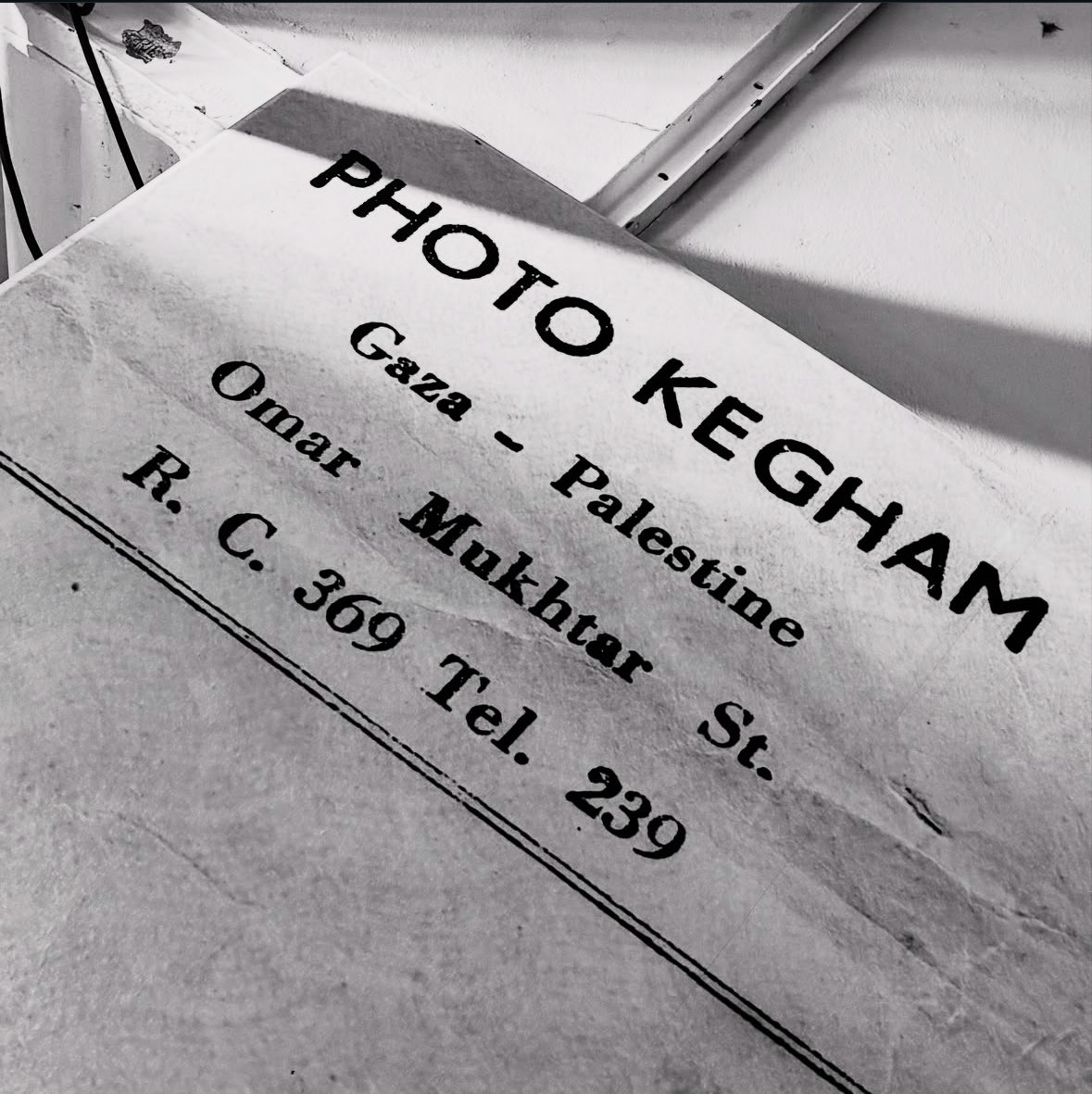
A woman lies in the grass, Odalisque-like, but in a dress, shielding her eyes from the sun. A larger portrait shows a dark-haired woman in a delicately floral shirt, craquelures stretching across the surface of the print. A boy, caught in a landscape, locks eyes with the camera lens. A man stretched out on a beach pulls on a nargileh. A teenage girl in pleated trousers, unbothered and smiling, leans against the office of Gaza’s National Guard. Men eat as a boy, both hands and mouth full of rice, stares at me. Che Guevara stands surrounded by a small crowd. A boat sails in silence.
Midwives in training cradle a model baby. Two nurses stand with a newborn between them. A sturdy nurse holds a newborn, just delivered. Next to her, a boy beams. Young people laugh, tossing an infant skyward. A man plays the piano languidly. Dancers are caught mid-step. Girls in a classroom study a photograph. A young Hassan al-Banna poses in a freshly pressed suit, standing in a garden. Planes hum overhead.
The Great Omari Mosque stands. A wedding photo: a bride’s cleavage and a turbaned man in sunglasses. Solemn faces blur into one another, the images superimposed, outlines merging. Grainy photographs, aged, negatives damaged, glossy prints. Silvery prints wrinkle and warp, the photos behind protective glass, I sidestep my own reflection. Children gather around a head of lettuce, laughing. A boy stands, legs apart, staring straight ahead, a UN biplane behind him. Two kids clutch a windmill; three are dressed as cowboys. A camel, then a girl expertly balances on a boat, one hand raised to the sky. People, all dressed up for masquerade ball — nurses, nuns, kimonos, a belly dancer — costumed, cross-dressed. Yul Brynner smiles.
Frames of joyful irreverence. Silhouettes of lovers and loners fade into cloudy sunsets in greyscale. Carefully set tables gleam with expensive crystal, raised in a toast.
Two adults and six children huddle around a checkered tablecloth, pouring over homework. Israeli forces retreat down Omar al-Mukhtar Street. Uniformed soldiers — perhaps Palestinians — pose on train tracks. Two others stand in front of a UNRWA jeep, with pressed uniforms and blank faces.
What stays with me is a small photograph of a man, head tilted upward, eyes glancing at the sky, softly smiling. It’s unremarkably beautiful — forgettable, it has burrowed itself into my memory.

Djeghalian ended up in Gaza by way of Syria, where he had sought refuge — he was a child when he survived the 1915 Armenian genocide. He earned a living taking photos and tattooing British soldiers before settling in Gaza with his wife, Zeyart Nakashian. In 1944, he founded Photo Kegham, Gaza’s first photo studio, where he worked until his death in 1981.
The legacy, as recounted by his grandson, has taken the form of a traveling exhibition — an epilogue to an undocumented history. The tragedy of the studio’s loss and the destruction of much of its archive reached its most devastating point when its last steward, Marwan al-Tarazi, was killed on October 19, 2023, during the ongoing genocide. Tarazi, his wife and granddaughter were killed when Israel bombed Gaza’s Greek Orthodox church. The exhibition features Tarazi as Kegham’s interlocutor.
My rage flares as Kegham recounts to me the ordeals and ambivalence of regional museums — their unwillingness to help save or preserve Studio Kegham’s archive. The exhibition represents only a fraction of what remains, he tells me, the entire show, which to me seems dizzyingly expansive, is developed from three boxes of negatives he found rummaging through a family closet in Cairo. The boxes, red, are also on display, alongside old cameras and documents. One document in particular catches my attention: a letter Kegham’s grandfather addressed to the Governor General of Gaza on November 9, 1956. It includes an inventory of items damaged or missing from the studio after Israeli soldiers forcibly entered it “by explanation of gunshot” on Friday, November 2.
 In a recent visit to the Yarmouk Camp in Syria, I experienced, firsthand and for the first time, such sprawling devastation. The camp felt like a continuous image, rubble, debris, scaffolding remains — my mind only registers grey. This is what Gaza feels like to me — I’ve touched this image everyday scrolling through thousands of photographs, for more than 400 days. The ceasefire hasn’t quite dissolved the continuous image of humanitarian crisis, but it introduces a pause to think of how we might picture it as the violence diminishes.
The war in Gaza is the most documented genocide in recent history. The repeated exposure creates a form of cognitive dissonance. The mechanical resharing of images eventually becomes numbing. The image of violence becomes ubiquitous and thus normalized. The only way to imagine Gaza is through picturing its devastation. The image, my heart argues, is necessary — it focuses attention on the genocide. Picturing Gaza’s humanitarian crisis is also a representation of the extraordinary resistance and struggle of the Palestinian people. It evidences the ongoing struggle for a state and fortifies memory of loss against forgetting. “The greatest battle Palestinians have waged as a people,” Edward Said once said, “has been over the right to a remembered presence and with that presence the right to possess and reclaim a collective historical reality at least since the Zionist movement began…” The image of Gaza is its dispossession.
In The Least of All Possible Evils: Humanitarian Violence from Arendt to Gaza (Verso, 2011), Eyal Weizman and Ariella Azoulay tell us that visible ruins become sites around which people gather, with destruction at the center. These spaces of assembly — the “visible ruins,” as Azoulay explains — become markers of colonial power. Even when the colonizer is absent, domination and violence remain ever-present within the humanitarian image.

The history of the humanitarian image of Gaza dates back to the mid-20th century, roughly from 1948 to 1968, when the United Nations Relief and Works Agency (UNRWA) actively documented Gaza, primarily for fundraising purposes. The photographic focus has been dispossession, often decontextualized: tent encampments, internally displaced Gazans queuing for food rations and supplies, bombed schools, hospitals and infrastructure. The most extensive archive we know of is the UNRWA archive, which focuses on community and care work. The living digital archive documenting the ongoing genocide continues to grow day by day, extending from that foundation.
But there is a history of critical image-making practices that outright resist Gaza’s humanitarian image. After visiting Unboxing, I turned to the anthology Gaza on Screen (Duke University Press, 2023), which followed from a film festival at Columbia University in New York, in 2019. The book, which I highly recommend, and its contributions by Gazan filmmakers and scholars make a critical argument about how we think of images of Gaza, which exceed a documentation function and become a basis for spurring and maintaining solidarity while holding space for potential, for a different future.
I want to imagine Gaza, and not as a humanitarian image. Gaza is near but has always, to me, felt like an abstraction. Until today, I’ve never visited Palestine. Still, when I have tried to picture Gaza — before the war — I’ve turned to Alaa Abdel Fattah’s essay, “Gaza: To be a prisoner of your own victory.” Alaa visited during the brief interstitial moment when the borders with Gaza were open, under the Muslim Brotherhood’s brief tenure in government. Gaza is distinct from other Palestinian cities. Bethlehem and Jerusalem are iconic, Gaza is not. He describes arriving at the strip with “tourist eyes,” in search of war wreckage, bombed buildings, and stereotypical destruction. “We’re not seeing any ruins,” he writes, “because the people of Gaza are busy with life, prising out and flattening the rebar from the rubble, grinding up the ruins into new cement and bricks… Do you look for rubble and destruction and ignore the people you’ve seen flattening out bomb-twisted steel?”

The political import of an exhibition like Unboxing is obvious. It presents an emphatic counter-image to the Gaza we’ve been conditioned to see — a Gaza that is colonized, destroyed, its image flattened into one of humanitarian crisis and irreparable destruction. Unboxing disrupts this narrative. It reconditions the viewer, but more importantly, it offers something revolutionary: an image of Gaza that is ordinary: a Gaza of quotidian moments, vibrant and alive — a cosmopolitan city, politically active, culturally diverse, familiarly sunny, opening onto the Mediterranean.
This focus on Gaza, historically framed by the years 1947-1948, draws attention to what Darryl Li has described as “the paradox of the Zionist victory in 1948,” with the largest concentration of displaced Palestinians fleeing west and settling into the strip, impeded by the natural topography of the Sinai desert. Thinking of Gaza pre-1948 feels even more politically urgent. It calls to mind Ghassan Kanafani’s critique of how narrowing the Palestinian struggle to the founding of Israel alienates the cause, ignoring decades of colonial domination — whether British, Zionist settler-colonial, or later, under the guise of humanitarian intervention.
The victimization of Palestine, amplified by the ubiquitous picturing of devastation, reduces it to a humanitarian image of crisis. Without a counter-image, the revolutionary struggle of the Palestinian people risks dulling us into pity and shades of empathy, instead of galvanizing solidarity — or, rather, asserting truth. On some level, we are aware of this — the recent release of an image in Al Jazeera’s recent documentary of the late Hamas leader Yahya Sinwar, casually trekking through the rubble, cloaked and smiling, almost prophetic, is entrancing — it has already begun to spark critical engagement and analysis. We crave the counter-image.
Kanafani’s call for literature and art that engage with resistance — rooted in a history that predates 1948 — is answered with clarity in Unboxing. The exhibition, in its quiet intimacy, stripped of pomp or spectacle, affirms Gaza, and by extension, Palestine, as whole, rooted and undeniable.


Sarah A. Rifky
Sarah Rifky is a curator and writer based in Cairo, Egypt. She is the co-founder of the Beirut art initiative.
تقارير ذات صلة

Gaza’s phase two arrives. Kind of …
Consensus over key questions lags behind the United States' announcement of progress.

Kings of famine
How a network of businessmen made over US$1 billion in “goods coordination”
A walk through the ruins of Zeitoun
Thaer Abu Aoun looks for any trace of the Gaza City neighborhood in the wake of Israeli withdrawal
Your support is the only way to ensure independent, progressive journalism survives.
You have a right to access accurate information, be stimulated by innovative and nuanced reporting, and be moved by compelling storytelling. Subscribe now to become part of the growing community of members who help us maintain our editorial independence.
Join us