
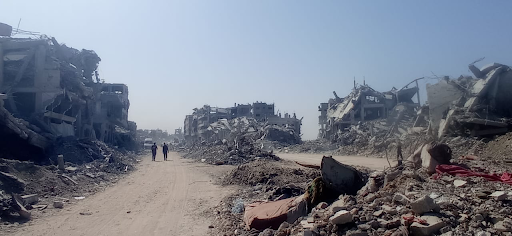
A walk through the ruins of Zeitoun
When I returned from southern Gaza after nearly a month of harsh displacement, it was hard to face the extent of destruction that the Israeli military had inflicted on my city.
In those first days of being back in Gaza City, I walked the extent of the city, trying to recall its features, its landmarks, its old buildings.
At some point, I found myself lost in a place I should have known by heart. The wreckage all looked the same. Colors and contours vanished, and the city became unvarying, sheathed in an ugly, uniform grey that depresses the soul.
I found a frail boy struggling to lift a bundle of firewood — pieces of what seems to have once been a child’s bed — and asked him where I was. “You’re in the Nadim area, west of Zeitoun,” he answered.
His answer shocked me. I knew this place so well. I looked left and right, trying to find something I could recognize, something that I could compare to my memory of this place. But it was more difficult than it seemed. This is a place that has clearly been destroyed over and over again and all of its features disappeared.
I headed east, and with every step, the uglier the destruction and the darker the grey became.
I could tell at first glance that several explosive-laden vehicles were detonated here. The buildings look like they were struck by a massive earthquake, or as if a nuclear bomb went off here.
I kept walking, my senses alert to any danger. There were fewer people the further east I went, which could only mean one thing: I was approaching the yellow line.
Getting closer to the yellow line means certain death. There, the Israeli military is positioned, its gun barrels aimed toward anyone who dares to approach — unarmed or not, young or old. Everyone is a target.
Just as I was about to turn back, someone called out to me: “Don’t go any further east, or you won’t come back.”
I nodded and changed direction. But before I left, I asked him where I was. “This street ahead of you is Salah Eddin,” he said.
Salah Eddin, the largest and most vital of Gaza’s streets. The military’s proximity to it means that the Occupation has carved out half of the city, keeping it under its control.
I thought about the many olive trees that had filled the eastern side of this neighborhood. Surely, there’s no trace of them now.
I headed north this time, walking along a street that could hardly be called a street anymore. A hole here, a hole there. I tripped a few times as I looked around. I had to sit down on a stone from the ruins of a house to catch my breath. Then I kept walking.
I came across a man sitting with his family on the rubble of a destroyed home. We talked, and he told me about his 40-year-old home, where 11 families had lived, now reduced to rubble.
As he spoke, Kamal al-Sarhy pointed to his family’s house, his eyes brimming with tears.
“I was displaced to southern Gaza when the shelling intensified in Zeitoun,” he said. “I was the last to leave this neighborhood, when the remote controlled explosive vehicles reached right under my home. I realized then that evacuation was the only way to save the lives of my family and myself.”
It was then that Sarhy gathered the belongings he could carry and left in the cover of darkness, first heading west and then finally making his way to the south. “We lived through all forms of suffering there — displacement and homelessness, the search for a tent to shelter us,” he said. “When I learned that there was a ceasefire and that the military was withdrawing from parts of the city, I chose to return immediately to see what had happened to my home.”
But Sarhy told me he was stunned by what he found when he returned. “It left me in a state of shock. I still haven’t recovered. My home, my family’s home, was razed to the ground. And here I am today, sitting on its ruins, not knowing what the days will bring,” Kamal said.
Thousands of buildings and houses across Gaza City have been leveled, its infrastructure erased, as if it had never existed.
Hussein Jamal, a resident of Zeitoun, told me the Occupation didn’t stop at destroying homes and buildings in the city. It sought to destroy anything that might later make the city habitable. There is no water, no electricity, no sewage systems, no hospitals, no schools, no universities. All of it has been reduced to rubble.
“Just to get water, I need to walk for miles in search of a source. To charge my phone, I need to walk for miles to find a person who owns a solar panel,” Hussein told me. “Life has become difficult to the extreme.”
“I was displaced to the southern strip when there was no other way. Tanks had reached deep into the neighborhood, and everything in their path was a target.” he said. “When the military withdrew, I found my home reduced to rubble, and the memories it held became a thing of the past.”
As I walked on through the neighborhood, I came across an elderly man digging through the rubble of a building. “This is my house, and underneath it is the body of my son,” he told me.
How could a father in his seventies, with all the cruelty and suffering he has been through in this genocidal war, bear such a psychologically heavy and damaging task: digging through the ruins in search of his son, whom he might never find?
I tried to keep talking to him as he sifted through the rubble. I asked him what happened. “My son refused to leave the neighbourhood. He thought the military wouldn’t reach our area, but he was wrong.”
“I’ve been searching through this rubble for days, hoping to find his body or even a part of it to console myself, to know that I had found him and given him a burial. At first, there were some people helping me, but, over time, they gave up, and I was left alone searching for him,” he said.
I touched him on the shoulder and continued walking.
I was trying to find anything that resembles the city’s erased features.
Here, there was once a mosque. I could tell by its minaret, of which only the top remains. And here was once a park. Here, a restaurant I used to visit before the war. Here was the home of one of my relatives, and here, there was the home of my friend Omar — Omar who was martyred several months ago while trying to bring food for his family. He was killed by a soldier who made sniping at unarmed, starved youth a game for his own amusement.
He was martyred while trying to reach his family with the sack of flour he was carrying. And now his home is gone.
I stood outside Omar’s home, that home that was once filled with life and laughter that brought us together so many times, that today has become nothing but rubble cloaked in grey.
I wished peace upon the house and its departed owners and continued walking.
تقارير ذات صلة

Gaza’s phase two arrives. Kind of …
Consensus over key questions lags behind the United States' announcement of progress.

Gaza’s child amputees

Israel finally approves Egypt’s gas deal after nail-biting battle
In an unexpected move, Israeli Prime Minister Benjamin Netanyahu announced on Wednesday Israel’s final approval of a controversial gas export deal with Egypt, months after Israeli hesitation following the initial…
Your support is the only way to ensure independent, progressive journalism survives.
You have a right to access accurate information, be stimulated by innovative and nuanced reporting, and be moved by compelling storytelling. Subscribe now to become part of the growing community of members who help us maintain our editorial independence.
Join us