
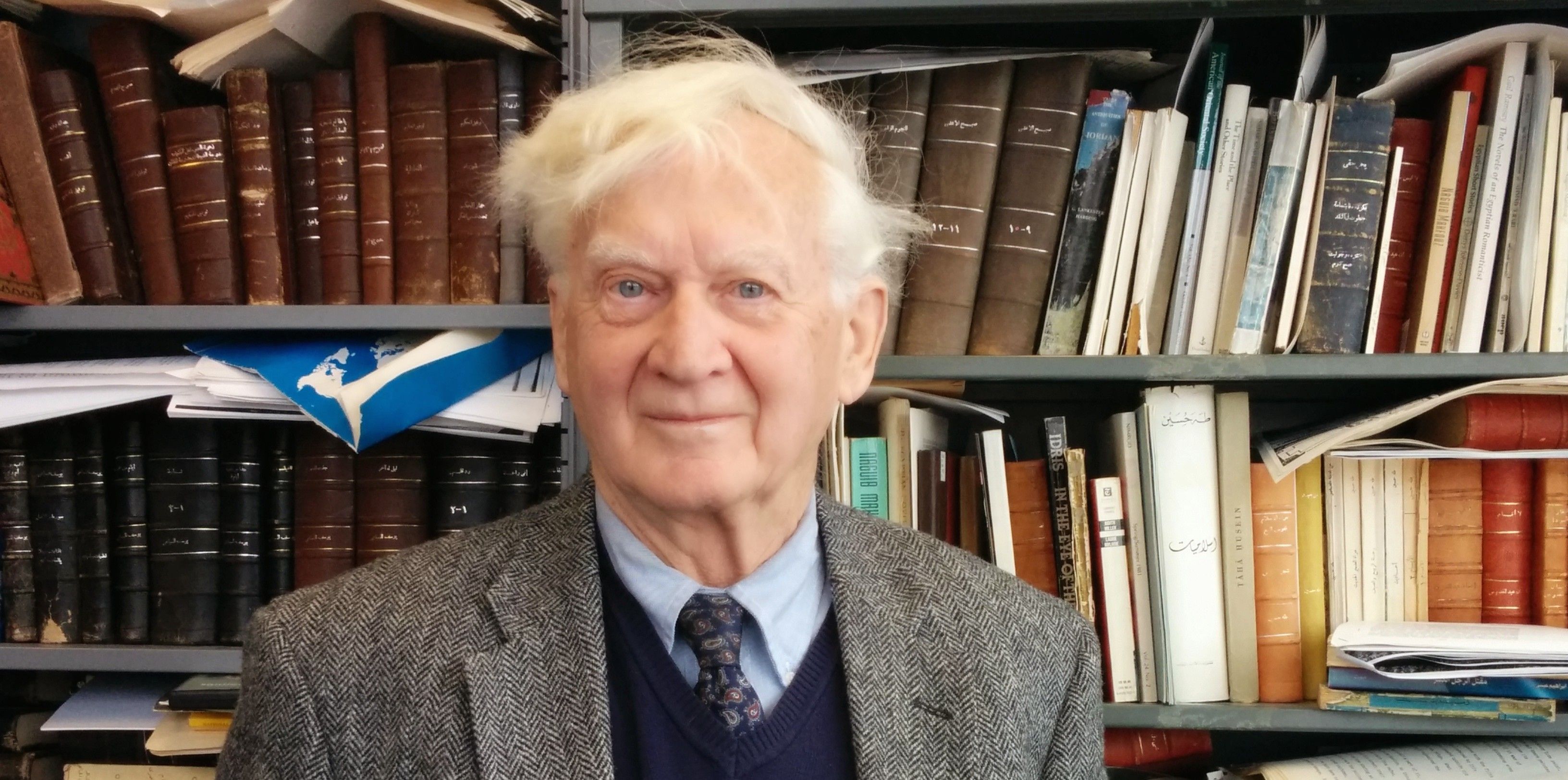
Part 1 of this interview, on Naguib Mahfouz's Midaq Alley and translation, is here.
On becoming an Arabist
HG: You started asking about Arabic novels after graduation. Weren’t you exposed to any contemporary Arabic literature during your studies at SOAS?
TL: For my PhD I had read studies on the national question by political theorists such as Satea al-Husary, Kostantin Zoreik (whom I later worked with during my fellowship at AUB), and also the Baathists, who were all advocating Arab unity against the threat of Zionism. Before that, my BA degree was in classical Arabic and all I did was prepare for that awful final exam, and contemporary novels were not part of the curriculum.
HG: And what do you think of that idea of Arab unity?
TL: If I were an Arab, I would support it. I would be pissed at the jealousies and the contending interests.
HG: So in your study program you never met people who came from Arab countries?
TL: There were. One close friendship I established very early in those years was with Salma El Jayyousi. I later co-authored with her our English translation of Emile Habibi’s novel The Secret Life of Saeed. We still find ways to see one another whenever we can, every summer or so.
HG: And knowing someone like her did not solve the familiarity issue with Arab culture back then?
TL: Even though I knew her very well, I just didn’t get it unfortunately. Essentially in my studies of Arabic at the University of London and in my work in the Middle East, I had great respect developed for Arabs, but I really didn’t quite understand what made people tick. I didn’t really understand the depth of the Arab-Israeli issue.
I tried hard but I just didn’t understand fully the seriousness of this. They were terribly serious because of the threat they perceive from possible expansion and the total injustices of how the Palestinians were treated. But I didn’t understand at all why they were always harking on Zionism and so on, because of course in my background in Britain, as you know, the creation of Israel was seen as a wonderful fulfillment of God’s promise and that it would all work out for absolutely everyone, including in the Middle East itself.
HG: Is Balfour well known to British people, Lord Balfour?
TL: No. It is astonishing how little knowledge there is in the West about the history of the establishment of Israel.
HG: When was it that you were studying Arabic?
TL: I started in 1955 and finished my first degree in 1958, so I was right there at the time when the Egyptian problem with Nasser [the Tripartite Aggression] was international, and I had ideas of joining the foreign service. It was obviously a good thing to study Arabic at that time.
HG: Did you have a special knack for languages?
TL: I studied French and German in school, and then when I was a conscript for two years in the navy I had the option of studying Russian in a language program. I enjoyed literature, not so much the languages as I hated so much to learn grammar. So after my Russian studies, you see, I wondered what to do with myself, and it occurred to me that to study Arabic would be a good idea.
I was five years old when World War II broke out and my father was at the Royal Navy. I was old enough even then to understand the war issue and the possibility that he wouldn’t survive, and of course the Nazis were dropping bombs over me all the time in the place where I lived in England, in Kent. My childhood and upbringing had given me perhaps an unusual sense of international affairs and international problems. Bombs were dropped in my neighborhood, we had shelters in our house and garden where we would hide because we might get killed.
HG: So the childhood experience of WWII was behind your interest in studying German, French and Russian. Was it then the Suez crisis that made you want to study the rise of Arab nationalism?
TL: Essentially, yes. It was a very serious issue from the viewpoint of the British, because British values were being challenged. Obviously British rights of ownership of the international Suez Canal company and all the rest of it. And you know there was a large number of British and French citizens living in Egypt at the time, seeking the sun of course, and a pleasant lifestyle, all of which was being threatened by Egyptian nationalism. And of course [Gamal Abdel] Nasser was a dictator, popular as he might have been in some regards, or as he presented himself to be. I was very much instinctively against dictators because I lived through WWII brought about by Adolf Hitler and Mussolini and the fact that no one knew how to control these crazy people. So being British I was brought up to think that anyone who wanted power shouldn’t have it. Nasser was a typical dictator. He believed he knew what was right and he wanted to bring that intuition to society regardless. He had some good qualities, but we in Britain look upon people who, like Gamal, seize power for themselves to be potentially problematic.
HG: You loved your country too. Were you a nationalist? Was it a post-war sentiment to be against nationalism?
TL: I knew clearly that something was very wrong with the world at large, and part of that had to do with the role of the Brits in influencing and dominating so many areas.
HG: The writings of the early Arab nationalists you were studying were mainly about the Zionist threat; or were they also about European imperialism?
TL: To them it was the same thing. It was Zionism and imperialism combined.
HG: So if Nasser was the dictator, what was the perception of the conflict over Palestine? Who was the opponent there?
TL: Well what happened was, as time went by in WWII, the world public came to see the despicable way the Jews were treated — the gas chambers of course, and all of that. And as soon as 1945 came and we gradually moved into occupation of areas where there were concentration camps, immediately the images were there on televisions. I had access to news programs, both radio and television, from that very year. The victorious soldiers, Americans and Brits, who first saw the camps had cameras. All those horrific pictures of mass graves and evidence of torture I saw at the age of 12 have been part of my memory.
HG: That must have resulted in huge feelings of sympathy and guilt.
TL: Of course. Enormous. And the British public generally knew of the ongoing attacks from Palestinian nationalists against the British mandate that first encouraged Jewish immigration there.
HG: And the Palestinians had rooted for the Germans in the war.
TL: Of course. Hajj Amin al-Husseiny, and I’m one of the few people who met him (that’s one of my few boasts that’s entirely appropriate — the other one is having met Faten Hamama when Yusuf Idris invited me to the opening night of the film Al-Haram [The Sin, 1965]). You may not realize it, but Husseiny was appointed by the British, and was considered a moderate and reasonable figure. But ultimately he grew disappointed by the British policy of allowing large-scale Jewish immigration, and in a sense of desperation he joined antagonistic forces in Iraq, fighting the British and not knowing what to do with himself. He later made his way to Germany where he was notoriously photographed shaking hands with Hitler.
HG: In Midaq Alley, we find the same support for Germans against the British occupiers is expressed by the Egyptian characters.
TL: Of course, “the enemy of my enemy is my friend.” Incidentally, my father shook hands with Churchill, you see, and I shook hands with Amin al-Husseiny, who had also shaken hands with Hitler. A curious circle of connections!
HG: Denys Johnson Davies referred to you as an Arabist, not merely a translator or scholar. What’s an Arabist? And how did that come about?
TL: Sometimes, from the American point of view, the connotations of being an Arabist are bad — because the concept is that if you’re an Arabist, you’re an Arab-lover and on the Arab side, as opposed to being more “rational” and therefore on the Israeli side. And I’ve been identified as a sympathizer with Palestine, especially through my translations of Arab fiction that express the Arab perspective on the conflict.
HG: Are these divides still significant now?
TL: Absolutely. Of course, the recent issue of Steven Salaita in Southern Illinois might be illustrative of what goes behind the scenes in many universities. I sometimes wonder whether there are those with a Zionist agenda who would like me to retire or resign.
Katie Glupker: None of these students ever said they wanted to be an Arabist. Can you tell us what that is?
TL: Well, if you’ve heard of Edward Said’s seminal work Orientalism, he depicted the Orientalists as a pretty nasty group, and Orientalism a shameful profession full of Western bias against Arab and Islamic views on religion and on life. Arabists use the term to differentiate themselves from Orientalists, but when I began my studies I probably thought of myself as an Orientalist, which wasn’t a negative term at that point.
But nowadays, we refer to ourselves as Arabists if we have a favorable or neutral view of the Arab world rather than a negative one, and a realistic one rather than a romantic one. Orientalists are always blamed for being too romantic or too negative.
KG: And what do Arabists do?
TL: They try to learn the Arabic language, and then use it one way or the other as journalists or translators. But it has a connotation of being someone who’s favorably inclined toward Arab society and culture, of course. It’s not a word that implies a negative confrontation.
After Midaq Alley came out, it became relatively famous — not so much in the general reading environment in the UK and the USA, but in terms people who studied Arabic literature who really weren’t aware that there was a novelist around in the Arab world of a high caliber. They were surprised by this novel. My next work was [Halim Barakat’s 1974 novel] The Days of Dust, which has a pro-Palestinian view, and that is a very interesting book. It deals with 1967, and people find it to be greatly enlightening about the problems and peoples in the Middle East. I always recommend it to students, and those who do read it say it changed their perception. I recommend it to you, it really is an important work to read because the Arab world is still stuck in the problem of the 1967 war.
KG: You said one of the reasons you picked Naguib Mahfouz was because you wanted to learn more about Arabic culture, then you said that some of the things you read seemed universal. Can you talk about that aspect of literature as a window into a specific culture? Most people don’t read work in translation. [Addressing the students:] You haven’t read many, I haven’t read very many. Do we read this so we can learn about another place, or are these people just like us?
TL: I grew up in Britain, and at the time of my upbringing, Britain was not an arrogantly and obnoxiously racist society, but it was a society that was mostly lily-white. There were very few people of color from Middle Eastern or African origins who were living in Britain at the time. The British population wasn’t anti-color, but on the other hand it didn’t understand people of color, and tended to view them negatively in my society. So there were certain terms used to define people of color in a negative way, Middle Eastern peoples included. So I grew up in a society where I was conscious of this negativity toward people from different cultures, and I reacted against it. Because I am convinced that we are all human beings, and one of my purposes in being an Arabist and introducing Arabic literature is to remind people and show them that indeed, we are all the same. Although we may have different shades of color and seem to have different values, in fact, our basic values are alike.
On Mahfouz, Ihsan Abdel Quddous and Yusuf Idris (et al)
HG: How did your meeting with Mahfouz go?
TL: It went just fine. I asked him what kind of division or percentage of royalties he preferred. I later learned that he referred to me as extraordinarily young. I was 20 years, or more, younger than him. He signed the contract and agreed to 50/50 division of royalties, which was very nice and generous of him — although I probably spent more time translating the book then he did writing it. But that was established very nicely. I always spoke to him in English — his English was very good, and I hate to butcher Arabic.
HG: Did you ever live in Cairo?
TL: I first visited Cairo in 1959, then I lived there for almost a year in 1963 when I was on a fellowship. But I kept up the contacts I made, and whenever I would go on sabbatical I would visit with them.
HG: You translated a few stories by Yusuf Idris, have you met him?
TL: I came to know him very well after meeting him in Cairo in 1963 and spending much time with him translating, with his close supervision, his amazingly courageous play Al-Farafir (1964) — one filled with dangerously snide comments and satire on the policies of Gamal Abdel Nasser. We became friends.
The next year, I was surprised and delighted to hear from him that he had been awarded a US State Department award that encouraged him to visit the US. He was initially hosted at the University of Chicago, and thereafter we invited him to come to Bloomington, Indiana, where I was teaching at the time, to talk to our students and faculty. When he arrived, he gave a nice optimistic and personal presentation on hopes for bringing change to Egypt through the efforts of courageous advocates of free speech, intellectuals such as Mahfouz and himself. He talked at length of their skills in presenting criticisms through their writings in fiction that were cleverly suggestive in their plots and characterizations without expressing themselves so openly as to be subjected to arrest or worse by the military regime and its agents.
Yusuf was a confident and engaging lecturer, and he spoke off-the-cuff with the enthusiasm and humor that made him so likeable and influential. We met again that evening in a forum that included some members of the Egyptian émigré community living in Indiana. As we chatted, voices were raised by some of them against the optimism and self-congratulatory tone of Yusuf's earlier remarks, with open criticisms of him and the other so-called "liberal" writers for being too tame in their cautious and nearly impenetrable suggestions in their writings in opposition to dictatorial rule in Egypt. What was needed, some of the Egyptians present forcefully argued, was more courage in open opposition from intellectuals inside the country — or, if that were impossible, emigration and opposition from overseas.
That meeting eventually dissolved and I met with Yusuf the next morning for breakfast. He seemed very depressed, devastated even, by the criticism leveled against him the previous evening. His difficult and deeply disturbing short story, Al-Aorta (The Aorta), by the way, that I later translated into English, suggests the misery of the Egyptian intellectual represented by Abduh — hated, shamed and viciously derided by an Egyptian public who insist that he has the solution to their problems, and who refuse to accept his pleas that he has been rendered impotent and empty by confinement and abuse in jail.
HG: You also translated Ihsan Abdel Quddous’s Ana Hurra (I’m Free, 1952). Have you known him? Do you think his work has been unfairly neglected by critics?
TL: Yes, it’s ridiculous! Let me illustrate the dilemma. Yusuf Idris once said to me the following riddle: “We will never forgive you for translating Ihsan.” Isn’t that significant?
HG: Who is “we"? And why?
TL: “We” is the intelligentsia of Egypt at the time. Why? Because of al-ain, al-hassad [the eye, envy]. Jealousy! They had huge jealousy of Ihsan Abdel Quddous. He had all the advantages. His mother was famous actress and publisher Rose al-Youssef; they always assumed he had big money in the bank. He told me that he didn’t, but they assumed that he did. They assumed he had power and access and control.
HG: Did it have to do with his political leanings? Wasn’t he a nationalist, and considered a supporter of the 1952 revolution and Nasser’s regime?
TL: People disliked Ihsan because of his success. Jealousy is a very important factor. Arabs understand this. We in the West don’t understand this at all, but it intrudes in our lives all the time. It was spiteful jealousy.
HD: Was he a better writer?
TL: He was more popular, and he was, in a sense, in control of them, because he had access to the film industry, for example, and he had his own printing presses. That he could publish a Yusuf Idris story and so assist it into film production anytime he wanted.
HG: He had power then, but now it’s gone and we only have his work. How do you rate the literary value of his work?
TL: I rated Ihsan very highly. I wrote an article that included commentary on him, Mahfouz and Yusuf Idris in the Middle East Journal in 1967. He wrote some novels that presented life from a woman’s view, like Al-Wisada Al-Khaliya (The Empty Pillow, 1957), for example. Very nice, appropriate discussion of the position of women in Egyptian society. The fact was, everybody was reading his work, and everybody knew that everybody else was reading his work. He reached a level of popularity that nobody else had. The American University in Cairo did a survey at one time on who was the most popular novelist, and Ihsan topped the list.
La Shai Yahom (Nothing Matters, 1963) is amazing. You must read it. I drew attention to it in my review because of what it does. At the time it was the most courageous piece of writing in Egypt since 1952. It asks questions about nationalization, for example, with sheer sarcasm.
HG: And that was permitted?
TG: But as a result of this he lost his ownership of the magazine Rose al-Youssef. I knew him well and I met him at his home. He was sitting at home because he was offended at a censor having been appointed in his office. He realized that he had lost favor with Nasser. His magazine had been excluded from nationalization before, because he was well-known to Gamal and a supporter of him from the beginning. It was he who explained the Arab defeat in 1948 by inventing the idea of the faulty arms that didn’t work. I believe the rumor was his own invention, and it was exactly what they needed to point to the corruption of the Egyptian government and ministers at the time and create a furor.
Incidentally, [Arab Legion commander] General [John Bagot] Glubb (or Glubb Pasha) came here to Ann Arbor to give a talk when I was a junior faculty member, and no one knew what to do with him after his talk. So I was selected to take him out to lunch and I asked him about the faulty arms issue. He should’ve known about it, but he said he never heard about it before. “Faulty arms? I never heard about it before, not the complaints, not the furor, nothing.”
HG: Wouldn't he have an interest in not admitting that?
TL: I don’t think so. General Glubb is the kind of Englishman who wouldn’t dream of telling a lie. He referred scathingly to Gamal Abdel Nasser, saying, “as far as I am concerned, he’s an awful nice fellow except that he’s always telling lies.” The British at that point really did believe that they were above telling lies. They didn’t need to.
Ihsan was at the fringes of the group surrounding Nasser throughout, and similarly with Sadat. But Ihsan was a very important writer. Nothing Matters introduces the idea of the secret service in Egypt in the form of officials in civilian clothes who might just enter an engineering company and say they have a need for various villas for government construction, demanding cooperation: “Build those villas and don’t tell anyone. Just build them.”
Imagine how this goes in the mid-1960s with Gamal still in charge. It could easily offend them. Imagine the courage in presenting this and dealing with it. You can search for any reference to the secret service, the mukhabarat, published in those years under Nasser and you won’t find a word.
HG: Naguib Mahfouz wrote about them in Al-Karnak (1974), but perhaps later.
TL: He wrote it before Nasser’s death, but it was published after.
HG: Since you have witnessed the nationalist era after the 1952 July revolution in Egypt, what do you think about the January 25 revolution?
TL: First of all, I was hugely surprised, delighted as well, but of course I was mature enough that I was suspicious that it wouldn’t lead to an easy, positive result. Because I know of the world and its works, you know. Domestic forces, the established millionaires, and the Arab-Israeli issue.
HG: Since you disliked Nasser so much, what did you think of Sadat?
TL: Sadat seemed to be just a joke. He was very funny. I didn’t appreciate or admire him early on at all. He was a self-oriented trickster, essentially. Presented himself as an Englishman, with his dog and his English tweed jackets and so forth. He knew very well how to manipulate his image. His ridiculous military uniforms, redesigning the swagger stick in the form of an Egyptian scepter, and the use of gold and the religiosity. That too was part of the outfit he put on. He was a narcissistic personality.
Though I must say I did admire his courage and his political skills. His regaining of Sinai in 1973 was brilliant for its surprise. You see, when I was on sabbatical in the fall of 1972 in Egypt, I saw a lot of evidence for war preparations. Then back in Ann Arbor in early 1973, I attended a lecture by the US chargé d’affaires in Cairo, in which he talked about how confident he was in our understanding of Sadat and our conviction that he would not do anything surprising or dramatic!
HG: And what did you think about his peace initiative with Israel?
TL: I did admire that, but I thought he was foolish to believe the Israelis would do what they said they would. I saw through the whole thing. Egypt was desperate for their own territory. You can’t be the leader of the country and have everyone know someone stole your territory. He exposed himself to violent anger from his opposition, and they wanted him punished. This of course happened to Youssef El Sebai, a member of Sadat’s peace delegation, when he was assassinated later by Palestinians, which is ironic because he wrote the first Arabic novel about the Palestine issue (Inni Rahela [Tragic Departure, 1955]).
I met Sebai by the way, and enjoyed his Saqqa Mat (The Water Carrier is Dead, 1952) tremendously. It’s really engaging, touching and affective.
HG: Mahfouz, in comparison, would be considered more cerebral, rather than affective or sentimental?
TL: He was not a sentimentalist really. I often wondered about his marital situation, but never met his wife or daughters. I think his novel Hadrat al-Muhtaram (Respected Sir, 1975) is a wonderful work. My own theory is that everyone was asking him to write an autobiography at that time, and I wonder if that work is reflective of his own view of himself, even his own personal negative criticism of himself. It resonated in some ways with his life. Whether or not he had ambitions to be a general director in his ministry job, I have no idea.
HG: But he was offered the post of editor-in-chief at one point, and he turned it down. I think he wanted to focus on writing.
TL: Anyway, the central character is someone who joins a bureaucracy and becomes obsessed with the ambition of becoming the leader of that ministry or institution. So he struggles, he betrays and walks over everybody in order to be that.
HG: So you think Mahfouz wanted to be something like the minister of the Arab novel?
TL: I think what he wanted to do was win international recognition. I have no doubt about his ambitions. Since his teens, he really thought that he had special gifts and a mission, and he aspired to be the greatest writer in Egypt.
When I first met him I had prepared a list of questions to ask him. One of them was about the most important influences on his own work. He gave the name of absolutely everybody you can think of. Name after name after name of all the notables of international literature. It shows that he was as dedicated and determined as the character in Respected Sir. And there’s also the early love affair which is referred to in the novel. Nobody really knows, but there’s a suspicion that his love affair did not work out, presumably because of him being from a lower class than her family. Or it could be the other way around — maybe he in fact loved someone like Hamida. Who knows? An unsuitable wife would not have suited his ambition and his personal objectives, and in the end perhaps he chose his ambition. He was writing articles about Jean Jacques Rousseau before he left college!
HG: I don’t know if you would call that ambition, or it might be that he was really interested in those big questions. That’s why he wanted to be an essayist first, like Taha Hussein and Salama Moussa, until he read Tawfik al-Hakim and became more interested in using the art of drama and fiction to convey ideas. It was an abrupt decision.
TL: Well, that decision coincided with Tawfik al-Hakim becoming famous and receiving a national prize for Ahl al-Kahf (People of the Cave, 1933).
HG: So you think it was always prizes for him? Some people would find that to be a turn off.
TL: It’s a turn-off for me as well. I don’t like over-ambitious people. In the British sense of values it goes roughly this way: If you can achieve, then that’s fine, as long as you don’t have to work hard. But if you have to work extraordinarily hard at it to achieve, then this is definitely a turn-off.
HG: But didn’t Darwin and Isaac Newton work hard too?
TL: Well, yes. These are geniuses; scientists driven by desire for discovery rather ambition, and if they were known to work hard then they would perhaps be demeaned in one way or another. Wasn’t Newton sitting under a tree when he happened to discover gravity? See, according to common British values, the purpose of existence is to have a good time, generally speaking. To be happy if you can, but most importantly to get along with others. Don’t offend anybody. Don’t try to inspire jealousy in anybody, and don’t try too hard because others are going to hate you. So by all means be successful if you are gifted, but keep a low profile.
HG: Was Charles Dickens a hard worker?
TL: Dickens was Dickens. He had unrivaled energy and genius and extraordinary depth of feeling.
HG: But how old are these values? I always think of British values as based on the Puritan Christian work ethic?
TL: Dickens I think was different, you see, because he was all heart. He was obsessed with portraying the miseries of the underclass and changing the values of society. He was driven by anger and compassion, and his ambition came as a result of a wish to express his emotion.
HG: And that’s acceptable?
TL: That’s fine, as far as I am concerned.
HG: Edward Said, in a review of Amam al-Arash (Before the Throne, 1983) and some other works, described the way and scope Mahfouz deals with Egypt’s history as overreaching arrogance.—
TL: He saw himself as the conscience of Egypt. And that work in particular was one of his least impressive. He seems to have felt a duty to evaluate all the leaders of Egypt, perhaps to be able to openly evaluate Nasser and Sadat, but it falls flat.
HG: And Mahfouz did side with the underclasses, or wasn’t that his issue?
TL: Not so much, in my opinion. He was essentially a detached intellectual, an observer. He valued the ability to have an independent mind, freedom of thought and the freedom to express.
HG: What about Yusuf Idris?
TL: Yusuf Idris was a person for whom you could develop close affection and real liking. He had a wonderful sense of humor, a tremendous personality, and he was a pleasure to be with. A delightful man.
HG: Was he more of a “heart”?
TL: And a risk-taker. Self-assured and almost narcissistic, but also courageous to an irrational degree. He too had a sense of mission. He was perhaps foolish in his denial of the forces that he had to overcome to achieve his goals.
HG: And what were these goals?
TL: His goals were to reconcile the Arab nations. I was in Egypt one time in 1985, and I couldn’t find Yusuf anywhere. So I asked Ihsan, who chuckled and then told me that Yusuf got himself a visa to Italy as if he was going on holiday, but instead took another flight to Libya and went on to meet [Muammar] Qadhafi, trying for a reconciliation between Libya and Egypt. That was close to the time when the US bombed Libya, so for him to think that [Hosni] Mubarak would defy American purposes was incredible. And, of course, as soon as he returned he was placed under arrest.
HG: Would you say the farafeer (flip-flappers) of Idris are equivalent to the harafeesh (lowest class) in Mahfouz?
TL: In a sense, yes. The farfour is a sparrow kind of bird, in a universe of birds where the eagles are at the top, and the least important is the farfour. The master figure is the dictator, and the lowest-class person is the farfour. It’s a brilliant, and deeply felt and affective work. I attended a performance of it at the Azbakiya theater and saw some regular people among the audience were moved to tears, literally weeping.
HG: Many readers in Egypt find Idris to be very socially committed, and they like to compare him to Chekhov.
TL: I think the most important thing for Idris was the sense of human dignity that you find referenced throughout his work — in the tragic woman of The Sin, for instance. Dignity and respect for the individual was a central theme of his work.
HG: But in terms of his overall literary output, quality and craftiness?
TL: Sheer genius. Inspired genius. His works flowed from him, and once expressed on paper he left them unedited. As if he didn’t know where they came from. Sometimes an entire story all flows in one breath, as in The Aorta.
HG: Do you think, as some Egyptian critics do, that he should have won the Nobel prize instead of Mahfouz?
TL: In some ways, yes. If you want to give the prize to the most extraordinary genius in the literature of the age in this society that you’re considering, then it would be a toss-up in a sense between Yehya Haqqi and Yusuf Idris in my opinion. (Yehya Haqqi is wonderful, sheer genius. Have you read Susu?) But of course the most obvious choice for the committee was Mahfouz, for the volume and impact of his work.
HG: And because he was more translated?
TL: Well, I would say because of his courage, as well. His work is very substantial. Look at Awlad Haretna (Children of the Alley, 1959), and imagine the foolishness of the man creating this parable of the faiths, and coming to the conclusion that all of them have proved ineffective — that none of them had solved the essential problems of humanity, including Islam. That work represented him and his philosophy, and represented that of a generation of educated Egyptians behind the scenes, the kind of things that people would never say. Mahfouz was suggesting a level of skepticism rarely expressed.
HG: But was the same view on faith and modernity represented in works by his contemporaries, like Haqqi’s Qindeel Um Hashem (Um Hashem’s Lamp, 1943)?
TL: It represented, in some senses, all those people — Yusuf Idris for example, Ihsan Abdel Quddous and, similarly, Yehya Haqqi. They all loved Islam in some ways, and they all had affection for the culture they inherited and had grown up into. Yet they all resonated with me because they were all men of the modern age, and like myself, skeptical of all faiths. Religions seem almost irrelevant today, an irritant even, since they insist on divisions and disagreements between people, which none of us should want now or for the future.
تقارير ذات صلة
Changing art forms, from page to screen: Women in 3 post-independence films
These films see much-needed change as having to take place over the bodies of women
Literary gems: Gone are the Days of the Pearls
Pearls, psychoanalysis and pre-oil nostalgia
Propaganda of shattered dreams: Remembering the films of July 23
This year I asked myself, do these films have much to offer besides their political message?
Your support is the only way to ensure independent, progressive journalism survives.
You have a right to access accurate information, be stimulated by innovative and nuanced reporting, and be moved by compelling storytelling. Subscribe now to become part of the growing community of members who help us maintain our editorial independence.
Join us