
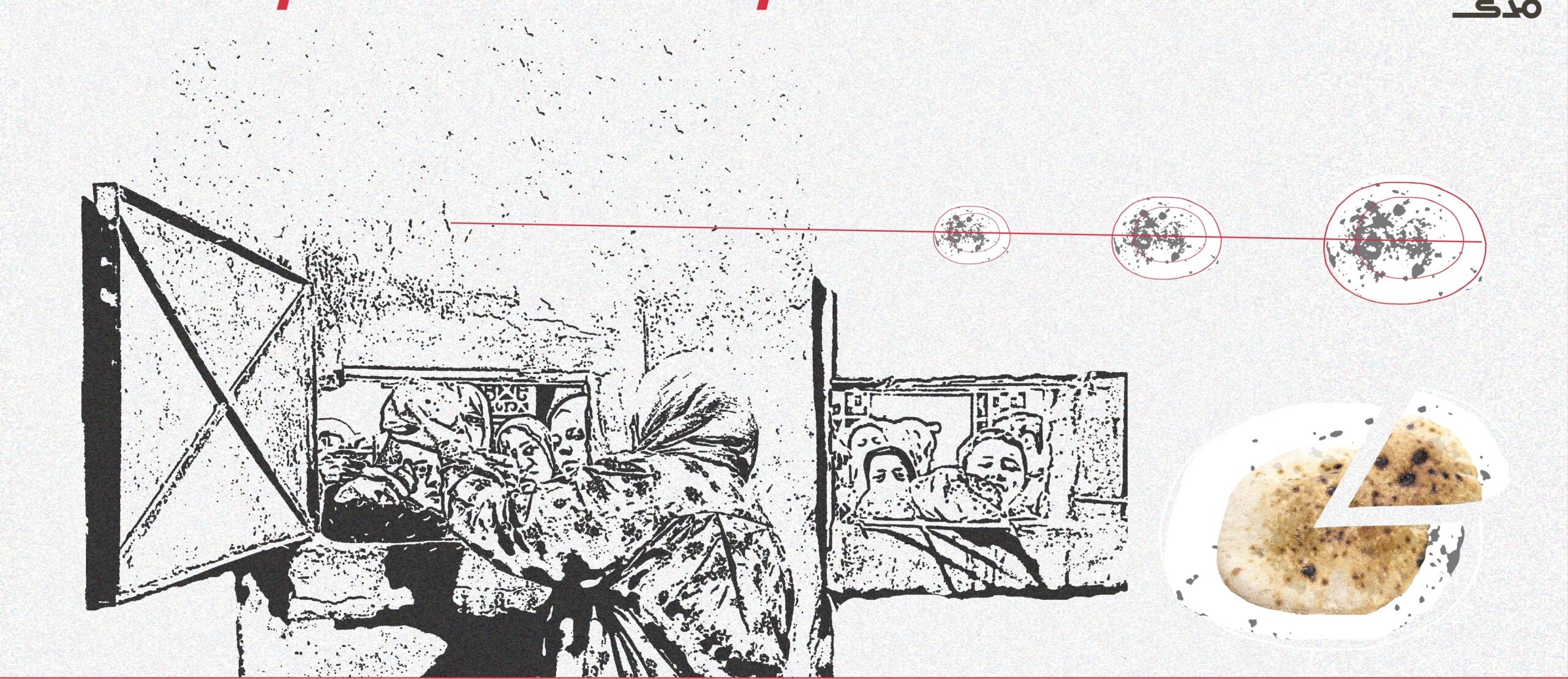
Each morning, Karima takes her son in hand and heads to a small bakery in Cairo’s Sayeda Zeinab neighborhood to pick up her family’s daily share of bread. Once the basket she carries with her is filled with five freshly baked subsidized loaves and five additional loaves that she pays for, she sits on the sidewalk across from the bakery for the bread to get some air.
Karima was concerned when she heard the news in August that the government intends to increase the price of baladi bread without mentioning economic alternatives for her family’s main food staple. She thought about her daily trip to the bakery and how much money she would need to buy enough bread for her family each month.
“One loaf costs LE1 and sometimes even LE1.5. It doesn’t have a fixed price, which means I will need LE300 every month. My husband has retired and receives a pension of LE3,000. How can we square this?” she says.
According to CAPMAS, a family made up of two adults and two children needs LE3,219 per month to meet its basic needs. Karima’s family is made up of six individuals: her and her husband and their four sons. The family eats 10 loaves of bread per day, which is enough for the family so long as her eldest son continues to eat just one loaf a day as per a new diet he started a month ago, and provided that her youngest son continues to refuse to eat baladi bread, which he finds heavy, preferring shami bread instead.
In the 2019/2020 Household Income, Expenditure and Consumption Survey, poverty rates in urban governorates stood at about 26.7 percent. The rates are higher in the lower-income areas of these governorates, like Sayeda Zeinab, than in areas inhabited by higher-income residents.
Karima exchanges half of the bread she is entitled to for bread points, which are added to her ration card as credit every month. She uses the credit to buy a bag of subsidized rice, sugar, and sometimes a bottle of sunflower oil from the grocery store close to the bakery.
Many beneficiary households resort to saving bread points to buy other commodities. The government has been encouraging this practice to the point that the Supply Ministry provides ration card owners with 10 piasters for each unpurchased loaf of subsidized bread per month, which is double the sale price of the loaf. Each ration cardholder is allowed to use the saved points of each month in the following month to buy commodities. According to the state budget, 26.3 percent of bread beneficiaries exchange bread for other commodities through the points system.
Ibrahim, the son of the owner of the grocery store that Karima goes to, was getting ready to close his shop when two women approached him.
Ibrahim helps his father manage the grocery store. He graduated from the commerce faculty at Helwan University three years ago, and, during his years of study, he helped his father expand his work as a grocer supplier from one to three stores.
The grocery stores of Ibrahim’s father are part of the Supply Ministry’s distribution network, which caters to “priority care groups,” a term used to describe low-income people in Egypt.
The two women, a mother and her daughter, stood in front of the store. The daughter took out two ration cards and handed them to Ibrahim. The first card belonged to her aunt and her children. She asked Ibrahim to see if the card was still working. He took the card and inserted it into a small machine, but it did not register. The daughter told him that her aunt had died a few months ago, so Ibrahim advised her to go to the supply directorate with her aunt’s death certificate in order to process a new card for her children.
According to a June 2020 Supply Ministry newsletter, the ministry registered more than 22.5 million ration cards in 2020, which service 71 million citizens that are considered as part of priority care groups. These include: those with a monthly income below LE2,400, those whose pensions are below LE1,500 a month, social insurance pensioners, those not covered by pension legislation implemented by Sadat and Mubarak, beneficiaries of the Takaful and Karama cash programs, widows, divorcées, single mothers, orphans, seasonal agricultural workers, street vendors, drivers, itinerant workers, independent craftspeople and vocational workers, the unemployed, prisoners, those with educational qualifications but still in search for jobs and have less than LE800 as monthly income, people with chronic illnesses, and people with disabilities (with no specified maximum income).
The Supply Ministry provides ration cards for each individual in the primary care group to buy goods worth LE50 every month. Citizens use their cards to buy basic goods from consumer cooperatives, which are the major outlets owned by the government and used to sell its food commodities in different cities. There are 1,259 consumer cooperatives in Egypt. But apart from those cooperatives, there are more than 30,000 grocery stores that have partnered with the government to distribute goods to outlets that provide for primary care groups, including the grocery store owned by Ibrahim’s father.
The government allows subsidy beneficiaries to list up to four individuals on their ration card, providing LE50 for each member of the family, LE7.5 of which is allocated for subsidized bread or the equivalent in bread points.
Ibrahim asked the woman what she wanted to buy with the other card. She asked if he could give her cooking oil using the remaining bread points she had. He agreed, took her card and brought her four bottles of cooking oil, three of which she was entitled to, and the fourth was exchanged for bread points.
Ibrahim tells Mada Masr that most of his customers who use ration cards exchange bread points for other goods, like sugar, cooking oil, or rice. While the service is meant to be free, he charges them a LE5 fee on each card, as exchanging bread for other food commodities from the grocery store requires him to order commodities from Supply Ministry distributors, which means spending more money on the supply process. Some of that spending cannot be invoiced, such as tipping the workers who carry the goods from the pickup trucks to the store. If they are not tipped, the workers could simply refuse to carry down the goods and ask Ibrahim to do it himself.
The Ahram, Nile, and Alexandria branches of the consumer cooperatives owned by the Supply Ministry have the highest number of beneficiaries exchanging bread points for other food items, followed by My Association project outlets and grocery stores.
For the woman at Ibrahim’s shop, using the ration card for bread “has become impractical.” Unlike bread, which people prefer to have fresh everyday, other goods can be easily stored, she says.
“Also, we won’t go out every day to buy subsidized bread from the edge of the earth. There are not many bakeries that sell subsidized bread, so we have to buy regular bread sometimes and use the remaining points to buy other things,” she adds.
Since the early 2000s, the government has taken quiet steps to push in that direction. There were successive decisions to reduce the size of bread and supervisors from the Supply Ministry would make sure that they were implemented. In 2005, bread came in at a weight of 160 grams, but in 2010 it was reduced to 140 grams. Those quiet steps have accelerated since 2014.
The government had realized by then that it was subsidizing bread for everyone without distinction, which often led to people cheating the system by smuggling subsidized flour from bakeries to commercial shops, more expensive bakeries that source flour at market price, and the general market. The new subsidy system that began to be rolled out in 2014 came in part as a response to try to combat this corruption. The government tied people’s access to subsidized bread with the ration cards given to primary care groups, in what was known at the time as the new mechanism to distribute bread via ration cards.
As part of the government's subsidy program, the ration cards included access to bread and basic food commodities. If a family of four has a ration card, then each person in the family is entitled to five loaves per day, so that the family share is 20 loaves per day, i.e. 600 loaves per month. Six hundred loaves then get deducted from the ration card.
According to the government, the current production cost of a loaf of bread is 65 piasters, but it is selling it to ration card owners at the price of 5 piasters. This subsidy costs the government about LE51 billion annually.
According to the government, there are 28,000 bakeries across Egypt that produce between 250 to 270 million loaves of subsidized bread every day, which go to around 70 million people registered on 20 million ration cards, Othman Ali Othman Hanafy, the youngest grandson of a family that owns a bakery in Sayeda Zeinab, believes that the number of bakeries has significantly decreased.
“In our neighborhood, we had 58 bakeries that sold subsidized bread. Now we have 22 bakeries only,” he said.
Othman inherited his job at the bakery from his father, who had inherited it from his father, Othman Hanafy. The grandfather at first was reluctant to pass the job on to his son due to its entanglement with a government authority that had caused him many problems. But his son was so adamant on taking on the work to the point that he threatened self-harm by consuming iodine tincture to pressure his father to bring him on, according to the story of the grandson.
The family had four large bakeries, but they were all closed four years ago following a government decision. According to the grandson, that happened after several cases were filed against them by the police in charge of Supply Ministry affairs and they were ordered to pay fines that totaled almost LE1 million.
“When the new system started, there were no clear guidelines about the operating hours of bakeries. The system was online 24/7, which paved the way for some tampering. Some people had invalid cards that still worked. But after a while, the government started to be more attentive and put clear guidelines for the work process and operating hours,” says Othman.
Before the implementation of the new system, Othman’s daily share of flour stood at 14 sacks, each weighing 100 kilograms. But this was cut in half, even though demand has been on the rise with the rising population. Many bakeries were affected by the changes in the bread subsidy system. Othman believes that the low-profit margin for bakeries is what opened the doors to corruption. “Low revenues in the process of producing bread is what pushed people to sell flour on the black market and neglect the production,” he says.
Even though his bakery was closed, Othman still uses it as an office to manage the rest of his family’s business. In the 1980s, the family expanded its businesses and started to trade in dairy products. They bought a farm in Giza to raise buffalo and sell their milk. Their business thrived and they opened additional shops in the neighborhood to meet the demand, whereas the bakeries were not bringing in enough revenues, according to Othman.
However, others have weathered the storm of the new system and the low rate of return. Ashraf, another baker in Sayeda Zeinab, is continuing to run his family’s bakery, which was established in the early twentieth century by his grandfather, who then gave it to Ashraf’s father. The family legacy is why Ashraf is so adamant about continuing to run the bakery. He also believes that helping those who need bread is a good religious deed.
“But the job has not been without its problems, as the expenses are high. The government is putting a price cap on bread, and yet, at the same time, it does not take into account the rising cost of electricity, gas, and wages,” says Ashraf. “You might be an owner of a bakery, but you’re still working for your own bread, and there isn’t much difference between you and the guy on the street selling the bread.”
On the other hand, private-sector bakeries that sell at market prices have been thriving. Bread prices on the market have jumped dramatically. In 2005, LE1 used to be enough to buy five loaves of bread from bakeries that do not sell subsidized bread. In the following 16 years, bread prices on the open market have increased by 500 percent. Today, one loaf of bread costs LE1 across Cairo.
“If the government gave me a choice, it would be better for me to work in a tourist bakery,” says Ashraf. “The government can then lift the subsidies from bread and give people more money so that they sort themselves out, and that way everyone gets what they deserve because everything outside the Supply Ministry program is better.”
تقارير ذات صلة
Bread politics
An eight-part series that takes an in-depth look at bread subsidies in Egypt
Q&A: How to save LE8 bn without raising subsidized bread prices
"This problem must be resolved within a framework of social justice"
The state and subsidized bread: Stuck between a strained budget and public anger
The government appears to be tight-lipped about any potential changes to the subsidy system for now
Your support is the only way to ensure independent, progressive journalism survives.
You have a right to access accurate information, be stimulated by innovative and nuanced reporting, and be moved by compelling storytelling. Subscribe now to become part of the growing community of members who help us maintain our editorial independence.
Join us