
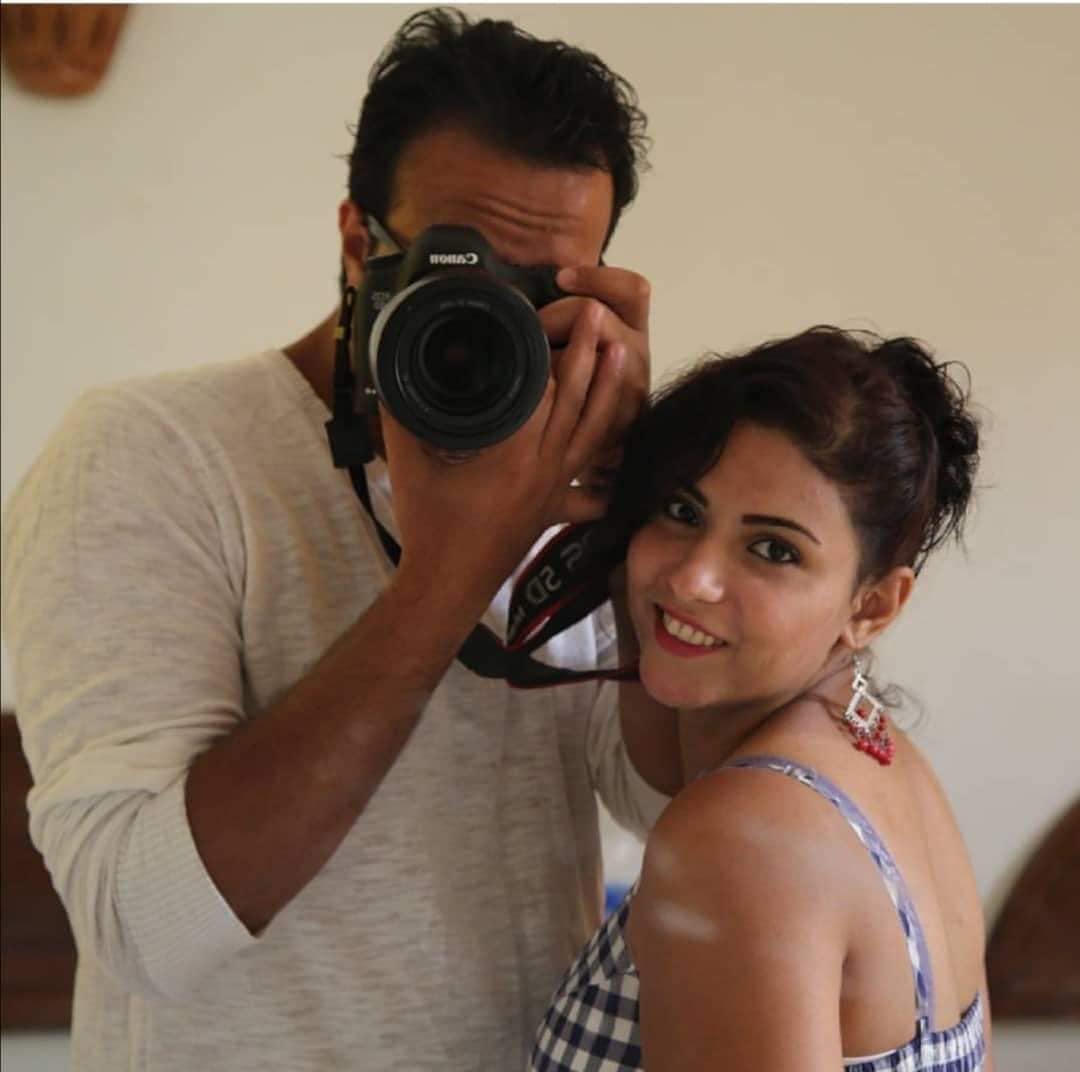
Solafa and Hossam: Once inseparable, journalist couple languish in prison away from their son
On the evening of November 26, 2019, Solafa Magdy and her husband Hossam al-Sayyad were sitting at their regular coffee shop in the Dokki neighborhood. The two journalists were joined by their friend Mohamed Salah, also a journalist. As they stood up to leave sometime after 10 pm, they suddenly found themselves surrounded by plainclothes security agents, who quickly arrested all three of them and drove them away.
Magdy and Sayyad had feared that this moment would come.
Six weeks earlier, their close friend, the journalist and activist Esraa Abdel Fattah, had been arrested from her car in Giza as she was driving to meet them. Plainclothes security agents pulled Abdel Fattah out of her car and took her away. Salah, who was with her at the time, was taken in a separate car, blindfolded and beaten before being dropped off on a highway. Meanwhile, Abdel Fattah was taken to an unknown location where she was beaten and tortured before being ordered into remand detention on charges of spreading false news and joining a terrorist group.
Abdel Fattah’s imprisonment came amid a sweeping arrest campaign in the wake of anti-government protests in September 2019. Even before Abdel Fattah’s arrest, Magdy and Sayyad were worried they would be targeted by authorities. Most evenings they would leave their 7-year-old son Khaled with his grandmother and the couple would not return home until late at night, afraid the police would raid their house and arrest them in front of him, according to a close friend who spoke to Mada Masr on condition of anonymity.
Despite the ongoing crackdown, Magdy and Sayyad were still shaken when Abdel Fattah was imprisoned.
“Solafa did not fully comprehend Esraa’s detention, that she was stuck in a cell, unable to speak to her family,” the close friend says. “Before Solafa’s arrest we would talk about the white clothes we would buy for Esraa in prison. After Solafa’s arrest we customized the clothes we had bought for Esraa to fit Solafa.”
Plainclothes security agents drove Magdy, Sayyad and Salah from the coffee shop to the Dokki police station where an officer cursed at and beat Magdy to force her to unlock her phone, according to the Committee to Protect Journalists. The three journalists were then blindfolded and taken to a National Security Agency facility where they were questioned about their journalistic work and the news outlets they worked for. The following day, Magdy and Sayyad were brought before the State Security Prosecution where they were charged with spreading false news and joining a terrorist organization and ordered held in remand detention for 15 days in Case 488/2019, the same case Abdel Fattah was charged in.
The couple has been behind bars ever since — like so many others, trapped in an endless cycle of remand detention. The case of Magdy and Sayyad highlights the stark dangers of working as a journalist in Egypt, and the particular difficulties faced by freelancers and field reporters who lack the financial and legal backing of press institutions or the Journalists Syndicate amid a widening crackdown on independent media.
It’s also a case of a family torn apart. Magdy and Sayyad’s imprisonment marks the first time the two have been separated from each other for any significant length of time since they first met over a decade ago. And for the past 14 months, their son, Khaled, has been forced to live without his parents.

Born in 1987, Magdy grew up in Cairo and studied law at Ain Shams University. Sayyad, three years her junior, studied political science at October 6th University. The couple first met in 2010, at a march in Alexandria to protest the police killing of Khaled Said. But it was during the 2011 revolution that the two grew close.
This was at a time when citizen journalism was exploding in Egypt. As the events of the revolution unfolded, much of it was documented by protesters and citizens taking pictures and videos on their mobile phones and posting them to social media. It was also a time when numerous media outlets emerged online, offering an independent alternative to state and private media that often acted as a megaphone for the government.
Magdy and Sayyad got married in 2012 and have been inseparable ever since, sharing their lives and journalistic work as a couple, according to Magdy’s mother, Taghreed Zahran.
Together they produced both print stories and multimedia news reports for television stations and online outlets. “They were self-taught journalists, a very good team, who were always improving their work; Solafa was mostly the producer and Hossam was mostly the cameraman,” a photojournalist friend and colleague of the couple currently living abroad tells Mada Masr.
Magdy started out working for 25TV, a new channel established in 2011 only to close a couple of years later. In 2013 she began freelancing for regional outlets, such as Daily News Egypt, the Iraqi television station Al-Sharqiya, Emirati newspaper Alroeya, and international outlets including BBC and Deutsche Welle. Much of her coverage focussed on human rights, minorities, social unrest, education, sexual harassment and migration. Sayyad worked with Magdy at most of the outlets while also freelancing for El-Badil and El-Bedaiah. The couple also published a number of video reports for Mada Masr.
“They worked on all topics, not only high-profile ones. They produced stories about people making boats and music instruments,” Sarah El-Banna, another friend of the couple living abroad tells Mada Masr.
“They always insisted on doing their job. Even when they had no outlet to work with, they published the news on their social media accounts,” says their mentor, Khaled El-Balshy, editor in chief of Daarb and a former Journalists Syndicate board member.
Following the ouster of President Mohamed Morsi in 2013, Egypt became a much more dangerous place to work as a journalist. At least six journalists were killed that year, according to CPJ, an unprecedented number for the country, and dozens were detained without charge. Egypt jumped into the top 10 worst jailers of journalists in the world in 2013, and has ranked the third or second-worst jailer of journalists in the world every year since 2015, according to CPJ’s annual census.
During this period, many journalists and photographers refrained from field reporting due to the increasing risk of arrest. Nevertheless, Magdy and Sayyad continued to report from the streets, braving the dangers to continue their work, according to their friends.
“I wouldn’t dare do what they did. We worked together and became friends in a very difficult time, between 2015 and 2019. At that time, there were assignments that I couldn’t accept because it would require street photography or portraying a political figure who could be under security surveillance,” the photojournalist said. “Downtown became a no-go area for me, it was too risky. I was a freelancer and I was always worried about everything. Solafa and Hossam, on the other hand, were always in the streets covering news and producing stories till the end. Journalism in Egypt would be much better off if we had more people like Solafa and Hossam.”
The photojournalist also says that, as freelancers, Magdy and Sayyad were working with little to no financial support or institutional backing. “When you are a freelancer you work on your own, you save money to buy equipment that needs maintenance and you have no insurance. Or you borrow the equipment from colleagues,” the photojournalist said. “Most of Solafa and Hossam’s work was with foreign media who don’t have offices in Egypt anymore, so they worked with no protection.”
They also did not restrict their reporting to Cairo and Alexandria. “They were very dynamic and active, always having ideas to work on, taking their equipment and moving around from the city of Tanta to Kafr El-Sheikh to Upper Egypt,” the close friend said.
For their efforts, Magdy and Sayyad were repeatedly stopped, threatened and harassed by police and by ordinary citizens because they did not have the “required permits” or because they worked for outlets disliked by authorities, according to the close friend.
The couple’s friends and colleagues are convinced that authorities eventually targeted them for arrest because of their journalistic work.
“Solafa and Hossam are examples of young journalists who emerged within an open public sphere, with a desire to work and develop, and suddenly the dictatorship came and shut off the profession,” Balshy said. “They were an example of freelance journalists who worked without the syndicate’s protection. The press syndicate should have defended them, whether they are members or not, but the syndicate abandoned them, as it has with many other young detained journalists.”
In September 2019, two months before her arrest, Magdy finally got an official press card from the Egyptian authorities. “She was so happy because she thought her job would get a little easier,” the close friend said. Around the same time, Magdy was awarded the Reham al-Farra Memorial Journalism Fellowship by the United Nations and covered the UN General Assembly in New York. Afterward, she was interviewed by The Glocal, an Egyptian website, as the only Arab fellow covering the UN assembly.
“From the beginning, I chose to be a reporter because of my conviction that the profession of journalism is the only profession to convey the voice of the weak; it is the only one that can change the fate of people, the only one that can make a difference in societies as long as there is an opportunity for it to do so,” Magdy said in the interview.
Despite their commitment to journalism, in the two years leading up to their arrest, the couple was finding fewer work opportunities as overall news coverage of Egypt waned, according to their friends. Sayyad also began to suffer from back problems, leading Magdy to learn video work to cover for them.
“Their earnings were never stable — they were always chasing work and sometimes spent 24 hours making calls to arrange a pitch,” the close friend said. “They could spend months without having any work.”
In 2017, they established the Everyday Footage School, a school that provides training programs in mobile journalism to young women. According to friends, the project had especially been a dream of Magdy’s. “Solafa was so excited to teach other girls to do everything using their mobile phones. She was good at it and wanted to pass the experience on,” the close friend said.
Reham al-Ghareeb, a journalist who graduated from the school in December 2018, said the program had a profound effect on her career. “The school changed me from being a local correspondent in Alexandria to something completely different. It changed my life, and I owe them. I now do work for Deutsche Welle, BBC, Mada Masr, Raseef22 and Al-Manassa,” Ghareeb said. “We were six young women in the program. They taught us everything about shooting and producing reports, they gave us field training, they taught us how to write a proposal, how to pitch it, how to make a storyboard, how to draft the questions, how to make full use of the mobile, how to produce sounds and edit.”
According to Ghareeb, the couple kept helping the trainees even after they graduated, presenting the work of their students, putting them in contact with media outlets and helping them launch their careers.
“Their imprisonment is a loss on so many levels. Imagine how many young people would have been trained and developed if the school was still around. Their place is not in a prison, they are not terrorists,” Ghareeb said. “We are completely helpless, we can only tell their story so people know that they are good people.”

Since their arrest, Magdy has been held in Qanater Prison and Sayyad in the Investigations wing of the Tora Prison Complex. In mid-December 2019, Magdy went on a hunger strike for several days to protest her prison conditions, particularly over having family visitations restricted to just 15 minutes. Visits are now just 20 minutes once a month, according to Zahran.
In March 2020, the Interior Ministry suspended all prison visits as part of preventive measures against the spread of COVID-19. “Visits were banned until August or September. During that time the prison refused to take the food we had brought several times,” Magdy’s mother said. Authorities also stopped allowing letters and correspondence through. “We used to receive letters from Hossam and Solafa in the beginning of their detention, now there are no letters from either of them,” Zahran said.
In Tora, Sayyad’s back problems worsened. “They sleep on the floor and for some time they were not allowed to receive winter clothes or blankets,” the close friend said. According to Zahran, Sayyad has lost around 20 kilograms in detention.
Magdy is also suffering from several medical problems in Qanater. Several months into her imprisonment she developed symptoms similar to ones she experienced when she had a uterine tumor that she had surgically removed in 2017, including bleeding. The prison doctor examined her and suspected a tumor at first but then rejected that possibility. The family has submitted several requests to both the State Security Prosecution and to the court for Magdy to be examined at a private medical facility at the family’s expense, according to Zahran and the couple’s lawyer Khaled Ali, but the requests have gone unanswered.
Magdy also suffers from skin problems, which Zahran consulted a private doctor about and afterward bought prescription medicine for, which she managed to bring to Magdy in prison. Like her son, Magdy also suffers from asthma, according to the close friend.
During her most recent visitation to see Magdy on January 27, Zahran brought flowers for her daughter for her 34th birthday on January 31. Prison authorities did not allow the flowers in. “You broke my heart today sweetheart, due to your illness,” Zahran wrote in a Facebook post later that day. “I was in pain, when I saw you sick. I still can't comprehend what is happening to you. I was devastated when you asked me to tell Hossam that you love him, and that you will love him your whole life. You are a great mother and wife Solafa, and I am so proud that you are my daughter.”
In April, ahead of World Press Freedom Day, the Washington Post spotlighted Magdy among critical journalist cases around the world. Last November, after she had completed a year behind bars, Magdy was named the Courage Awardee by the International Women’s Media Foundation.
As with thousands of other prisoners, Magdy and Sayyad’s remand detention orders have been renewed on a routine basis for the past 14 months.
In August, Magdy and Esraa Abdel Fattah were suddenly charged in a new case (Case 855/2020), even though they were still being held in remand in the original case. The charges in the new case are the same as the first — joining a terrorist group and publishing false news.
A lawyer explained to Mada Masr at that time that the tactic is used by authorities to preempt the release of a detainee: if a defendant is ordered released in the first case then the implementation of the detention orders in the second case begins. The practice, known as tadweer or “rotation” is an increasingly common tactic used by authorities to keep detainees locked up without trial past the maximum two-year limit for remand detention. In its latest 2020 report, CPJ specifically highlighted the cases of journalists held in remand detention, saying the Egyptian government “went to great lengths to keep custody of journalists not convicted of any crime.”
A mix of defendants have been added to Case 855/2020, including lawyers Mahienour al-Massry, Amr Imam and Mohamed al-Baqer, journalists Islam al-Koulhy and Mohamed Salah, blogger Mohamed Oxygen, political science professor Hazem Hosny and, briefly, the three EIPR senior staff members who were eventually released.
Magdy’s lawyer, Ali, says that these types of cases are based on investigations by the National Security Agency, which always result in the same charges of publishing false news and inciting against government institutions.
“Pretrial detention is an exceptional measure which contradicts the rule that says a defendant is innocent until proven guilty. No one should be imprisoned unless they are convicted,” Ali says, adding that pretrial detention should not be a form of punishment. “Legislators have allowed for pretrial detention when there is a necessity for interrogation. Solafa is now facing two cases and she is in prison, so why not interrogate her in both cases? Why wait until she is released from the first case to interrogate her in the second? Just to keep her in prison? And how did she get accused in a new case while she was already locked up?”
The national security investigations make the improbable claims that the defendants meet with Muslim Brotherhood members inside prison to publish false news about prison conditions and that those statements disturb public security and harm the public interest, Ali says. He adds that lawyers know very little about the charges because they are not allowed to read the case files or see any evidence.
During interrogations with Sayyad and Magdy, they were not informed of the alleged false news they are charged with publishing, nor the name of the terrorist group they are accused of joining, Ali says. National security investigations are not really interrogations, according to Ali — the prosecution simply declares the charges to the defendants without conducting any questioning. According to CPJ, Egypt leads the world in jailing journalists on false news charges.
“Solafa and Hossam were interrogated only once by the prosecution; the rest were renewal sessions, and after 150 days their renewals were ordered by the court,” Ali says.
Since their arrests, the once inseparable couple now rarely meet.
According to Ali, Magdy and Solafa only see each other during renewal sessions at the prosecution or in court. At times, lawyers request they be allowed to talk to each other, although this never exceeds a couple of minutes. Ali says they have a legal right to correspond with each other and make phone calls but that this never happens.
Ali also says that there is legal standing for one of them to be released in order to care for their son. Article 488 of the Criminal Procedures law stipulates that if both parents of a child younger than 15 years old are sentenced to prison for less than a year, and neither have been imprisoned before, then the courts can stagger the prison sentences so that at least one parent is free to care for the child at any time.
“How can they imprison both parents leaving a child alone? We have submitted requests to the prosecution and to the court as well as the Public Prosecutor to release either of them but our requests have been ignored,” Ali says. He points to past precedent, such as the case of journalists Hassan El-Qabany and his wife Aya Alaa. In December 2019, Alaa was released to care for their young daughter. “It can’t be right that the law grants that right in cases where there is a final verdict yet prosecutors do not take this into consideration in cases of pretrial detention,” Ali says. “We call for the release of at least one of them, especially as there is no evidence against them.”
The imprisonment of both Magdy and Sayyad has taken a heavy toll on their 7-year-old son. The couple has tried to protect him by pretending they had traveled to the United States for work and were unable to return because of coronavirus restrictions.
“In the first few months we were able to exchange letters between Khaled and his mother and father,” Zahran says. “But they no longer allow letters inside and the last letter from Khaled was in August. We had to tell him that the mail is broken. Sometimes we buy presents for him and tell him that his parents sent them.”
A few days after the arrests, Khaled suffered an asthma attack and was transferred to hospital, according to the close friend. And in the past couple of months, he has been suffering from an allergy that doctors said was caused by a nervous breakdown, according to Zahran.
“At the beginning, Khaled felt disappointed. He used to say ‘Mama and Papa went to America and left me,’ but then he started to feel something wasn’t right,” the close friend says. “One time I brought him a big teddy bear, and I was playing with him, and suddenly he told me: ‘I will take it from you and throw it in prison.’ He probably heard us speaking about prison.”
In a heart-wrenching video posted on Facebook on December 31, Khaled addresses his parents and wishes them a happy new year and sings a song. “I feel like I am dreaming that you have traveled, and when I wake up I will find you have returned safely,” he says.
Zahran says the ongoing prison ordeal has crushed their family. “I am giving my grandchild all of my time, but it is not enough for him, I cannot replace his parents,” she says. “The family has been destroyed. Even by law one of the parents should be released. Why does a 7-year-old feel like he is an orphan? They did nothing. Some people say they got arrested for writing about Esraa, is that a reason? She is their friend.”
In one of the rare letters that Magdy managed to send from Qanater Prison in January 2019, Magdy directly addresses her son and talks about their plight: “In the new year, I tell my son: be proud of your mother and father, we are in prison for advocating for a better life for you and for all of us. Be proud Khaled, and raise your head high among people. In the new year, I ask you not to forget about us. Don’t forget those who are paying the price with their freedom, their lives being wasted behind bars. Don’t forget those who are dreaming of a decent life for every human being, hoping for a better country. A new year is starting and Hossam and I are apart, with high walls between us, blocking light and freedom, simply because we are journalists and we did our job with dedication and professionalism.”
تقارير ذات صلة
Egypt’s new rights image met with skepticism in DC
'We did not come to whitewash the face of the Egyptian government'
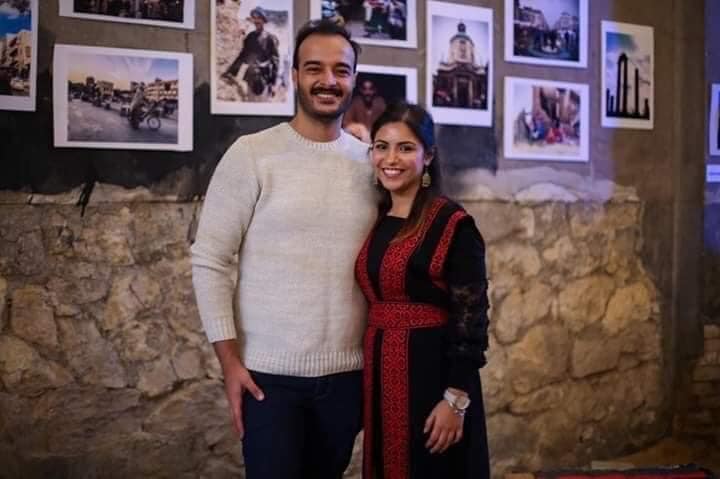
Journalist Solafa Magdy accuses police officers, personnel of assault, harassment, Interior Ministry denies
Magdy was arrested alongside her husband on November 26, 2019
Your support is the only way to ensure independent, progressive journalism survives.
You have a right to access accurate information, be stimulated by innovative and nuanced reporting, and be moved by compelling storytelling. Subscribe now to become part of the growing community of members who help us maintain our editorial independence.
Join us