
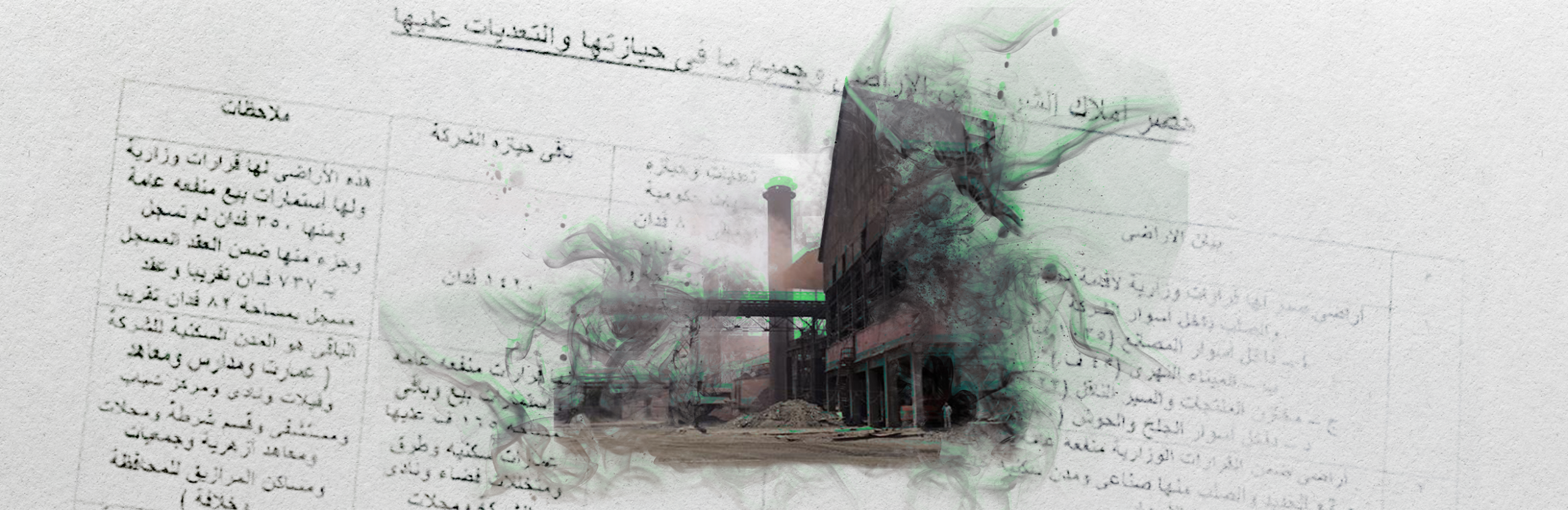
Since the state’s decision to liquidate, the company’s assets have slowly been looted
After stormy debates and heated exchanges, the general assembly of the Egyptian Iron and Steel Company (EISC) convened on September 22 to approve yet another extension to the company’s liquidation timeline, adding a fifth year starting in January. The hall erupted with chants from individual shareholders: “Void, void, void. Five years of liquidation is void.”
When the extraordinary general assembly decided to liquidate the company on January 11, 2021, it set a two-year deadline. But when that period elapsed, the liquidation had barely begun, prompting one extension after another.
Throughout the past four years, minority shareholders have repeatedly demanded that the liquidation committee provide a clear and precise inventory of the giant public company’s assets — particularly its land holdings — along with a fair market-based valuation rather than be based on book value, so that they might know what their dues will amount to once the company’s debts and obligations are settled, as one shareholder said during the September meeting.
During this entire period, shareholders say they received nothing from the five successive liquidators except “stalling and procrastination,” as one attendee put it. The mounting tension and concern have become increasingly visible in successive assemblies, where altercations frequently break out between the minority shareholders — who hold 15.52 percent of the company — and the liquidation committee overseen by the Metallurgical Industries Holding Company (MIHC), which owns the remaining 84.48 percent.
Their concerns have also spilled over into a stream of complaints filed with the Egyptian Exchange and the Financial Regulatory Authority. The shareholders demanded the dismissal of the current liquidator Osama Badawy and the appointment of a “neutral and independent” replacement, arguing that Badawy’s appointment violated Article 26 of Law 144/1988 governing the Central Auditing Organization (CAO). Badawy monitored the company’s accounts up until the start of liquidation in his role as director of account monitoring at the CAO. His appointment came after the resignation of the previous liquidator Walid Mohamed Helal Mahmoud Abdu (October 2023 - February 2024), who, according to shareholders, had begun imposing strict oversight on the liquidation process to prevent theft.

The complaints also pointed to several violations in the liquidation process such as concealing key information from regulators, the stock exchange and shareholders. This includes contracts for selling production lines and scrap worth LE14 billion that were not disclosed in the liquidator’s reports or in the minutes of general assemblies, ignoring repeated CAO requests for an actual inventory of the company’s warehouses rather than relying on book records and failing to provide an accurate survey and fair valuation of the company’s landholdings. Moreover, information has been circulating about re-designating the land for environmentally friendly industrial use, despite the general assembly having already approved shifting it to real-estate use in order to maximize returns from its sale, especially as parts of it are in prime locations directly overlooking the Nile in Helwan.
When the state decided to kill off this industrial giant — declaring its recovery impossible — its stated aim was to stop the ongoing hemorrhage of losses and relieve the government, represented by MIHC, of the burden of financing an unprofitable operation that had deepened public debt. Another goal was to unlock the value of the company’s enormous assets by reinvesting them in more profitable economic activities amid a severe national economic crisis.
Yet more than four years later, the corpse of the Egyptian Iron and Steel Company still lies sprawling on the roadside of liquidation, as various — mostly governmental — entities attempt to carve out the largest possible share of the spoils, whether through bureaucratic security tools or outright looting. This is clearly documented in CAO biannual audit reports and in the proceedings of successive general assemblies. They contain a trove of incidents and details that amount to evidence of corruption and squandering of public funds — of which we highlight only those whose stench was impossible to ignore.
***
The ‘direct order’ looters
In its report on the financial status of the liquidation process for the first half of 2024, the CAO issued scathing criticism of the company’s asset sales conducted through “direct order” procedures, which were marred by multiple instances of corruption. These included favoritism toward certain companies — some affiliated with sovereign bodies — selling to them at prices below what the valuation mechanism had set, and repeated incidents of theft, none of which prompted the liquidation committee to take the necessary legal actions.
According to the CAO report, the committee sold, through direct order, the pipe warehouse and related inventory, along with furnaces 3 and 4 and their attachments, to Multi-Trade Cairo, a subsidiary of the General Intelligence Service, per a contract dated April 21, 2024.
The committee, according to the CAO report, sold the assets for around LE1.534 billion, tax included, even though the valuation figures were as follows: “around LE3.615 billion from Masr Capital, LE1.491 billion from Omana Consultants and LE2.049 billion from the Quality Services Group.” The average then would be LE2.358 billion — excluding the customary 15 percent markup and VAT, the CAO said.
But the liquidation committee discarded the highest and mid-range valuations, adopting only the lowest figure provided by Omana Consultants, according to the report.
The liquidation committee’s response to the CAO’s observation, as recorded in the documents submitted to the Egyptian Exchange in October 2024 containing the CAO report, the liquidation committee’s reports and the general assembly minutes, read as follows: “In light of Multi-Trade’s representative objecting to the valuations on the grounds that they were inflated with the intention of causing losses to a company affiliated with a sovereign state entity — as had occurred in previous sales — a study was conducted by the committee formed under Resolution 29/2023 [the liquidation committee], together with specialists from the company. Their report concluded that the valuation used as the basis for the sale was objective.”
Beyond this transaction, the liquidation committee sold Multi-Trade the machinery and equipment of the billet and heavy-section rolling mills, as well as the plate and sheet rolling mills, rollers and their subsidiary warehouses — with all their attachments — for LE631 million (excluding tax), under a contract dated June 20, 2023. The contract stipulated that the deal would be executed in five stages over six months (180 working days), with no stage beginning before the previous one was completed. It imposed a late-delivery penalty of 0.5 percent of the total value per week of delay, capped at three weeks; and a late-receipt penalty of 1 percent capped at four weeks, rising to 2 percent per week for another four weeks.
Multi-Trade failed to meet both the receipt schedule and the due dates for its payments. In response, on September 17, 2023, the liquidation committee issued an addendum adjusting the payment amounts and deadlines and extending the receipt period to 275 working days.
The company was also supposed to pay 5 percent of the contract value as a final performance guarantee upon signing, but it did not. The liquidation committee then issued a second addendum on October 3, 2023, treating the performance guarantee as part of the payment for the first stage of the September revised contract — meaning, according to the CAO report, “there are no guarantees for the contract.”
The committee handed the site over to Multi-Trade on October 9, 2023, to begin the first stage — representing 6 percent of the deal’s value — with a duration of 25 working days. When the stage’s end date arrived on November 12, it was extended to January 11, 2024, “despite the head of the handover committee confirming that the client had been negligent in receiving,” according to the CAO.
The liquidation committee calculated the late-receipt penalty at around LE697,000 based on the remaining work for the stage, “in violation of the 11th clause of the contract,” which would have placed the penalty at around LE3.029 million. It also failed to calculate the late-payment penalty for the second stage, due on November 13, amounting to around LE1.3 million.
Despite the discounts, Multi-Trade paid no penalties at all, after the liquidation committee decided on December 13, 2023 to exempt it, citing that “the delay was beyond its control, and in consideration of economic conditions,” according to the CAO. The report added that on November 21 of the same year, the committee issued a third addendum, selling Multi-Trade — also by direct order — 3,000 tons of roller equipment at LE24,600 per ton.
The liquidation committee’s preferential treatment for Multi-Trade did not end there.
According to the CAO report, under a contract dated December 26, 2023, the committee sold the sovereign company the equipment and machinery of the hot and cold-rolling mills and their subsidiary warehouses with all attachments, as well as furnaces 1 and 2 with their attachments, three finishing depots in the steel sector, oxygen station 3 and other equipment and machinery, for a total of LE3.138 billion, “excluding tax.”
Around six months later, on June 3, 2024, the committee amended the contract so that the price would become “tax included.” It also revised the installment schedule for the remaining value of the rolling mills (totalling LE2.142 billion), spreading payments over 15 installments starting June 6, 2024, instead of February 1 of the same year — an adjustment the CAO said was “inconsistent with the liquidation’s scheduled completion date of December 31, 2024.”
In October 2024, the EISC’s general assembly approved extending the liquidation period for another year, beginning January 2025.
***
Multi-Trade was not the only sovereign company to receive preferential treatment.
On October 3, 2021, the committee offered for sale solidified cast iron, iron-bearing dust and waste materials through negotiated procurement — a form of sale in which the administration selects from offers submitted directly to it. The CAO observed, in its budget review dated June 30, 2024, that the committee “did not announce the procurement in the manner stipulated by the company’s regulations [...] whether in terms of the circumstances that justify resorting to this method, or by specifying the quantities offered for sale and the conditions of sale [...] and the deadline for submitting bids.” It noted that the committee “settled for offers from only four companies,” and ultimately awarded the sale to Upper Egypt Company for Agricultural Manufacturing and Land Reclamation, a subsidiary of the Defense Ministry’s National Service Projects Organization, at a price of LE4,100 per ton of cast iron (tax included) and LE140 per ton of dust (tax included). Two contracts were issued accordingly.
Two and a half years later, on May 27, 2024, the liquidation committee decided to terminate the contract “amicably,” citing “certain losses and thefts at the work site,” as well as improper technical handling that had damaged quantities of iron-bearing dust, rendering them “valueless.” Still, the CAO noted that the Upper Egypt company recovered the remainder of its final performance guarantee, as well as the balance of its advance payment, without application of the penalty clause stipulated in clause 11 of the contract — even though it had received 1.284 million tons out of a total contracted quantity of 1.8 million tons.
In its report, the CAO documented five attempted thefts detected by the EISC’s security department, including three committed by employees of Upper Egypt company, one by an employee of Multi-Trade and another by an employee of Al-Shorouk for Trading and Supplies. The CAO noted that in all cases, the liquidation committee merely recovered the stolen materials and imposed fines, without referring any incidents to investigative authorities.

The committee’s squandering of public funds was not limited to sovereign bodies. Its “direct order” sales extended to the private sector as well.
According to the CAO’s 2024 budget report, the committee sold, by direct order, the machinery and equipment of the Linda oxygen station 4, with all attachments, to the Arab Company for Special Steel (Arcosteel), owned by Cairo Chamber of Commerce chair and businessman Ayman al-Ashry, for LE154 million excluding tax. The sale relied on the average of four valuations conducted in April and May 2023, and the contract was signed on November 27 of that year.
The CAO noted that the sale did not take into account “economic variables during that period nor what the valuations stipulated regarding the sensitivity margin [a price-increase margin based on market mechanisms] of 10 percent and 15 percent, and that the validity of the [valuation] report was six months from its date. Moreover, the station’s historical cost, including all its attachments, is around LE331 million, while its net book value is about LE149 million.”
In response to the CAO’s reports during the general assembly meeting in October 2024, the liquidator argued that the sale was based on external valuations conducted by firms accredited by the Central Bank of Egypt, “taking into account that the station was sold for operational use, given its strategic importance in supplying oxygen to the Health Ministry.” The CAO representative countered that despite this strategic importance, the buyer was Arcosteel, not the Health Ministry.
Decision 24/2021, which halted the last operating machines at Egyptian Iron and Steel Company on May 31 of that year, had explicitly excluded Linda 4 from sale due to hospitals’ critical reliance on it for oxygen supply during the COVID-19 pandemic. “If not for this station, Egypt would have faced a major catastrophe during COVID-19,” Kamal Abbas, the general coordinator of the Center for Trade Union and Workers Services, tells Mada Masr.
***
Land spoils
From the start of liquidation until the end of the first half of 2024, CAO reports repeatedly echoed an observation first raised in its review of the financial statements for the fiscal year ending June 30, 2020: “The company has not conducted a full inventory of all land holdings [...] detailing area and location.”
The reports stressed that “a comprehensive survey must be conducted of the land under the company’s possession by the Egyptian Survey Authority or a specialized firm, in order to determine the true areas and boundaries of the company’s land, and to provide us with supporting documents for ownership or the legal status of each plot.”
The liquidation committee eventually complied and carried out a land inventory, according to the CAO’s report on the financial statements for the second half of 2024, which continued to request documentation proving ownership of those lands.
The inventory, however, revealed a discrepancy of 1,124,917 square meters between the company’s records and the committee’s findings, according to the report. The company’s books listed its land holdings as 8,899,343 square meters (around 2,118 feddans), while the inventoried area amounted to 7,774,426 square meters (around 1,851 feddans).
The CAO also noted a major difference between the company’s recorded land holdings and the total area compiled earlier by former liquidator Major General Hesham Nazmy (June 15, 2022 to January 12, 2023), who reported a total of 3,448 feddans (even though a copy of the survey obtained by Mada Masr showed an additional 4 feddans in Nazmy’s survey).


The inventory compiled by Nazmy shows that the land allocated, by ministerial decisions, for establishing the iron and steel factories amounts to 1,500 feddans (6,301,245 square meters), of which 1,035 feddans (4,347,859 square meters) lie inside the factory walls.
According to an audio recording of the general assembly discussions held in May — of which Mada Masr obtained a copy — one shareholder interrupted the liquidator during his response to the CAO’s observations, asking him to disclose the total land area. Badawy then provided a new figure, different to what appears in the company’s records, the committee’s inventoryNazmy’s survey, even the CAO’s report: 2,615 feddans (10,985,170 square meters). He explained that the area recorded in the budget represents only the land that is registered and in the company’s possession, totaling 900 feddans (3,780,747 square meters), while the remainder falls under “land expropriated by land expropriation decrees” and “land under informal possession with no encroachments.”
Nazmy’s survey showed that of the 1,500 feddans, 50 feddans are held by the Armed Forces and 30 feddans have been encroached upon by local residents, with removal orders issued for them. He noted that the unregistered portion amounts to only 350 feddans, which means the land that should be registered in the company’s possession is 1,150 feddans, not 900 as Badawy claims.
Comparing the total land area announced by Badawy in the assembly meeting with the findings of the inventory committee brings the total area of missing land up to 764.5 feddans (3,210,744 square meters).

In any case, none of the representatives of the CAO at the May assembly commented on these discrepancies. The figures mentioned by Badawy were also deleted from the minutes of the meeting that were sent to the stock exchange, a copy of which Mada Masr obtained.
***
The land chaos did not stop at the maze of registration, encroachments and missing documents. It extended to land which the company had already relinquished before liquidation as part of debt settlements, only for the “state” to later contest the EISC’s ownership of it.
Just hours before the liquidation decision was announced, the EISC’s ordinary General Assembly convened on January 11, 2021, to decide on transferring ownership of some land owned by EISC to settle debts owed to MIHC, the Egyptian Natural Gas Holding Company and Banque Misr.
In November 2018, EISC signed a joint cooperation protocol with Banque Misr and MIHC to settle debts owed to the bank amounting to US$59.561 million. Per the January 2021 general assembly meeting minutes, it was agreed that “the EISC shall pay an amount of LE750 million as a final settlement of the debt’s amount, to be paid as follows: LE375 million through transferring ownership of 73,685,518 shares of the EISC to Banque Misr at a price of LE5.11 per share ‘from the shares owned by the Metallurgical Industries Holding Company’ [and] LE375 million through transferring ownership of real estate assets owned by EISC to Banque Misr.”
In January 2019, the shares were indeed transferred to Banque Misr. In February 2020, the company evaluated three land plots — 20,000, 7,500 and 30,000 square meters — as an in-kind settlement for the remaining debt. All of these plots lie “within the EISC housing complex in Tebbin, Helwan,” according to the minutes of the January 2021 general assembly, which state that the bank chose the first two plots for a total of LE375 million, “according to the average price of the valuations” at the time — meaning the square-meter price was about LE14,000. A contract transferring ownership of the two plots to Banque Misr was signed on June 15, 2020, according to the assembly minutes.
Yet beginning in December 2022, Banque Misr appeared in the company’s financial statements as owing LE16.5 million to the company, for “the remaining value of the land delivered in settlement of the debt and not yet collected,” according to the CAO’s report on liquidation progress for the second half of the year.
There is no explanation — neither in the liquidators’ reports nor in the CAO’s reviews — of the reason for this debt. According to the January 2021 assembly, the price of the two plots selected by the bank, totaling 27,500 meter square, “equaled the remaining debt owed to the bank (LE375 million).” So where did the extra LE16.5 million come from?
The company’s general assembly, convened on November 30, 2021, had approved changing the land’s designated use from industrial to residential and selling it at public auction to maximize returns. It also decided to reappraise the value of the land through three specialized firms accredited by the central bank and to amend the previous assembly’s November 1 decision regarding transferring land to settle dues owed to the MIHC, based on directives of the public business sector minister to re-value the land in order to protect the rights of creditors and shareholders.
Was the re-valuation carried out based on the change of land use, causing the land price to exceed the original debt value despite what was stated in the January 2021 assembly? Neither the liquidators’ reports nor the CAO’s provide any mention of an answer.
In the years that followed, the CAO continued to repeat this observation in all its liquidation reports, insisting on the need to collect the outstanding amount owed by Banque Misr to safeguard shareholders’ rights. In turn, the liquidation committee kept providing the same stock response in the general assembly minutes: “This debt corresponds to the area recorded in the sale contracts, and the value will be determined and collected after the land survey and receipt are completed,” adding even more ambiguity regarding the fate and value of this land.
Was the land received by the bank, as per the CAO and the January 2021 assembly minutes, which identified the two plots inside the EISC residential complex in Tebbin? Or is the land still awaiting surveying, as the liquidator maintained?
The confusion surrounding the land went beyond the issue of Banque Misr owing the company money to who owns the land as such.
When the CAO representative Dalia al-Sharkawy repeated the observation, MIHC chair and head of the assembly Mohamed al-Saadawy cut her off: “The state said, ‘This land isn’t yours. It was expropriated.’ The land belongs to the Cairo Governorate, unfortunately.”
This revelation prompted a new question posed by a shareholder during the September assembly’s discussion over the land: “Did the land look appealing to them after its designated use was changed?”
Mada Masr made repeated attempts to contact Saadawy for answers, but he did not respond to requests for comment.
It was Saadawy himself who had defended transferring the land to the bank during the January 2021 assembly, insisting that it was “registered” and that the company had proof, after CAO representative at the time, Osama Badawy, objected on the grounds that the land “is not listed in the company’s asset register, nor in its budget, and cannot be disposed of at all.” Badawy added that there was a fatwa — he did not specify by whom — stating that the company’s sale of these lands was invalid “because they had been expropriated and had become designated for public benefit.”
Although the company’s head of financial affairs at the time, Mohamed Abdel Zaher Sayed, affirmed during the meeting that “there are contracts registering these lands in the company’s project sectors,” Badawy insisted that “there is nothing to prove this statement is valid. And if such documents or contracts existed, why weren’t they presented to the CAO for review although we requested any contracts for these lands just recently, and none were provided?”
Both sides stuck to their positions, and the assembly concluded with the MIHC — holding the majority — approving the transfer of the land to the bank.
Later, after Badawy became the general liquidator on April 25, 2024, his position shifted. The land transferred to Banque Misr was no longer public property that could not be disposed of. Instead, he joined Saadawy in the May assembly in promising to solve the issue and escalate it “to the highest level.” This prompted the CAO representative to urge them to include a clear explanation of the land’s status in the response to the CAO’s findings. “Instead of replying to the CAO’s report by saying you will look into the matter until you complete a land survey and then settle the value, the response must be based on the reality on the ground,” she said.
Saadawy agreed, saying, “You are right, ma’am.”
On June 24, the liquidation committee sent the minutes of the May assembly in the stock exchange disclosure. The CAO’s remark about Banque Misr’s outstanding debt was recorded, but the committee’s written response contained no clarification — only the same phrase: “This debt corresponds to the area recorded in the sale contracts, and the value will be determined and collected after the land survey and receipt are completed.”
Just like the Banque Misr land, no one knows the status of the Qabbary warehouse land in Alexandria — 14,012 square meters — which the liquidation committee sold to the Defense Ministry.
This land appeared only once in a brief paragraph in the liquidator’s report on the second half of 2022, which stated it had not been included in the liquidation accounts for the period “as the sale contract and registration at the Real Estate Registry had not been completed, and the full payment — around LE14 million — had not been settled as of December 31, 2022,” according to that period’s supplementary report to the financial statements.
Yet Nazmy’s land inventory, dated October 22, 2022, states that the land had already been handed over to the Armed Forces Engineering Authority’s Bashayer al-Kheir project at a price of LE1,000 per square meter, and that the compensation had still not been paid.
Since then, not a single liquidator’s report nor any CAO report has mentioned this land again. And there is no clarity around a series of questions. How was the land valued at LE1,000 per square meter? Was the contract registered? How much of the payment did the company actually receive? And how much remains unpaid?

One of the signs of the chaos surrounding the EISC land survey came under the recurring heading: “encroachments.”
Much like its repeated demands for a full land survey, the CAO repeated a single g sentence in all its reports since reviewing the company’s financial statements for the fiscal year ending June 30, 2020: “It has been found that cases of encroachment on the company’s land and property continue.”
Among those encroachments — still noted in the CAO’s latest report presented to the general assembly in September — is a 107-feddan (449,488 square meters) plot that the Tebbin district authorities seized, even hanging a sign on its fence declaring that “it is prohibited to deal with this land as it belongs to the Tebbin district,” according to the CAO’s December 2022 report.
The story of how the district seized this land, as recounted to Mada Masr by former EISC chair Samy Abdel Rahman (November 2017 to July 2018), is highly indicative of how state bodies vied to claim whatever they could from the company’s carcass.
According to Abdel Rahman, the 107 feddans belonged to the company and lay on the New Army Road beside the National Cement Company. When he took office, around 40 houses with full utilities had already been built on the land, in addition to several graves. He notified the police to remove these encroachments, except for the graves, he said, and asked the Tebbin district for a permit to build a fence around the land to prevent further encroachments.
Abdel Rahman was a strong supporter of developing the company and opposed its liquidation. He was therefore eager to reclaim its assets and sell some of them to finance development. But before he could build the fence, the former Public Business Sector Minister Hesham Tawfik dismissed him from his post, according to the former chair. He later discovered he had been handed a judgment in absentia fining him LE360,000, based on a report filed by the Tebbin district accusing him of constructing a fence without a permit and in violation of engineering standards.
“I filed an objection to the ruling, and it was accepted. I was acquitted because I proved that the fence was built after I had left my position,” Abdel Rahman tells Mada Masr.
He assumed the case was closed, but he was mistaken. A few months later the case was reopened after two new witnesses appeared: the company’s property manager and the district head, both of whom testified that Abdel Rahman had overseen the fence’s construction. “They said I was standing there while the fence was being built,” Abdel Rahman says, adding that the company then applied for a settlement under the law on building violations reconciliation, and the request was approved.
In its report on the liquidation account for the first half of 2023, the CAO repeated its comment on the 107 feddans as it had in previous reports. But this time, the liquidation committee went beyond its usual response — “necessary action is being taken” — and detailed what had been done, confirming that the land was now back in the company’s possession: “Procedures for reconciliation with the Tebbin district regarding the fence violation have been completed in accordance with Law 17/2019 on reconciliation of building violations, and Form 10 [the final stage of settlement prior to the law’s later amendments that removed it] has been received. It should be noted that the public business sector minister’s Decree 60, dated March 3, 2022, stipulates in its first article that all encroachments on the 107-feddan plot in the Tebbin district belonging to the EISC under liquidation, located opposite the company’s gate overlooking the Nile, are to be removed by administrative means,” according to the minutes of the company’s General Assembly on October 23, 2023.
Even so, the CAO’s note about the 107 feddans remained unchanged, word for word, in its report on the liquidation account for the first half of 2024. What did change was the liquidator’s response: “The status of this land will be reviewed, and the necessary legal measures will be taken and communicated to you,” according to the minutes of the company’s general assembly on October 28, 2024.
By the end of 2024, the CAO issued its report on the liquidation account for the second half of the year, with no mention of the status of the 107 feddans — only the total number of encroachments: 86. But for the first time, it noted that “seven government entities occupy around 123 feddans,” adding that the company’s response failed to address what measures had been taken to prevent encroachments from recurring, according to the minutes of the May General Assembly meeting.
During the discussions of the May assembly — the audio recording of which Mada Masr listened to — Badawy said: “Regarding the encroachments, there is a committee formed under Lieutenant General Osama Askar…”
Saadawy cut him off: “No need to mention names, please.”
“To remove encroachments,” Badawy continued, “and we removed about 12 or 15 feddans.”
This clarification would eventually appear as a single line in the assembly minutes: “Legal procedures are being taken with the relevant security and administrative bodies.”
***
And the looting continues
According to the audio recording of the May assembly, Dalia al-Sharkawy, the CAO representative, said that successive liquidation committees had sold only 46 percent of EISC’s assets, excluding land, even though the liquidation period is scheduled to end on December 13, 2025. She also noted that some deliveries extend beyond that date.
Her colleague Ashraf Fathallah added another remark concerning the total amounts collected from the liquidation, which stand at around LE2 billion, while the company’s obligations amount to LE7.3 billion. “So is the remaining liquidation expected to cover this gap?” he asked.
The liquidator responded: “The agreements that have actually been finalized, with registered contracts, down payments made and delivery and receipt procedures completed, total about LE14 billion,” he said, explaining that this figure does not appear in the liquidation reports because those reports only record amounts actually collected.
Fathallah responded that given that between LE500,000 and LE600,000 is collected every six months, the liquidation will last at least another ten years.
At that point, Saadawy interjected: “Mr. Ashraf, you know how difficult liquidations are. Where were you when Ahliya took 22 years?” referring to the ongoing liquidation of the Ahliya Company for Metallurgical Industries, underway since 2004.
The liquidation committee later sent the minutes of the May assembly to the stock exchange in a disclosure that omitted the total value of the contracts mentioned by the liquidator. It merely stated that “these contracts are not collected in a single installment but paid in tranches [...] A certified plan will be submitted to complete the contracted work as quickly as possible, as there are reasons beyond the control of both parties hindering progress.”
Four months after the May assembly discussions, the EISC’s extraordinary general assembly decided, on September 22, to extend the liquidation period by another year — allowing the machinery of public-funds squandering to keep running, while shareholders continue scrambling to protect their rights in the absence of any real accountability or oversight from the authorities responsible.

تقارير ذات صلة
Brandishing the military trial stick: The govt’s price control bluff
Another wave of inflation is crashing in. On March 10, and for the third time in the course of a year, the government raised fuel prices again, justifying the decision…

What’s up tomatoes?
During Saturday’s press conference, Prime Minister Mostafa Madbuly addressed the recent surge in tomato prices, following a tour of the Obour Wholesale Fruit and Vegetable Market. “There was a problem…

‘Subsidizing profit?’ – A look into the lifespan of energy subsidies for the industrial sector
The price that industrial actors pay for natural gas remained untouched by the government
Your support is the only way to ensure independent, progressive journalism survives.
You have a right to access accurate information, be stimulated by innovative and nuanced reporting, and be moved by compelling storytelling. Subscribe now to become part of the growing community of members who help us maintain our editorial independence.
Join us