
Shayma Kamel’s Cinderella paintings
A little girl in Egypt dreams of being a beautiful Disney princess. In a sense, she’s encouraged. Her bedroom walls are populated with such characters, and her parents leave her to watch the films to get some peace and quiet. But she will never realize the dream. She lives in a society that while permissive, even encouraging, of the image of the Disney princess, ultimately finds it unacceptable for a woman.
This contradiction is the central theme and conceptual backbone of Shayma Kamel’s current solo exhibition, “Cinderella’s Tales” at Mashrabia Gallery. Most of the works combine both images of fantasy and reality, creating a contrast that runs throughout the show.
It is not just Disney princesses that evoke childhood. Girl’s bedroom wallpaper is a recurring motif. It takes the form of a strip of repeated female cartoon characters pasted along the bottom of the canvas in some paintings, and in others it is represented by collaged floating paper objects — from fruit, flowers and leaves to cockerels, butterflies and light bulbs.
Bright block colors of paint underline this child-like aesthetic, while providing an effective abstract visual counterpoint to collaged paper images and fabric pieces incorporated into some of the works. This form, reminiscent of the work of German artist Sigmar Polke, who pioneered the use of collage with furnishing fabrics, combined with abstraction and pop colors in the 1970s, is perhaps the most compelling and successful aspect of the exhibition.

In one painting, a traced green outline of a slim naked girl sits, filled in with white, against a background of brownish black painted in broad strokes. To her left, “Dars 1” (“Lesson 1”) is written as if on a blackboard, and to the right, the first letters of the Arabic alphabet with rough pastel-blue silhouettes of corresponding images. These are Lesson 1. But the body of the girl separates the lesson and the sign, so “Lesson 1” could refer to the strip of female Disney characters, running like wallpaper along the bottom of the canvas, that she’s sitting on. Read this way, the work alludes to the way in which the gender lessons that shape a person are given before anything formally labeled a lesson.

A number of the works feature female bodies encased in Islamic garb. One includes the same traced outline of a seated naked woman painted on top of – within – what appears to be the shape of a fully veiled woman, which in turn is cut out of the dense, pastelly paint of the background. It’s as if we are seeing an awkward, fantastical x-ray image. Instead of her face there is a precisely cut-out photograph of a large red rose. Below her, along the bottom of the canvas, the same four faces of female Disney characters are repeated in a pasted strip. Floating opposite her, these characters stand also in various poses in yellow dresses, this time with parts of their faces covered with black paint marks, made to look like pieces of black cloth. A couple of these figures appear to be looking at the seated woman — her naked form much smaller than the space she takes up with her bulky garments — and it is almost as if they are taunting her. Covering their faces is a gesture toward “modesty” yet they remain alluring, if not more so.

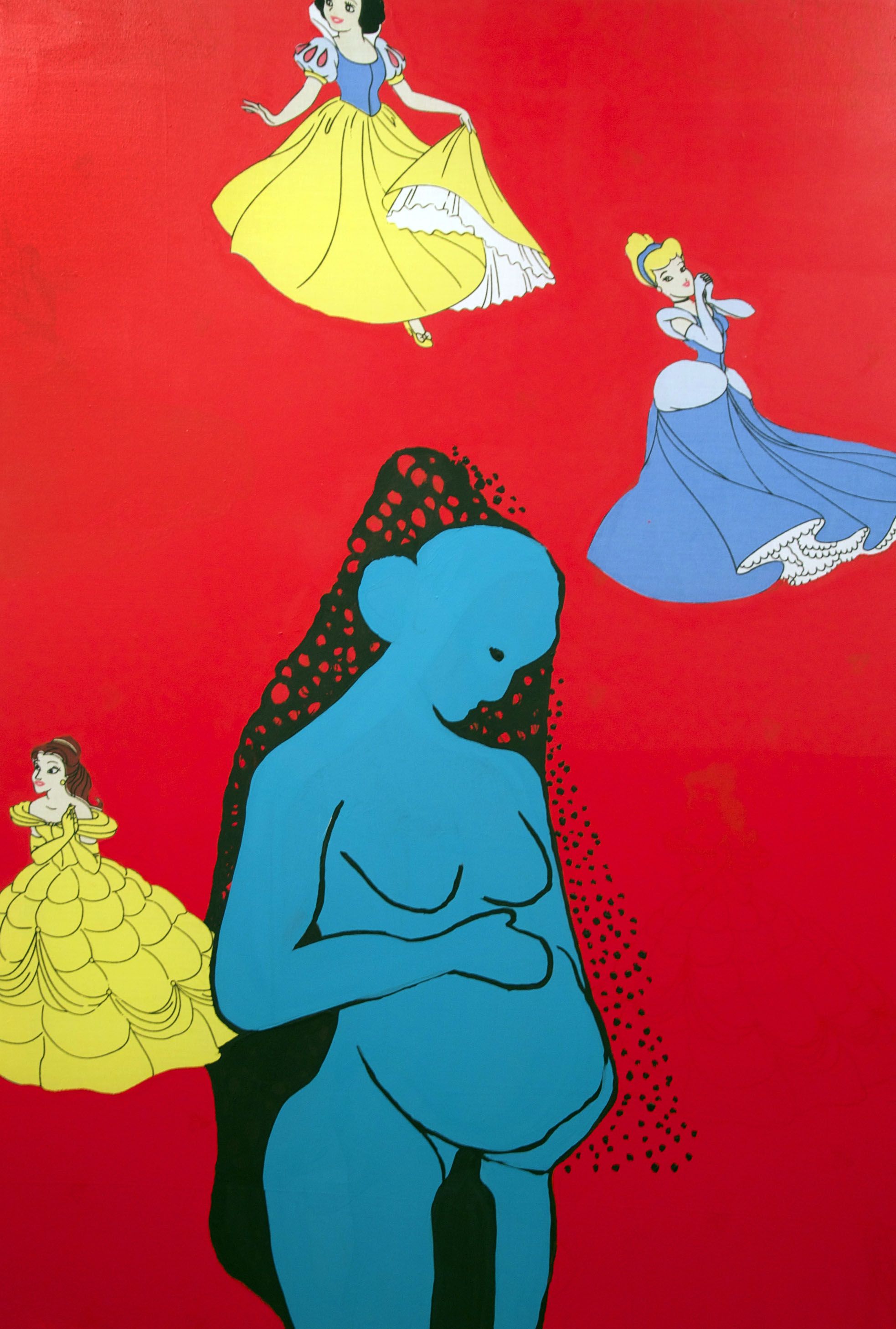
In another painting, a blue pregnant woman is outlined in black, her form partly surrounded by a veil. She is seen simultaneously as clearly pregnant and as she would appear to others when draped in cloth — Kamel seems to be telling us her form becomes, as a black shape, indistinguishable from other women. Around her are pretty Disney characters in various poses of Disney femininity.
In both these works, there is a clear sense of how distant childhood fantasies and desires are from the grown woman’s present reality, and an equally clear sense of her being trapped, boxed in, by Islamic garments. In fact, it is as if all that stands between her and Disney is Islamic conservatism. Or perhaps this garb serves as a visual stand-in for all the restrictions society places on its women. But there are no clues in the paintings that particularly support this latter interpretation.
Three square canvases — making up a triptych — are rich in color. Layers of patterned fabric and paint of pinks, oranges, reds, greens and blues are interrupted by the black, abstracted silhouette of what seems to be a veiled woman. In places, the black paint is faint, and the colors of the collaged patterns beneath show through, suggesting perhaps that the lines between image and fantasy aren’t always hard and fast, as implied in the other works.
The relationship between image and reality in the exhibition rarely goes beyond the level of contrast, however. The visual language of contrast and dichotomy is used, but boundaries and outlines are not blurred. There is no nod to the ways in which women negotiate conflicting desires and expectations.
In these works, the pop image is desired. But perhaps we need to think of fantasy or image as being both desired and undesired at the same. Where expectations of women are contradictory, desire itself is contradictory.
The exhibition’s premise is an interesting one: exploring how imported images such as Disney’s white princesses circulate among other images in a society like Egypt’s. It might have been nice had the Disney princesses also featured Jasmine of “Aladdin,” which, when it came out in 1992, was the company’s biggest blockbuster.
Kamal seems to imply that the contradiction between image and reality simply comes from these imported images coming up against the realities of a conservative society. But do little white girls in the West realize their Disney-shaped childhood fantasies? Usually not.
Feminists have long offered commentary on the conflicting demands and expectations placed on women in patriarchal Western societies — summarized simply in the virgin-whore dichotomy. In a society that is more conservative, this tension takes starker form, and while there are key differences, it is not all that different in some essential ways.
Juxtaposing reality and fantasy to point to contradictions in contemporary society is promising, but in the end the works point to these contradictions more than exploring them.
“Cinderella’s tales” is showing until March 20 at Mashrabia Art Gallery, 8 Champollion Street, Cairo. Opening hours, 11 am – 8 pm daily except Fridays.

تقارير ذات صلة
How power-blind accountability mechanisms failed Nayera Ashraf and countless other women
How do (in)formal justice systems reinforce power dynamics and short circuit justice?
On leaving heaven: Ibrahim Ahmed’s show at Virginia Commonwealth University
“It Will Always Come Back to You” is the first retrospective exhibition of Ahmed's work

Video | Street bling
As Ramadan ends, Mada Masr takes to the streets to enjoy the colorful decor while it lasts!
Your support is the only way to ensure independent, progressive journalism survives.
You have a right to access accurate information, be stimulated by innovative and nuanced reporting, and be moved by compelling storytelling. Subscribe now to become part of the growing community of members who help us maintain our editorial independence.
Join us