
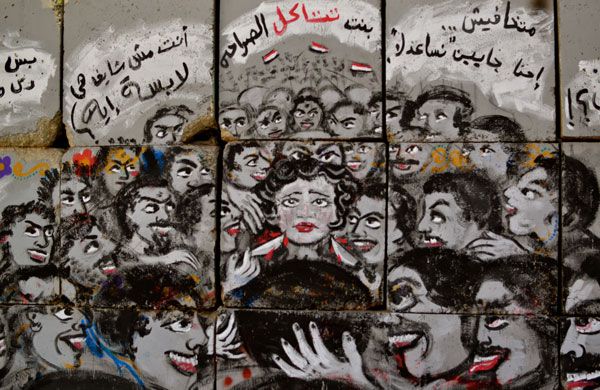
How power-blind accountability mechanisms failed Nayera Ashraf and countless other women
Last Monday, footage of a horrific murder went viral, as Nayera Ashraf, 21, was knifed to death in broad daylight at the gate of her university by a stalker she not only had rejected marrying multiple times but had also sought all possible preventive measures to deter.
Accounts of Ashraf’s attempts at deterrence did not only come from her friends and family but also from the Public Prosecution. In its statement on Tuesday, the prosecution said it had gathered enough evidence, including 20 testimonies, that Ashraf was murdered despite resorting to “customary reconciliation sessions” and filing a number of “police reports” detailing the threats her stalker and future killer had made against her.
Embodying the spirit of “immediate justice,” the public prosecution’s second update on Wednesday announced it possessed enough evidence to conclude its investigations and “refer the murderer to criminal court, only 48 hours after the incident.”
Not only did the prosecution omit any reference to Ashraf’s customary reconciliation sessions in their Wednesday statement, but it further warned that “strict legal measures'' would be applied if the circumstances of Ashraf’s death “or any other circumstances are addressed or circulated or made subject to interpretations or discussions.” On Sunday, Mansoura’s criminal court issued a gag order on the case, and by Tuesday, the court had handed Nayera’s killer a preliminary death sentence in what was reported as “the quickest criminal court proceeding in Egypt’s history.”
Despite the expedited ruling, there remain questions about why both the formal justice system and the informal customary reconciliation sessions failed to protect Ashraf from being murdered in broad daylight. To unpack these questions, Mada Masr took a closer look at how both of these accountability mechanisms reinforce predominant power dynamics and short circuit any meaningful justice in cases of gender-based violence.
What are customary reconciliation sessions?
Customary reconciliation is a community-based conflict-resolution measure most prevalent wherever access to legal intervention is deemed unreliable. Held by community, relational and security representatives occasionally, customary reconciliation sessions are a nationwide extralegal track to end social disputes, predominantly those resulting from sectarian or gender-based violence.
In most cases, leaders of reconciliatory sessions claim to empower traditional justice customs. But, whose customs do they judge by? Based on the study of 45 customary reconciliation cases, the Egyptian Initiative for Personal Rights (EIPR) raised questions on the ways in which customary reconciliation councils assume their power, highlighting a persistent trend of favoring the more socially empowered stakeholder.
In April, Nevine Sobhy reported to the police that she was beaten by a pharmacist for not wearing the hijab while visiting his drugstore in Ramadan. The Interior Ministry denied in a statement that Sobhy was subjected to any violence, saying that after listening to the pharmacist, the ministry decided that “he is a family friend who commented on the volume of her makeup, only in a friendly way.”
Sobhy — a 30-year-old Christian from Monufiya — took to social media to say that she and her family were pressured by the local police station to resort to customary reconciliation and that only after protesting inside of the police station was she allowed to file an official complaint.
After ten days, a customary session led by “security figures,” in the presence of the village’s mayor and its church’s priest, concluded reconciliation between Sobhy and the pharmacist, making him pay a sum of LE100,000 for his actions — on the condition that Sobhy withdraws her police complaint.
“I was slapped on the face twice by the pharmacist,” Sobhy wrote on Facebook, “and was slapped for the third time by the police station’s disregard for my complaint, and their push to turn to customary reconciliation against my will.”
Sobhy was let down by both state and community models of accountability, who acted to merely contain the issue. As soon as the customary session ended, a group picture was shared with the press where Sobhy posed much less proudly than 13 other men, including the man who assaulted her, who stood next to her celebrating a “successful” reconciliation.
“The injustice of customary reconciliation lies in its power-blind dynamics, which places the aggressors and the victim unjustly on equal footing,” Shaimaa al-Tantawi, the director of the feminist organization Barah Aamen, told Mada Masr, noting that whether the conflict is between a Muslim and a Christian or a man and a woman, it’s always the side with more power in the wider social context, usually the initiator of the violence, that has the interest to push for reconciliation.
“In such a case,” EIPR’s expert on religious freedom and conflict Ishak Ibrahim wrote, “reconciliation always implies clear acquiescence on the part of the victim in order to avoid anything beyond beatings.”
Trying to take matters into one’s own hands
In January, when neither the formal or informal justice routes were accessible, Fatma Safwat, 35, took to social media to magnify a desperate cry for justice.
Safwat live-streamed a protest for justice from inside a police station in the Minya city of Maghagha, as she headed to report her husband for domestic violence. With a bruised face and police personnel in the background, Safwat narrated the extent to which her husband’s “influential connections” have obstructed her accessibility to justice, having her “beaten up by the police chief for requesting to report his violence.”
After insisting on filing a report, Safwat said, the police chief told her that her husband plans on filing a complaint of theft against her, and that he would drop it only if she were to withdraw her complaint.
During the 24-minute video, enraged and humiliated by “the police's complicity with her husband,” Safwat called upon Minya’s security head and the president to intervene and save her. “They want to frame it as a report vs a report,” Safwat cried at the top of her lungs. “I am the one getting beaten, yet I am the one being threatened with jail.”
The live-video was interrupted when police personnel attacked Safwat and confiscated her phone. The following day, the public prosecution released a brief statement on how “the prosecution’s intervention led to reconciliation between a couple in Maghagha,” saying it investigated a woman’s complaint against her husband, who is accusing her of theft.
“After interrogating both parties of the conflict,” the prosecution said that “the complainant” denied any assault or violation from the police staff, as well as any accusation she earlier directed towards her husband. “Both parties filed a reconciliation report,” the prosecution added, and the husband admitted he “wrongly accused her of theft.”
Immediately after this update, Safwat live-streamed once again, wearing the same clothes and bruises she had a day earlier, but this time to thank the presidency, the national council for women's rights and the state security for their intervention on her side. “I don’t care if I was treated respectfully because of the live-video that I did. All I care about is that I’m eventually treated with respect,” Safwat said.
For Safwat, the weight and the outreach of her aggressor’s power had her attempt the unthinkable: live-stream a single-person protest inside a police station in Egypt in 2022, which is only way she could counterbalance the power her aggressor possesses, even if for a brief day.
Neglect and ‘immediate justice’
While Sobhy’s reconciliation was announced after one session and Safwat’s concluded in 24 hours, with Nayera Ashraf’s case, what came to the fore instead was the state’s systematic reluctance to act on reports of gender-based violence and to instead “immediate justice.”
The prosecution’s statement last Wednesday highlighted that it referred the killer to court in two days in efforts to achieve “immediate justice” — a concept embraced by Egypt’s judiciary earlier this month — as “one of Sisi’s top achievements in the justice system since he came to power.”
In his study of ‘Immediate, Procedural Justice,’ judge Suhail Nabil provides for the state’s understanding of what constitutes justice and the conditions that deem a procedure just. Yet, the validity of a just procedure is judged only by how far it “reduces the time duration of the conflict.”
According to Nabil’s argument, justice only begins when a complaint is made and fully materializes as soon as a ruling is out. In this sense, justice is simply a definite “set of procedural rules whose application would achieve immediate justice” — a procedure is deemed just when “extreme sanctioning” tools are exercised.
In this race to be the most immediately punitive, Egypt ascended last year to the top of the list of countries that hand out death sentences, according to an Amnesty International report. In terms of implemented execution, Egypt came in third last year, behind China and Iran.
“Carceral approaches tend to focus on punishment and retribution, rather than social transformation and prevention,” alternative policy researcher Farah Ghazal wrote in her proposition of Anti-Carceral Feminist Justice in Egypt, adding that, “a focus on punishment and retribution tends to translate into a carceral society, or a society dependent on increased surveillance, a warped understanding of gender relations, and ultimately, a normalization of the prison itself as a valid ‘corrective’ mechanism for any perceived ills of society.”
For Nayera Ashraf, the “immediate justice” provided by the carceral system only came after her death went viral, despite her consistent complaints and attempts to deal with the issue at an earlier level.
According to a criminal justice researcher who spoke to Mada Masr on condition of anonymity, this failure to push for social transformation at an earlier moment has to do with the lack of organizational autonomy across the different bodies who should be part of the state’s approach to justice.
“It is possible to understand justice as a process, and not merely a procedure, but only in a functional, institutional state, wherein the judicial system would be sufficient to handle procedures of legal complaints, while legislative and executive bodies, non-governmental civil society organizations, would be enabled, with respect to their capacities, to challenge the structural roots of violence in society,” says the criminal justice researcher.
“But in Egypt’s case,” the researcher adds, “all institutions, whether state-run or independent, are stripped of organizational autonomy by the very same power that is the root cause of the greatest forms of violence in society.” For the researcher, the state presents justice as if it is managing things at an elevated level, where the practice of justice is confined to procedure — but, in fact, it is operating on orders from the highest levels of the state, which trump any institutional procedures.
Community-based reconciliation and the formal justice system share a similar shortcoming then: their inability and incapacity to recognize their power and separate their approach to it from their supposedly objective role in adjudicating complaints. The restrictions on who is allowed to exercise power, voice complaints, seek redress in everyday affairs is thus effectively mirrored in the justice system.
“An approach to feminism that is anti-carceral argues,” Ghazal added, “that finding justice for women’s grievances in the state, as it exists today, is simply not possible. This is because of the view that the state is an indivisible part of the patriarchal violence that is inflicted on women every day – evident, for example, in the notorious procedural difficulty of reporting such violence and lack of medical and psychological support throughout the process. If the very infrastructure of the state, anti-carceral feminism asks, is patriarchal – how, then, to earnestly expect from it justice for gender-related grievances?”
In the meantime, while sensational local news coverage appeasing mass social media followers have blurred attempts to magnify recurrent systemic flaws in addressing gender-based violence, a number of initiatives and statements issued by feminist organizations pointed out how the justice system tends to exhibit systematic silence when women file for protection orders, echoing Ghazal’s argument.
“The police report Ashraf filed unsurprisingly fell on deaf ears, as many such filings do,” Barah Aamen head al-Tantawi told Mada Masr, adding that the police regularly dismiss such complaints based on the assumption that they were filed out of misplaced spite, spurred by a woman’s fight with a partner or family member.
“With regard to Nayera Ashraf’s case,” a statement from the Bread and Freedom Party said, “the victim attempted all official and societal measures to prevent the perpetrator from pursuing her, but the laxity of the security services and the unreliability of its protective measures eventually led to her brutal murder.”
“This heinous crime calls for wide discussions about the security services’ priorities, methodologies, and the ways with which it generally deals with citizens’ complaints of violence, abuse and bullying, and with women’s complaints in particular,” the statement added.
The statement also resurfaced a collective demand, initially issued in July 2020 and singed by a number of political parties, dozens of NGOs and hundreds of citizens, to “issue a uniform anti-gender-based violence law,” in which it expands the legal perception of what constitutes gender-based violence, to include wide scale practices of microaggressions and allude to effective preventive measures in the interest of victims and witnesses.
The number of police reports filed by Egyptian women subjected to violence in 2021 amounted to 813, whereas 296 women have been killed in instances of gender-based violence — 214 of whom were killed by their partners (an average of 4 murders per week, or one every 40 hours).

Ahmed Medhat
Ahmed Medhat is a journalist and independent researcher who worked with international media offices in Cairo. He holds a BA in Islamic Studies and Linguistics from Al-Azhar University. Past projects…
تقارير ذات صلة

Video | Dancing king
Ali Abdelfattah is an accomplished male bellydancing instructor.

Gender and Labor: An open call
The deadline for pitches or initial drafts is October 3, 2019.

Disquiet, vulnerability and muffled violence: A conversation on the films of Ahmed ElGhoneimy
All three of your films display a certain kind of disquiet towards the idea of masculinity
Your support is the only way to ensure independent, progressive journalism survives.
You have a right to access accurate information, be stimulated by innovative and nuanced reporting, and be moved by compelling storytelling. Subscribe now to become part of the growing community of members who help us maintain our editorial independence.
Join us