
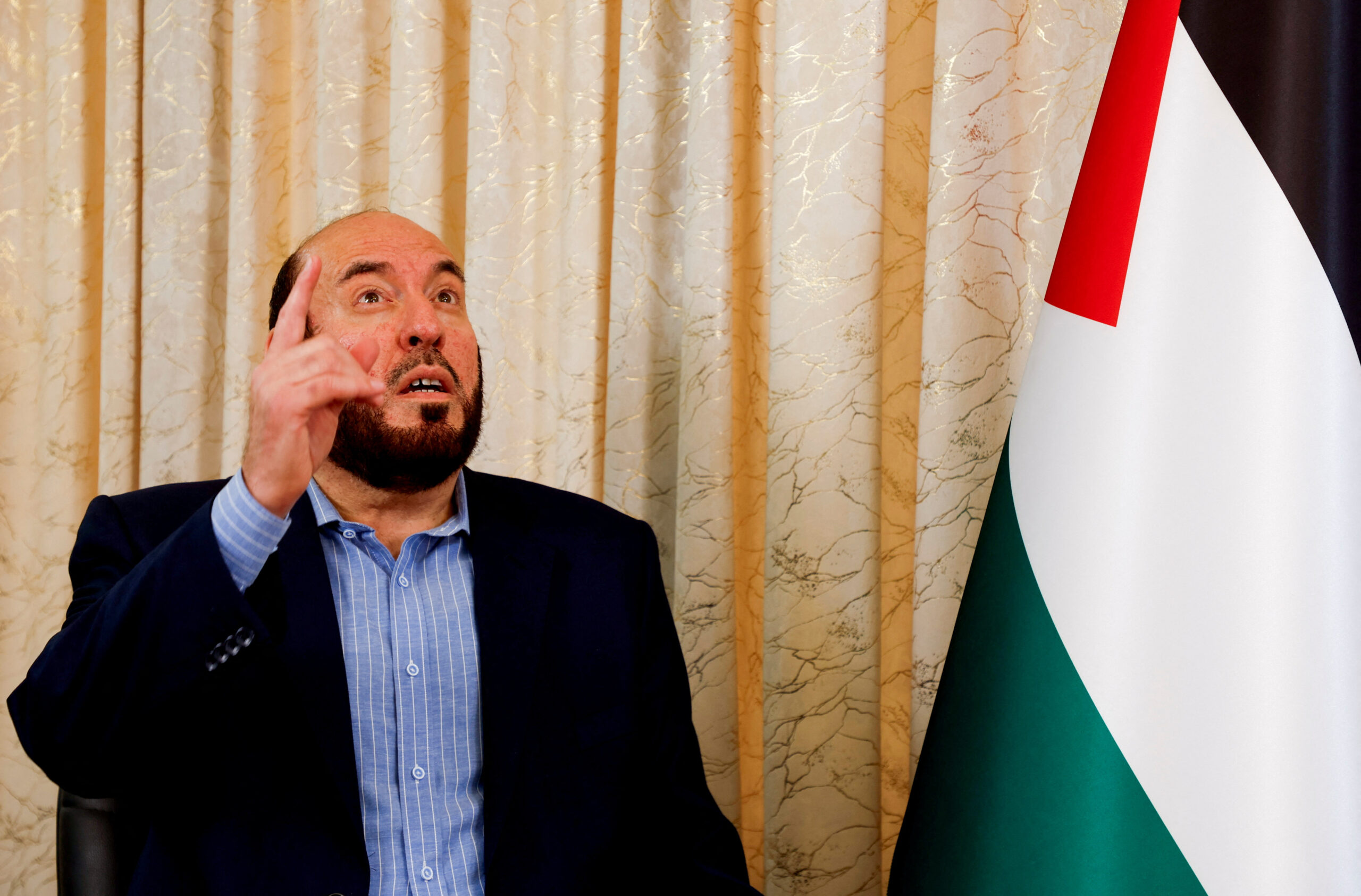
‘Resistance will persist’: Q&A with Hamas leader Mohamed Nazzal
In early October, Hamas took a calculated leap. It was days before the two-year anniversary of the launch of a war that has decimated Gaza and seen Israel kill at least tens of thousands of people, and the movement decided to use what seemed like its last remaining point of leverage to try to bring an end to the carnage: handing over the prisoners held in the strip.
The move came in response to a 20-point proposal for an exchange of prisoners and a post-war governance model for Gaza released by the White House as part of a joint press conference between United States President Donald Trump and Israeli Prime Minister Benjamin Netanyahu. In their address, the two heads of state praised one another while handing down ultimatums to Hamas: accept the deal or else.
Hamas decided to accept part of the deal: handing over the remaining living prisoners held in Gaza and the bodies of those who had died. The more controversial aspects of the plan — including the de facto protectorship of Gaza and decommissioning of Hamas security forces — were to be subject to intra-Palestinian dialogue and adherence to internationally accepted positions on a two state solution.
Over several days in Sharm el-Sheikh earlier this month, negotiators from Turkey, Egypt, Qatar, Hamas, Israel and the US hammered out an agreement on what has been called phase one of the proposal, which pertains to the exchange of prisoners, entrance of aid and the extent of a preliminary Israeli withdrawal. The more contentious issues of the 20-point proposal have been pushed to phase two.
So far, the truce has mostly held. Israel has killed over 100 people who have approached the “yellow” line, the figurative line demarcating Israeli withdrawal that the Occupation has made literal with the installation of yellow-painted barricades. There has been a revolving door of American officials who have visited Israel since the ceasefire went into effect, and US drones have been deployed over Gaza to ensure the truce is adhered to. The US administration has flip-flopped on whether it finds Hamas’s reimposition of security to be a problem, while Israel has criticized Hamas for slowness in returning the bodies of killed prisoners, threatening to limit the entry of aid.
But a step toward phase two has remained elusive. Egypt has hosted delegations from Hamas and Fatah to try to broach a counter proposal to the White House’s plan for a depoliticized Palestinian implementing “board.”
To talk about everything that has happened since early October and what comes next, Mada Masr sat down with Mohamed Nazzal, a leader in Hamas and a member of its political bureau.
***
On October 19, a Hamas delegation led by Khalil al-Hayyah arrived in Cairo to follow up with mediators and Palestinian factions and forces on the implementation of the ceasefire agreement.
According to Nazzal, the delegation met with Palestinian factions that had also traveled to Cairo for consultations on forming an administrative Palestinian committee to govern Gaza in the coming phase.
So far, 40 independent Palestinian technocrats — without an affiliation with any faction — have been nominated, most of them from Gaza and having remained there throughout the war, according to Nazzal. Between 10 and 15 members will be selected to make up the committee.
There has so far been little progress on phase two of the ceasefire, and several terms of the first phase also remain unfulfilled.
For Nazzal, the delay can be explained by the fact that the Occupation never wanted to enter into the ceasefire deal to begin with. “Thus it is placing obstacles to implementation in a smooth and easy manner.”
The Occupation, he says, did not adhere to the deal in its first phase. “The Rafah border crossing was not opened and aid didn’t pass through in a smooth manner. ”
For Nazzal, the matter requires intervention from the American leadership and the three mediating countries — Egypt, Qatar and Turkey — to pressure the Occupation into initiating the second phase. “After two years of war are we not going to make concessions on the rights of the Palestinian people,” he says. “We are not talking about a peace process. We are talking now about ending a genocidal war on the Gaza Strip. We want this agreement to last as long as possible.”
Tensions in the first phase are mounting over the issue of handing over the bodies of Israeli prisoners.
So far, what has been achieved in the first phase is the prisoner exchange, Nazzal says, but the exchange of bodies “is not an easy matter logistically. It needs time, and not a short amount of time.”
“We informed the mediators that we need time, and we requested the involvement of countries with expertise in this matter, including Turkey. But the Occupation refused their entry,” he says. “Efforts are underway by some countries to expedite implementation and step out of the first phase.”
On Wednesday, during US Vice President JD Vance’s visit to Jerusalem, Netanyahu stood by his side, saying that the two had discussed day-after scenarios. When asked about the idea of deploying Turkish security forces in the strip, Netanyahu retorted: “I have very strong opinions about that. Want to guess what they are?”
Vance said that Turkey could play a "constructive role,” but stressed that Washington is not going to “force anything on our Israeli friends when it comes to foreign troops on their soil.”
Nazzal says that Netanyahu’s rejection of any Turkish role in Gaza as part of a ceasefire monitoring mission “reflects his great sensitivity toward Turkey, which he views as an enemy.”
“There is a state of unease between Erdogan and Netanyahu,” Nazzal adds. “And while Turkey’s position is similar to that of other states that condemn the Occupation, there is extreme sensitivity due to Ankara’s regional role. The Occupation has, over the past period, excluded Turkey from being a mediator. It was only brought in in recent weeks under pressure from US President Donald Trump.”
In recent days, Israeli media outlets have seen mounting discussion about the government’s stance on the body of Yahya al-Sinwar. Several reports, among these by the Wall Street Journal and the Israeli military’s broadcast, have noted a hardening within Israeli leadership against the possibility of returning his body under any exchange deal. An Israeli security source said plainly: “We will not hand over the bodies,” adding a new layer of tension to the negotiation process.
According to Nazzal, one of Netanyahu’s government officials “suggested burning Sinwar’s body.” He says that Israel “raises hell” over the bodies of their own prisoners. And although many of them have decomposed and others lost their features, he adds, the Occupation insists on handing them over without exception. In return, “there is a proposal to burn Sinwar’s body — an evidence of the sadism that characterizes the Occupation.” Even prisoners who died in Israeli prisons arrive in a “horrifying state,” he says. “Their organs were stolen and their features disfigured from torture.”
According to Nazzal, “October 7 provided evidence of the nature of the Occupation, which was viewed in the West as the only democracy in a jungle of beasts. But Western countries found out that the Occupation has nothing to do with humanity. Sinwar’s body, despite our regard for this great figure, is no more precious than the bodies that have not yet been handed over. And we will certainly not forget our hostages — living or dead.”
During the Sharm al-Sheikh negotiations, the release of the six senior Palestinian prisoners, including the prominent figure of Marwan Barghouti, held in Israel emerged as one of the most critical issues that nearly scuttled the entire deal.
“We are still pressing for this issue to be brought back up. We believe that these six senior figures are the responsibility of the Palestinian people and factions, and we must work on having them released. What happened regarding this matter in Sharm al-Sheikh was that we kept trying to secure their release until the very last moments, but the Occupation showed an extraordinary level of intransigence. We tried, through the mediators, to exert pressure. They could have insisted on their release and risked stalling the deal, but the mediators and the US leadership ultimately chose to reach a deal, and the matter was deferred to a later stage.”
A few days into the ceasefire in Gaza, clashes broke out between members of Hamas’s police and groups affiliated with large families in the strip. The confrontation left several dead, including a prominent journalist.
Commenting on the matter, Nazzal says the problem “is not with the families or clans themselves. But there are certain individuals within some clans who were contacted by the Occupation, with the aim of sowing discord between the clans and Hamas. The clans, however, denied the Occupation the chance to do that.”
“We hold the Tarabin tribe in Gaza in high regard. Our issue is not with them, but with Yasser Abu Shabab, who allowed himself to be in the hands of the Occupation. What we are certain about is that he is an agent for the Occupation. Our problem is with people like him.”
Vance said on Wednesday that Israel and the US are facing difficult tasks ahead: disarming Hamas and ensuring it no longer poses a threat to Israel.
“There are many statements made by the US administration,” Nazzal says. “We believe that these statements come within the context of the negotiation process. Disarmament is not on the negotiating table as a standalone issue, but there are many details linked to it. We are awaiting official proposals to be put on the table. Disarmament and other topics necessitate a unified Palestinian stance, not just Hamas’s. We must consult with all factions, and this should take place in the second phase.”
On the afternoon of Tuesday, September 9, Israeli airstrikes targeted a building in the Katara district in the Qatari capital Doha where Hamas’s negotiating team was present.
Witkoff, recalling the day, said to the media last week, “[Ron Dermer] — the lead minister in Israel — and Jared were at my home. And we were going through the peace proposals that we were putting on the table. And — and at the time, we were discussing compromise deals. We were discussing what they called the ten and ten. Ten hostages come out, ten get left for the final negotiation. [...] We woke up the next morning to find out that there had been this attack. [...] It had a metastasizing effect because the Qataris were critical to the negotiation [...] And we had lost the confidence of the Qataris. And so Hamas went underground, and it was very, very difficult to get to them.”
Nazzal explains how Hamas returned to the negotiations. Recalling the day of the Doha attack, he says that the airstrikes took place at 3:45 pm. Missiles were fired at the office where Khalil al-Hayyah and the delegations convened to discuss the American proposal.
“But the delegation wasn’t there. Those targeted were moved to a safe place, and it was difficult to communicate with them.” Nazzal says. “The first meeting with Khalil was probably a month later, and it was emotional. Of course, I had sent him a letter of condolences for his son Hammam before our meeting, especially since he was the third son he lost. He lost his son Hamza, who was a member of the Qassam Brigades, in 2009. The second was Osama, the eldest, in 2014. And Hammam was the third.”
“After the aggression on Doha, Qatar’s position was that it would not resume its mediation role unless two conditions were met: first, that the Occupation issue an apology, and second, that it pledge not to carry out any operation that would endanger Qatar’s security. After Netanyahu offered an apology along with a promise that such an incident would not be repeated, Qatar agreed to resume the negotiations, and we were informed of that. From our side, our goal was the negotiations, because we want the war in Gaza to stop,” Nazzal says.
Nazzal also spoke about the proposals put forward by Jared Kushner for rebuilding the half of the strip under Israeli control, in an attempt to disarm Hamas. The proposal stipulates dividing Gaza into two zones: one under Israeli control and the other under Hamas’s control.
For Nazzal, Washington is marketing itself as the leader of the world. There are contradictions in the daily American statements, Nazzal says, “but what matters to us is what is said at the negotiating table.”
“We have no issue with rebuilding the areas under Israeli control, as this will serve the interest of the Palestinian people. But at the same time, we insist that reconstruction must also include the areas currently under Hamas’s control. There is a battle on the ground over reconstruction, and it shouldn’t stop.”
On Thursday, the Knesset, in its preliminary vote, passed two bills — one to annex the West Bank, and other to annex the Maale Adumim settlement.
Commenting on the move, Nazzal says that annexing the West Bank is nothing new, as Israeli leaders have been declaring such intentions for years. The real issue, according to Nazzal, is demographic. “The Palestinian people are rooted in their land and do not accept being driven from it. They continue their struggle on all fronts. If the Occupation thinks that such decisions will enable it to continue the genocide of the Palestinian people, it is delusional — especially after the lesson of the October 7 battle, which proved our steadfastness.”
This decision, Nazzal says, puts the deal at risk. “But we will not surrender. We will continue to defend our people on both the regional and international levels. All forms of resistance will persist.”
Nazzal also addresses the displacement plan that continues to target Palestinians. He stressed that the issue is not one of property or money, but the fate of a people and their land. “The Palestinian people are the ones who will lead the confrontation against this plan. There is no force that is capable of driving us out of our land. After the October 7 battle, the Occupation thought that this was its chance. But the Palestinian people stood firm and remained in Gaza. Palestine is not a piece of real estate that could be handled in this manner. It is the cause of a steadfast people.”
تقارير ذات صلة
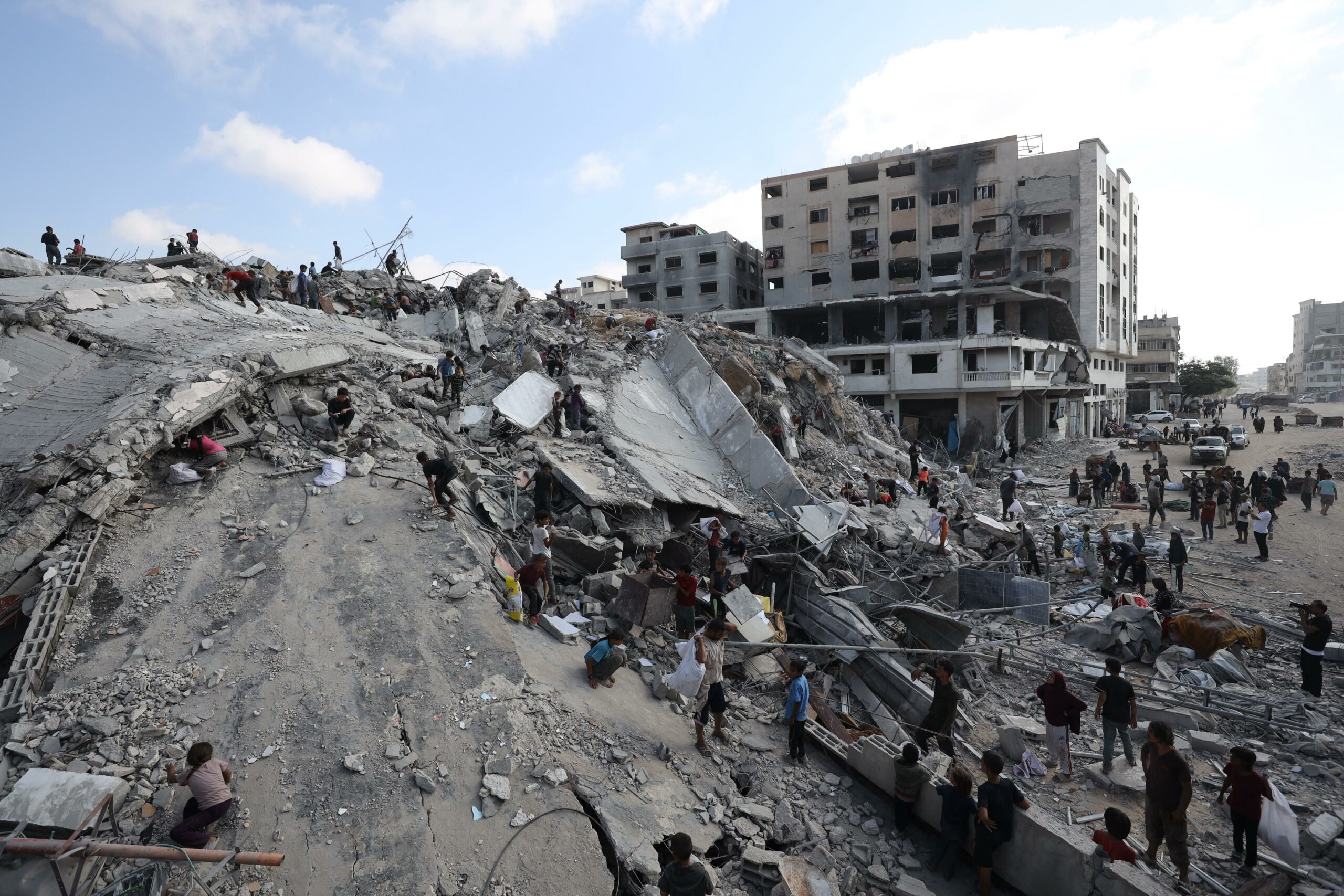
Israel targets multi-story residential towers in escalation of Gaza City operation
The targeting represents a new development in Israel’s tactics as it seeks to empty Gaza City
Your support is the only way to ensure independent, progressive journalism survives.
You have a right to access accurate information, be stimulated by innovative and nuanced reporting, and be moved by compelling storytelling. Subscribe now to become part of the growing community of members who help us maintain our editorial independence.
Join us