
Israel targets multi-story residential towers in escalation of Gaza City operation
Israel’s military warned the families living in the high rise Mushtaha al-Qahera tower block in western Gaza City that it was about to attack their home on Friday afternoon.
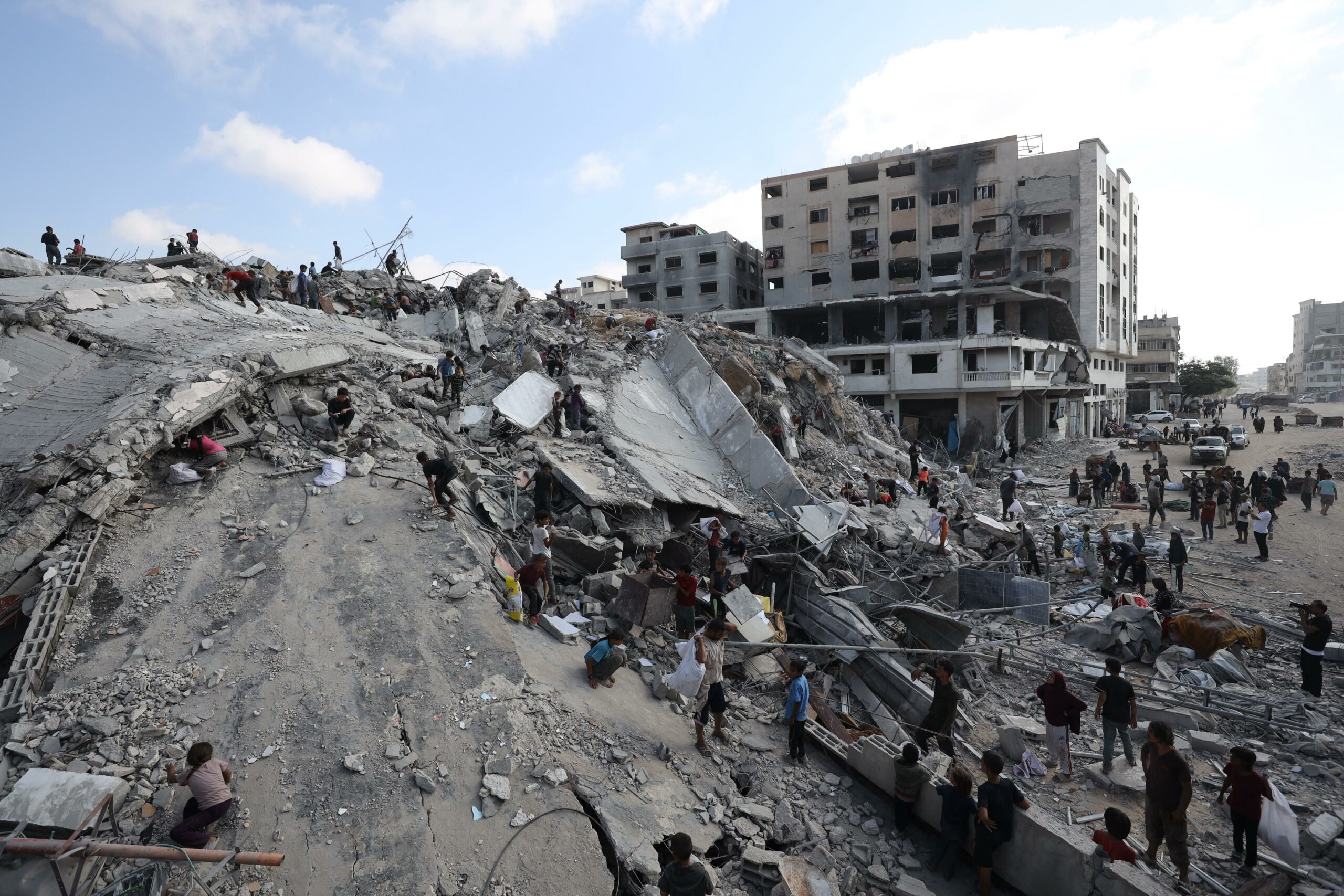
Moments later, at least two airstrikes targeted the 12-storey building’s lower floors, bringing it crashing to the ground in a cloud of concrete and smoke that was meters high. Shrapnel flew hundreds of meters into the air, injuring several people in the vicinity, said Salem al-Bayed, an eyewitness who was nearby at the time.
The destruction of the Mushtaha tower represented a new development in Israel’s military tactics as it seeks to empty Gaza City of the 1 million people estimated to be living there.
Prior to razing the tower to the ground, the military released a statement saying it had designated dozens of similar buildings located all over the city as military targets primed for aerial bombardment over the coming days.
The next target was the Soussy tower, a 15-storey residential block in the southwestern Gaza City neighborhood of Tal al-Hawa, which came within Israel’s cross hairs the following day.
Israel’s military spokesperson instructed residents of the building and of nearby tents and buildings to evacuate on Saturday afternoon, claiming the building was housing “Hamas terrorist infrastructure inside or next to it.”
Just 50 minutes later, it said it had completed the attack. Residents described taking around 20 minutes to evacuate the building and its surroundings. Images in the aftermath of the airstrike showed children picking through the rubble for wood and other usable materials.
Israel’s military has described the new attacks as a way of targeting Hamas infrastructure and capacity, releasing graphics that show scores of buildings, most of them high-rise blocks, highlighted in the red color that indicates its intention to attack.

But the attacks also come as Israel seeks to empty Gaza City of as many residents as possible amid its operation to “capture” and take control of the most populous area of the strip.
Around 1 million people were estimated to be living in Gaza City before Israel declared the entire metropole a “dangerous combat area” last week.
The invading military’s advance began on fronts to the southwest, northwest and north of the city starting weeks prior.
More than 57,000 people are estimated to have been displaced in August from the Gaza Governorate, where the city is located, as per monitoring conducted by the Global Camp Coordination and Camp Management Cluster, which estimates that over 27,000 were displaced from the neighboring North Gaza Governorate.
Though the population movement represents a substantial strain to infrastructure already inadequate to support crowded areas in the south and central parts of the strip, they fall far below the targeted displacement figures of around hundreds of thousands of people cited by Israeli military correspondents.
Families speaking to Mada Masr about being displaced cited prohibitively high costs for transport and shelter, as well as limited residential options preventing many from making the move.
The tower block strikes quickly destroy housing options for all of those in the surroundings. Prior to the airstrikes on Mushtaha, people were seen throwing bedding and belongings from the tower block’s windows in a rush to evacuate the premises.
Commenting on the impact of the Mushtaha bombing on residents of the crowded Ansar area of western Gaza City, Bayed pointed to the complexity of evacuating not only the tower, but the area surrounding it which was packed with thousands of tents sheltering other displaced families.
Invading military advances aerial, ground attacks
At the same time, Israel has substantially escalated its operations on the city, with heavy shelling targeting the Sheikh Radwan and Jalaa Street areas in the city’s north at the time of writing.
Israel’s airforce t intensified its airstrikes on Thursday night, targeting residential buildings and tents sheltering displaced people in Gaza City’s west, many of whom had fled the relentless military violence elsewhere in the city.
A strike targeted an apartment in the Roaya building, killing and wounding several people, while another struck a tent sheltering displaced people inside the Islamic University of Gaza campus, killing four and injuring several. Three people were also killed in a strike on the Hassouna family’s apartment in the Abu Dhabi building.
Several other strikes hit areas across the city on the same night. In central Gaza City, a strike targeting a building in Yarmouk killed four and injured many others.
Simultaneously, artillery shelling pounded the Sabra, Zeitoun, Shujaya and Daraj neighborhoods in the city’s east, where Israel has conducted a campaign over recent weeks using remote-detonated explosives to rip through residential areas, clearing the way for its ground forces to advance.
On the northern front, Israeli tanks advanced suddenly and swiftly on Thursday night, reaching as far as the Sheikh Radwan Pond and Abu Eskandar Street, firing heavily and indiscriminately at homes and anything that moved, eyewitness Abu Nader Lafy told Mada Masr.
“Gunfire targeted homes on Jalaa, Oyoun, Awal and Yarmouk streets to the south — areas that the Occupation hasn’t reached since the last ceasefire,” he said.
Troops deployed remote-controlled explosives in the areas they entered. “We spent the night hearing non-stop blasts,” Lafy said, describing the explosions as more powerful than previous rounds, since the devices were planted near densely populated residential areas.

تقارير ذات صلة

‘Resistance will persist’: Q&A with Hamas leader Mohamed Nazzal
Hamas leader discusses Qatar strike, snags in ceasefire, steps for technocratic govt

Your support is the only way to ensure independent, progressive journalism survives.
You have a right to access accurate information, be stimulated by innovative and nuanced reporting, and be moved by compelling storytelling. Subscribe now to become part of the growing community of members who help us maintain our editorial independence.
Join us