
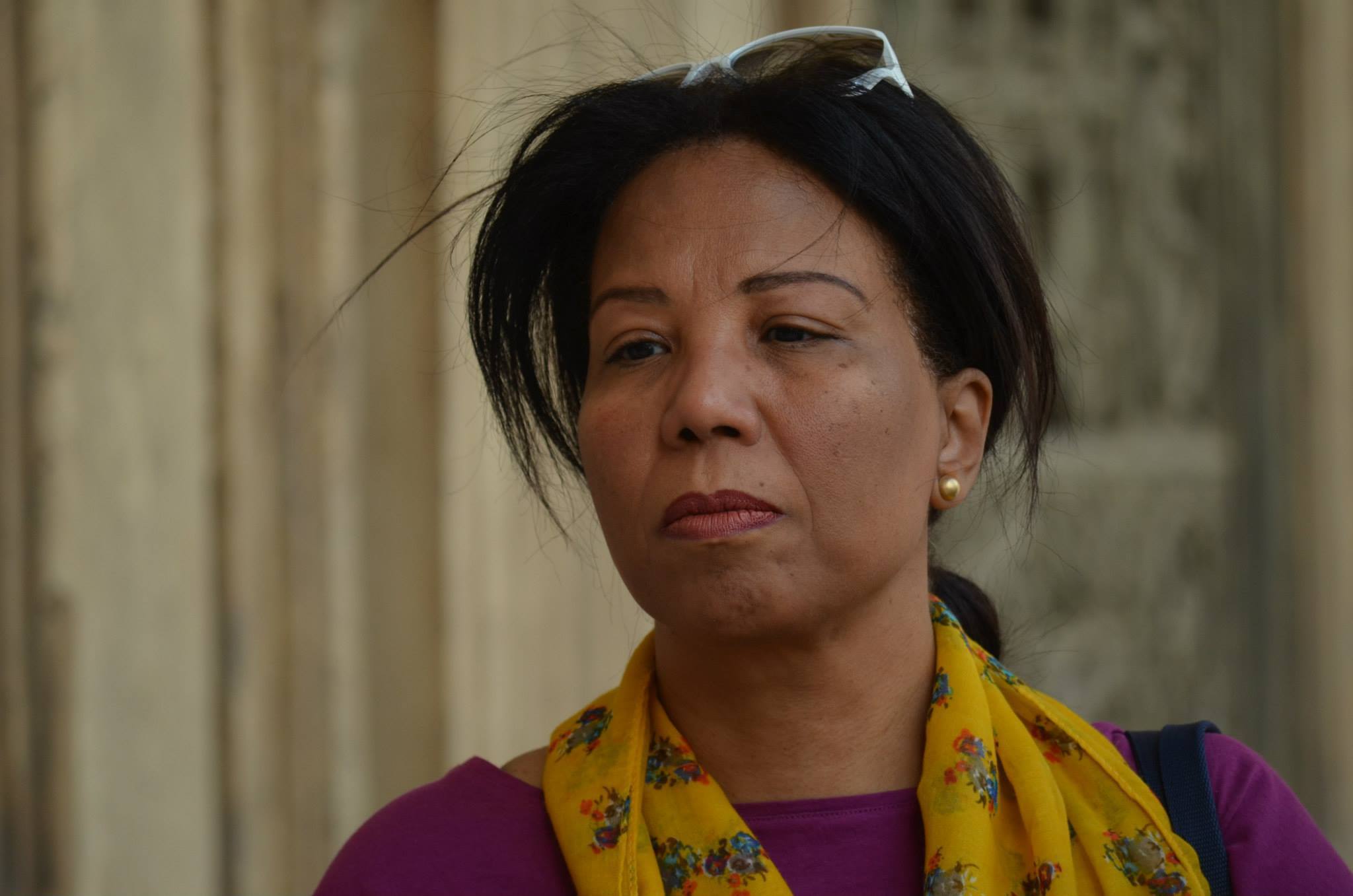
Q&A with lawyer Azza Soliman: The campaign for a Just Family Law
The personal status law has long been a point of contention in Egypt. For years, the government, Al-Azhar and civil society groups have battled for authority and influence over the creation of a new law to govern issues concerning marriage, divorce, custody and inheritance. The latest efforts came last month when three leading women’s rights groups — the Center for Egyptian Women’s Legal Assistance, the Women and Memory Forum, and the Guardianship is My Right campaign — launched the Just Family Law campaign, which aims to address a number of outstanding issues by putting forward a new bill.
Over 60 parliamentarians have signed onto the proposed bill and it has been presented to the House Constitutional and Legislative Affairs, though it is still unclear if they will take it up for discussion. The draft legislation includes a comprehensive set of amendments, that aim to strengthen women’s rights. One notable example is an amendment that grants mothers who have survived rape the right to establish parentage of their babies under the names of the children's fathers.
The bill also proposes that divorce be adjudicated in court and that women receive compensation in case of divorce, as opposed to the status quo, which affords Muslim men the continued unilateral and unconditional right to divorce without resorting to legal proceedings.
Another amendment gives the non-custodial parent regular visitation rights and provides for the inclusion of additional terms in the marriage contract, which would be agreed upon by both parties and may include a division of wealth in the event of divorce.
The bill also prioritizes the mother in regard to child custody and stipulates that the mother can retain her right to custody in the event of remarrying. It further stipulates that a Coptic mother who is married to a Muslim man has the same right as a Muslim woman in retaining custody of her children. The bill does not object to polygamy, but calls for the prohibition of underage marriage.
Just Family Law’s legislative proposal was drafted as a response to another bill for the personal status law that the government leaked to the press in February of 2021 but quickly retracted after it sparked a firestorm of controversy, leading to the launch of the Guardianship is My Right campaign and a number of rights organizations characterizing it as a “pejorative philosophy against Egyptian women [that] blows away a 100-year long struggle by Egypt’s feminist movement.”
The issues of contention in the government’s controversial draft law included not granting the mother the right of financial guardianship over her children. It also granted a woman’s guardian the right to unilaterally end her marriage within one year of the marriage contract — provided she was not pregnant or had given birth — including if the husband was deemed “unsuitable.” Current laws deny women the right to make decisions in key areas of their life without the consent of a male guardian.
Mada Masr spoke with the attorney and head of CEWLA Azza Suleiman about the outstanding issues in the current personal status law and the philosophy behind her organization’s proposal for a more just bill.
Mada Masr: What are the most prominent problems in the current law, both legally and in its implementation?
Azza Suleiman: The problem with the current law is that the worldview of the legislator who drafted it in the 1920s is the same one that governs us now. Even the draft laws that have been proposed by the government, Al-Azhar, or political parties, have all reinforced that same worldview, which is that women are not equal to men, that women must obey men because they have financial power and the prudence to manage personal status issues.
There are problematic articles that pertain to divorce. While men enjoy the right to divorce their wives unilaterally, the terms of divorce when it is initiated by women are extremely specific, complicated, and subject to scrutiny and proof, which is why women can spend years in court before they are able to obtain a divorce. And after a divorce, a man can live his life normally and remarry, whereas a woman’s life is held up in the courts as she fights to obtain her rights and the rights of her children.
Another problem lies in fathers being ranked near the bottom of the list in terms of eligibility for child custody, even though the decision to bring a child into the world is shared between mother and father. There are also issues with the articles that pertain to guardianship, which all favor men. Even in the event of the father’s death, guardianship of the children goes to the grandfather, not the mother — he would have to relinquish guardianship rights to her, as if women do not actually have natural guardianship over their children. It becomes difficult to issue birth certificates and passports. It becomes difficult to make decisions about the children’s education. And in the case of financial guardianship, the mother is subject to probate court, whereas the father is not, because he is considered a natural guardian.
Revoking a mother’s custody of her children if she gets remarried is another problem, one that pushes her to never remarry or to get married in a non-official way, which can be used to blackmail her. I’ve seen mothers pay money to avoid being publicly outed as having remarried and at risk of losing custody of their children.
Similarly, there is a problem with the articles relating to husbands who go missing. The law considers a husband missing only after a minimum period of four years. And if he returns, the wife is tossed back like a ball to her first husband, against her will, even if she has remarried, as long as she has not borne any children from the second husband.
The current law also does not address “accompaniment or hosting,” meaning that it does not grant the right for non-custodial parents to share the responsibility of raising the children, despite this being vital so long as criteria are stipulated to protect the children.
When it comes to implementation, there are problems with the family courts themselves. Settlement offices do not have a strong role, and expert opinions are non-binding before a judge, who ultimately enjoys discretionary powers. This brings us to another problem, which is the extent to which those who are tasked to deal with such matters are qualified to do so. Do they consider social or gender dimensions? Do they receive regular training to be able to address the problems they encounter? It’s vital to train those who are charged with administering justice, including the police and forensic medicine practitioners.
Another problem in implementation is the issue of educational guardianship over children. According to the law, the custodial mother only needs to present the birth certificates of her children to the court, but some judges request to see the children. Many mothers refuse to put them through this experience.
MM: Why did the draft law leaked by the government in February 2021 spark such widespread anger?
AS: The draft law reinforced the same legislative philosophy of the current law, which treats women not as citizens but more like vessels for reproduction. It also gave a woman’s guardian the power to annul her marriage contract if the guardian considered the husband unsuitable, as if women do not have the right to their own experiences and choices for which they are responsible. Can a father annul his son’s marriage if he feels the marriage is not good enough? Look at how many fathers use their guardianship authority to force their daughters into failed marriages for a variety of reasons and to prevent them from continuing their education, just because they can.
MM: What is the reasoning and goal of the draft law you are proposing?
AS: The philosophy that guides us is equality between men and women, just as the Egyptian Constitution stipulates as well as international agreements signed by Egypt. We also drew on personal status laws in Arab and Muslim-majority countries and relied on interpretations of Islamic jurisprudence. We envision a holistic law, one that respects the legislative system, but aims to address the shortcomings of all the laws that relate to personal status issues. In our proposal, the administrative judiciary would become more involved. We defined marriage not as an arrangement of enjoyment or of property, but as a shared responsibility, one that must come with agreed-upon values.
Our bill also prohibits the obedience ordinance, verbal divorce, unilateral divorce and revocable divorce. In cases of conflict, divorce should happen through the courts. We also requested that marriage contracts include conditions agreed upon by couples, which is something that will make the job of judges a lot easier. Our bill also stipulates that all personal status affairs be handled by one court, so that you do not have a child support case in one court and another guardianship case elsewhere.
The court would consider a case if reconciliation fails and assess the need for compensation for any potential damages. It would not revoke a mother’s custody over her children if she decides to remarry, except if there is a danger to them. Also, motherhood does not know religion, and Coptic mothers have the right to retain custody over their children.
In paternity disputes, the draft law puts the burden of denying parentage onto the father, and if the father refuses to undergo a DNA test, this can be used against him in court. Child marriage would also be prohibited, and not merely the official “registration” of this marriage, which is the case in the current law. Under our bill, penalties could be issued against witnesses, guardians and the person who officiates the marriage contract of a minor. Financial and educational guardianship would be equally divided between mother and father in the new contract.
MM: You do not call for the prohibition of polygamy in the draft law. Why?
AS: Ten years ago, I was for the complete prohibition of polygamy, but the reality we saw through our work across Egypt’s governorates reflected something different. I saw husbands who choose to stay with wives who have disabilities for instance, and who have no support system otherwise. Also, complete prohibition will require state intervention, and the state cannot handle such a responsibility right now. But our draft law presents different scenarios in which polygamy would be prohibited without harming women. In our proposal, if a married man wants a second wife, the court would assess his financial capability, and the second marriage would only be allowed through a court order. If the man wants to divorce his first wife, the decision cannot be left to his individual discretion, and he must attend to his financial responsibilities toward the first wife.
MM: Why did you not propose a secular personal status law?
AS: In 2020, we were hoping to have a civil law for all Egyptian men and women — a civil law, a secular law, it doesn’t matter what you call it. What matters is for the law to include all principles of justice, citizenship, freedom, fairness and a respect for the Constitution and international agreements. I believe that the draft law we are proposing is strongly leaning toward that civil end of the spectrum. I am also involved in other circles that are working on a civil personal status law, and I think all of our groups should discuss and present everything we hope to see. It’s important to create a dialogue and break taboos.
MM: What is the goal of the Guardianship Is My Right campaign?
AS: Our goal is to start a dialogue about the draft law. MP Nashwa al-Deeb has sponsored our bill and secured the signature of 60 other MPs. She presented it to the House Constitutional and Legislative Affairs Committee, which is a positive step, but we still do not know whether it will be discussed or not. Previously, MP Abla al-Hawary sponsored another draft bill we had prepared, and a hearing session was scheduled, but then the bill was shelved. We are discussing the draft law with relevant groups, organizations, political parties, lawyers and media figures in different governorates. We will also publish women’s accounts of the hardships they’ve endured under the current personal status law.
تقارير ذات صلة

The long and costly wait for a new personal status law
Bassant Soliman’s suicide triggered renewed public backlash against personal status laws in Egypt

Interview: X’s new restrictions fail to protect users from AI image manipulation
Mada Masr spoke with digital helpline coordinator Tasneem Mounir on why X’s ban falls short

Navigating digital consent violations: Speak Up’s founder talks partnering with Pornhub
In February, Speak Up partnered with Aylo — parent company of Pornhub and other adult websites
Your support is the only way to ensure independent, progressive journalism survives.
You have a right to access accurate information, be stimulated by innovative and nuanced reporting, and be moved by compelling storytelling. Subscribe now to become part of the growing community of members who help us maintain our editorial independence.
Join us