
Navigating digital consent violations: Speak Up’s founder talks partnering with Pornhub
Speak Up, an NGO working to combat online blackmail and cyberbullying against women, was founded in 2020 amid a wave of momentum sparked by thousands of testimonies of sexual violence shared online in the wake of the Ahmed Bassam Zaki case.
The firestorm erupted over dozens of sexual assault, harassment and blackmail accusations against Zaki — a 21-year-old university student who was charged in July 2020 with attempted rape and indecent assault.
A conservative backlash ensued to support Zaki and others facing similar accusations, and to scrutinize the women raising their voices.
Speak Up was born in the same month, with its founder, Gehad, launching a spontaneous form inviting women to share their experiences, attached to a social media post emphasizing that all women in Egypt face sexual harassment.
What started with a post quickly turned into an initiative, from Speak Up’s founder responding to thousands of form submissions and comments on her post, to lawyers volunteering to offer legal support to these women.
The Speak Up page was created, and over the years, new forms of support for women were made available, evolving the initiative into what it calls a “platform for action.” The organization launched multiple partnerships with governmental and non-governmental entities and expanded its services, as it transitioned into a fully formalized nongovernmental organization.
Today, the NGO works through advocacy campaigns against sexual harassment, offers pro bono legal and psychological assistance, works on legalisation reforms, launches awareness campaigns and offers safe online spaces to provide support for victims and minorities.
A helpline was added to Speak Up’s services in August 2024 as a confidential support line for individuals affected by online blackmail, harassment and digital violence, according to a report the NGO published in January.
The aim, according to the report reviewed by Mada Masr, is to address cases involving “nonconsensual sharing of private images or videos, social media harassment, unfair removal of content on Sexual and Reproductive Health Rights (SRHR) and wrongful disabling of accounts related to sensitive topics.”
Partnerships to tackle nonconsensual published content
Through collaborations with platform administrators, Speak Up works to remove online content it deems harmful and responds to cases of impersonation, harassment and defamation, aiming to protect those affected.
In a study based on reports to its helpline — The Reality of Cyberbullying and Blackmail Crimes in Egypt — Speak Up found that cyberbullying and online blackmail targeting women is on the rise.
However, the report noted that 290 cases received in January were deemed “non-reportable” by the NGO due to factors such as “insufficient evidence” or “falling outside the scope of actionable violations.” One key limitation regarding reports on nonconsensual content is that Speak Up only handles the content that is publicly accessible. Cases involving private messaging platforms fall outside its scope and are referred to Egyptian law enforcement.
Over the past two years, Speak Up partnered with Meta, Youtube, Tiktok and Pinterest to escalate reported cases and follow up until the nonconsensual content is removed.
The NGO also collaborates with civil society groups and policymakers in Egypt and the region as part of its helpline framework.
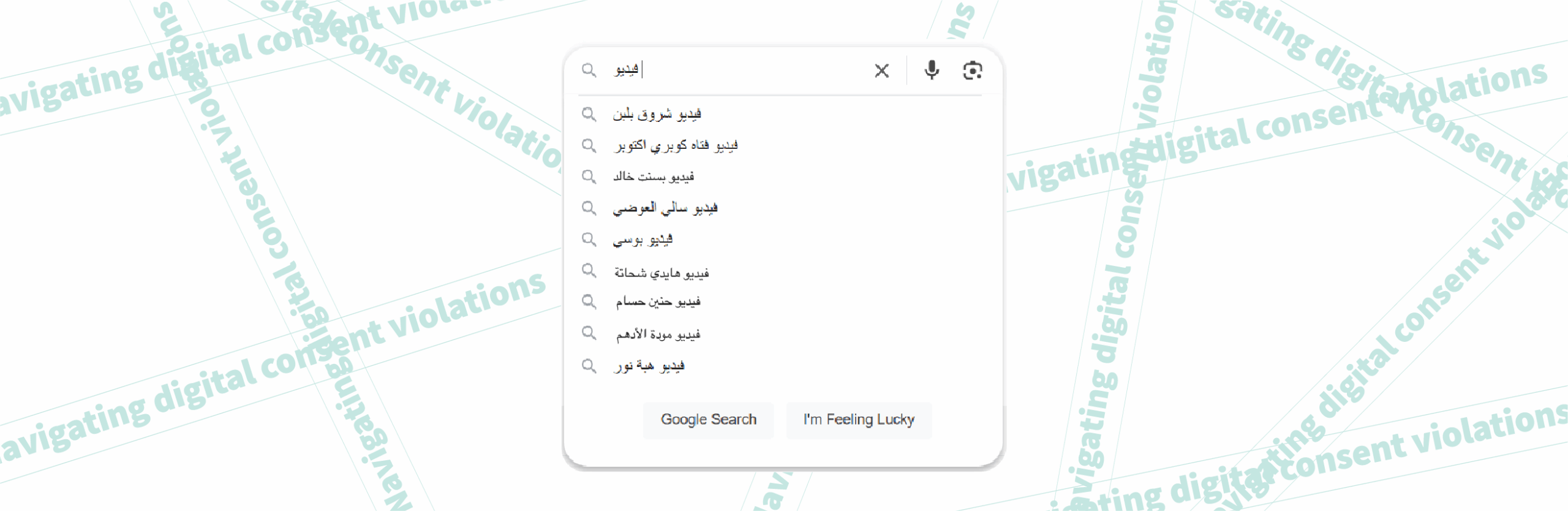
In February, Speak Up announced a new partnership with Aylo — parent company of Pornhub and other adult websites — as part of Aylo’s “trusted flagger” program. The move sparked heated debate on social media, with some praising the step and others criticizing the collaboration.
The partnership allows Speak Up to directly remove nonconsensual content from the adult websites based on its helpline reports.
Pornhub has faced repeated lawsuits and accusations over the years for enabling uploads of nonconsensual content involving women and children. According to the adult website, the Trusted Flagger program, launched in 2018, offers NGOs and official bodies a “robust and efficient” system through which they can report content, trigger immediate suspensions of URLs, monitor outcomes and communicate with the platform’s support team.
The step is timely. Sharing nonconsensual content has been used for blackmail or defamation in notable cases in recent years — including in those of Bassant Khaled and Haidi Shahata, aged 17 and 14 respectively, both of whom took their own lives in January 2022 after being subjected to online extortion. Such images, or even the claim that such images exist, pose a serious threat to the women or girls involved, from social ostracization to physical threats to their safety, including violence by family members.
In other cases, women may seek to remove digital content in which they appear due to the risk of legal or security-related repercussions, given sex work is considered a crime under the Criminal Procedures Code. Since 2020, security bodies have used sex work charges in their campagin targeting young women earning money by producing short-form video content on platforms like TikTok and Likee.
In 2022, content creator Moka Hegazi was convicted of "prostitution and debauchery” for her online content, while Haneen Hossam and Mawada al-Adham received human trafficking charges in 2021. Hossam and Adham were ultimately tried on different charges, violating “family values,” when their cases were referred to the court.
Other routes to combatting nonconsensual content
State and other institutions are often slow to respond — or take no action at all — in cases involving violations of women’s rights, whether related to sexual violence or the uploading of nonconsensual content. Even when there is a response, it is often delayed or ineffective. At the same time, women subjected to such violations are also at times hesitant to report the incident out of fear of societal judgment and stigma.
Even when women choose to pursue official channels to address breaches of consent, many find themselves entangled in the complexities of the process — both social and bureaucratic. In his essay Arab Porn, Youssef Rakha argues that dancer Dina’s status as a public figure allowed her more freedom to push back against social backlash when she decided to argue in court and in media interviews that private footage in which she appeared with businessman Hossam Aboul Fotouh had been filmed without her consent.
Dina ultimately dropped the charges against Aboul Fotouh, saying at the time that rewatching the footage “hurt her psychologically,” but that she had forgiven him and no longer wanted the matter to remain “a topic of conversation forever.”
The Pornhub partnership
All of this explains why the partnership announcement was met with positive reactions online. Some argued that collaborating with adult websites is important to empower women to request the removal of content, protect them from public scrutiny and push back against platforms’ disregard for individual cybersecurity.
More conservative voices, however, questioned the morality of partnering with companies in the adult industry to begin with.
Others argued that while the partnership could support women, it should not have been publicized in the way it was. They criticized the optics of promoting Aylo, given its track record of violating consent and the labor rights of sex workers globally.
Mada Masr spoke with Speak Up founder Gehad a few days after the announcement to learn more about the partnership and how the initiative plans to navigate the collaboration.
The interview is reproduced below and has been lightly edited for clarity.
***
Mada Masr: Tell us about the partnership. How did it happen and why do you think it’s important?
Speak Up: We launched a similar partnership with Meta over a year ago, and we used to do that kind of partnership only with Meta, but not publicly. We would reach out to Meta when we received cases. Last year, we established a similar collaboration with TikTok. That’s when we started thinking of launching the helpline, as a service in Egypt for cases where — and this happens with a very high frequency — pictures of women or girls or other types of content are leaked. They can reach out to us, and we contact the platforms directly. In many of these cases, no matter how many times the girls try to report the content themselves, the platform will not take it down.
We have partnerships with Meta, Youtube, TikTok and Pinterest, and now this latest collaboration with Pornhub. There are platforms who reach out to us, and in other cases, for instance, when we get a case related to a certain platform, we reach out ourselves to request a way to remove the content.
We hope to have access to all platforms; this partnership with Pornhub is not the first and will not be the last.
MM: When you publicly announced the partnership and displayed Pornhub’s logo on your pages, some social media users raised concerns about giving publicity to Pornhub. How do you respond to those concerns?
SU: First off, with every platform we’ve worked with, we announced the same way, using the same format. This one just happened to go viral. But we did it that way because to announce the partnership, there has to be a joint statement that the platform approves, so there’s a lot of back and forth. That’s why we use the same wording for all announcements.
The second thing is that we make the announcement for one specific reason: so that people who have content on that platform are aware that we can flag it for removal, and can come to us if they have a problem.
MM: In the case of Aylo, who reached out to whom? And will you receive any compensation from the company?
SU: We contacted them because we received reports about videos on their platform, so we reached out to find a faster way to remove them.
And no, and we do not receive any financial compensation from any of the platforms we work with.
MM: Can you walk us through how the process works, starting from when you receive a complaint to the content being removed from a platform?
SU: With Meta, Youtube, TikTok and Pinterest, when we first receive a report from the complainant, we check to see if it’s within our scope. Sometimes, we get reports completely unrelated to our scope of work. If it is within our remit, we submit a report from our side, which differs from what individuals file directly on the platform. We add context explaining why the content needs to be removed — not just that it violates policies, but also why it might be harmful even if it doesn't violate specific rules. Then, we submit our report to the platform for action.
In our new partnership with Aylo, however, we have the authority to access and delete the content ourselves immediately. We then leave a note explaining why we removed it. That way, we’re not just reporting and waiting on something that could be very dangerous.
Pornhub has nearly 50 partners worldwide, but none of them were from an Arab country. They did something new recently — if you go on their website and search keywords like "nonconsensual," you get a warning that such content is illegal, and if you are someone whose video has been leaked, you can contact a trusted flagger in your country to remove it. This reporting process through trusted flaggers is always faster. But this wasn’t implemented in Egypt until now — our partnership means they will display this message across 23 Arab countries.
MM: Given these already established partnerships, are you seeking to collaborate with more platforms in the future?
SU: Yes, definitely. We often receive reports about content on platforms we don’t even know about yet, so we’re trying to establish partnerships with all of them.
MM: Your January report said 290 cases were deemed “non-reportable.” How do you navigate the cases you receive? Does it involve judging whether the content violates consent? What if someone reports content that isn’t theirs?
SU: I’ll tell you something, I feel like you can really tell. There’s a big difference between something leaked without consent and something that a person did consensually — that’s very clear to us. When someone other than the depicted person reaches out to us, we ask to be put in touch with the individual involved for one reason: to ensure they haven’t already filed a report with the Interior Ministry’s Internet Crimes Combatting Unit. If we remove content before the unit files a report, it can disrupt the investigation by interfering with IP address tracking.
For content reported by someone other than the depicted individual, we wait two weeks before taking action, which is roughly how long it takes for the Cybercrime Unit to retrieve the IP. After that, we start sending reports to the concerned platform, regardless of who reported it. If it seems the content might have been shared consensually, we then reach out to the individual themselves. But in most cases, it’s very obvious. I feel the situation here in Egypt is not the same as abroad.
MM: How does your work intersect with that of the Interior Ministry’s Internet Crimes Combatting Unit? When do you step in, and when do they handle the reports themselves?
SU: The unit establishes the publisher’s IP address, and through that, they identify the person and send the information to the Public Prosecution so that an arrest can be made, a police report filed and so on.
So, if the account is deleted before the cybercrime unit gets the IP address, the whole report is deemed invalid because they don't have evidence to present. But once they have the IP, it's fine. Sometimes, girls come to us after they’ve already canceled the legal procedures, but the account is still up. In that case, we ask them to check with the officer — once they confirm that they’ve gotten the IP, then we can step in and close the account.
On the other hand, cases involving Facebook Messenger — which are not public — are handled solely by the cybercrime unit, because those messages are encrypted. Even if we try to report it, whoever checks the report can’t access or view the messages.
MM: How do you respond to accusations on social media that by partnering with Pornhub, you’re supporting a platform with a negative reputation for publishing nonconsensual content?
SU: What I think is that all of the platforms we work with — not all, but most — have had catastrophes. And if we keep talking about moral positions, whether it’s about their stance on everything happening, like Palestine, Gaza, privacy… There are catastrophes.
But these are platforms that people still use everyday. So I’m not saying that Pornhub is safe or good, I just believe that in the end, if someone wants to use it, they can, and if they don't want to, they don't have to. But the reality is: people are getting hurt on there — and I'm just trying to solve that problem. I’m not telling people, “Go there, that platform is perfect.”
And if we don’t work with them? Will the platform get shut down tomorrow? No. On the contrary, Egypt is one of the top 20 countries watching Pornhub.
To me, it’s just like any other platform: they all have dishonorable positions, and we have differences with them. But we’re not claiming they’re good, we’re talking about a specific partnership. Are they waiting for us to promote them? They have billions of dollars. No one is waiting for us to advertise for them.
Also, this is not new, they have this kind of partnership in other countries too. So, this is not an advertisement, we are announcing [the partnership] publicly so people who have content published without their consent know they can come to us. Because at the end of the day, how would they find out?
I don’t want to exaggerate, but around 70 percent of the people objecting are really asking: “So you want girls to do these things without getting punished? You’re helping girls do that? You’re encouraging them by deleting their content.” So there is a huge catastrophe. It's like they’re saying, “So girls can do whatever they want and no one is allowed to see?” And the answer is: Yes.
تقارير ذات صلة

Interview: X’s new restrictions fail to protect users from AI image manipulation
Mada Masr spoke with digital helpline coordinator Tasneem Mounir on why X’s ban falls short
The unspoken crime of marital rape
There is no statute criminalizing marital rape, nor is it a legally valid reason for divorce
DETOX | Better late than never
Women are rightfully angry, and they’re demanding to be heard.
Your support is the only way to ensure independent, progressive journalism survives.
You have a right to access accurate information, be stimulated by innovative and nuanced reporting, and be moved by compelling storytelling. Subscribe now to become part of the growing community of members who help us maintain our editorial independence.
Join us