
Popular markets without people
Farmers, vendors and buyers struggle to get by amid Covid-19 preventative measures
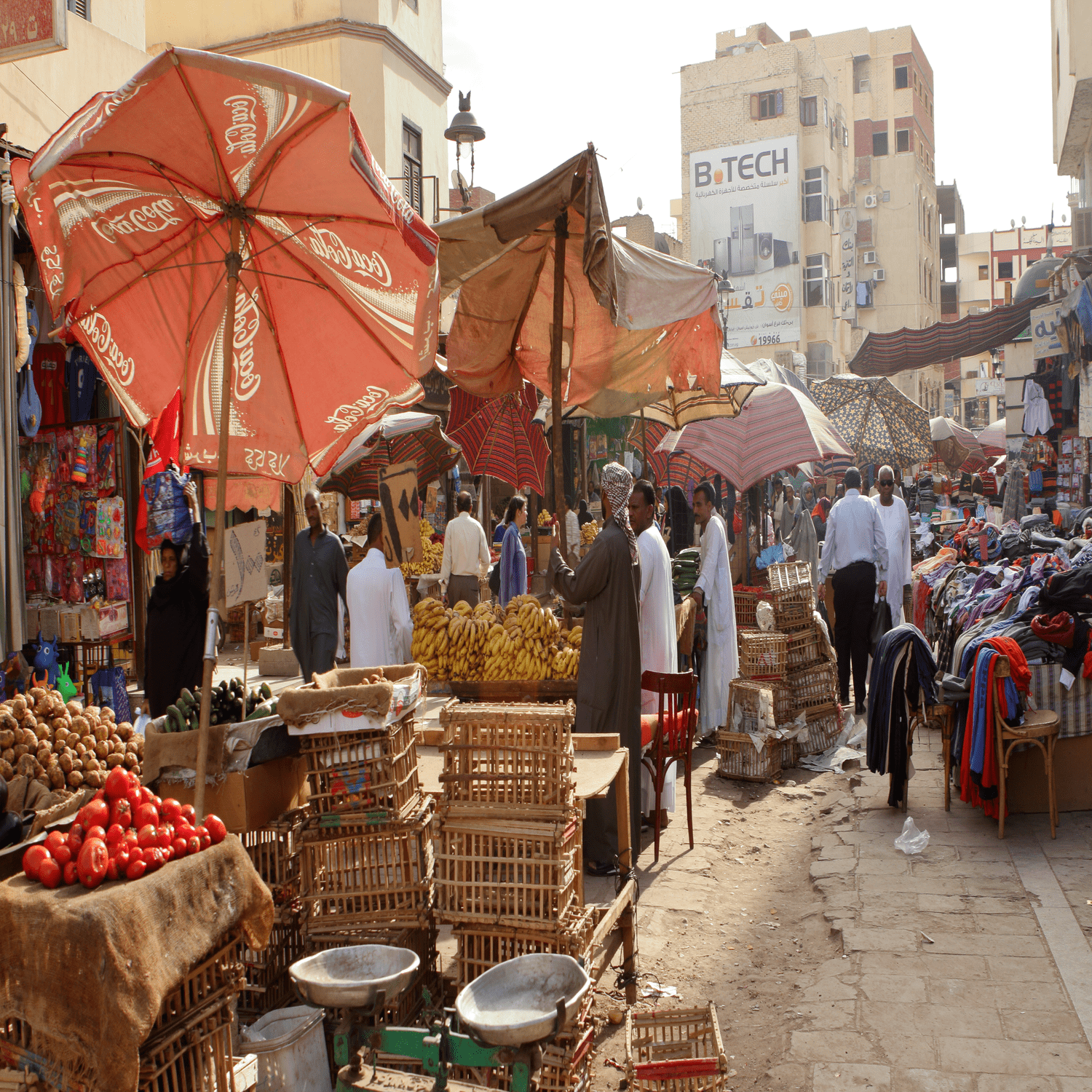
“We urge you not to crowd, for the sake of your health,” says a voice, ringing out from somewhere in the popular market of the Kafr al-Sheikh village of Ibshan. It is midday on March 18, and the market is bustling with people.
However, there are also personnel from the police and the local council, who are wearing masks that distinguish them from vendors and market-goers, encouraging vendors to pack up and leave in compliance with the government’s decision to shut down local and popular markets, a move meant to help curb the spread of the coronavirus outbreak.
Disgruntled, the vendors begin to pick up boxes filled with vegetables and fruits and move them to small pickup trucks. Other vendors take their plates of cheese, eggs and ghee wrapped in bedsheets back home.
However, some vendors refuse to pack up their products, and, a few hours later they reconvene at a nearby fish market. The holdouts set up shop in a 400-meter strip of land in the corner of the market, which is tucked away from the view of the authorities but thus also from the sightlines of potential buyers.
The government has put a host of exceptional measures in place to curb the spread of COVID-19. While there has yet to be the nationwide shutdown seen in other countries, the government has moved to reduce the number of public employees and prevent large gatherings. Some private companies have granted their employees permission to work from home, while others have given their employees paid leave. And following calls from members of Parliament, Prime Minister Mostafa Madbuly announced on March 24 that a nationwide curfew would go into effect the following day, from 7 pm to 6 am daily.
Crowded marketplaces pose a public health risk — a risk that has only increased in recent weeks. The night before police moved to close the popular market in Ibshan, the Health Ministry put the official government tally of positive cases of coronavirus in Egypt at 196, with a death toll of six. Those numbers have since risen to 1,070 cases and 71 dead, and government officials increasingly speak of a move into the community transmission phase. However, alongside public health concerns, COVID-19 has troubled the vital economic relations in a place like the Ibshan market, from small landholding farmers who sell their crop directly in popular markets to women who bring in extra money by selling homemade cheese.
The government has put forward measures to help low-income groups that will be affected by the preventative measures. But while there has been a call for informal workers to register in the Manpower Ministry’s database, it is still unclear how much support they will receive or how they will fare if suspension of work continues.
***
In the Delta, daily markets for agricultural and animal products are prevalent, despite the increasing urbanization of Egypt’s primary agriculture area.
According to Walid Sukkar, the vice president of the Bila municipal council in Kafr al-Sheikh, vendors in daily markets are considered “street vendors,” and the governorate collects a 20-pound occupancy fee from each of them. However, that blanket term doesn’t capture who is selling what and why in Egypt’s marketplaces.
According to Sukkar, marketplace vendors can be divided into four categories. The first category includes vendors who sell fruits and vegetables in different markets in the region throughout the week.
The second category mostly consists of agricultural workers who sell their produce grown on land that does not exceed a few hectares (a feddan is equal to 24 hectares). Studies estimate that smallholding farmers who own less than 3 feddans, make up 90 percent of Egypt’s landowning farmers. Smallholder farmers do not deal with merchants directly because of the small amount of produce they produce, which is why farmers go to the weekly village markets themselves to sell their produce.
The third category includes younger vendors who buy products from wholesalers and resell them in the market. And the fourth and final category consists of women who sell chicken, eggs, or homemade ghee, or cheese, as well as precut vegetables.
According to Sukkar, the municipal council does not consider women in the fourth category as “occupants,” because they are extremely poor and their products are too meager in comparison with the other vendors.
Saeeda is among those women whom Sukkar describes as the poorest of vendors. Saeeda works all day and sometimes at night in Ibshan, Kafr al-Shaikh, to support her three children and her husband, who has disabilities. Saeeda also works as a domestic house cleaner for some of the villagers and as a daily wage agricultural worker, earning about LE50 per day. In addition to this, she makes cheese and ghee, and sometimes she raises chicken to sell their eggs in the village market or in neighboring villages. Saeeda puts the money she makes into buying weekly household necessities from the same market. After the markets were shut down, Saeeda tried to sell her products directly to some of her personal acquaintances. But everything has come to a halt, she says.
Heba, a mother of five boys, also works as a vegetables and fruit vendor in the village market in Gharbiya. She was forced out of the main market and now buys a smaller supply from wholesalers to avoid losses during the government’s COVID-19 prevention campaign.
One of Heba’s customers also used to sell one or two chickens in the market and use the money for household staples. Now, she is forced to sell her chickens to a poultry shop at a lower price just to be able to buy a portion of her household needs. On top of that, the price of vegetables has gone up since the government called on people to avoid large crowds and stay at home which, according to Heba, caused a spike in demand.
The decision to suspend local markets did not just affect vendors of agricultural and household products, but also women in villages and cities who depend on these markets to buy their weekly household supplies.
Not only are women across governorates paying higher prices for vegetables, they told Mada Masr — without the proximity of local markets, buyers cannot avoid pricey transportation costs necessary to travel to larger markets.
To address this crisis, the municipal council in Bila decided to open sales outlets for vegetables and fruits across the villages as an alternative to the local market. The outlets have been set up in collaboration with the major traders in the city whose products are sold in those outlets, according to Sukkar. However, the smaller vendors, who are more in need, have no way to sell their products. Some of them have tried to sell on side streets, far from the market.
In an attempt to help smaller vendors and others experiencing hardship, especially under the current restrictions to curb the COVID-19 outbreak, Minister of Manpower Mohamed Saafan announced that registered informal workers will be entitled to a one-time aid of LE500. The sum is less than the monthly income of LE735.7 that marks the official household poverty line, which 32.5 percent of Egyptians fall below. At the time of the announcement, just 120,000 informal workers were registered in the ministry’s database, leading the ministry to call on unregistered informal workers to register on the ministry’s website. Even though the website had many technical errors due to high traffic, there are now 1.2 million new registerees. But this is nowhere the estimated number of actual informal workers in Egypt, which is around 10 to 12 million, according to the ministry’s spokesperson Haitham Saad. In its latest report, the Central Agency for Public Mobilization and Statistics estimates the number at just over four million.
Mohamed Wahballah, the head of Parliament’s Manpower Committee, defined informal workers to Mada Masr as “those who do not work for someone else,” adding that market vendors are considered informal workers and can register in the ministry’s database. Wahballah said last week that the ministry was reviewing the data of the new registrees and planned to process most of the applications by the end of that week.
The Ministry of Social Solidarity announced last week that 60,000 families will be added to the Takaful and Karama cash transfer program in the next two months, but many citizens in dire need still cannot enroll in that initiative for various reasons.
While Heba can register as an informal worker in the Ministry of Manpower’s database, she cannot benefit from the Takaful and Karama program. Heba’s husband receives a government pension, which disqualifies the family for Takaful and Karama. Yet Heba and her five sons, who are all enrolled in school, do not actually benefit from the government pension or the ration card because Heba’s husband separated from the family and now lives in a different house. Despite this, Heba cannot ask for a divorce. “I cannot work in the market as a divorced woman. Being in the market is difficult. I just say that I’m married so that I’m able to continue,” says Heba.
To get help, Heba could go to one of the charity organizations that have launched initiatives to help low-income families during the crisis, such as the “Kheir Initiative” that has been organized by the Resala Association. A number of famous actors and athletes have joined the initiative, which aims to deliver essential items to households.
The Life Makers Foundation also launched a special initiative for daily wage laborers and families under the poverty line who have been affected by the government’s preventative measures. The initiative aims to establish a digital payment network, where beneficiaries can receive codes to exchange for household goods, cash, personal hygiene products and sanitizers from over 53,000 outlets across the country, including the ministry’s subsidized outlets. This initiative, which was launched a few weeks ago, follows World Health Organization guidelines by enforcing social distancing measures to keep volunteers and target beneficiaries safe.
Umm Ayah, another vendor, waits for those solutions to come to fruition in her usual spot, close to an Azhar-affiliated institute in Mansoura. She tries to sell her ghee and cheese, even though her usual customers, employees in the institute, have all disappeared following the decision to suspend activities at educational institutions.
“Yesterday, I went back home with all of my products,” she says. However, despite the tight situation caused by the COVID-19 crisis, Umm Ayah believes that the current governmental measures are the best way to protect her and her family, especially given the poor healthcare system in Egypt.

تقارير ذات صلة

Devaluation drama and hot money’s return: What happened with the pound’s historic plummet?
'As long as there is more demand than supply, the price of the pound will continue to decrease.'
Q&A: Egypt’s emissions, the environment, and the relationship between air pollution and COVID-19
The loudest voices in this area are not those of environmental scientists, but of investors
Q&A with anthropology professor Hania Sholkamy | On the need to rethink social spending as crisis response after COVID-19
The pandemic exposed flaws in the way social protection is thought about in Egypt
Your support is the only way to ensure independent, progressive journalism survives.
You have a right to access accurate information, be stimulated by innovative and nuanced reporting, and be moved by compelling storytelling. Subscribe now to become part of the growing community of members who help us maintain our editorial independence.
Join us