
Popular culture in the years before rebellion
That popular culture is an expression of the voice of the people is one of the main tenets of “Popular Culture in the Middle East and North Africa: A Postcolonial Outlook.”
The collection, co-edited by Walid El Hamamsy and Mounira Soliman, was published earlier this year by Routledge. Hamamsy is Assistant Professor of Interdisciplinary Studies at Cairo University and Soliman is Associate Professor of Comparative Literature. Together they felt that “work on popular culture in this region was at best scattered, and looked down upon.”
So they sought to examine popular culture — its status as a “lower” form of culture, its relationship to mainstream culture, and the idea that it can be a form of resistance to domination.
The editors argue in their introduction that mainstream culture is imposed as the representative voice of the people, but through popular culture people resist and assert their own perspectives. Citing the work of scholar Stuart Hall in which he describes the relationship between mainstream and popular culture as one of containment and resistance, Hamamsy and Soliman’s approach is that the two are in a constant state of back and forth; they cross borders, overlap, intersect and influence one another.
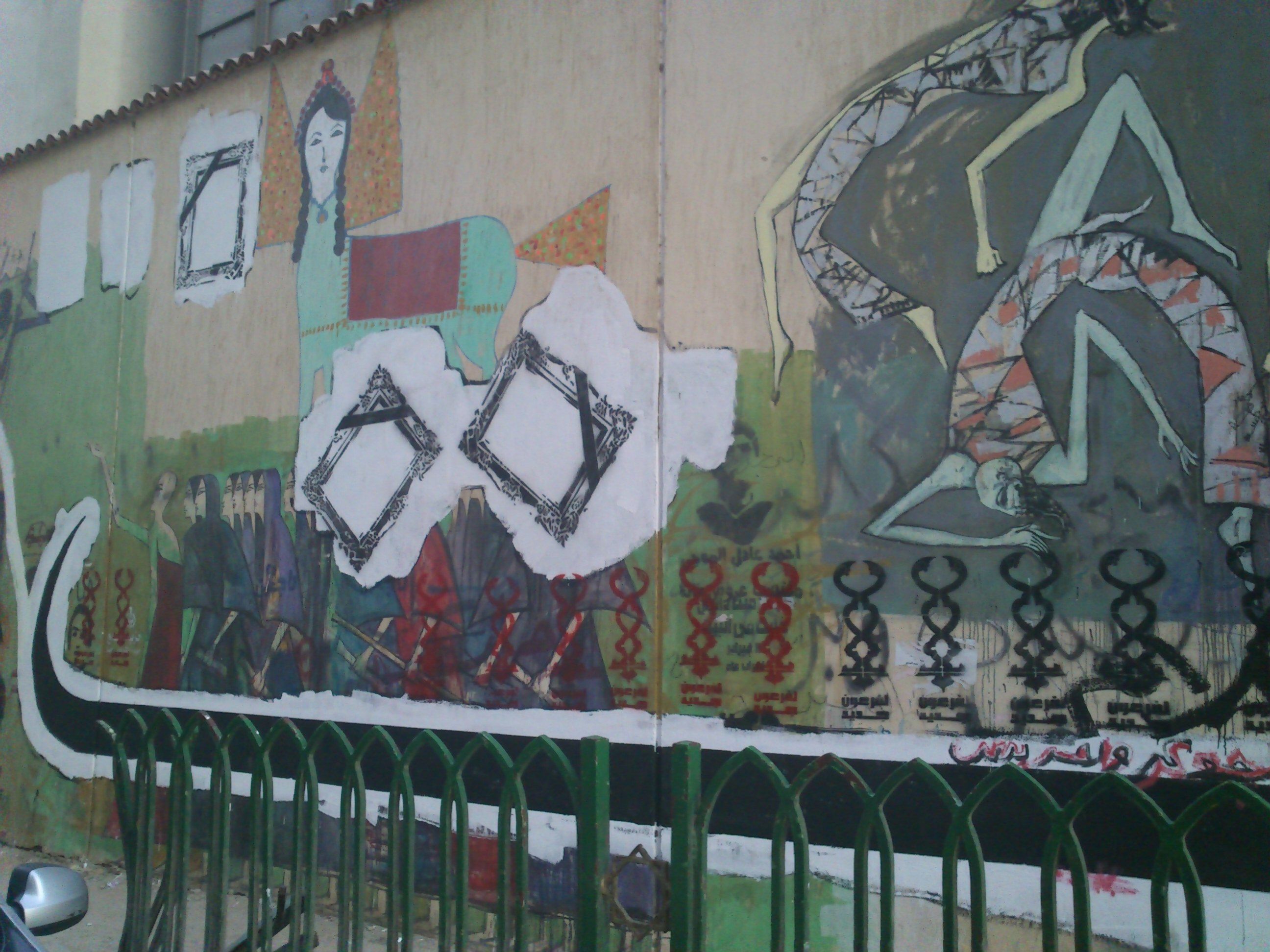
With this vision, the editors have compiled 15 articles on diverse forms of expression — from music, dance and theatre, to graffiti, comic books and literature, and from cinema, television shows and advertisements to social media and initiatives such as Mosireen and Kazeboon in Egypt. The articles also cover a significant geographic scope over the last decade, a critical period in the region’s history, one that saw the backlash of the September 2011 attacks and then by the decade’s end popular rebellion across the Arab world.
Religious media of the decade
Particularly interesting in the context of Egypt today is the article “Satellite Piety: Contemporary Islamic Programs in Egypt” by Omaima Abou Bakr, professor of English and Comparative Literature at Cairo University. It traces the evolution of Islamic television shows on satellite channels over the past decade from the traditional weekly Sheikh al-Shaarawy Quran lectures through to the emergence of young modern televangelists such as Amr Khaled and later the Salafi shows.
Private channels such as Al-Hayat, Dream and Al-Mehwar regularly feature shows that discuss religious subjects in a modern, informal context. The hosts and guests may be men in suits or fashionably veiled women, and the conversation is held in an everyday language, covering topics such as marriage, domestic issues or inheritance problems. Abou-Bakr finds that the format of these shows reflects the desire of many Egyptians to integrate religion into their daily lives.
Meanwhile, she explains, there was a second trend in the form of Salafi shows that rose over the past two years on channels such as Al-Nas, Al-Hafiz and Al-Rahmah, banned by the Mubarak regime on account of religious extremism. These channels were allowed to operate post-January 2011. Despite their stricter and more traditional format, content, and even gender discrimination in choosing hosts and guests — which put many audiences off — these shows became popular among a significant number of Egyptians. Abou-Bakr argues that this points to the fact that there is more than just one voice of the people.
But shortly after the book’s publication, these shows were thrust back to the margins with their closure following the ouster of former President Mohamed Morsi in July 2013.
The banning of the shows was itself controversial. Many claim it was a necessary move given the sectarianism, hatred and violence incited on these channels. Others see it as infringement of freedom of expression and of the media. From a cultural point of view, this not-so-subtle form of “containment” sought to eliminate this marginalized culture rather than neutralize it.
The containment factor seems to have won this battle for now — but what of the larger cultural struggle? Had these Salafi shows not been forcibly removed, how would they have developed?
Readers and literary critics are far apart
The book also brings the field of written culture over the past decade into the frame. In Richard Jacquemond’s article “The Yacoubian Building and Its Sisters”, the French scholar and translator of Arabic literature offers a close examination of readership trends, as well as the bestselling titles in modern Egyptian literature. They reveal a series of thwarted expectations.
Against the odds of an ailing education system, a mostly incompetent publishing industry and failed state cultural policies, a generation of avid readers has risen from the ashes following many years of drought in the reading scene. Jacquemond proceeds to examine a list of the bestselling titles, using the most downloaded books on the website www.4shared.com as his basis, since it is otherwise difficult to obtain reliable statistics given the high rate of piracy and fluidity in the Arab book market.
Alaa al-Aswany’s “The Yacoubian Building,” Khaled al-Khamissi’s “Taxi” and Youssef Zidan’s “Azazil” top the list of the most popular fiction titles in the last decade. “The Yacoubian Building” has sold millions of copies, but neither its form nor content can be considered innovative, Jacquemond argues. It has been shunned by the Arab literary world and some critics question whether it ought to be considered literature at all.
“Taxi” also struggles with its status. Its structure does not qualify it to be a “proper novel” as Jacquemond puts it, but rather a series of encounters that puts Khamissi on the literary scene, but does not make a novelist of him. The third novel, which does fit the criteria of a proper novel, is “Azazil.” However, Jacquemond attributes its massive success to its highly controversial topic rather than form.
Other popular titles over the last decade include the satirical writings by Ghada Abdel Aal and Omar Taher, which build on the satire genre developed by an older generation of writers, for instance Ahmed Ragab.
Jacquemond also notes that detective novels and political thrillers such as Ahmed Mourad’s “Vertigo” and Ahmed Khalid Tawfik’s “Utopia”, both popular works, represent a move into relatively unchartered territory for Egyptian authors. The article points to the marketing campaigns of these two books including the cover design and title, similar in English and Arabic.
This Jacquemond calls a sign of “the growing insertion of this new Arabic literature into the global literary market.” The titles are the same in the English translation, as is the case with Khamissi’s “Taxi,” which is another indication, Jacquemond argues, of “the national elite’s Westernization.”
This research finds that the bestselling works of the past ten years include both traditional forms of writing deeply rooted in modern Egyptian literature, such as realism, the historical novel and satire, as well as new forms and genres. Some of these new forms, Jacquemond suggests, are better suited to communicating with a Western or Westernized audience.
The diversity of writing forms among the bestselling works indicates that novels which are not conventionally recognized as “highbrow” are read as much, if not more, than those works hailed by the cultural elite.
The chapter concludes that although these works have successfully created a new niche in the reading world, this trend can have detrimental results for aesthetic value. He goes so far as to argue that these works add no aesthetic innovation and are follow a more “economic market oriented logic.”
While Jacquemonde’s findings are pertinent in relation to the titles he considers, there are a number of literary works that have gained popularity and have an important aesthetic component — such as Bahaa Taher’s “Sunset Oasis” and Mohamed al-Bisatie’s “Hunger.”
Although these books have achieved fewer sales and downloads according to Jacquemonde’s research, they have garnered enough success to indicate that readers still care about the aesthetic aspects of literature. Both have been reprinted in several editions, and the first even went on to win the International Prize for Arabic Literature in its first round, while the second made it to the same prize’s longlist a few years ago.
Most of the book’s articles were written before the Arab uprisings. Still, the book is timely. As its editors indicate, it examines popular culture in the immediately preceding period. And since one of the most significant achievements of the revolutions was to breathe life into the artistic scenes of the region, the book, and particularly its last chapter “The Aesthetics of the Revolution” can be a beginning to understanding those scenes today. Written by Hamamsy and Soliman on forms of popular creativity directly related to the Egyptian revolution, the chapter takes a close look at the art that came out of Tahrir Square, such as slogans, songs and graffiti, as well as art used for mobilization, such as al-Fan Midan, the Bassem Youssef Show, and independent activist cinemas, such as Mosireen and Kazeboon.
By understanding the popular culture, one can hear the voices of the people.
تقارير ذات صلة
Mai Serhan imagines Palestine and recounts life after for us
"I have never been to the place where I am from, but I can imagine it for us, Baba, for you and me." This opening line of Mai Serhan's I…
Who’s Afraid of (a) Minor Detail?
Adania Shibli and Specters of the Disaster on Literature and the Body
A conversation with Shady Lewis Botros on the genealogy of literary refusal
The writer discusses his decision to turn down the Sawiris Cultural Award for his recent novel
Your support is the only way to ensure independent, progressive journalism survives.
You have a right to access accurate information, be stimulated by innovative and nuanced reporting, and be moved by compelling storytelling. Subscribe now to become part of the growing community of members who help us maintain our editorial independence.
Join us