
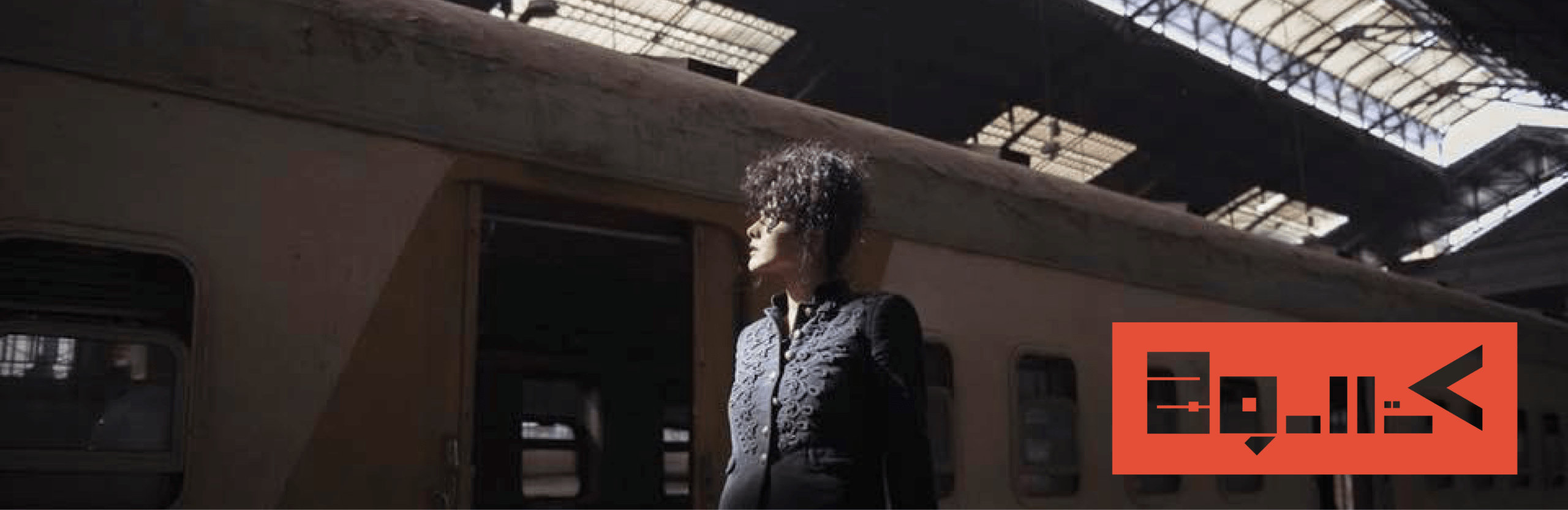
Podcast | Katalog #2: Dina El Wedidi
Katalog is a podcast by Mada Masr about the process, production and deeper meaning behind selected works from the contemporary Arab and North African musical landscape. Co-produced and hosted by music journalist and writer Maha ElNabawi, and musician and sound engineer Adham Zidan, the podcast offers behind-the-scenes stories of musicians, their inspiration, and their process through a dynamic sonic experience.
In each episode, we feature a guest musician, and together we break down their tracks to give our listener a more intimate understanding of the complex layers that make up their unique sound.
In this episode, we talk to Egyptian singer and composer Dina El Wedidi, who started her musical career with El-Warsha Theater Troupe in 2008 and was also a founding member of The Nile Project, with whom she has released two collaborative albums.. Dina grew famous for her distinct vocal style, and her ability to infuse Egyptian folk music with a modern sound. Through the many concerts she performed with her band over the years — as well as several workshops with iconic musicians including Kamilya Jubran, Fathy Salama, and Gilberto Gil — Dina’s musical style has evolved, culminating in her first solo album, Tedawar w Tergaa (Turning Back, 2014), which included contributions from many musicians across Egypt’s music scene.
After the release of Tedawar w Tergaa, Dina decided to take a different direction, producing her second solo album herself, this time without musicians. The album, titled Manam (Slumber) is made entirely out of train sounds in addition to her voice. Slumber is Dina’s first experiment in music production, in cooperation with German-American sound engineer Brian Smith.
In this episode, we speak with Dina about her experience working as a producer, the difference between working with human beings instead of machines, and the importance of creating balance in life. But first, we ask her how the idea for Slumber originated, and what prompted her to deconstruct the sounds of a train and form a band out of them.
https://soundcloud.com/mada-masr/katalog-dina-el-wedidi-01
My name is Dina El Wedidi, I’m a musician from Cairo.
The album, Slumber, was recorded in four train stations — in Alexandria, Cairo (Ramses), Luxor and Aswan. About 95% or 97% of the “music” you hear on the album is composed of train sounds. It was written in different rooms all over the world. In the two years I worked on this album, I had the freedom to work wherever I went — wherever I could use my laptop or a pen and paper. And I was producing it alone, so I didn’t need anyone with me.
Shortly after the release of Turning Back, I decided that I wanted to learn more about composition and music production. It all began when I started taking a production course. Meanwhile, a friend of mine, Wael Abdel Fattah, a researcher and writer, was working on an archive of train sounds for his website [Medina]. He asked me to make use of what I was learning about production and to help him record some of those sounds.
I spent a day recording in Alexandria, and after I finished felt that I was hearing something else entirely from the sounds I recorded. It was as if I was telling myself that something will come out of this sound — like meeting a musician and knowing that we’ll be able to work well together. This was exactly this type of relationship that happened with the train sounds. When I heard the train, I heard a full band. It was great — there were so many different sounds. I would hear a train whistle, but I don’t hear it as a whistle, I would hear an orchestra. I hear the train rattle the tacks, but they’re not just tracks, they’re drums. So I couldn’t help but want to further explore this.
After spending some time playing around with the sounds I recorded for the project and trying to understand what I was hearing, and where it could go — I knew that I could pull something out of this, something very far from anything I could have originally imagined. So that was the start of Slumber.
When the idea of the album came about, I saw it as one complete piece, 30 minutes long. Its title is Slumber, what happens to a woman inside a train when she dozes off for a half-hour, but isn’t really asleep, nor is she awake. She hears the sounds of the world of the train all around her, and at the same time, she is inhabiting her own personal world. I didn’t imagine myself as the central character; rather, it was as if there was a character inside of me who had seven stories to tell. Each of those correlates to the seven stations she stops at during the train ride. Slumber takes us into that dream world of hers. Perhaps I also called it Slumber because it’s the one space in which no one intervenes — when you’re sleeping. At first, I worked on the tracks as separate songs, but when the name Slumber came about for the album, this idea of being between two worlds, it gradually started to crystallize as one sequence.
I’d go to the stations and record for 7 to 8 hours at a time. I recorded sounds that I knew might not have any interest to a music producer; there was a lot of noise, and the sound wasn’t very clean — the condition of some of the recordings wasn’t the best — but at the same time, I had a lot of raw material to sit down and edit. That allowed me to create a sound library, and see how I would deal with it later. So the journey involved recording and categorizing sounds, then I would see what else I needed and go back and record some more. Those stations are an endless world of sounds. I was able to capture many more elements each time. For example, there is the sleeping car, which brings out certain f sounds that are different than those which dominate the first-class car, or the second-class car, or the sounds around the station itself — I tried to capture details that I was drawn to so I could sit with them and see where they would take me.
The composition was built over two years in this way. But at some point, I decided that I didn’t want to record anymore and that I was very happy with the library I had. I didn’t want to confuse or overload myself with too many sounds — I wanted to have limitations in this very wide space I was working within in this experiment because that in itself is a challenge I wanted to explore.
Ever since I started making music, I’ve been trying to fulfill my curiosity towards the things that inspired me. So with El-Warsha, I was doing folk; with my band, very generally speaking we were doing fusion music; with The Nile Project, it was more world music. With the train album, I found out that I wanted to work more within limited parameters to discover how from this limited pool of sounds we could create more and more sounds, like how a train horn can become so much more, or how to pull out rhythms from the sound of wheels., or how we take a loop of the sound of shaking windows and make it into noise. So I felt the best way to benefit from that unlimited world was to actually limit myself. I wanted to delve into that experience with my own capacities, in addition to the software I was using, which helped me build on those sounds.
The first movement was called “Watan” (Home). This is one of the sounds that was recorded (an excerpt plays at 7:12). It’s a train horn, and it was from one of the first sounds that I liked from the material I had. So, I wanted to take that sample and live with it for a while. From there, the idea for “Watan” came about. When I heard this horn, I felt I could create layers out of it. So I started to explore how, from one single layer, I could pull out many other layers through transposing, and that was the first step of my process; as simple as that.
When I get into the mood to compose, I see the sounds as a band. It’s like saying, I want an oud line in this track, so here I heard lines as if they were written. There are many weird sounds, so you take a sound and edit it and call it something, and you play with it and go through a long process of trial and error — it was all part of the experiment.
In general, I’ve always liked recording random sounds, it is something that I’ve been doing since 2016. But when I first started recording for this project I was a beginner and I was mostly driven by curiosity; I wanted sounds to give me more challenges that I could work out and practice on in editing, learning to clean up sound — or knowing when to use a low fi and not clean it. There were some sounds on the album that sounded almost dusty, and I kept thinking about the people who would listen to it on their laptops. If it were up to me, I’d want everyone to hear it through headphones, not speakers — this is a record made directly for your ears. So I really wanted to preserve what my ears were hearing, regardless of the options the software was giving me, and that was the challenge.
Most of the compositions were made without a metronome. I did that on purpose because I wanted to maintain the spirit of the sounds as I heard them. So it was almost as though I were some sort of (sonic) seamstress, as though I were sitting and sewing patches next to one another. This is the part I felt was handmade, but it’s also what made things a bit difficult for Brian. He'd ask: “Where’s the tempo? What’s going to lead this rhythmically?” This was the very first composition, so I wanted to create a loop and speed it up, slow it down and resample it in the form of small pieces and see which of them I liked ... and then certain patterns would emerge from these loops. At first, there wasn’t any singing. Then I realized I could sing something in bayati [one of the melodic modes, or maqamat, in traditional Arabic music] on these train sounds. So I thought I’d like to make this composition, and then this came out (she sings it out).
For me, writing doesn’t come easily, but at this time I was writing almost every day, for two whole years. I would write down anything that came to mind; I considered it part of the journey I was embarking on nearly on my own. I like to collaborate with poets and have done so many times before in my previous works. But, I felt this was a very personal experiment, and I didn’t want to bring a poet and tell them how I’m feeling and ask them to render it into words. I had a strong feeling that I wanted to see this experiment through to the end.
At first, I would see the story or theme I wanted to write about, and of course, they were all themes that were occupying my mind at the time. I wanted to write about them, at first, in a simple way. Sometimes I write the musical composition first then try to figure out what I’m feeling from the sound that emerges. Other times I write the words first and create a certain story, and then sit and work with the environment that these words came to me through to pull it out into the music. It’s not that I mix and match, but I take my time and ask myself how I see things, what I want to be instrumental, what I feel needs lyrics — and, in that case, what kind of words. These sounds I’ve built, why have I built them? So the composition that comes is very often similar to the story the words are telling.
“Al-Qamar” (The Moon) was a different journey entirely in terms of composition. I wanted to begin to create drum racks from the train sounds. After I laid down the rhythm, I started composing. This, too, is a story; she is singing to her love, who reminds her of the moon in that he is far, and not around all the time. So I wanted something groovy and dreamy because she’s on this journey. Musically, I took my time — it’s the segment with the longest and most open intro on the album. And we can now hear a part of the harmony that happens without vocals (a snippet plays at 13:12). I generally like my harmonies without vocals, I kind of wanted the album to be instrumental, to be honest (laughs) — I felt like I did all that work on the sound then suddenly my voice came in and just blanketed everything! So, yeah, this is the sleeping car, where I would record horn sounds from the cabin, and they would come out pretty clean — this was the phase where we needed to pull out clean sounds, to act like a cello.
So while “Watan” started with my desire to create loops that ultimately made a pattern, in “Al-Qamar” I started taking sounds from the train and would say, this is similar to a kick, this sounds like a snare, this sounds like hi-hats; this I want to create from the sound of glass, this from the sound of brakes — or the tapping of a leg, or the shaking of a chair. It was one of the hardest parts when working with Brian to make this drum rack for the album, so we kept working to figure this out. But even though I had that drum rack I still used my hands, that’s why you have the feeling of a tempo that slows down and speeds up, it’s on purpose as if a hand is playing it. There are also certain sounds I liked that weren’t the cleanest and I tried to keep them as raw as I could, so that they’d give the feel of the train, of that dream ride she’s on, which is far from perfect.
I felt an incredible sense of freedom while working on this album, I was the happiest I’d ever been in my life. It was as if I’d never made music before, everything was a new discovery in this experience. That’s why I see it as such a personal and intimate experience; the fact that a distribution company got involved is what brought it to an audience, but even if that hadn’t happened I would have still greatly valued this journey.
I had a very important reference while working on Slumber: Steve Reich’s Different Trains. But on his album, he worked with samples of train sounds but with the aid of a quartet. I was also occupied with John Cage’s writings about sound. These were my two major influences.
If we compare Turning Back and Slumber, I spent years working on the first, from 2007 to 2014. I worked with poets, 47 musicians, my music partner and producer Nancy Mounir, who worked on the arrangements, and my other producer Miles Jay. I had musicians that I’d tell what I wanted to relay and they would play it. It is an experiment that I love and cherish dearly, but Slumber was a learning process, and perhaps I wouldn’t have had the chance to learn as much if I’d embarked on another journey similar to the one I had with Turning Back. With the second album I had a different responsibility, and a lot more freedom.
In Turning Back I was presenting myself more as a singer and composer, here I’m presenting myself as a producer, so I was more sound-oriented. The experience of working with machines allowed me to experiment in a lot of ways and learn a lot of things, not just about the machines, but about myself — how I can evolve, what I can work on, where I could go afterward. Beyond that, when you’re not working with anyone, you have different kinds of visions to explore. But I wasn’t working entirely alone, I was lucky enough to have my small crew: co-producer Brian Smith; sound engineer Hussein Sherbini, who made a big difference; and my artistic consultant, Kamilya Jubran. They all helped me a lot in figuring out what I wanted and what I needed.
Working with trains made me appreciate the value of working with humans even more — how important collaborations are, to have people who take you by the hand at a certain point and help you pull through; it’s beautiful. I spent a lot of time playing with the material before I ultimately told Brian that I needed him to work with me, and his role was very important, I needed another ear. We had a lot of discussions and we took each other’s opinions, his role as a co-producer was crucial in helping me realize when certain compositions were finished, that I had to move on.
I truly respect every stage one has to go through during experimental projects like this. There were times I felt very free and there were times I felt very stuck. There were times I wanted people’s opinions, and other times I didn’t want anyone’s opinion at all. I was open to all those moments, I felt that it was all part of the process, that it was normal to be stuck, and others would reassure me and tell me that at some point it’ll be over. So I gave each phase its time — I would sometimes open a new session and work there until I could unblock what I’d been stuck with in the previous one. I tried to find ways out of those loops I’d get caught in.
I feel that music is the place where I find myself most, so I try to make things easier on myself. Sometimes I can’t get near a laptop so I pick up the guitar, and sometimes I can’t stand the guitar so I grab my phone and record voice notes with my ideas. I don’t really see making music as work, although, of course, touring and live performances do feel like work, or when your producer gives you a deadline, for instance — that definitely causes pressure. But I try to see it positively; that everything has an expiry date, you either get it out now or you don’t, so, for instance, I had fun for two years working on this project, now I simply have to finish. There are some projects that take seven years, like Turning Back, other projects take three months — everything has its life span. When I start I try to figure out what I need to do and tell myself I’ll find a way to handle it, regardless of what happens throughout the time where I’m supposed to be working. I’ve started to accept that there will be times where I feel stuck, and other times where I’ll be inspired by pretty much everything, and times where I need to do something else entirely to be able to go back to music.
There are certain staples in my daily life that I need because I care about them. Since I used to spend a lot of time alone I tried to work out regularly in order to keep up my mood, there are also other things like acting, which can open up new doors in my practice. Working with different musicians from different musical backgrounds, for instance. Travel, reading, nature, animals. All of these things are really important for me to strike a balance between my work and the rest of my day. But, yeah, I don’t really see music as work, but more as the space that makes me happiest. It’s important to not make my whole life about music or work — I can’t handle having one thing; I need a world.
When it comes to the sense of place, or the environment I work in and how it affects me, I see that Egypt is a very rich place musically and that the sources of inspiration here are endless. But for me, I started focusing more on my choices. Where will I have the most impact and energy? I try as much as I can to make maintaining my freedom my main criterion — from what I listen to all the way to what I create.

Maha ElNabawi
After graduating from the American University in Washington, DC with a Bachelors degree in Business, Maha began her publishing career in NYC with indie pop culture magazines, the likes of…
تقارير ذات صلة

Podcast | Katalog #3: BLTNM
In this episode, we speak with the founders of BLTNM, a record label based in Palestine.

Podcast | Katalog #1: Maurice Louca
Katalog is a podcast about the process, production and meaning behind select works from the region
Not to salute the parrot: Strolling through the sound of Egypt
Music is marking territory, but what sort of map is this?
Your support is the only way to ensure independent, progressive journalism survives.
You have a right to access accurate information, be stimulated by innovative and nuanced reporting, and be moved by compelling storytelling. Subscribe now to become part of the growing community of members who help us maintain our editorial independence.
Join us