
Not to salute the parrot: Strolling through the sound of Egypt
Here’s an actual Nazi fiat, from a decree for dance orchestras in Bohemia : “So-called jazz compositions may contain at most ten percent syncopation; the remainder must consist of a natural legato movement devoid of the hysterical rhythmic reverses characteristic of the music of the barbarian races and conducive to dark instincts alien to the German people.”
Let’s see what one of the most enduring of those “barbaric races,” meaning we who “drink from Her Nile,” think, and for this, a jittery phone-video I stumbled upon.
Daytime in an alley market, circa 2021. Feels like Cairo. A butcher-shop with an outdoor area, round wooden cutting-tables for counters, mahraganat music on duty, twisting the maimed, unlived time of capital panting down our necks into pulse. The whole scene is not very “legato.”
An intimate frenzy, crowd in sync, meatmen, buyers, passersby: if you’re not prancing, you’re clapping. The highlight is this middle-aged butcher, a plump man in blue jeans and a white sleeveless undershirt of the style Americans would refer to as a “wife-beater” to this day. Across the folds of his belly fat are two faint patches of red, like the burial shroud of someone’s martyr, lover. He swings the knife over his head to the grainy beat. Behind him, a skinned cow hangs upside down. Carnival on-the-go, transcending the weary quotidian, from within, from below, must be a mark of health in nausea. What befalls a half-imagined community shorn of its lawless song and dance? Miraculously, it doesn’t look like Egypt will have to answer anytime soon.
The camera cuts to a fellow butcher hacking audibly at a slab of meat. The sacrificial flesh trade sneaking from corporeal to spirit, squeezing for human value in a world gasping for meaning, noise to breathe. Money will change hands, everyone will try to go to sleep, something remains, a ritual hug, an improv mutual-aid, a handbrake pulled long enough to remind us that we’re not alone, that we’re all here to get ready to die and that there’s a more scenic road to get there. The rites of Dionysus. A skinny older man does the tipping-the-dancer gesture, showering imaginary banknotes of appreciation on the star. Our man lays down his weapon, a hand on the wood, a shockingly sultry ass shake, fingers for articulation. The effervescence is warm, like the floor on which he’s standing, ankle-deep in the ripples of a bubbly stream of fresh blood.
Still, often, reeling from a news injection, our daily bread of horror and permanent crisis, private jets above and hungry bellies selling kidneys below, one’s left to wonder if art has any right or reason to exist anymore.
This doubt is endemic to the human condition: unhealed we repeat, everyone out to score a fix. It drips down like poison in an IV into the veins of anxiety and depression when what the species has resigned itself to paralyzes our feeling for tomorrow. But anxiety and depression, the yin and yang of these times, can precipitate flashes of clarity and inspiration, an existential palate hard to procure in easy lulls.
Times like these work up the art-doubting demon, but they wake up the art-worshiping one too, taking the New Sound of Egypt as my guide. Makes sense to listen when something won’t be quiet: the symptom is a stab at cure.
“To survive reality at its most extreme and grim, artworks that don’t want to sell themselves as consolation must equate themselves with that reality.” Consciously or unconsciously, we might add. That was Adorno pondering art’s sociality in Aesthetic Theory, sifting through the rubble, the fascist storm still spitting on the shallow grave of “Civilization.” What we’re going through now has to be up there too, no, the stakes, the black comedy of it?
***
“I’m gonna leave a little bit for you, because I feel like it / I’m good, I don’t want the change … Shove aside, it’s a circus.” That’s from the opening lines of Double Zuksh’s groove-incarnate Fokak, released in Cairo in late 2020, a Cocaine-a (sic: cocaine, retailing at LE3,500 a gram in Cairo and blown off the shelves — around 50 percent more than the new minimum wage and, like our national debt, one of the priciest globally — and humbler amphetamines for everyone else, is big business in Egypt, comes with the “Washington Consensus,” this upper soaked in blood from source to nose that’s also an anesthetic) production, featuring the effortlessly truant 3enba. “Thing is, I’m a danger to others,” he informs us elsewhere.
Pressed, we can file this as hip-hop-adjacent mahraganat. Hip-hop is the quintessential aural manifestation of neoliberal being, the supreme “cultural gray-out,” the fast food beat of the flattening and suffering of the world coupled with the demise of internationalism, the collapse of alternatives. But it’s also the appropriation of technology in the hands of the subaltern, as Tricia Rose, the American hip-hop scholar, wrote. Like it or not, rap seems to be the closest thing we have to a voice of the struggle of the Planetary Ghetto.
The Zuksh brothers made their position clear in an Instagram story: “This is mahraganat, not rap, our own take … making art of it.” That’s what they did with Fokak, back then a sign of the blooming of a new cohort of mahraganat boundary-pushers trying to break from peddling out the tired same. At the risk of conflating taste and value, this was “good music.” Fokak has this addictive “aesthetic feeling,” a gritty dignity. There’s a rush, chaotic daring that smacks of what could’ve been here all along via negativa. Within its heavily commodified and gentrified field, this has to be world-class, urgent, bleeding. And as the theorist (and whisperer to former French President François Mitterrand) Jacques Attali wrote in Noise: The Political Economy of Music, “death alone is silent … we must learn to judge a society more by its sounds, by its art, and by its festivals, than by its statistics … by listening to noise, we can better understand where the folly of men and their calculations is leading us, and what hopes it’s still possible to have … the world is not for beholding, it’s for the hearing” Amen. Perhaps society speaks in melody and rhythm much more honestly, more presciently than it ever could in word or image. Perhaps music never lies even when it does.

But it’s always contradictions. Towards the end of the track: “… with this weapon you’re going to taste, boy…” I get the genre trope and market diktats, but you can’t help but wonder if there’s more to it — whom the boy all these men are hounding, really, deep down, is, this free-floating enemy/scapegoat/displacement that needs to be put down, better feared than forgotten, loud than unseen. Round here there’s winners and losers, and in Fokak’s world “anybody I can stamp on,” and “On Mars there’s only the strong ones” (why Mars? Musk?) and “it’s easy to raise my weapon … by my command you’ll die from fear … you’re not escaping injury.” My bruised pride is your problem, your loss is my gain, everyone’s stained and everything is complicit and guess where you stand, boy?
Music is marking territory, but what sort of map is this? Fokak demands to be taken seriously while proclaiming, implicitly, cynically, that nothing is serious any longer, that history has indeed ended and it’s not a pretty sight, scrambling to watch who gets to cut up the rotting cake. Either way, to lean on Adorno once more: “society appears in [art] all the more authentically the less it is the intended object … in the culture resurrected after the catastrophe, regardless of its content and substance, it has taken on an ideological aspect by its mere existence.” And both for what’s said and unsaid, what’s coming is even more terrifying. But all is not lost. There’s a way out hiding in the music, rebellion by other means.
My translation is embarrassing: a variety of raw that won’t be dragged across linguistic borders. Fokak’s lyrics are representative of a second-person streak in the “street music” of Egypt: hustler gladiator-ring dynamics, a fistful of confused interpellation and non-consolation in this delectable three minute bite. “The curriculum is easy, of the cheap kind / we’re geniuses with no education.” This screw-you-and-your-education that’s also lament and message and record rings truth-content, zero false-consciousness. In the smog of aimless aggression, this is speaking up sideways, and it’s been a strawman theme in Egypt’s “blue-collar” scene for good reason: education apartheid.
“We’re bats, fly in the dark, dervishes and music is unjust … crushed and life is bitter … used to dream I could fly and with my hand touch the sky, now I’m at the top, a human alone … my dream got capital punishment … the street’s your biggest friend, any hit leaves a scar … everything is lost … one time we push drugs, one time we’re gangs…we drink we forget, we forget we drink, on the pillow too much crying… it’s over, I’ve thrown away kindness and will live it with a cold heart … won’t respect anyone … I’ll always be dominant [classical sexual metaphor for that]…” That’s 3enba in his superb social critique collaboration with Molotof, The Underworld. Let this sink in: “I wish it weren’t so, pray for me, mother.” Doesn’t get more praxis. Hence education. “All paths were closed,” they tell us. Take 3enba: “There’s no money for our education / money talks.” Education is a clean symbol; it’s all about class at bottom really, the commandment to obey. Everybody knows it whether they know it or not. “I don’t think about the past,” is all over mahraganat and rap. You don’t think about it when it’s been unkind, there to grind you into fodder, to claw back what you’ve managed to snatch and stick you and your posterity with the bill, to remind you that you don’t belong where you think you want to be, the disemboweled dance of freedom, fate and facticity. Something exists, a smudge that no amount of money or fame can erase if you were born in the wrong pockets of town, a nest of safety you can never really foul out of reach, a particular kind of protection, of callousness, of delusion that takes caste to fortify.

On the surface that scene is doused in late-bourgeois non-values. But under the rags-to-riches displays, the cars and guns (since when and why and how has a gun culture visual taken root, vapid copying or something deeper, so above so below?) and leather bags full of cash and designer-shades and pools and it-sneakers and overpriced street fashion and the “thousands I spray around,” there’s the occasional disgust with the whole charade, the aversion in the craving, “money comes and goes,” money as filth, as danger, as the ambivalent Demigod. What they all want is money and we’ve forgotten the taste of happiness because it’s all with and by and for cash and I’m drowning in a sea of poison, as 3enba expounds in The Underworld, or money won’t change me, as per Marwan Pablo who is now perfectly fine with flashing wads of dollars on camera (reminding us that “Pappy didn’t give this to me,”) or boy you’re like money: social degradation revealed, a cut through the “master fiction.” Money comes and goes is a poor-man’s view of cornucopia. Up there it stays right where it is, metastasizes, and is more than sacred.
I’m told, by an open-minded millennial man bemoaning the new strain of violence where he’s lived all his life (a neighbor stabbed in the heart in the middle of the street in broad daylight over a “balcony basket” insult apparently: American violence) the reason young men in his working class neighborhood in Helwan get married these days is the drugs you can push to the dance-touched captive audience: “The kid would put down LE20,000 for the drugs and the DJ and the speakers, and by the end of the wedding has 70,000 in his pocket, sits around and does nothing till the money runs out, and no one can speak a word to him till then.” It’s worth a pause, this education theme, then, because the kids keep scratching it. This hurts.
In the end, a violent and “uneducated” sound is structured by a violent, futile, impotent and uneducated reality. Music knows us better than we know ourselves, can show us what we could be, how to slip higher, deeper. But the reality principle is not unchecked, its other gets you right where it wants you, forages where it’s been destroyed. Therein lies the greatness of artists like Pablo and Double Zuksh and 3enba and Co. This is a fight. Parasitic and comprador to the marrow, the so called elites have largely cast their lot with gaudy mediocrity long ago, no longer bothering with aristocracy anymore (reading books and patronage of the arts and so on,) exploiting and consuming and partying rabidly, doling scraps of charity to keep the hands of the famished in their pockets, doing the bidding of whoever happens to be occupying mommy’s and daddy’s bedroom.
Breakthroughs in music have been a working class specialty for over a century universally. Let those kids make the music, we’ll have them sell our shit and want to be like us. Untrained, peaceless, unwanted, art has a chance of getting interesting though. Progressive or deeper in the muck? I think it’s both. A set of drums on a corner with bodies stepping outside themselves in filched transcendence is a welcome omen (check out @dr.hybarman, or @sharon_drumz, for a taste,) an escape and violence-drainage that’s also a skirmish, especially when the playing is so wild, fresh, vicious. Musicians are seers, double agents of and against the empirical, stability and sedition. That’s the key point of Attali’s book, that changes in music and its economy herald changes in the social formation, code of production, general timbre. As the literary critic Frederic Jameson wrote in response to Attali, music as “searching out the future in the present … as the place of emergence of new realities” For example: vagabond village fiddler, court musician, flesh and blood, radio, gramophone, record-player, Walkman, Discman, iPod, Spotify. And what circle of hell next, just administering the “intended effects” of music straight from the algorithm into our VR brain cells without the hassle of hearing or leaving bed?
If we listen to 3enba and don’t take “I’ll-live-it-with-a-cold-heart” as a plea for another totality, if we don’t try to see through the tame work that came in the wake of the early edgy days, a diagnosis and prognosis convulsing before real money swooped in, we don’t get him. And what artists like him wear and do with their bodies and their money and think and feel and act and say (or can’t or won’t say) will register — it already is. This is the dominant way of ordering and seeing reality, the primary urban cultural expression where consciousnesses and consciences are molded and ideas and affects go to blossom or die. The good ones resonate because they’re talking back at us from further down the trail. Heaven and hell, along with so-called ‘family values’ have run into real trouble: Marwan Pablo is the kind of preacher this moment is asking for.
The Underworld drags you through a maroon body of water searching for any shore to take us; you’re more than welcome to disappear there for as long as you need. Fokak’s torn asphalt and car-fumes, riding a dangerously seductive beat (courtesy of the octopean Coolpix Boy, the tight producer,) the wily Sagat high-hat bringing the bass-line to the wound, this one little twist to the downloadable playbook making the received fecund, and now overused everywhere. The sound itself is the hope, the education, I guess. It’s tempting to ignore the lyrics in Fokak, to pretend, like with all the guns these kids play with on camera, like with the material conditions behind them, that they’re not there. “I’m driving at full speed, someone wake up the kids,” is the emotional core, tense, raucous, a middle finger with a side of street-suave, cocky yet scared and scarred. You say you’re a lion, boss, when you can’t accept your kin have been had. Fokak is the music equivalent of the visuals of Egyptian truck art, death-flirting and defying bold colors, The Underworld being the philosophical aphorisms on walls and tuk tuks and microbuses, like “Won’t find hope here.”
So what are the bodies saying? At first glance, Fokak’s video is empty, the product of a blatantly for-profit state — I post, you like, therefore I am: projection and display — a bunch of guys with elaborate haircuts and outfits in a clear-cut vertical up in the viewer’s face from low-shots, dear leaders taking turn in the center. Aside from 3enba (you get the feeling you’d rather not find yourself on his wrong side for real,) dear leaders look like a pretty peaceful bunch underneath the overloaded power spectacle. The desolate, sunless warehouse setting though, the rusty inside of a stationary microbus, the Adidas tracksuits: a non-place place, a hideout from a grinding calamity and an encircling, blurry womb of violence. Restlessness. Fokak is flattened neo-colonial/neo-imperial culture alright, but it’s opening up too, being heard, making seen, the groove a ticket out of structural need and powerlessness: no fundamentalist’s fallacy, no backdoors out of the maze. I’m tired of the old that never was mine. I don’t know what I am or what I’m supposed to be but I’m that and something’s wrong and I’m trying to get at it, looking straight at you, boy.
And in the struggle for a serene, sane collective, gestures matter. In the age of image, body rules. To colonize is to control flesh, how it moves, how it sings, what signs it gives, how it sees itself: self as the last battle ground, self as a hallucination. Music as meaning molding, but also erasure. No Kantian Sublime here, but plenty of its urban orphan, the smashed glass of the city catching a failing moon, end-stage capitalism. The cage and the key out. Rules for thee but not for me, what you take is what you get. Me, mine, myself and I, but I can’t bear to stand or die or dance alone. There’s razor sides to this.
“My mood is sweet, but inside it’s chaos” It is. Outside too. “I don’t remember you, boy, tell me who you are” Precarity. The colors in Fokak are dystopian. So they are in The Underworld. A lot of red and black. In the latter we only see 3enba, which is rare, I alone beyond good and evil. And it’s claustrophobic: he’s licking his wounds in a bathtub. “Step aside, kid, daddy is here … I’m at the top, push you off the plane.” Push you off because I can’t see the stars when you’re piled up above me.
Fokak: “You [the singer’s woman] have got two or three days max with me, and then I fly, fly, fly away … With me your situation won’t be ordinary, and don’t doubt my loyalty, but I don’t like the nightly headache .” The men-flying-away urge, against loyalty, is a real social/psychological problem, the old obedience-maintenance rule trickling down, not only in “husband-wife laws”— it’s a central organizing principle, family, religion, work, subsidies back in the day, extrapolate. The misogyny and machismo in Fokak don’t stop there, “Bitch” (in English) is generally ubiquitous. It’s a hip-hop thing, of the dregs of the real, societal-Oedipus. It’s man’s eternal fear of woman, a symptom of a deep malaise ravaging this land. But you can hear the cracks breaking out these days.

In Egypt’s restive new wave there’s where we’ve been, are, and are headed. What if we forget that art should never reconcile fully with its very conditions, that it is a cue that society, despite it all, is doable? While every other major art form is on life-support, the sonic riot blazes on. When all you need to make and spread art is a semi-functioning PC, likeminded friends, an okay internet connection or a cyber-cafe nearby and no formal prospects, the rules have morphed, can’t compound-gate or new-capital this flood out. Beware: you can sneak a lot of contraband in a tune. For how long? What if these are the golden years roaring towards their grave, the keyboard and tight snare-drum and synth slashed time afire, from rowdy electro shaabi to avant-garde mahraganat and breathtaking abstract jazz, off-the-beaten-track electronic explorations, neo-classical and sound art slithering out of the “nightmare of history” like a wildflower? What kind of patient will be slammed on the operating table one day, what notion of good life, what ruins of yet another gilded age?
I’m told Marx said music is the mirror of society. Mirror, yes, but mother too.
O’ children of no-future, what is to be done?
***
The first time I noticed something was up in Egypt’s ‘street music’ scene it must have been 2007 or 2008, “global financial crisis” vibes. Well past midnight in the office I wasted a good chunk of my youth and heart, probably working on some privatization (institutionalized pillaging) pitch. A bunch of rat-racers, very well-to-do kids (the education thing,) plus the odd overambitious social climber huddled around a YouTube video: a young man rapturous on a keyboard in an alley-wedding, boys dancing awkwardly. This idiot is drumming on a keyboard, someone said.
The musician is Islam Chipsy, one of the pioneers of Egypt’s shaabi explosion, unknown back then. Here was a man who had decided he would eat with his hands on the royal table, doing whatever he wants with the keyboard. Remember: music as prophecy, slamming and slicing the keys in the “informal economy” — something afoot. And weddings, the breeding ground of much of Egypt’s popular music and accordingly the “high-art” riffing and feeding off the latter, are society reproducing itself, a founding myth, a mutilated intuition, the persona of weddings is the id of the social. These are old Bacchic, deranged affairs, but what they’ve mutated into, on the whitecaps of people like Islam and the New Sound (and new drugs), feels like a novel pageant.
A few years later I went to see him live in the old Cairo Jazz Club. It wasn’t a full-house (by their post-Fordism standards.) Islam had evolved, more self-assured, playful, in control of his anarchic craft, the improv shouting-match with the drumming frenzy off-the-cuff and sparkling with passion and originality. One of the drummers pointed his bracelet-laden bony tattooed arm at the audience like a spear, sending greetings from the slums to the “beautiful people of Zamalek and Maadi and Heliopolis.” Removing the bandage on a festering class laceration calmly, but everyone got the point, I hoped. This is us and them.
If Fokak and The Underworld are doom, Islam is cheery euphoria, the anything-can-happen end of our bipolar disorder, tradition wired all the way up on a Japanese keyboard flanked by two merciless drummers, the notes can’t even catch a breath of the city in a lush mood on a blue night. Islam knows where he stands in the scrolls of the undead, stealing marginal cultural power from the main grid, shaving at the chains of form. It is touchingly life-affirmative, a celebration for a funeral, a drunken smile with my teeth smashed in.
In a 2013 interview with Norient, Islam was asked what his biggest dream was: “To have my own office, to have a passport, to travel abroad and to develop my music.” Egyptian spirit. In 2017, Kronos Quartet solemnly covered him on NPR; reverse-raiding sure is delicious.
Little did anyone know what these seedlings were headed for in those days: “WE RUN THIS SHIT.” The subaltern was about to storm the fort from a cracked window, yet again, and music is “the enemy of fate.”
With a rupture most social streams get a jolt, but some get dammed up, locked up, detoured, and the buzz flows into whatever remains unblocked. Look within, tell the beat. In mahraganat the beat is called The Bones. You make sure you tap into this mass groove the Egyptian body has been yearning for, and is relishing the gift hysterically, and you’re good to go. Mahraganat is home-grown and Bakuninian until it’s not, a cross-generational, body and ecstasy-positive, communal and delirious creature, a blacksmith of agency, but also of adaptation and “passive consent” tinged with non-resignation. No wonder the state is at a loss, veering between let-them-eat-cake, denial, disdain, let’s-make-money, hopeless attempts at smashing and some exceptionally repulsive classism. Last year, the former Musicians Syndicate head, Hany Shaker, forced 3enba to change his name and sign a piece of paper for him to be able to perform legally. He did, but not quite — he simply moved the letters around a bit. The age of excess, of absurdity. Organic-artists, at this stage, are incomparably more crucial and decisive than organic-intellectuals. There’s a vision of freedom in all this; to what, is unclear. There are many ways to de-reconcile. Veiled teenage girls roll-blading Downtown to 3enba is one. But there's a risk. The New Left and the Cultural Turn have turned out badly.
In his 1969 essay Revolution and Sex, Hobsbawm, the jazz obsessed old-school Marxist historian of the 19th and 20th centuries and their underclass, “the Uncommon People,” that he was: “There is no great social revolution which is not combined, at least peripherally, with such cultural dissidence … But taken by themselves, cultural revolt and cultural dissidence are symptoms, not revolutionary forces. Politically they’re not important … The more prominent such phenomena are, the more confident we can be that the big things are not happening.”
Well?
Art can be homeless, an “opium of the people,” but it’s dangerous. Often it’s the only door ajar, knowledge by other paths across the guns and gods and gold. Participation creeps in mysterious ways.

***
Let’s pay our respects to the backbone of the “middlebrow,” so to speak, on the production side: Molotof. Want to rhyme, he’ll give the rhythm, decorated with some wormy techno phrases. He wasn’t down with producers not getting credit for their music, so he’s changed that. This scrawny, eloquent, usually hooded or back-capped producer has found the artery.
What strikes me the most is his unrelenting noir. It’s what happens when you crash after a hit of Islam Chipsy but need to dance closer to the shadow and ache, a rickety fan on a suffocating summer night. Molotof, so far, has been keeping it technically simple, compositionally minimalist, you know it’s him from the first kick, inhaling beats for sustenance, a motherboard for a mode of life. “This city is one big festival,” he tells us, every track a throbbing trancy sorrow, those cards he knows how to play so well, keeping it popular and artful, the old Egyptian dream come true: how far you can go with the little you have. (Abo Sahar and his PC keyboard, almost nightly live-streaming from the tiny yellow room in the fields have got this down.) Molotof’s instinct is impeccable, but one worries about stasis, about capital’s drooling frontal assault on the marketable artists. His sound doesn’t lend itself well to false-optimism and sales jingles though, lifting so many scruffy voices into solid music highlands.
In a documentary with Vice, we see him with a Palestinian rapper, struggling with a thought, something along these lines: You have this thing, an intellectual head, a depth in the words, a cause, we have a street thing in Egypt, but not like this.
I see where he’s coming from, the deluge of nonsense and empty-representation. You reap in the superstructure what you sow in the base, and back down.
Molotof, in that documentary, also said he took the decision “not to be in reality,” getting “a bad feeling when I intermingle with the actual, too-real world … no, I don’t want to know what’s happening in the world, and it won’t make any difference.” The defense-mechanism withdrawal seeps through the unbright, unconscious sound beyond your control. Here's the thing about music: it drinks at the village well. No one will tear their shirts off to a two minute video-art piece when you have your kids’ protein on mind, aware of what’s going on or not.

***
(CAIRO, Aug. 21 [1952] — The special military tribunal that was to try the instigators of the cotton mill riots of Aug. 13 concluded its hearings today at the mill town of Kafr al-Dawwar near Alexandria. The prosecutor demanded the death penalty for twenty-seven of the twenty-nine accused.)
New York Times. It was a labor strike. In the end, Mostafa Khamis and Mohamed al-Baqary were executed by the Free Officers on September 17, 1952, right off the bat if you will, to send a message to the proletariat. (That signature has spooked Mohamed Naguib to the grave.)
Fast forward: Kafr al-Dawwar has given us Yunis. With him we’ve moved from the 65 million views of Fokak to low, four digit terrain. “The injustice of the numbers,” as someone commented on one of his videos; but not its tyranny. We’re in avantgarde valley, even though the core of the sound is ancient, picked apart, reassembled, tenderly and madly hauled forward. Yunis’s wailing keys and baraka beats are a caravanserai between the seen and unseen, I am Dancer and Dance. Sufi hadras and moulids, takhmirs and zar ceremonies, African roots, are his raw material, alive, branching, gyrating dreams through the mystic oases of the Land Beneath the Waves, “heritage” not to be “revived” as Yunis is adamant in his interviews because it hasn’t gone anywhere, but a stream to be dipped into and reimagined before it merges back into the sea, pushing it out of its usual abodes to see what happens. “The tradition of all dead generations” can “weigh like a nightmare on the brains of the living,” but let’s not awaken in the middle of a caricature wasteland dazed and naked with no color in our eyes.
And we do have a curious relationship to history in Egypt. The curse of being around for too long that you lose interest or itch or the lust to “seize hold of a memory as it flashes up in a moment of danger” (Walter Benjamin in On the Concept of History), the infinite succession of removal attempts that come with every change of guard, power’s need to redraw the past in its own image, the blemish of subjugation, perplexity, manufactured ignorance, this zen-like absorption in the emergencies of a never-ending present? Like I just found out Plotinus was from Assiut.
And so with Yunis we grapple with what it means to be on this side of reality but with an umbilical cord too far down and beyond the material. Here identity is a different problematic than in Fokak and The Underworld, less of a collage, groundedly drifting at the liminal. That Yunis wasn’t minted in the metropolis isn’t accidental. That he’s, following Ibrahim X, his fellow Kafr El Dauwar Records (KDR) comrade, probably trying to settle in France isn’t random or non-consequential. KDR, of which Yunis is a co-founder, has to be one of the coolest micro indie labels on the planet at the moment, the surreal visual artwork, the artistic statement, the work, the aura, all of it. (Same can be said of HIZZ, Rakete, SLOVVDK, Nashazphone, irsh, and more, the proliferation of a mode of production signal; RIP 100copies.) Dedicated to the underground music scene of its namesake city of a few hundred thousand, KDR can’t be but a tribute to the memory and lesson of the militant labor history of its home-town.
Forgotten struggles bud strange-colored roses.
***
Transplanting the jugular of the noise of now into more mysterious realms where uncanny beings lurk in the no-crutches, no guardrails beat, El Kontessa’s sets are an essential stop.
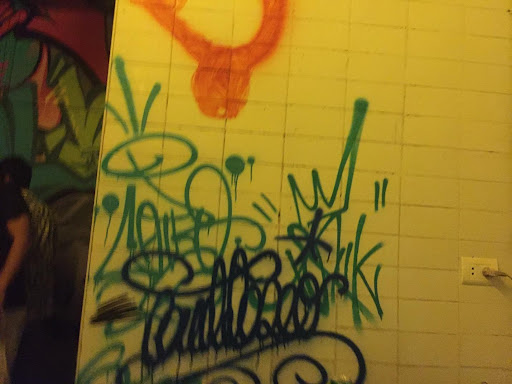
The first time I tried to see her live I failed. It was at this undergroundish venue in Maadi I hadn’t heard of. Rama and Rami Abadir on the line-up, so three off the list. It was in the back of a repurposed mid-century villa. First floor they have exhibitions. Second tattoo artists. Back-garden for music. Took a while to find the purple-glow windows, smoke and chatter. A table with piles of vintage Kodak cameras. A cracked marbelish staircase opened onto a high-ceilinged room which must have served as a bathroom, or a “servants quarters” in a previous incarnation, white tiled walls soaked in feral graffiti, a standalone gravity toilet-tank above an ancient brown mini-fridge with empty cans of beer, plastic cups with dead cigarettes in the dregs, cans of Red Bull, crumbled pack-foil on top. Behind a counter stood two kids in their early twenties, one on a laptop, the other pouring wine and handing out warm beers from a carton. The bartender was a pretty boy, an 80’s Miami-dealer silk shirt, a nice simple silver earring. I waited behind a group of girls as they paid. An awkward boy joined them, mumbled something about him gaining belly-weight. “I don’t see,” a girl said and turned.
I was already feeling my age, a decade and a half off easily. Almost everyone was post-hipster, Reagan/Thatcher-years nostalgia fashion, a hint of punk, a hint of disco, long white socks on shorts, androgyny galore, a lot of Doc Martens and clunky sneakers. Vintage used to be parching for 1968, now we’re pining for the 80’s and 90’s, and soon, longing for what, this, nostalgia for nostalgia, but pushing forward still?
The music room was drenched in purple neon, cool abstract paintings on the walls. By the massive window stood Rama in her black t-shirt, Abadir sliding in and out from under the decks. I sat down on the wooden floor. The hard-hitting breakbeat /grime/jungle/drum & bass/rap/footwork electronica discord I was expecting was ambient .
When the next DJ came on, I went outside. Garden full, youth counter-culture, a particular demographic slightly broader than what a rite like this would’ve looked like, class-wise, 15, 20 years ago. I sipped my pee-warm Stellas, rolled cigarettes and watched.
A very healthy queer/fluid to straight ratio. An “artsy” crowd, sensual. “Masculinity” under sweet assault, placid sabotage, tolerance for ambiguity, self-indulgence. You could be in Berlin, Mexico City, London, no markers for better or worse. It got packed inside. They closed the giant window, I’m assuming for police concerns. I tried to make it to El Kontessa’s set, but the rusty taste of can after can got me, food. “If you leave you can’t come back,” the bouncer said. Fine.
Within an hour, watching an IG Story of El Kontessa decomposing Fokak into something even more titillating and alienated, curating the culture of the masses totally missing from the evening (and it’s a thin line between honoring and lifting in lesser hands,) I stroked regret. In the river, not just of sounds, but equally the words bursting up from the streets, she knows where to fish and what to sample : “What, you think you’re human in this world of monkeys, look in the mirror,” in the forlorn scrambled messages, in the “death of code,” no respect for unchosen boundaries and categories, polystylism, rhizomic identities, mixing of past and future, high and low, center and periphery, and for the love of whatever, never again the Face of the Father. When being is “out of joint,” the sound shreds. No mellow from those excavating for exits.

***
Then there’s Maurice Louca: no repetition, never a commodity.
With him we’re in 828 YouTube subscribers land. All I can tell you is what his first album is to me. If my soul is sparrows calling for each other across the ocean, Salute The Parrot is a key note. Home when you’re far away and don’t even know what home is or if you’ll ever forgive it or if there is such a tale. Cruelty and kindness, agony and splendor, giving amid blows, the layers upon layers that have touched, tortured us and made us who we are, every last shred, what better parting toast to a youth gone. “Wake up, don’t fall asleep, we’re saluting the parrot,” over and over until the whole thing breaks with the “shudder” that is the stamp of great art. 2014. Then Maksim: “it’s okay, go somewhere, do it well, dip your brush, don’t be scared we’ll meet again, remember this, enjoy the ride, and ‘be sure to smell the flowers along the way.”

Weeks after failing to see El Kontessa, I went to see Maurice Louca play his Elephantine album for the first time live in Egypt with an otherwise all-white ensemble. Without the ‘Global North,’ what would the indie music scene look like here? Without our culture, our sweat, our music, this beautiful mayhem we’re making, where would the raiders be? Better not throw out the baby with the bathwater though. If these avant-garde musicians are not to starve, physically and artistically, and as long as the world is what it is, so called Western ‘“high culture,” nicked off our backs, is unavoidable. 828 YouTube subscribers doesn’t get you Faustian Silicon Valley money, even if you want it (That’s mahraganat/rap’s task, making attention-assets for Palo Alto psychopaths; life likes paradoxes.) They need venues, festivals, labels, “enlightened” funding, engineers, a deep pool of listeners, studios, critics, musicologists, exposure, gear, freedom, a bench of “schooled” jazz cats. The glory is what they’ve done with scraps. And they’re leaving in droves, brain and soul drain.
I took a corner stool, came to steeped in what happens when Salute the Parrot takes a twilight swim in jazz to say goodbye, to figure out what’s yet to be searched.
A couple of months later I saw him play again with Ayman Asfour, the free-association ready violinist, to expunge Jazz Club. Rawabet Art Space, very civil. They were joined by the subtle drumming of Karim Yassin. When Maurice picked up the slide-guitar, it was like driving into the trembling desert sun at the gates of the world on a wide, open, silent highway.
Afterwards, I went straight to the Sayeda Zeinab moulid. The buzzing serpentine alleys around the mosque decked in light and color and sweets-stalls and party-cones for sale and banners of saints past and Sufi chanting on every corner, on speakers and live in the little tents where fakirs and seekers, men, women, children, and whatever, able and not, dervishes and lovers, salt-of-the-earth in white and green, pilgrims of the invisible, sit, smoke DIY shishas, cook, eat, sleep, pray, mourn, sing, dance, clap, shit, talk, laugh and weep amongst themselves and with the demons and angels. The tattered tarps. Giant steel pots. Torn slippers in the mud.
I happened upon this building-entrance, drawn by the music they were making inside. It stood out from what I had seen, rows of men whirling, the women sitting on chairs in the back, some dancing, kids running around. I couldn’t see the musicians, but they had the texture nice and thick like a spiritual broth should be, and were tight on the Rhythm of the Spheres.
Later, as I was about to cross a street, someone handed me a hot plate of marvelous stuffed-cabbage. “From our lady,” he said, nodding at the mosque. I held one up with my fingers and blew on it. Everyone around me was doing the same. A “street child” walked past, whistling, singing a line from Fokak, took a plate and emptied it in a plastic bag where she’d been hoarding “blessings.”

“The Other Shore,” that’s where Abdullah Miniawy chants from, station of no-station. What does it take for an artwork and a prayer to become one, rooted and free, free of dogma, of what you’re not, of what they say about you, to embrace and transcend, to destroy, preserve, discover — soul as a work of art, as lab, as metaphor?
My ribs gore one another until they spit the name of god.
So behave!
Oil them, put them back in order…
I see a forest, inhabited by flying angels, silent [his translation.]
His arc is a novelist’s supplication. In a 2013 interview with Egypt Today from the little conservative oasis with the mythical lake where he’s from, after a childhood in Saudi Arabia and teenage rapping, he said “he wants a piece of land to farm his own food and return to the simpler life. And while he is unsure of where he’s going, still searching for his own Sufi path and unwilling to leave Fayoum, he remains uncompromising about his music, certain in his belief that music is a message.” Driven out of Egypt, now he’s thriving at the frontier of the art-scene in Paris: poetry, singing, chanting, acting, trumpeting, exquisitely Djing, composing for dance, theater, exhibitions — “faces turned toward the sky / whispering secrets to the heaven.” That’s Hallaj. Miniawy’s face howls in his unearthly Arabic from the heavens at the factory floor:
Meanwhile, in the factory, they treat us like passing meat on a conveyor belt…
Blood stained the bed
***
The second time I tried to see El Kontessa, I didn’t fail. Jazz Club again, necessary evil, the new one in the shiny soulless mall (RIP Vent.) Yunis, El Waili, Molotof, El Kontessa, Abo Sahar. ‘Doors close at 8:30.’ I arrived on time. The doors didn’t close. They started late. LE300 cover. LE500 for a bottle of Omar Khayyam. You couldn’t move your hand to your mouth if you wanted to, a side of covid. It felt like a farewell to a cultural moment, not a genesis. Maybe it was just me.
A boy in a fur coat made the rounds. Young film stars. By the time Yunis was done I had to be on the terrace and stood near the door. I noticed someone who had a steady stream of people hugging him warmly. It was Patrick Zaki, released from prison that morning or the day before. Someone took Patrick by the hand to introduce him to Molotof, who was standing to my right, hooded, shy. All I got was the latter’s smile, clenched fist on mouth, crouching back, patting Patrick on the shoulder.
One of the Zuksh brothers walked in with a small entourage. They stood for a while with Molotof, cracking jokes. Beautiful women, rich women, stopped for social media ammunition. El Waili played, full on acidy and open to bad trips.
As Molotof got ready to come on, I noticed the Zuksh standing in the corner, smoking cigarette after cigarette, reserved, nervous, no lion in this zoo.
By the time El Kontessa played, it was well past midnight. I couldn’t make it to Abo Sahar, sated, saved in the conviction that art will always have a right and reason to exist, that in bouts of doubt, it’s the holy grail. I saw him a few months later at Zawya Cinema’s anniversary party. When he was done with his set he asked, so gracefully, kindly, uncertainly, “Were you happy?”
The real barbarism is to let the poems run dry, to waste the music, not to dance our own way through the pool of blood.

Summer, 2022
تقارير ذات صلة
Creating a history mixtape: A conversation with Andrew Simon
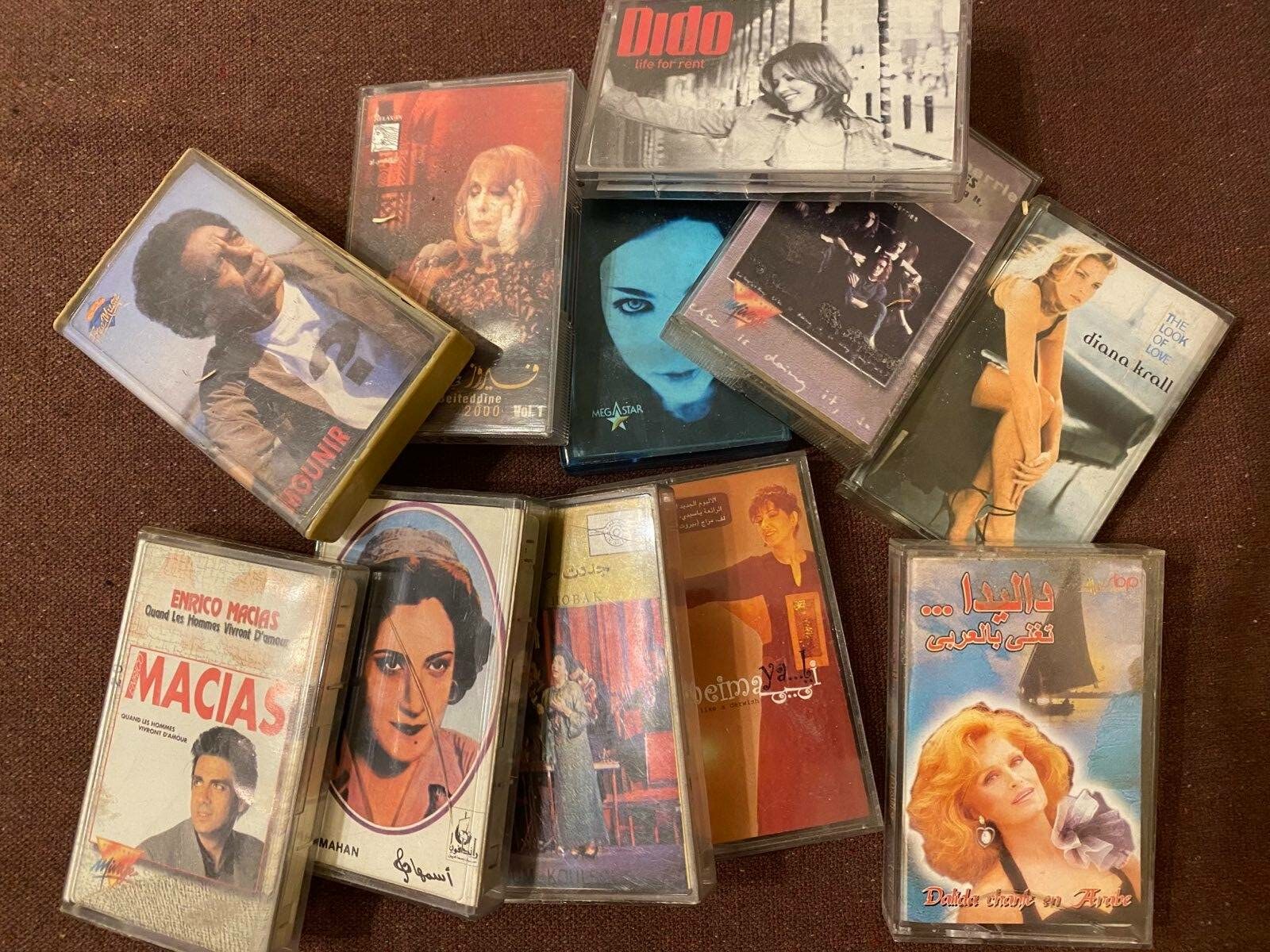
Cassettes decentralized state-controlled Egyptian media long before the invention of the internet
Detox | The music in the background
I ended my journey among the ruins of the fallen Cassette Kingdom
Detox | ‘Everything’s gonna be alright’
Well, we all know what’s up, and it’s not pretty.
Your support is the only way to ensure independent, progressive journalism survives.
You have a right to access accurate information, be stimulated by innovative and nuanced reporting, and be moved by compelling storytelling. Subscribe now to become part of the growing community of members who help us maintain our editorial independence.
Join us