
Murderers, thieves and conmen: The Maadi land controversy
“Everything you see in front of you,” mutters Hajj Mohamed Abdel Raouf as he moves his finger across the skyline, “was built by murderers and thieves.”
The horizon he points to is cluttered with redbrick buildings and satellite dishes. In the foreground of the scene, mounds of rubble sit under a lingering cloud of dust. The rubble lies directly outside the plot of land which Abdel Raouf’s family has been harvesting for four generations.
“This is agricultural land,” he spreads his arms to indicate the surrounding field, divided into compact crops of barley, onions, tomatoes and corn. “You farm it. You don’t build on it. And you certainly don’t build shoddy, unregulated apartment towers that are liable to collapse and kill entire families.”
The 56-year-old farmer’s plot of land sits directly adjacent to the Supreme Constitutional Court on the Corniche, and is currently one of the few remaining verdant patches in a landscape that, until recently, consisted almost entirely of fields.
Shortly following the 2011 uprising, the fields were razed amidst an unprecedented lack of national security. In their place, apartment buildings rose at a remarkable pace. The months that followed marked a period of increasing unrest among residents of Dar al-Salam — the informal, borderless neighborhood enveloping the disputed area — with gunfights regularly breaking out between neighbors over issues of land ownership and illegal construction.
Matters became more convoluted in March, when the Maadi Investment Company claimed ownership of the 36-acre area and erected a barricade around the entire plot of land, including Abdel Raouf’s field and those of his neighbors. Simultaneously, a campaign was initiated to tear down the newly constructed buildings, a process now in its final stages.
Despite being fenced in with the illegal constructions and their growing rubble, Abdel Raouf sees a clear difference between his farmland and the adjacent plots. More importantly, he sees a difference between farmers like himself, and the “con-artists and opportunists” who tried to make a living off of “land they’ve never owned.”
“The Maadi Investment Company does indeed own the majority of this land,” Abdel Raouf asserts. “They’ve owned it for a long time. I’ve been here my whole life, I know what I’m saying.”
According to Abdel Raouf, the portion of the plot currently being leveled — which he refers to as the “northern plateau” — was legally obtained by the company in the 1970s. Yet, he insists, “The company’s claim never extended to our land. We’ve been here since 1960 — since before the Corniche existed, when these fields reached the Nile.”
Abdel Raouf will be the first to admit his family never owned the land that they’ve been tending to for years.
“We were renting it from the government. We had an agreement,” he says, spreading out a series of aged documents across a rickety, wooden bench — agreements that seemed inconsequential when he was recently approached by representatives of the company, claiming they had documents proving Abdel Raouf’s father had signed the land over to them in 1989.
“The problem is, my father died in 1975,” he shrugs. “So I got a lawyer.”
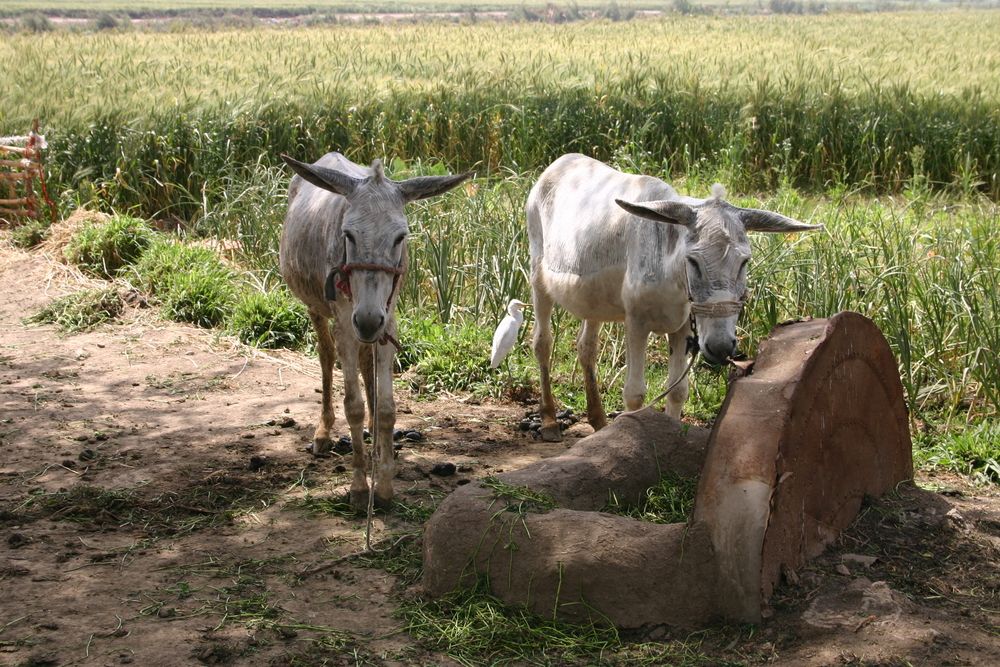
Nonetheless, Abdel Raouf does not anticipate being allowed to stay on the land much longer. Walking around the plot, proudly pointing out his varied crops and few animals, he explains how the recently erected barricade around his land has made it impossible for him to take any of his animals or his cart out for business. He mentions that during its construction, a piece of the cement barrier fell and crushed his mule.
He then leads the way to the home he shares with his wife and seven children: A single, unfurnished room with dirt floors and mud walls, on one of which hangs a large vinyl poster of Field Marshal Abdel Fattah al-Sisi.
Standing in the doorway, he holds up two fingers. “I only have a couple of requests,” he says.
“First, I don’t want to be treated as a criminal. The criminals are the ones who steal lands and build unregulated housing, the ones who intentionally hurt themselves just to blame it on government forces or reckless deconstruction. Those buildings,” he nods towards the direction of the structures beyond his field, “represent a safety hazard, as well as a perpetuation of lawlessness. It might be unpleasant, but they had to be torn down.”
“I want there to be some distinction in the government’s eyes between the thieves whose greed has brought nothing but misery to this neighborhood,” he continues, “and the farmers like myself who defended the land, and tended to it right, and refused to sell what wasn’t ours when millions were offered to us.”
His second request is somewhat simpler.
“But if the government still wants me to leave, I’ll leave,” he sighs. “I just want them to tell me where to go.”

Ali Abdel Mohsen
Ali travels between journalism and arts and claims that one informs the other for him. He often writes long observational pieces that reflect on the social and the political, but…
تقارير ذات صلة
‘We inherited this land, we cannot leave it:’ Rent hikes over 170% threaten farmers on Endowments, Agricultural Reform land
The hikes come within a recent push to maximize state revenue and prioritize large-scale farming
Rice export ban for everyone but Argany
In early February, the Egyptian Customs Authority renewed its ban on rice exports, which has been in place for over eight years per the given rationale that it will help…

Video | Hibiscus for your heart
Well known for lowering blood pressure, hibiscus is especially loved during Ramadan
Your support is the only way to ensure independent, progressive journalism survives.
You have a right to access accurate information, be stimulated by innovative and nuanced reporting, and be moved by compelling storytelling. Subscribe now to become part of the growing community of members who help us maintain our editorial independence.
Join us