
Man handed 7-year prison sentence for beating South Sudanese teacher to death nearly 2 years ago
An Egyptian man charged with beating a South Sudanese teacher to death last year was sentenced on Monday to seven years in prison by the Ain Shams Criminal Court, according to lawyer Huda Nasrallah.
The verdict is the culmination of a nearly two-year struggle for justice by the marginalized South Sudanese community in the area, which has continually faced racially motivated violence.
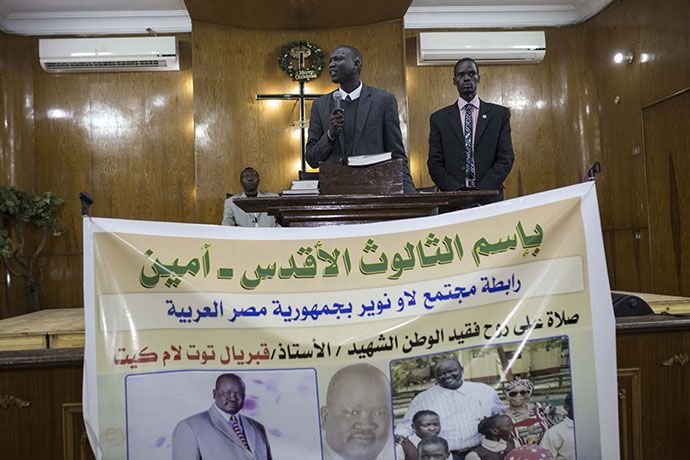
Yet, the sentence was seen as insufficient by some members of the community. Marco Deng, a South Sudanese priest and the principal of the school where Gabriel Tut, the 49-year-old teacher, worked, told Mada Masr on Monday that the seven-year prison term was “one hundred percent unjust.”
Tut had lived in Egypt since 2005 and worked as a volunteer teacher at the Children’s Education Center, a school that serves the South Sudanese community in the Ain Shams district of Cairo under the supervision of the United Nations High Commissioner for Refugees and Egypt’s social solidarity and education ministries.
Students and staff at the school had long complained of repeated verbal assault and intimidation by Emad Hamdy, a local resident who owns a concrete and building equipment store near the school.
On February 9, 2017, Hamdy began insulting and physically intimidating children as they filed out of the school, Deng said at the time. Hamdy then entered the school grounds, attacking the gatekeeper and eventually confronting Tut and two other teachers while reportedly yelling, “You are animals. You are stupid.” Hamdy later grabbed a metal rod and struck Tut on the back of the head as he was walking out of the school, killing him instantly.
Deng was not at the school when Tut was killed. But he watched the events unfold on the school’s surveillance footage, which he later submitted to the public prosecutor’s office.
Hamdy was arrested after the incident and remained in custody for nearly a month before being released by the Ain Shams prosecutor’s office.
It took a full 10 months after Tut’s murder for the case to be referred to trial, Nasrallah says, and only after she pressured the prosecution to act, warning of tensions in the neighborhood with Hamdy out of custody and continuing to harass members of the school.
According to Nasrallah, Hamdy and his family were influential in the neighborhood, having sway with officials at the local police station.
In the first court session in December 2017, Hamdy was sentenced in absentia to 15 years in prison. His conviction for Tut’s murder was appealed, and a retrial was ordered.
The retrial was postponed several times due to continual requests to delay hearings by the defense, according to Nasrallah. In the last court session on August 29, Nasrallah requested an arrest warrant be issued for Hamdy and that the court hear testimony from the janitor of the school, who was an eyewitness to the murder.
Nasrallah also requested to hear testimony from the police officer who conducted the investigation into the incident to counter accounts from defense witnesses, whom Deng says were not actual eyewitnesses to the incident but residents of the neighborhood.
Both the janitor and the police officer testified that the beating was intentional, contradicting claims by Hamdy and his defense team that Tut fell down and hit the ground in an alleged altercation with Hamdy.
An arrest warrant was issued for Hamdy two weeks ago and he was taken into custody. On Monday, the court sentenced him to seven years in prison.
Deng decries the sentence as inadequate, saying that Hamdy killed Tut intentionally and that he should have received a harsher penalty. He said that Hamdy posed a real public threat, and that, in the nearly two-year period he was free after the killing, he continued to threaten the South Sudanese community.
In September, less than a month after the school janitor testified in the case, Hamdy physically attacked him, Deng says. When he tried to file a legal complaint, the Ain Shams Police Station refused, claiming that the janitor’s residency permit had expired.
Deng says he is going to request official intervention by the South Sudanese Embassy in Egypt, as well as the South Sudanese Foreign Ministry.
Nasrallah also says she wanted to see the defendant receive the maximum penalty for Tut’s murder, given that the surveillance footage and the police report constituted clear evidence that his death was premeditated. Nasrallah adds that the sentence cannot be appealed.
However, she believes Monday’s ruling might discourage others in the neighborhood from attacking members of the South Sudanese community.
تقارير ذات صلة

Migrants haunted by the damp
The floor was cold concrete. The floor was cold tile. The air was heavy. A mix of stale sweat, cigarette smoke and dampness. Stale sweat, dampness clinging to the walls.…
‘Egypt’s guests’ in danger: Refugees face increasing arrests, deportations
Thousands of refugees in Egypt have been subjected to arrest, detention and forced deportations

Egypt’s 1st bill on asylum-seekers to balance rights against ‘stability of Egyptian society’
amid regional instability and pressure from the European Union to control migration routes.
Your support is the only way to ensure independent, progressive journalism survives.
You have a right to access accurate information, be stimulated by innovative and nuanced reporting, and be moved by compelling storytelling. Subscribe now to become part of the growing community of members who help us maintain our editorial independence.
Join us